"He went into a treatment center twice, and the last time he went back again. That's it, there's no use." We hear this from exhausted families, who have every right to be tired. But when we sit with these families and review what happened, we usually find the problem was not the patient alone, but a treatment plan that lacked important links. Knowing the reasons addiction treatment fails is the first step toward keeping them from repeating.
Does addiction treatment really fail?
The US National Institute on Drug Abuse says relapse rates in addiction are similar to those in other chronic diseases such as diabetes, hypertension, and asthma, citing a review published in JAMA in 2000 that compared addiction with these diseases in heritability, causes, and adherence to treatment. It adds that relapse does not mean treatment failed; it means treatment needs to be resumed, adjusted, or replaced with another.
When a person with hypertension sees his pressure rise after he stops his medication, we don't say his treatment failed; we readjust the plan. The same idea applies to addiction. Relapse, with its details and signs, has its own guide in relapse in addiction.
The reasons addiction treatment fails, in brief
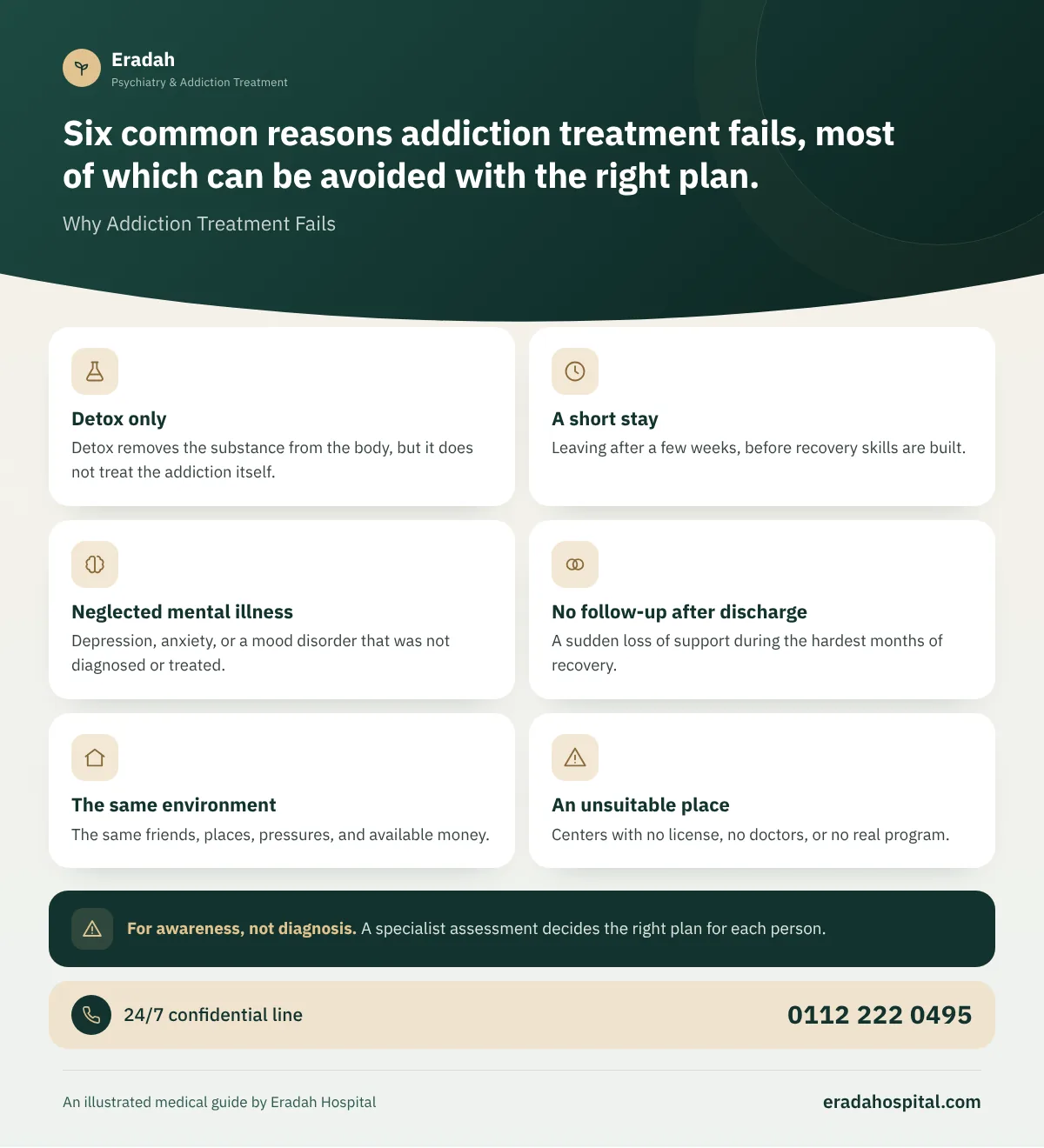
Detox removes the substance from the body, but it does not treat the addiction itself.
Leaving after a few weeks, before recovery skills are built.
Depression, anxiety, or a mood disorder that was not diagnosed or treated.
A sudden loss of support during the hardest months of recovery.
The same friends, places, pressures, and available money.
Centers with no license, no doctors, or no real program.
Reason one: relying on detox alone
The tenth principle in the principles of addiction treatment published by the US National Institute on Drug Abuse states that medically supervised detox is "only the first stage," and that by itself it changes long-term drug use very little. It safely eases the physical symptoms of withdrawal, but it does not treat craving, the causes that led to substance use, or the skills needed to resist going back.
This is why a family that says "he was treated for a week and came out" usually means he completed detox, not the whole treatment.
Reason two: leaving treatment early
The Institute's principles state that most patients need at least 3 months of treatment to clearly reduce or stop their use, that taking part in residential or outpatient programs for less than 90 days is of limited effectiveness, and that leaving treatment early is one of the biggest problems programs face. This does not mean every patient needs a 90-day stay, but that the whole treatment journey, with its different stages, needs enough time.
Reason three: neglecting the co-occurring mental illness
The ninth principle states that many people with addiction have other mental disorders, and that anyone who comes with one problem should be examined for the other, and that the two should be treated together. A young man who used cannabis to calm his anxiety, or tramadol to escape his depression, will return to the same substance if the anxiety or depression returns untreated. This is what is called dual diagnosis.
Reason four: no follow-up after discharge
The Institute's principles describe addiction as a chronic disorder punctuated by relapses, so short, one-time treatment is usually not enough, and many people need long follow-up. The first months after discharge are the hardest, because the patient faces his real life with its triggers. You can see how this stage is built in the follow-up and relapse prevention program.
Reason five: returning to the same environment
- The same friends and the same phone numbers.
- Money available without controls in the first weeks.
- Family conflicts that were never resolved, or constant blame.
- Work pressure or unemployment with no plan.
The Institute notes that stress and cues linked to use, such as people, places, and even smells, can trigger intense craving without the person noticing what set it off. This is why good treatment includes the family, as in the family treatment program.
Reason six: an unsuitable treatment facility
Some places offer "confinement," not treatment: no psychiatrists, no written plan, no treatment for co-occurring illnesses, and sometimes violence and restraint. These experiences do not merely fail; they leave a psychological mark that makes the patient refuse any later treatment. The standards that distinguish a safe facility are in the guide to how to choose an addiction treatment center.
Reason seven: does treatment fail if the patient enters unwillingly?
Not necessarily. The eleventh principle in the Institute's principles states that treatment does not have to be voluntary to be effective, and that pressure from family or work can increase entry into treatment, staying in it, and final outcomes. But motivation needs to be built during treatment through motivational interviewing and the therapeutic relationship, not assumed or forced with harshness.
What do you do after a treatment attempt that did not work?
- Don't start from zero; review what happened: when did the decline begin, and what came before it?
- Ask: was a co-occurring mental illness treated? Was there follow-up?
- Discuss with the doctor the right level of treatment now: a longer stay, intensive outpatient treatment, or a relapse-prevention medication.
- Involve the family in the new plan, with clear boundaries and real support.
At Eradah, with every patient who has been treated before, we begin by reviewing the previous attempts, because what did not work in them determines what we need to add now.