What makes Eradah's dual diagnosis program different?
Many patients and families have been through the same experience: the psychiatrist says “treat the addiction first and then come back,” and the addiction clinic says “his mental state isn't something we can manage.” So the patient goes back and forth between the two and is never fully treated by either. This program was designed specifically to end that cycle.
The basic idea is simple: there is one patient, so there is one plan. The psychiatrist, the addiction doctor and the specialists work together on the same case, agree on treatment priorities and their order, and speak to the patient and family with one voice. This is what international references recommend, including SAMHSA's guide to co-occurring disorders and NICE guidance, which states that a person with psychosis should not be excluded from services because of substance use, nor a person with addiction from psychological treatment because of mental illness.
For the definition of dual diagnosis, how common it is and why addiction and mental illness occur together, see our detailed guide to dual diagnosis. This page explains how we treat it in practice at Eradah.
Who is this program for?
The program suits anyone with an addiction to a substance or a behavior alongside a diagnosed or suspected mental disorder. Among the most common cases we see are:
| Mental health disorder | What we often see | Learn more |
|---|---|---|
| Depression | Substance use to numb sadness, or depression that gets worse after stopping stimulants | Depression and addiction |
| Anxiety and panic disorders | Relying on sedatives, alcohol or pregabalin to feel calm | Anxiety and addiction |
| Bipolar disorder | Substance use that increases during manic episodes and disrupts mood stability | Bipolar disorder and addiction |
| Schizophrenia and psychosis | Hashish or stimulant use together with psychotic symptoms | Schizophrenia and addiction |
| Post-traumatic stress disorder (PTSD) | Using substances to escape memories and nightmares | Trauma and addiction |
| ADHD (attention-deficit/hyperactivity disorder) | Early onset of substance use and high impulsivity | ADHD and addiction |
We also see cases of borderline personality disorder, chronic insomnia with dependence on sleeping pills, and drug-induced psychosis, which needs follow-up to confirm that it has resolved. If the condition is acute, such as a severe psychotic episode or a risk to the person's safety, care begins with medical stabilization first and the patient then joins the program.
How do we assess the case and tell the effects of the substance from the illness?
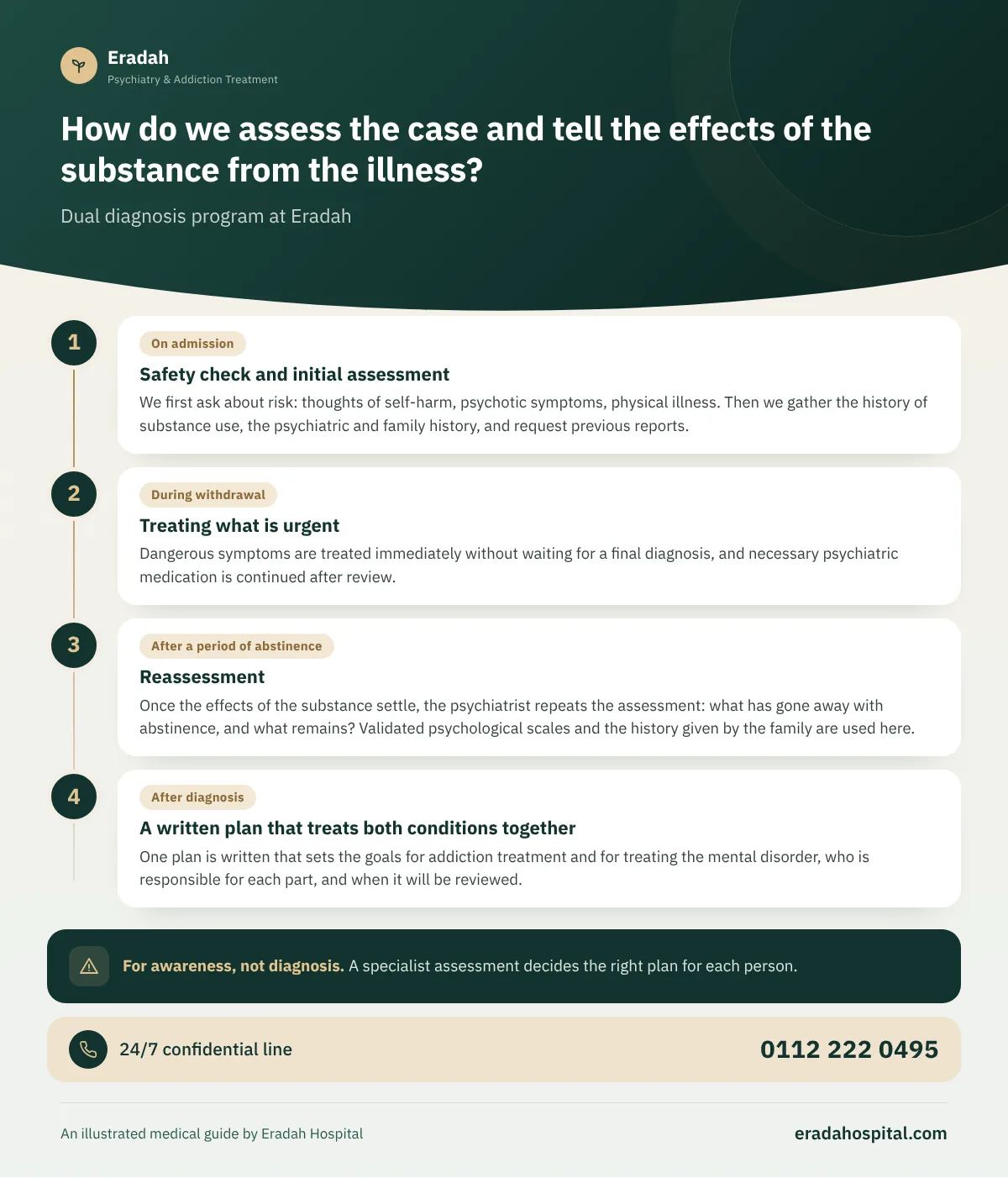
This is the most delicate step in the program. Drugs and withdrawal from them can mimic almost any mental disorder: stimulants can cause temporary psychosis, alcohol withdrawal can look like severe anxiety, and the period after stopping crystal meth (shabu) can resemble depression. That is why we do not make a final diagnosis on the first day:
- On admissionSafety check and initial assessment
We first ask about risk: thoughts of self-harm, psychotic symptoms, physical illness. Then we gather the history of substance use, the psychiatric and family history, and request previous reports.
- During withdrawalTreating what is urgent
Dangerous symptoms are treated immediately without waiting for a final diagnosis, and necessary psychiatric medication is continued after review.
- After a period of abstinenceReassessment
Once the effects of the substance settle, the psychiatrist repeats the assessment: what has gone away with abstinence, and what remains? Validated psychological scales and the history given by the family are used here.
- After diagnosisA written plan that treats both conditions together
One plan is written that sets the goals for addiction treatment and for treating the mental disorder, who is responsible for each part, and when it will be reviewed.
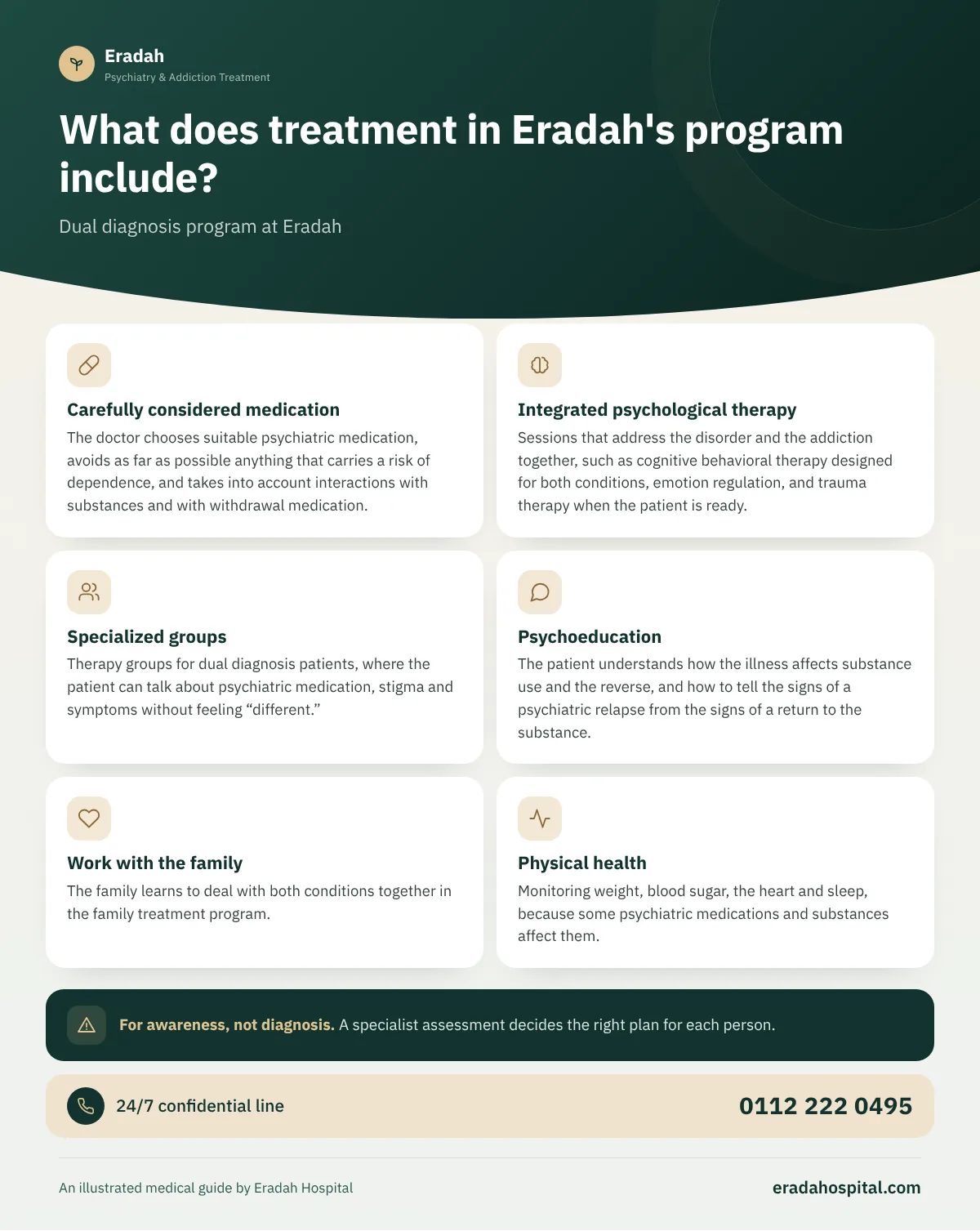
What does treatment in Eradah's program include?
The doctor chooses suitable psychiatric medication, avoids as far as possible anything that carries a risk of dependence, and takes into account interactions with substances and with withdrawal medication.
Sessions that address the disorder and the addiction together, such as cognitive behavioral therapy designed for both conditions, emotion regulation, and trauma therapy when the patient is ready.
Therapy groups for dual diagnosis patients, where the patient can talk about psychiatric medication, stigma and symptoms without feeling “different.”
The patient understands how the illness affects substance use and the reverse, and how to tell the signs of a psychiatric relapse from the signs of a return to the substance.
The family learns to deal with both conditions together in the family treatment program.
Monitoring weight, blood sugar, the heart and sleep, because some psychiatric medications and substances affect them.
Treatment proceeds at a pace that suits the condition: a patient with schizophrenia, for example, may need shorter sessions and simpler tasks at first, and a patient with trauma needs to feel safe and stable before approaching painful memories. NIDA's principles state that effective treatment addresses a person's multiple needs, not substance use alone.
How do we choose psychiatric medication for a patient with addiction?
This is one of the things that worries patients and families most, and it is a fair question. Some sedating medications can cause dependence, so in this program the doctor prefers alternatives that do not carry that risk whenever possible, and uses others only for a short time and under direct supervision if necessary.
- Most antidepressants, mood stabilizers and antipsychotics do not cause addiction in the usual sense, but their side effects need monitoring.
- No psychiatric medication is stopped suddenly or has its dose changed except by the doctor's decision, whether during the program or after it.
- Some medications, such as lithium, need regular blood tests, which are arranged as part of follow-up.
- Medication is reviewed regularly: whatever is no longer necessary is tapered gradually, and whatever helps continues.
Is the program residential or outpatient?
The program is offered in both forms, and the level is chosen according to a multidimensional assessment like the one the ASAM model describes, with particular attention to psychiatric risk:
| The situation | The most suitable format, usually |
|---|---|
| Acute psychiatric symptoms or a risk to the person's safety, or complicated withdrawal | Medical stabilization, then residential treatment on the dual diagnosis track |
| A relatively stable mental disorder with moderate or severe addiction | A period of residential care, then a gradual move to outpatient treatment |
| A stable condition, good family support and lighter substance use | Outpatient treatment or a day program on the dual diagnosis track |
What happens after the intensive phase ends?
Dual diagnosis needs longer follow-up than addiction alone, because the mental disorder itself may need extended treatment. NICE guidance stresses the importance of continuity of care and coordination between services. So the patient stays with the same psychiatrist as far as possible and joins the aftercare and relapse prevention program, with a plan that covers both the signs of psychiatric relapse and the signs of a return to the substance, and who to contact in each case.
The program is supervised by the medical director, Dr. Mahmoud El-Sawy, Consultant Psychiatrist and Addiction Specialist, whose areas of expertise include dual diagnosis, depression, anxiety, bipolar disorder and psychotic disorders, alongside substance addiction. You can find his qualifications and the team's specialties on the medical team page.
Suicidal thoughts, or an acute psychotic or manic episode? Get help now
- Talking about wanting to die or that life is pointless
- Saying goodbye to others or suddenly giving away important belongings
- Hearing voices that command them to do something, or intense suspicion that someone wants to harm them
- Not sleeping for days, with impulsive, reckless behavior and rapid speech
- Severe agitation or violence after use or during withdrawal
- Complete withdrawal from others and stopping eating and drinking
Stay with the person and do not leave them alone. Listen calmly without arguing or blaming, and move dangerous objects out of reach. Call an ambulance (123) or go to the nearest emergency department, and you can call the mental health support line 16328 around the clock.
Ambulance 123 Mental health support line 16328