What is depression?
Depression is a mood disorder that changes the way a person feels, thinks and behaves. It makes days heavy and joyless and drains energy and interest in almost everything. Doctors call it major depressive disorder or “clinical depression” to set it apart from the natural sadness everyone goes through.
Sadness is a normal part of life. It comes after a loss or disappointment and then gradually eases. Depression, by contrast, is a persistent condition that does not improve just because circumstances change or because someone tells you to “get out of the house and cheer up.” It lasts for weeks or months and affects sleep, eating, concentration, relationships and work.
Depression does not mean the person has a weak will, little faith, or is “being dramatic.” It is an illness with biological, psychological and social foundations, like diabetes or high blood pressure. It needs a correct diagnosis and structured treatment, and recovery is possible and common.
Is depression common? Depression in numbers
Depression is one of the most common mental disorders in the world and a leading cause of disability and lost ability to work. It affects men, women, children and older adults from every social class and culture, although many people do not seek help because of stigma or because they do not know that what they are going through is a treatable illness.
Sources: the World Health Organization (depression fact sheet) and the American Psychiatric Association. There are no unified, up-to-date Egyptian figures, and the gap between those who need treatment and those who receive it is large in most countries of the world.
Sadness or depression? The key differences at a glance
What separates sadness from depression is persistence, scope and impact, not how hard a person cries. Ordinary sadness and grief come in waves with moments of relief in between, and the person keeps a sense of self-worth. Depression lasts most of the day, nearly every day, for at least two weeks, dulls pleasure in everything, and comes with guilt or a feeling of worthlessness.
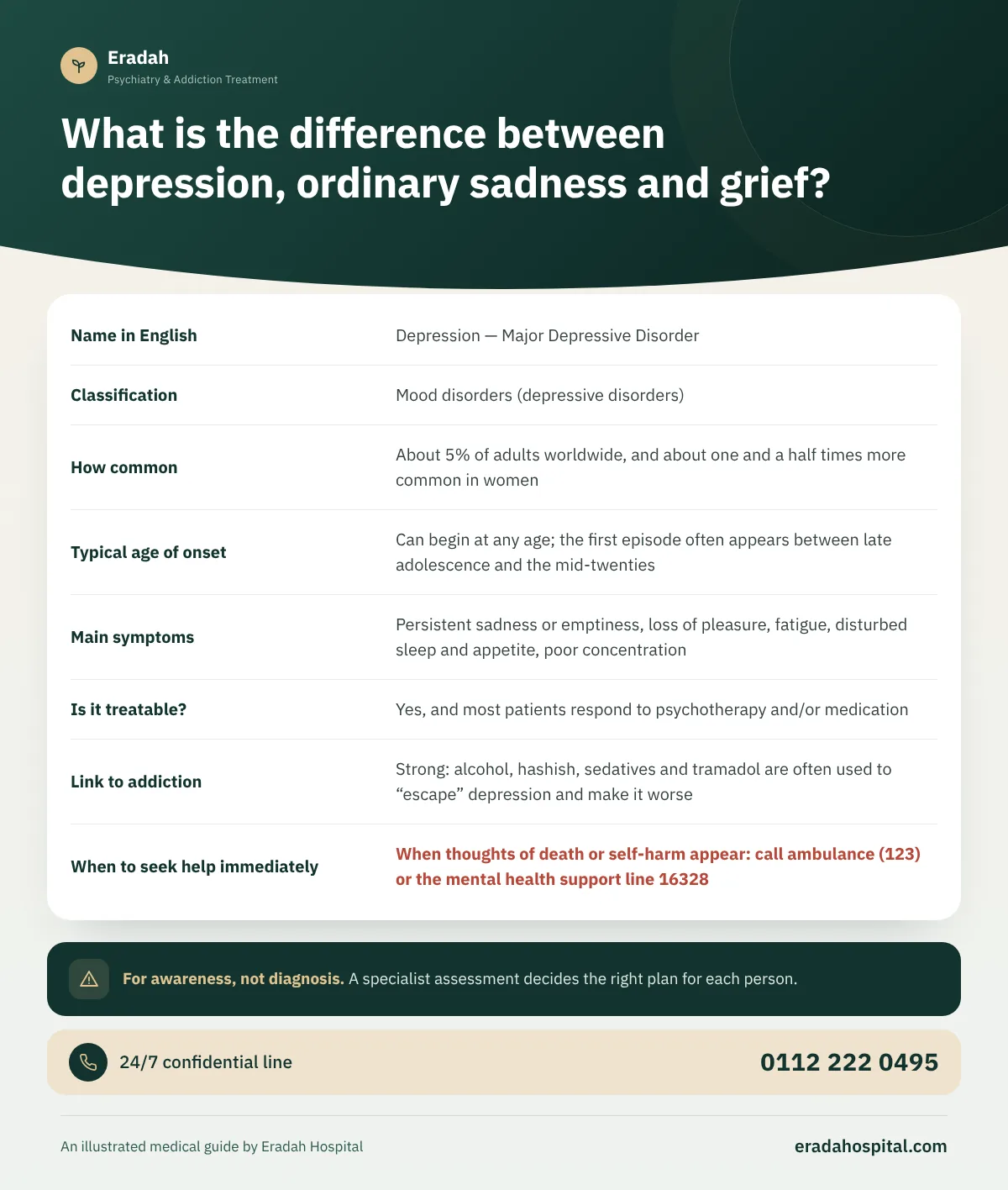
In some people grief can turn into depression, which is why the doctor assesses the whole picture. You will find the detailed comparison and the signs of that shift on the page The difference between sadness and depression: how do you know your sadness has gone beyond the normal?.
What does depression feel like from the inside?
Many patients describe depression as less like sadness and more like a “loss of color.” Things that used to make them happy no longer stir anything, getting out of bed takes enormous effort, and simple tasks such as taking a shower or answering the phone feel like a mountain.
“I wasn’t sad all the time, as people think… I was empty. I would see my children laughing and know I ought to be happy, but I felt nothing, and then I would blame myself for it.” (A common expression among many people with depression, not a quote from a particular patient.)
The suffering is made worse because depression speaks in a harsh inner voice: “You’re a failure,” “Nothing will ever change,” “Everyone is better off without you.” These thoughts are part of the illness itself, not facts, and they ease with treatment. Many people also feel real physical pain and fatigue that tests cannot explain, which is very common in our societies, where people express psychological distress through the language of the body.
What happens in the brain during depression?
There is no single cause of depression, and the idea of a “serotonin deficiency” alone is an oversimplification. Research points to changes in the function of brain networks that regulate mood, reward and the handling of stress, in neurotransmitters such as serotonin, norepinephrine and dopamine, and in stress hormones such as cortisol, along with a role for inflammation and genetics.
The brain is adaptable: psychotherapy, medication, physical activity and regular sleep all help these networks regain their balance. The full details on biological, psychological and environmental factors are on the page Causes of depression.
How does depression differ from similar conditions?
Depression can look like other conditions, and telling them apart is very important because the treatment differs:
| The situation | What they have in common | The key difference |
|---|---|---|
| Bipolar disorder | Depressive episodes that look identical | The presence of manic or hypomanic episodes (excess energy, little sleep, impulsivity), which requires different treatment |
| Generalized anxiety disorder | Tension, sleeplessness and poor concentration | The core feature is anxiety and negative anticipation, not loss of pleasure, and the two often occur together |
| Underactive thyroid and anemia | Fatigue, sluggishness and slowing down | Revealed by blood tests, and they can cause depressive symptoms that improve when they are treated |
| Chronic insomnia | Tiredness, distress and poor concentration | The main problem is with sleep itself, although insomnia is a risk factor for depression |
| Substance-induced depression | Low mood and loss of pleasure | Linked to substance use or withdrawal, and needs specialized assessment in dual diagnosis |
Because some physical illnesses and medications can cause depressive symptoms, the doctor sometimes requests simple tests before confirming the diagnosis. This is part of a good assessment, not doubt about the patient’s suffering.
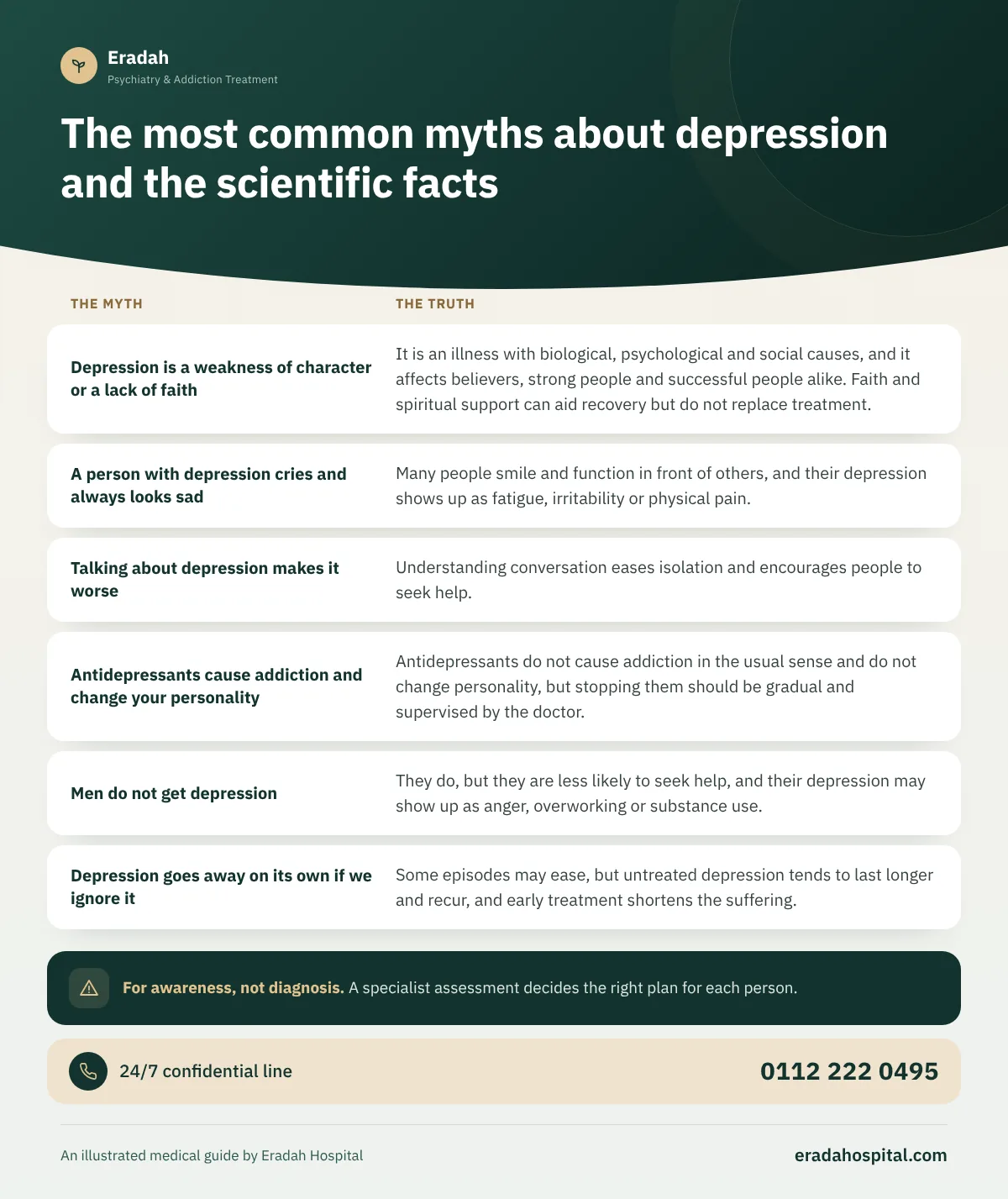
Common myths about depression, and the facts
| The myth | The truth |
|---|---|
| Depression is a weakness of character or a lack of faith | It is an illness with biological, psychological and social causes, and it affects believers, strong people and successful people alike. Faith and spiritual support can aid recovery but do not replace treatment. |
| A person with depression cries and always looks sad | Many people smile and function in front of others, and their depression shows up as fatigue, irritability or physical pain. |
| Talking about depression makes it worse | Understanding conversation eases isolation and encourages people to seek help. |
| Antidepressants cause addiction and change your personality | Antidepressants do not cause addiction in the usual sense and do not change personality, but stopping them should be gradual and supervised by the doctor. |
| Men do not get depression | They do, but they are less likely to seek help, and their depression may show up as anger, overworking or substance use. |
| Depression goes away on its own if we ignore it | Some episodes may ease, but untreated depression tends to last longer and recur, and early treatment shortens the suffering. |
When do you need to see a psychiatrist?
You do not have to hit “rock bottom” to ask for help. See a psychiatrist if you notice in yourself or someone close to you:
- Sadness, emptiness or loss of pleasure lasting more than two weeks without improvement.
- Clear effects on work, study, family care or self-care.
- Marked changes in sleep, appetite, weight or energy.
- Turning to alcohol, sedatives or any substance to “get through” the feelings.
- Repeated thoughts about death or that life is not worth living. In this case, help is urgent, not something to put off.
A psychiatrist is a medical doctor with specialist training who can diagnose and prescribe medication when needed, and who usually works with a therapist or psychologist who provides talk therapy. The visit is confidential, and it does not mean you are “crazy,” as the common stigma would have it. It means you care about your health.
Can depression be cured?
Yes. Most people with depression recover, especially with appropriate treatment and sticking with it. Many return to a full life after an episode, and some come out of it with a deeper understanding of themselves and better skills for coping with stress.
But depression can come back, especially after more than one episode or when treatment is stopped early. That is why doctors focus on relapse prevention, not just on removing symptoms, and on teaching the patient and family the early signs of a return so they can step in quickly.
How can a family support someone with depression?
Family support is one of the strongest factors in recovery, but good intentions alone are not enough. What really helps:
A phrase like “I’m with you, and I believe you” helps more than “Be grateful, others have it worse” or “Pull yourself together.”
Offer to go with them to the doctor and help them book the appointment, because depression robs a person of the energy this step takes.
Improvement is gradual, and there may be good days and hard ones. Do not treat a relapse as a failure.
Any talk about death should always be taken seriously, without panic and without ignoring it.
Accompanying a person with depression is exhausting, and asking for support for the family is not selfish.
Depression guide: everything you need to know
We have gathered everything about depression into 14 pages, each answering one question in detail. Choose what you are looking for:
Depression symptoms and signs
Psychological, physical and behavioral symptoms in detail, how depression appears in men, teenagers and older adults, with non-diagnostic self-assessment questions.
Causes of depression
How genetics, brain chemistry, hormones, trauma, life stress and physical illness interact in the onset of depression, and what the protective factors are.
Harms and complications of depression
What untreated depression does to the heart, sleep, pain, work and family, and its relationship to suicide risk and substance use.
Types of depression
Major and chronic depression (dysthymia), postpartum, seasonal and psychotic depression, and how they differ from bipolar depression.
Depression treatment
Cognitive behavioral therapy, interpersonal therapy and behavioral activation, classes of antidepressants, how long treatment lasts, and the role of brain-rhythm regulation sessions and magnetic stimulation.
Depression and addiction
Why some people with depression turn to alcohol, hashish, tramadol and sedatives, how substances worsen depression, and why both must be treated together.
Psychotic depression
What is psychotic depression? Its symptoms, examples of the delusions and hallucinations that come with it, how it differs from schizophrenia and bipolar disorder, why it is an urgent condition, and the latest science on its treatment.
The difference between depression and anxiety: how do you know which you have, and why do they so often occur together?
The difference between depression and anxiety in feelings, energy, sleep and thoughts, why they so often occur together, which comes first, and questions that help you tell them apart before seeing a doctor.
The difference between sadness and depression: how do you know your sadness has gone beyond the normal?
The difference between sadness and depression in duration, scope, self-image and the ability to enjoy things, when grief for a lost loved one becomes prolonged mourning, and signs that it is time to see a doctor.
Treating depression without medication: proven options and who they suit
Treating depression without medication: cognitive behavioral therapy, behavioral activation, exercise and guided self-help, when guidelines recommend them on their own, and when medication becomes necessary.
Depression relapse: why it comes back, and how to catch its signs and prevent it
Depression relapse: why it returns after improvement, its early signs, the role of staying on treatment and mindfulness-based therapy, and how to write an early warning plan with your family.
Depression in teenagers: how do you tell it from age-related mood swings, and what should the family do?
Depression in teenagers: signs that show up as irritability, withdrawal and falling grades, how it differs from ordinary teenage mood swings, how to talk with your child, and the role of psychotherapy and medication.
Depression in men: why it hides, and how do you recognize it?
Depression in men often hides behind anger, overwork, alcohol and drugs. Learn its particular signs, why men delay seeking help, and how it is treated.
Symptoms of depression in women: how do they change across life stages?
Symptoms of depression in women and how they change with the menstrual cycle, pregnancy, the postpartum period and approaching menopause, why it is more common in women, and safe treatment options.
Suicidal thoughts or danger to self? Get help now
- Talk about wanting to die, being a “burden” on others, or life having no meaning
- Severe despair and a feeling that there is no way out and no hope of getting better
- Suddenly saying goodbye to family and friends, giving away personal belongings or putting affairs in order
- Complete withdrawal from people, or a sudden unexplained calm after a period of intense distress
- Increased use of alcohol or drugs, or reckless behavior that puts their life at risk
Do not leave the person alone. Ask them calmly and directly about their thoughts and listen without judgment or blame; asking does not plant the idea, it opens the door to help. Call the ambulance on 123 or take them to the nearest emergency room, or call the mental health support line 16328 (24 hours), and keep medications and anything they could harm themselves with out of reach.
Ambulance 123 Mental health support line 16328