Why does the family need a treatment program of its own?
When addiction enters a home it changes everything in it: the mother cannot sleep, the father swings between anger and shame, the wife covers for her husband in front of others, and the siblings feel they have become invisible. After years of this, habits and feelings form inside the family that do not disappear just because the patient stops using.
SAMHSA's guide no. 39 on family therapy confirms that addiction affects the family as a whole system, and that involving the family in treatment benefits both the patient and the family: it improves adherence to treatment, reduces tension at home, and helps family members recover from what they have been through. NICE guidance also includes family interventions and behavioral couples therapy among the recommended psychological interventions in suitable cases.
That is why at Eradah we do not treat the family as a visitor asking about the patient's condition, but as a party with its own needs and its own plan. For general advice to relatives, such as what to avoid at home and how to start, see our guide for the families of people with addiction; this page explains what happens inside the program itself.
What does Eradah's family treatment program include?
The patient and his family with a therapist, to discuss what has happened and what will happen, in a safe space that prevents blame and shouting.
Sessions for relatives without the patient, to understand addiction, answer their questions and help them make difficult decisions.
A regular meeting of several families going through the same experience, which eases the feeling of isolation and shame and where they share what has worked for them.
Simple talks about addiction as a disease, withdrawal, craving, signs of relapse and dual diagnosis.
A private space for the life partner, covering trust, money, children and the marriage.
Guiding parents on how to talk with children in a way that suits their ages, and referring those who need it for specialized support.
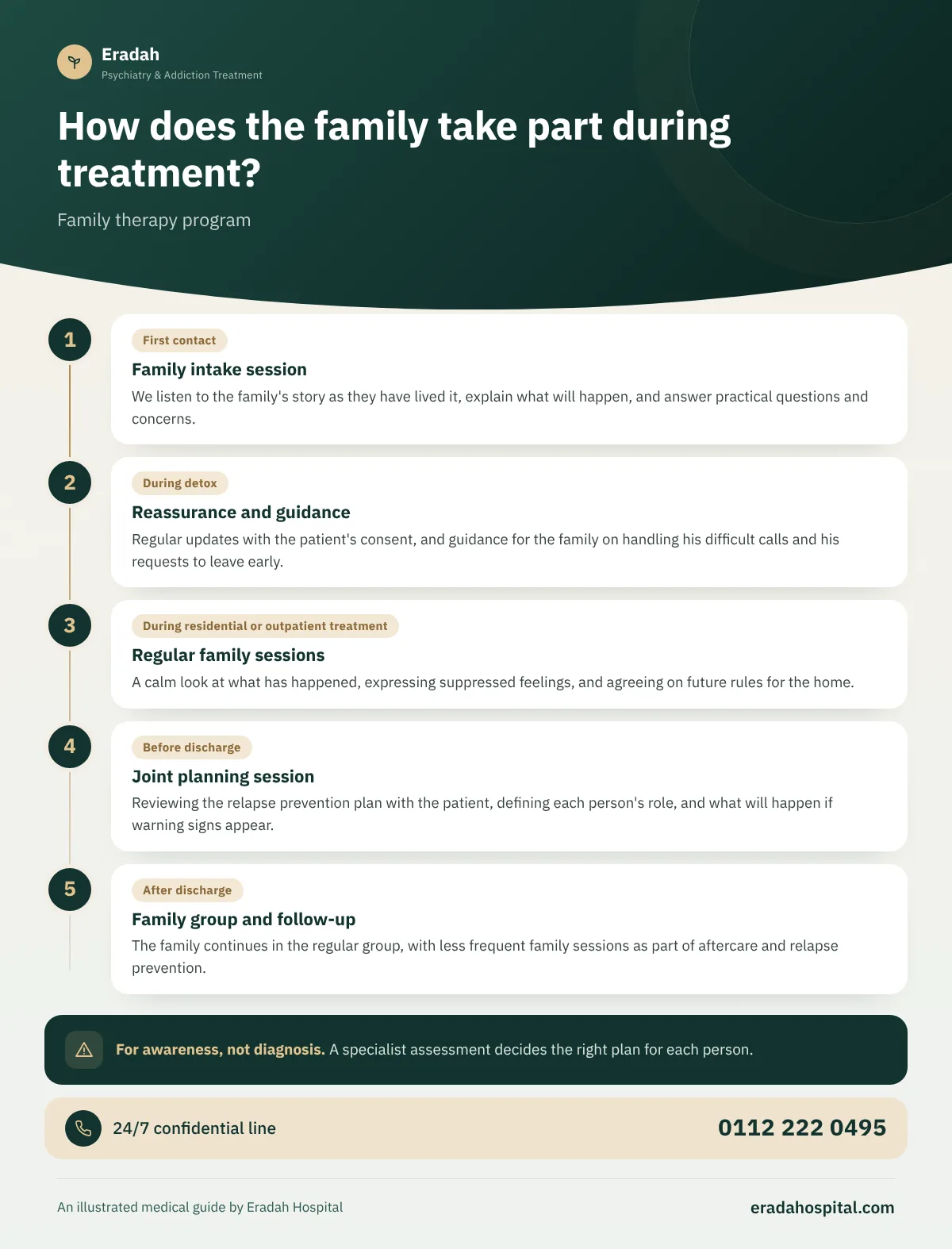
How does the family take part during treatment?
- First contactFamily intake session
We listen to the family's story as they have lived it, explain what will happen, and answer practical questions and concerns.
- During detoxReassurance and guidance
Regular updates with the patient's consent, and guidance for the family on handling his difficult calls and his requests to leave early.
- During residential or outpatient treatmentRegular family sessions
A calm look at what has happened, expressing suppressed feelings, and agreeing on future rules for the home.
- Before dischargeJoint planning session
Reviewing the relapse prevention plan with the patient, defining each person's role, and what will happen if warning signs appear.
- After dischargeFamily group and follow-up
The family continues in the regular group, with less frequent family sessions as part of aftercare and relapse prevention.
How does the program deal with codependency?
Codependency is a pattern many relatives fall into with good intentions: the mother's or wife's whole life revolves around the patient, so she pays his debts, lies to cover his absences, gives up her own life, and feels it is her job to stop him from using. The result is often that the patient does not face the consequences of his use, and the family is drained until it collapses.
In the program we work on this with practical steps, not blame:
- Recognizing behaviors that unintentionally protect substance use, such as giving money without asking questions or lying to his employer.
- Telling the difference between helping, which supports recovery, and rescuing, which postpones confrontation.
- Reclaiming parts of the relatives' own lives: sleep, work, friends and health.
- Accepting that the family cannot control the substance use, but can control its own responses.
- Dealing with feelings of guilt: the family is not the cause of addiction, though it has an important role in recovery.
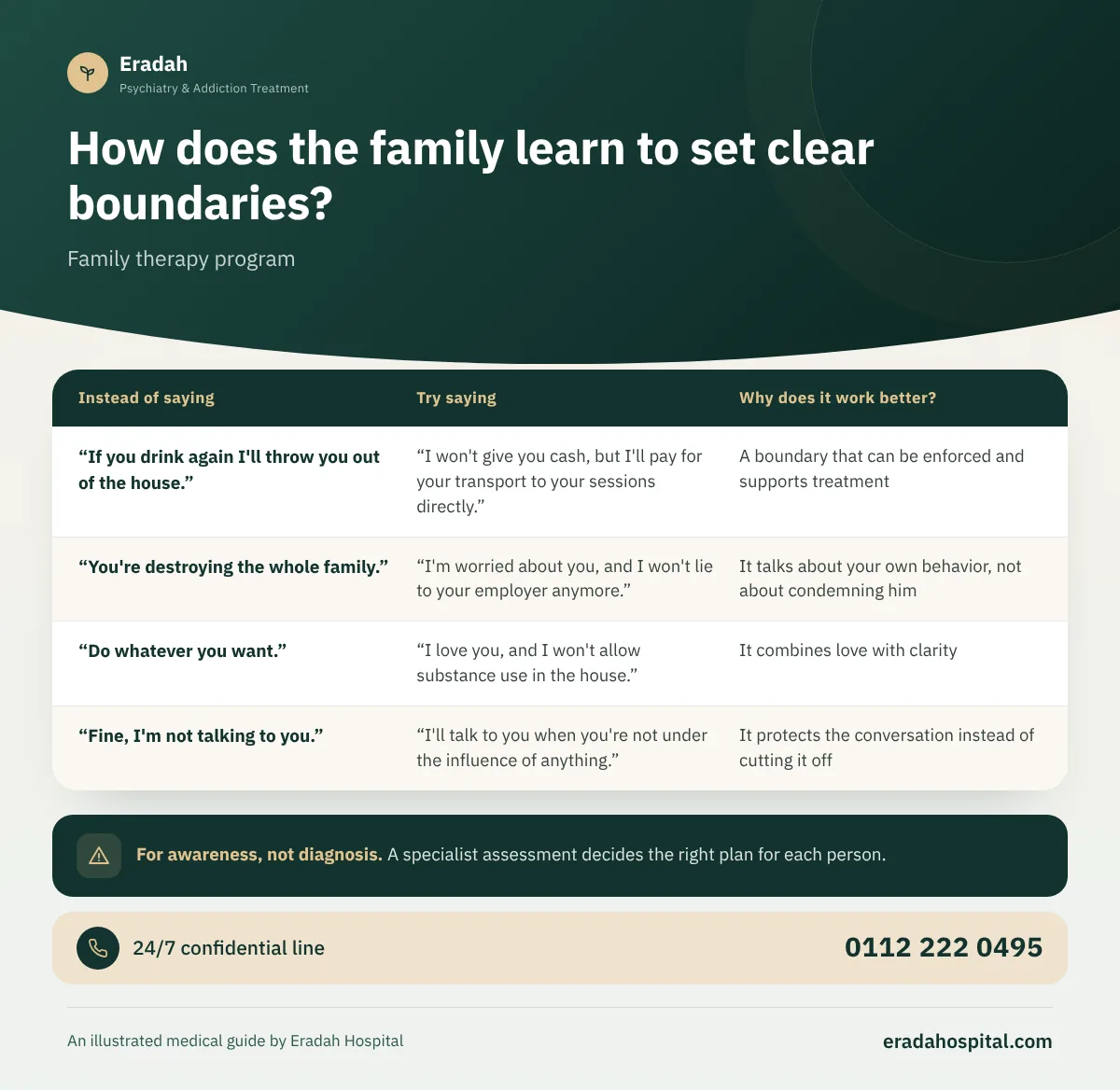
How does the family learn to set clear boundaries?
Boundaries are clear rules that protect the family and support recovery; they are not meant as punishment or threats. In sessions we help the family put its boundaries into calm language and then practice keeping them, because a boundary that is not enforced is worse than none. Examples of boundaries families often work on:
| Instead of saying | Try saying | Why does it work better? |
|---|---|---|
| “If you drink again I'll throw you out of the house.” | “I won't give you cash, but I'll pay for your transport to your sessions directly.” | A boundary that can be enforced and supports treatment |
| “You're destroying the whole family.” | “I'm worried about you, and I won't lie to your employer anymore.” | It talks about your own behavior, not about condemning him |
| “Do whatever you want.” | “I love you, and I won't allow substance use in the house.” | It combines love with clarity |
| “Fine, I'm not talking to you.” | “I'll talk to you when you're not under the influence of anything.” | It protects the conversation instead of cutting it off |
When a person refuses treatment altogether, the family needs a different approach. Systematic reviews have shown that the Community Reinforcement and Family Training (CRAFT) approach helps a considerable share of families get their relative to enter treatment, and you can find an explanation and practical phrases from it in our guide on how to persuade someone with addiction to accept treatment. At Eradah, the family can begin counseling sessions based on these principles before the patient agrees.
How does the program improve communication at home?
Years of addiction leave behind distorted communication: accusations, lies, silence and judgment. In family sessions everyone, the patient and the family, practices simple skills that change a great deal:
- Speaking in the form “I feel…” instead of “You always…”.
- Listening to the end before replying, and restating what you understood in your own words.
- Choosing the timing: no important discussion while angry or under the influence of a substance.
- Acknowledging small progress instead of waiting for perfection.
- Agreeing on a way to ask for help when the patient feels craving.
What is shared with the family and what stays confidential?
An adult patient has the right to his medical information. So at the start we agree in writing on what can be shared with the family: for example attendance, adherence, test results and the general plan. The details of what the patient says in his individual sessions remain confidential between him and his therapist, unless there is a real danger to his life or the lives of others.