What is tramadol?
Tramadol is a painkiller from the opioid family, but unlike morphine and opium, it is not extracted from the poppy plant; it is made entirely in pharmaceutical laboratories. Doctors prescribe it to relieve moderate to severe pain that ordinary painkillers cannot manage.
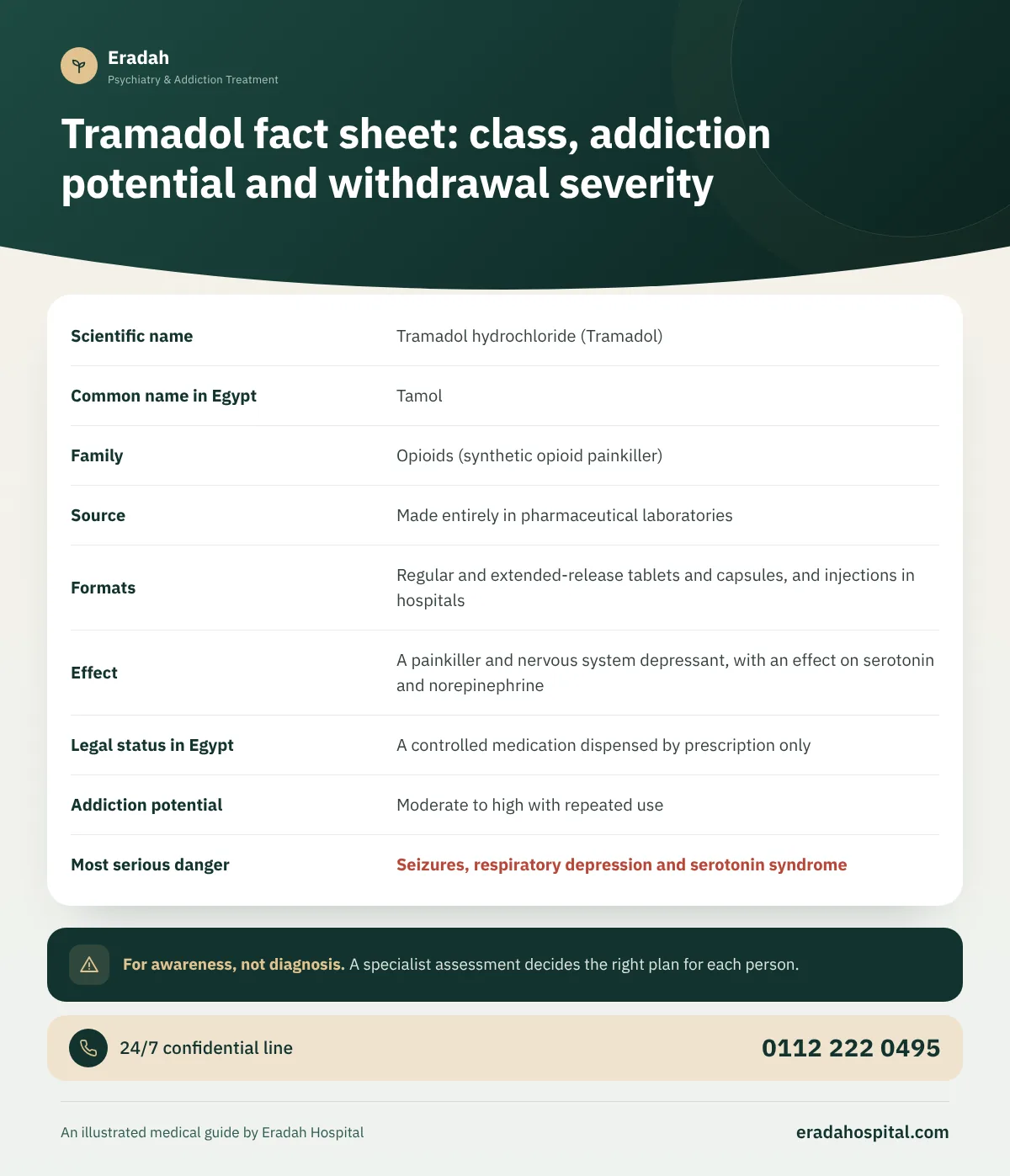
Tramadol spread worldwide decades ago as a “milder” painkiller than traditional opioids, and for years it was treated as low-risk. But as its use widened, many cases of addiction, seizures and poisoning appeared, and many countries tightened controls on it, including Egypt, where it has become one of the most misused medications.
On the Egyptian street, tramadol is known as “Tamol,” and alongside the licensed medications circulate smuggled tablets of unknown origin whose true strength and impurities are unknown, which adds to the danger of the drug itself another danger that cannot be predicted.
It is important to distinguish between a patient who takes tramadol by prescription and for a set period to relieve real pain, and someone who takes it without a prescription, in larger amounts, or for purposes other than pain relief. The medication is the same, but the risk differs greatly depending on the pattern of use and follow-up.
Forms of tramadol and its names
Licensed tramadol comes in more than one dosage form, and may come alone or combined with another painkiller such as paracetamol:
Their effect starts within a short time and lasts for hours, and they are the most commonly used for relieving acute pain.
They release the drug slowly over the day, and breaking or chewing them is dangerous because it releases the whole amount at once.
Used only inside hospitals and under direct medical supervision.
Unlicensed tablets of unknown strength and source, and the most dangerous forms of Tamol in circulation.
How does tramadol affect the brain? The dual mechanism
What distinguishes tramadol from other opioids is that it works in two ways at once, and this explains much of its effects and risks:
| The mechanism | What it does | What follows from it |
|---|---|---|
| Activating opioid receptors | The liver converts tramadol into an active product that is stronger than tramadol itself at opioid receptors | Pain relief, euphoria, drowsiness, respiratory depression and addiction |
| Raising serotonin and norepinephrine | Blocks the reuptake of these two neurotransmitters in the nerves, so their concentration rises | Temporary improvement in mood and energy, and a risk of seizures and serotonin syndrome |
In the liver, tramadol is converted by an enzyme known as CYP2D6 into an active product with a stronger effect on opioid receptors. The activity of this enzyme differs genetically from person to person; some people convert the drug very quickly, so the active substance rises dangerously high in them, while others convert it slowly and get little pain relief from it.
Because tramadol acts on serotonin and norepinephrine as some antidepressants do, many people who misuse it describe feeling energetic, with improved mood and the ability to work for hours. This sensation deceives them and makes them believe it is a “stimulant” rather than a painkiller.
It is commonly said that tramadol is a mild painkiller, but in reality it is a dual-action drug that combines the risks of opioids and the risks of serotonin medications in one tablet.
The medical use of tramadol
Tramadol has a real place in medicine, and doctors prescribe it in cases such as pain after surgery, injuries, and some chronic pain when other painkillers are not enough. The doctor decides the dose and duration according to the condition, liver and kidney function, and the other medications the patient takes.
- Take it only with a doctor’s prescription and only for the duration the doctor sets.
- Tell your doctor if you have epilepsy, a previous head injury or depression.
- Tell them about all your medications, especially antidepressants, migraine medications and sedatives.
- Do not combine it with alcohol, sedatives or pregabalin.
- Keep it away from children; it is prohibited for those under 12 and can be fatal for them.
- Do not stop it suddenly or change your prescribed dose except on your doctor’s instructions.
Why did tramadol spread in Egypt?
Tamol spread in Egypt for overlapping reasons, the most important being how easy it was to obtain for many years, the spread of smuggled tablets, and mistaken beliefs surrounding it, such as the belief that it increases the ability to do hard work or improves sexual performance, or that it is “just a painkiller” that does not cause addiction.
The page on causes of tramadol addiction covers these factors in detail, but the bottom line is that the belief that it was safe was one of the biggest reasons for its spread, and that many people started it to relieve real pain or to cope with work pressure before it turned into dependence.
Tramadol compared with other opioids and medications
Tramadol is often compared with other painkillers and substances that are misused in Egypt, and these are the most important differences:
| Substance | Source | Medical use | Main risk |
|---|---|---|---|
| Tramadol | Fully synthetic | Prescription painkiller | Seizures, respiratory depression and serotonin syndrome |
| Morphine | Natural, from opium | Severe pain in hospitals | Respiratory depression |
| Codeine | Natural, from opium | Some cough medicines and painkillers | Dependence and respiratory depression in rapid converters |
| Heroin | Semi-synthetic, made from morphine | Not used medically in Egypt | Fatal overdose |
| Pregabalin | Synthetic and not an opioid | Nerve pain and epilepsy | Multiplies respiratory depression if mixed with opioids |
Mixing tramadol with pregabalin or sedatives is common in Egypt and is one of the most dangerous patterns of use, because it multiplies the depression of breathing and consciousness.
The legal status of tramadol in Egypt
In Egypt, tramadol is a controlled medication dispensed only by prescription, and possessing or trafficking it without a medical basis falls under Law No. 182 of 1960 on drug control and its amendments, with penalties that can include imprisonment. This also covers travelers who bring the medication into Egypt without a clear prescription.
The Fund for Drug Control and Treatment of Addiction offers free, confidential treatment through hotline 16023, alongside specialized centers, and treatment does not expose the patient to legal liability.
This is general educational information and not legal advice.
Tramadol guide: everything you need to know
We have gathered everything about tramadol into 11 pages, each answering one question in detail. Choose what you are looking for:
Tramadol harms
From seizures, respiratory depression and serotonin syndrome to its effects on the liver, kidneys, hormones, mental health and family life.
Causes of tramadol addiction
Why does a prescribed painkiller turn into addiction? The role of the substance, mistaken beliefs, work pressure, chronic pain and psychiatric disorders.
Symptoms of tramadol addiction
The physical, behavioral and psychological signs a family may notice, and when use becomes addiction.
Tramadol withdrawal symptoms
Withdrawal with two faces: the usual opioid symptoms, and atypical psychological symptoms that may include panic and hallucinations. Duration and risks.
Tramadol addiction treatment
From assessment and safe gradual withdrawal to supporting medications, psychological therapy and relapse prevention, and the length of each stage.
How long tramadol stays in the body
How long it stays in urine, blood, saliva and hair, and why it may not show up on the traditional opioid test.
Tramadol 225 and red tramadol
What are tramadol 225 and red tramadol? Smuggled tablets whose contents may differ from what is written. Why there is no safe dose for misuse, and the risk of seizures, respiratory depression and serotonin syndrome.
Tramadol alternatives for pain relief
Is there a substitute for tramadol for treating pain? Non-opioid painkillers, nerve pain medications, physical therapy and exercise, and psychological treatment for pain. What the evidence says, and why one drug should not be swapped for another.
Tramadol and sex: the truth behind “the pill that makes it last”
Tramadol and sex: what the studies say about delaying ejaculation, why use ends in reduced desire and erections, and the danger of combining it with Viagra and premature ejaculation drugs.
Dealing with a person addicted to tramadol: what should the family do and avoid?
Dealing with a person addicted to tramadol step by step: how to talk with them when they justify it by work or pain, the danger of sudden stopping and seizures, mixing it with pregabalin, and when to call the ambulance.
Types of tramadol: a guide to the dosage forms and the differences between them
Types of tramadol in detail: immediate-release and extended-release tablets, drops, injections and combinations with paracetamol, what distinguishes each type, and why smuggled tablets are the most dangerous.
Do you suspect a family member is misusing tramadol?
Many families find out late because Tamol does not look like a “drug” to them, or because the person justifies it by pain or exhaustion. These steps help you make a good start:
- Do not dismiss it on the grounds that it is “just a painkiller”; dependence on it is a real illness.
- Choose a calm time to talk, and express your concern without accusation or threats.
- If the medication was prescribed for real pain, ask to see the treating doctor together.
- Do not try to stop it for them suddenly at home, especially if they mix it with sedatives or pregabalin.
- Learn the signs of overdose and seizures, and the ambulance number, 123.
- Seek specialist consultation for the family even if they refuse treatment at first.
Signs of tramadol overdose: call an ambulance (123) immediately
- Convulsions or a sudden epileptic seizure, even in someone who does not have epilepsy
- Very slow, irregular or stopped breathing
- Pupils that are extremely small, like pinpoints
- Blue lips and fingernails and cold skin
- Loss of consciousness, with no response to calling or touch
Call an ambulance on 123 immediately. If the person is convulsing, place them on their side away from hard objects, do not put anything in their mouth, and stay with them until help arrives. Emergency doctors use naloxone to reverse respiratory depression, while being ready to manage seizures.
Call the ambulance 123