What is OCD?
OCD is a condition in which the mind gets stuck in a “loop” of doubt and anxiety: a disturbing thought intrudes on the mind against the person's will, causing anxiety, guilt or disgust; the person performs an act or ritual to feel reassured, gets a little relief, and then the thought returns stronger.
The DSM-5 diagnostic manual and the ICD-11 classify it in a separate group, “obsessive-compulsive and related disorders,” after it was previously listed under anxiety disorders, because it has distinct features, brain mechanisms and treatments.
OCD is not diagnosed merely because someone has disturbing thoughts; everyone has strange thoughts at times. The difference is that in a person with OCD these thoughts stick in the mind, cause severe distress, and drive rituals that take a long time, an hour or more a day in many cases, or clearly disrupt their life.
What is the difference between obsessions and compulsions?
| Point of comparison | Obsessions | Compulsions |
|---|---|---|
| Nature | Thoughts, images, urges or doubts that intrude on the mind | Repeated visible behaviors or mental acts |
| Does the person want them? | No, they come against their will and often conflict with their values | They perform them out of compulsion to feel relief, not because they enjoy them |
| Immediate effect | Anxiety, guilt, disgust or a feeling that “something isn't right” | Brief, temporary relief |
| Examples | Fear of contamination, doubt about whether the door is locked, a thought of harming a loved one | Repeated washing, checking, counting, repeating a prayer or a phrase in the mind |
| Long-term effect | Grow stronger the more the person tries to push them away | Keep the OCD alive because they teach the brain that the danger is real |
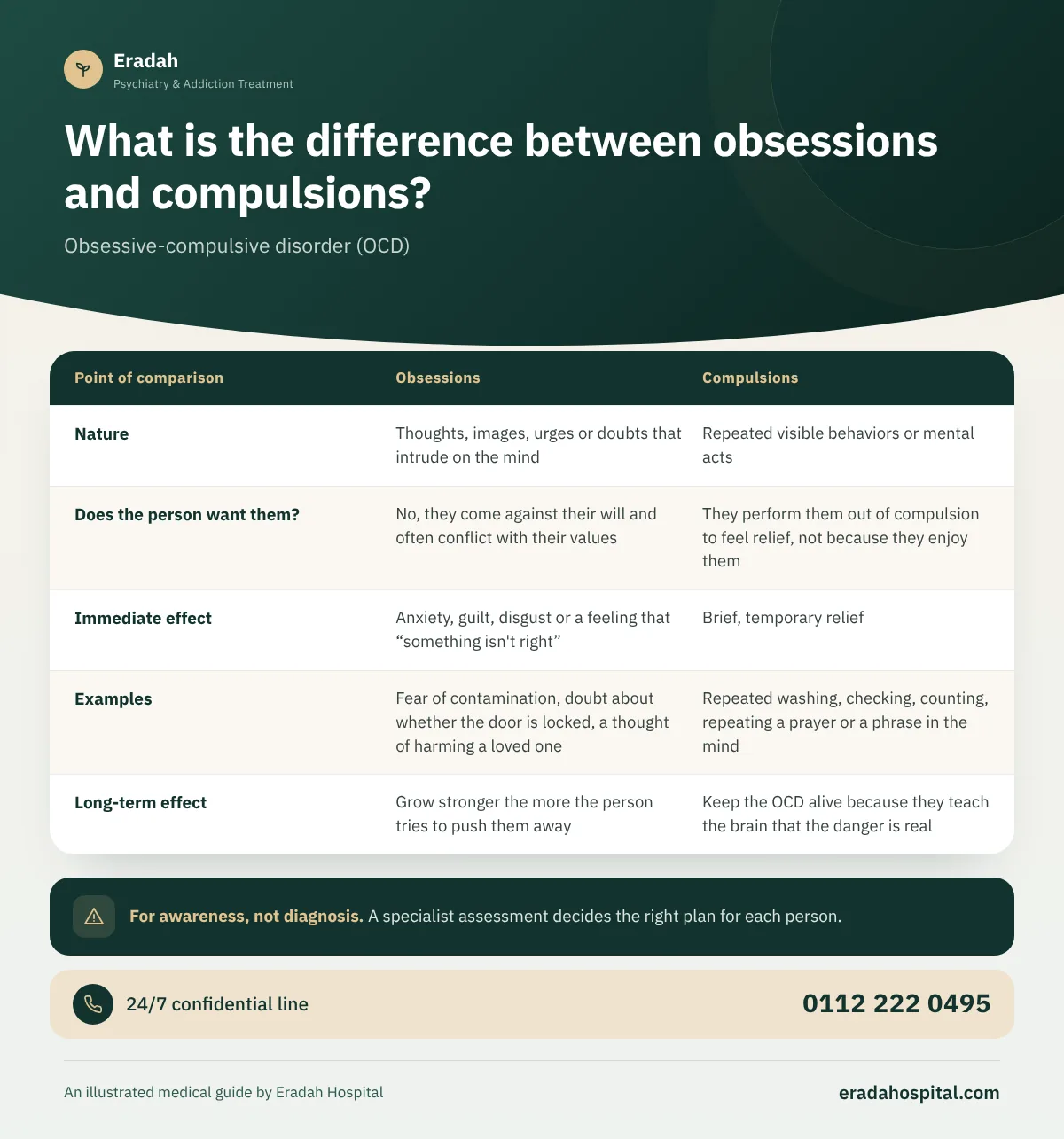
Not every person experiences both in the same obvious way; some compulsions are completely hidden and happen inside the mind, such as mental reviewing, repeating particular words, or “canceling” a bad thought with a good one, so the person looks calm from the outside while fighting an exhausting struggle.
How does the OCD cycle work?
- 1The intrusive thought
“Maybe I didn't turn the gas off properly... the house will burn down because of me.”
- 2Severe anxiety
A sense of danger and responsibility that doesn't ease no matter how logically the person thinks.
- 3The compulsion
Going back to check the gas once, twice, ten times, or asking a family member to reassure them.
- 4Temporary relief
The anxiety eases a little, and the brain learns that the ritual is what “saved” the situation.
- 5The OCD returns stronger
The thought comes back later, and each time the ritual needs more repetition or greater precision.
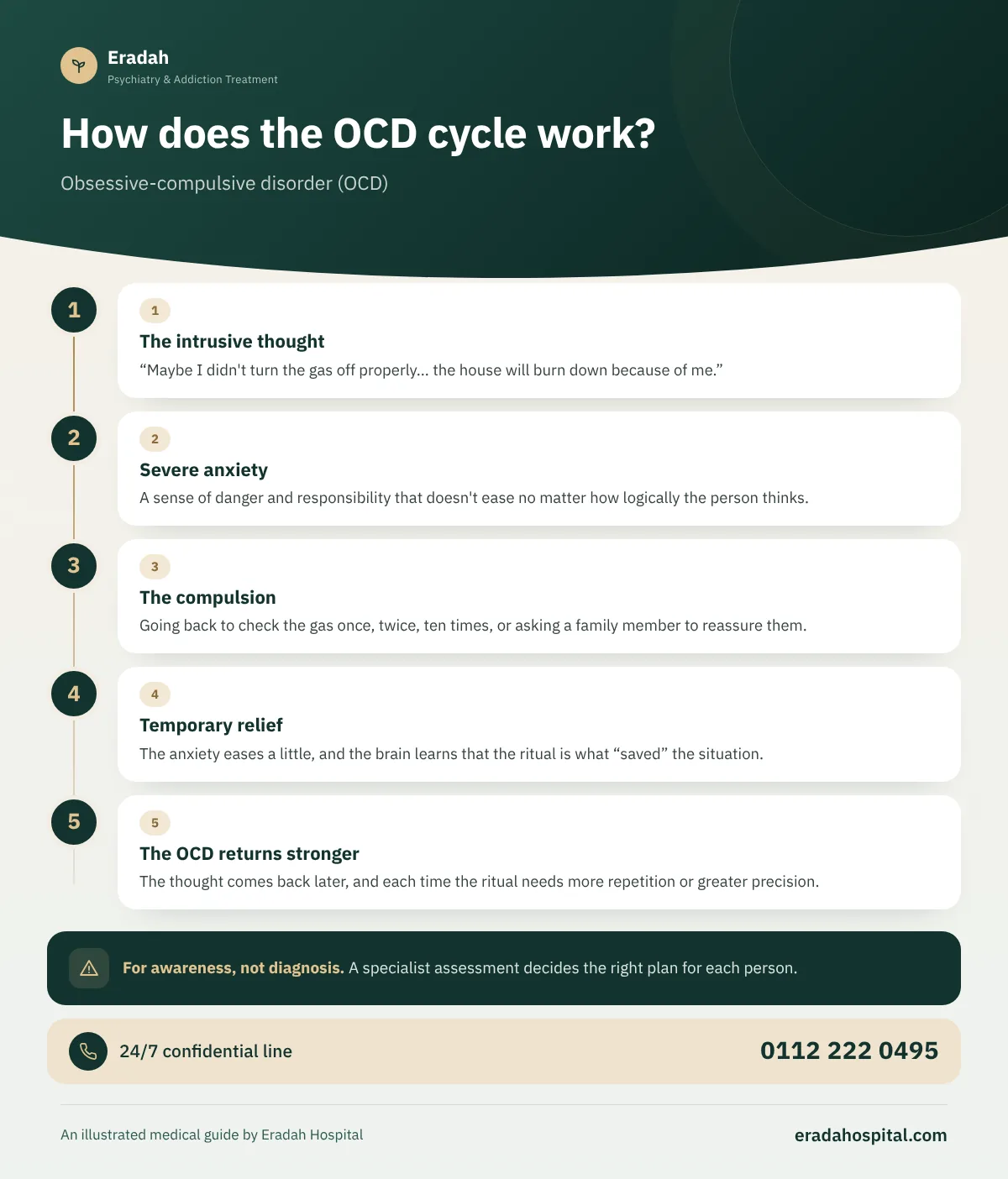
Understanding this cycle is the key to understanding OCD as a whole: the ritual that looks like the solution is actually what feeds the problem. This is why treatment works by gradually breaking the cycle, not by “convincing” the person that their fear is illogical, which they usually already know.
What does OCD feel like from the inside?
“I know my hands are clean, and I know I washed them a minute ago, but the feeling that they aren't clean enough keeps screaming inside me until I wash them again.” With words like these, many people with OCD describe what they go through; this is not a quotation from any particular patient.
Patients describe OCD as a voice of doubt that won't be quiet, and a feeling of incompleteness or of things not being “right” that always needs more reassurance. Many suffer in silence for years, ashamed of the content of their thoughts or afraid of being called crazy, although OCD has nothing to do with madness, and most people with OCD fully realize that their thoughts are exaggerated.
How common is OCD and when does it start?
OCD usually begins between late childhood and early adulthood, and symptoms can appear as early as age six. It starts earlier in males, with a large share showing symptoms before age ten, while in females it usually begins in adolescence, and it is slightly more common in women in adulthood. It may also appear or worsen during pregnancy and after childbirth.
The World Health Organization, in its estimates, has counted it among the conditions that cause the most disability and loss of quality of life, which confirms that treating it as a “personality trait” or a “habit” is unfair to the patient.
What happens in the brain in OCD?
Research points to a problem in a neural circuit linking the brain's frontal cortex with deep regions called the basal ganglia and then the thalamus, which scientists call the “cortico-striato-thalamic circuit.” This circuit is responsible for detecting errors and giving the signal “done, it's over,” and in a person with OCD it seems to keep sending the danger signal, so the feeling of completion never arrives.
The neurotransmitter serotonin is involved, which explains why SSRI medications help, along with other neurotransmitters such as glutamate and dopamine. The encouraging part is that imaging studies have shown activity in this circuit improves with successful treatment, whether medication or psychotherapy.
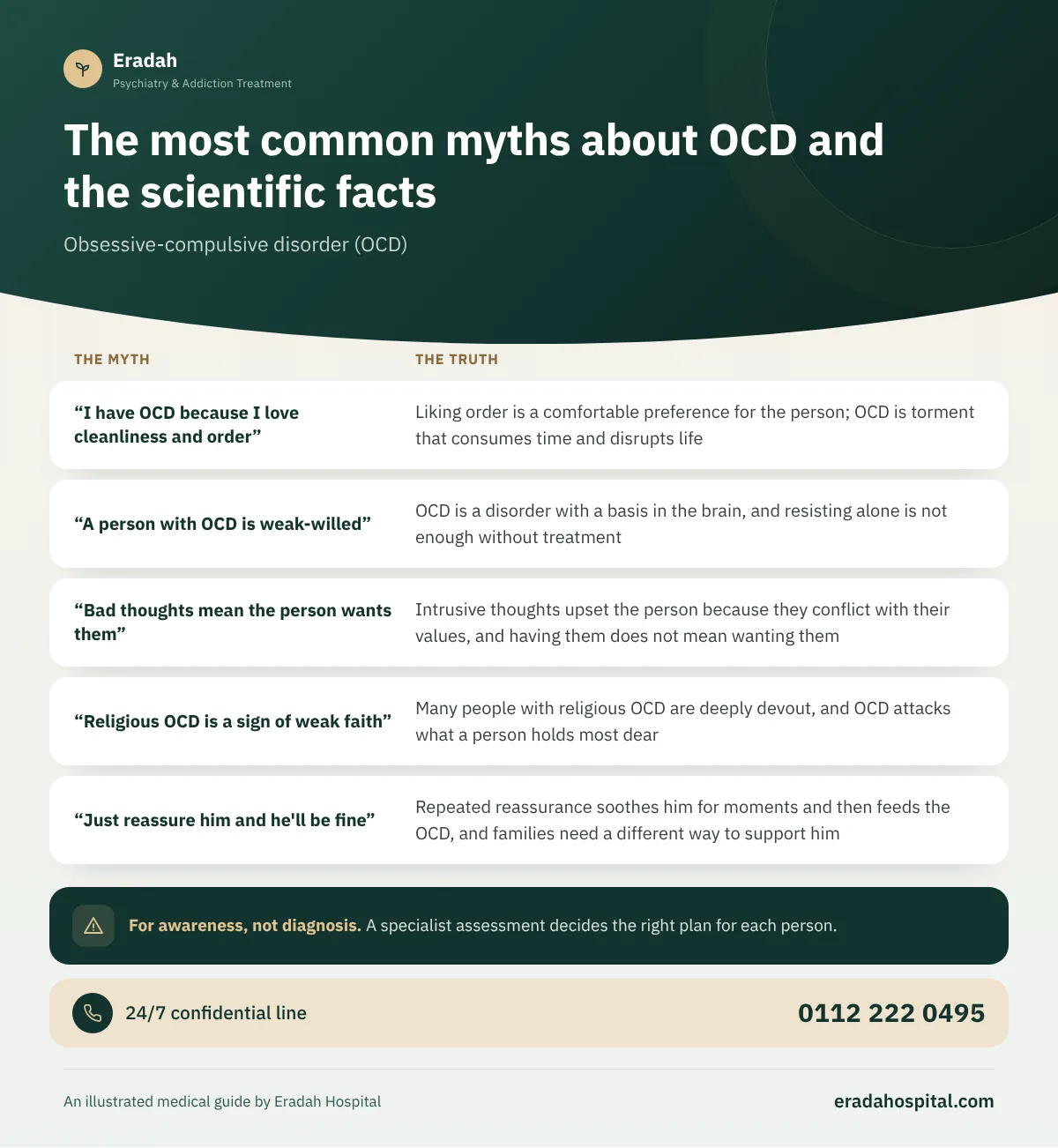
Common myths about OCD and the facts
| The myth | The truth |
|---|---|
| “I have OCD because I love cleanliness and order” | Liking order is a comfortable preference for the person; OCD is torment that consumes time and disrupts life |
| “A person with OCD is weak-willed” | OCD is a disorder with a basis in the brain, and resisting alone is not enough without treatment |
| “Bad thoughts mean the person wants them” | Intrusive thoughts upset the person because they conflict with their values, and having them does not mean wanting them |
| “Religious OCD is a sign of weak faith” | Many people with religious OCD are deeply devout, and OCD attacks what a person holds most dear |
| “Just reassure him and he'll be fine” | Repeated reassurance soothes him for moments and then feeds the OCD, and families need a different way to support him |
What is the difference between OCD, obsessive personality and other conditions?
| The situation | What sets it apart | How it differs from OCD |
|---|---|---|
| Obsessive-compulsive personality disorder | A constant preoccupation with perfection, rules and control as a fixed trait | The person usually sees their traits as correct, and there are no intrusive thoughts or rituals to relieve them |
| Generalized anxiety disorder | Realistic, prolonged worry about life matters such as money and health | No specific rituals, and the worry revolves around real, possible problems |
| Psychosis and schizophrenia | Fixed unrealistic convictions and hallucinations | A person with OCD usually realizes their thoughts are exaggerated and resists them |
| Religiosity and normal carefulness | Worship that brings peace of mind and stays within the limits of religious rulings | Religious OCD goes beyond what religion requires and brings torment, not tranquility |
Telling these conditions apart requires a psychiatrist, especially since OCD can occur together with depression, anxiety disorders or tic disorders in a large proportion of patients.
When should you see a psychiatrist?
- If the thoughts or rituals take up an hour or more of your day.
- If you have started running late for work, study, prayer or appointments because of the repetition.
- If you have started avoiding places, people or things for fear of triggering the OCD.
- If your family takes part in the rituals or changes their lives to avoid upsetting you.
- If the OCD is accompanied by persistent sadness, loss of hope or thoughts about death.
Can OCD be cured?
Yes, significant improvement is possible. Most patients who receive appropriate treatment, whether exposure and response prevention therapy, medication or both, notice a clear drop in symptoms and get their time and their lives back. Some patients need several treatment attempts before reaching the most suitable plan, which is normal and does not mean failure.
And early diagnosis saves years of suffering; every year a person spends in rituals deepens the cycle, and every step toward treatment opens a way out of it.
What is the family's role with a person who has OCD?
The family is often the first to see the rituals and the first to be affected by them. Their role is to understand and encourage treatment, without stopping the rituals by force and without taking part in them without limits:
- Treat OCD as an illness, not as stubbornness or “being spoiled,” and avoid mocking the rituals.
- Don't argue with the content of the obsession logically for hours; the person usually knows the thought is illogical.
- Be aware that taking part in rituals or giving constant reassurance may feed the OCD unintentionally.
- Encourage a visit to a psychiatrist, and offer to go along to the first visit.
OCD Guide: Everything You Need to Know
We have gathered everything about OCD into 12 pages, each answering one question in detail. Choose what you are looking for:
OCD symptoms
Obsessive thoughts and visible and hidden compulsions, and their signs in children, adolescents, adults and after childbirth, with self-assessment questions.
Causes of obsessive-compulsive disorder
The role of genetics, brain circuits and serotonin, bacterial infection in some children, thinking patterns and stress, and risk factors.
Harms of OCD
Lost time and disrupted study and work, the effect on marriage, family, skin and sleep, depression, and how early treatment prevents complications.
Types of obsessive-compulsive disorder
Contamination, checking, symmetry, intrusive thoughts and religious OCD, and how it differs from hoarding disorder and related disorders.
OCD treatment
Exposure and response prevention therapy, SSRIs and clomipramine (without doses), the length of treatment, and how families can stop going along with rituals.
OCD and addiction: why do they occur together and how are they treated together?
OCD and addiction: how common substance use is among people with OCD, why some turn to alcohol and sedatives, the difference between a compulsion and an addiction, and how both are treated together.
Sexual OCD
What is sexual OCD? Why sexual thoughts you hate intrude on you, how to tell obsession from real desire, hidden compulsions, and treatment with exposure and response prevention.
Religious OCD
What is religious OCD? Why you repeat ablution and prayer and are never reassured, what is the ruling on blasphemous thoughts you hate, the difference between piety and OCD, and treatment with exposure that respects religion.
Cleanliness and contamination OCD: why do you never feel clean?
What is cleanliness OCD? Why a person washes their hands dozens of times without relief, the difference from loving cleanliness, forms of mental contamination, its effect on skin and home, and how exposure treats it.
Doubt and checking OCD: why are you never reassured no matter how much you check?
What is doubt OCD? Why you keep going back to check the door and the gas without being reassured, how checking weakens trust in memory, the difference from pathological suspicion of others, and treatment methods.
OCD in children and adolescents: a guide for parents
OCD in children and adolescents: how it shows up at home and at school, the difference from normal childhood rituals, sudden onset after an infection, and how to help your child and how it is treated.
OCD and marriage: a guide for the patient and their partner
OCD and marriage: can a person with OCD marry and what do they tell the other person, relationship OCD before and after engagement, the effect of rituals on married life, OCD after childbirth, and couples therapy.
Suicidal thoughts or danger to self? Get help now
- Talking about death or saying that life with OCD is “unbearable”
- Severe despair and a conviction that things will never get better
- Complete isolation, or giving up eating or sleeping because of rituals or fear
- Saying goodbye to family or writing farewell messages
- A sudden change to strange calm after a period of intense suffering
Stay with the person and listen calmly without blame, and don't dismiss what they say. Call an ambulance (123) or go to the nearest emergency room if the danger is imminent, contact the mental health support line 16328, and keep medications and dangerous objects out of their reach.
Ambulance 123 Mental health support line 16328