Is addiction a disease that can be treated?
Yes. Addiction is a chronic brain disorder, not weak willpower or a moral flaw, as many people assume. It changes the brain’s circuits for reward, motivation and self-control, so a person keeps using even while seeing the harm with their own eyes. This is why “advice” and “promises” alone are not enough, and why specialized treatment is a necessity, not a luxury.
The US National Institute on Drug Abuse (NIDA) describes addiction as a complex but treatable disease. As with diabetes and high blood pressure, success is not measured by the problem disappearing within a week, but by the patient’s ability to regain their life, work and relationships, and to have fewer and shorter relapses until they stop. You can read more about the effect of drugs on the brain on the dopamine page.
Addiction is a complex but treatable disease that affects brain function and behavior, and no single treatment is right for everyone. From the principles of effective treatment, NIDA
Treatment today is built on clear scientific evidence: an individual assessment, safe detox, proven psychological and behavioral therapies, supporting medication when needed, and long-term follow-up. When these elements work together, many patients improve in a real and lasting way.
What are the stages of drug addiction treatment?
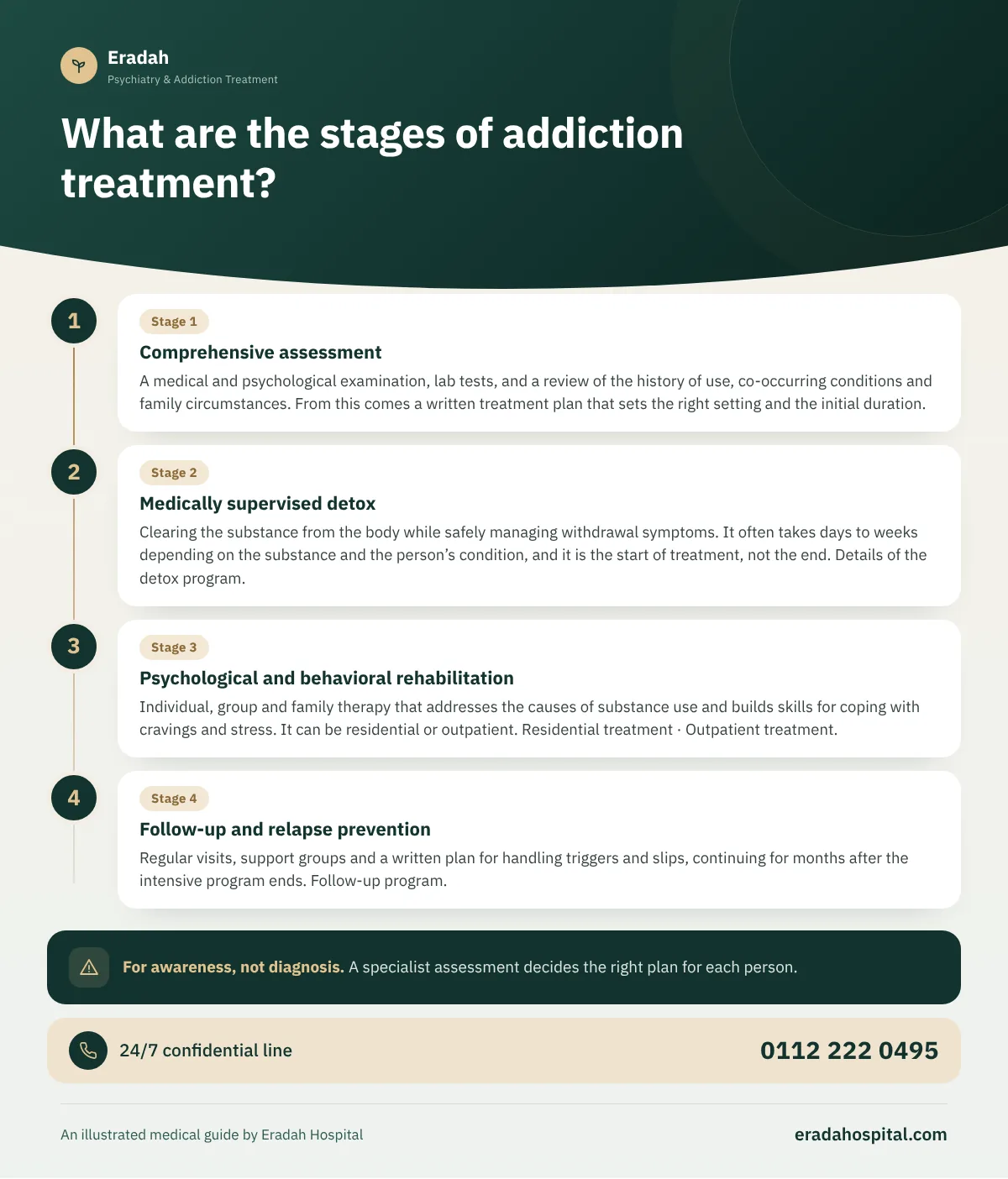
The international standards of the World Health Organization and the United Nations Office on Drugs and Crime agree that treatment is a continuum of care, not a single session or a week in a facility. Here are the four stages in brief, each with its own detailed page:
- Stage 1Comprehensive assessment
A medical and psychological examination, lab tests, and a review of the history of use, co-occurring conditions and family circumstances. From this comes a written treatment plan that sets the right setting and the initial duration.
- Stage 2Medically supervised detox
Clearing the substance from the body while safely managing withdrawal symptoms. It often takes days to weeks depending on the substance and the person’s condition, and it is the start of treatment, not the end. Details of the detox program.
- Stage 3Psychological and behavioral rehabilitation
Individual, group and family therapy that addresses the causes of substance use and builds skills for coping with cravings and stress. It can be residential or outpatient. Residential treatment · Outpatient treatment.
- Stage 4Follow-up and relapse prevention
Regular visits, support groups and a written plan for handling triggers and slips, continuing for months after the intensive program ends. Follow-up program.
The US institutes state plainly that medical detox alone does little to change substance use over the long term. That is why leaving after the detox days without rehabilitation and follow-up is one of the most common causes of relapse, and one of the most dangerous with opioids, because the body’s tolerance has dropped.
Residential or outpatient? The levels of care in brief
The setting for treatment is not chosen by preference or by fear of what people will say, but according to the severity of the condition and its risks. An outpatient clinic or a day program may be enough for stable cases with a supportive environment, while residential care suits severe or multiple addictions, repeated relapses, a triggering environment and a co-occurring mental illness, and intensive medical supervision is needed when there is a risk of withdrawal complications or psychosis. The team decides the level after assessing six areas, summarized in the infographic below:
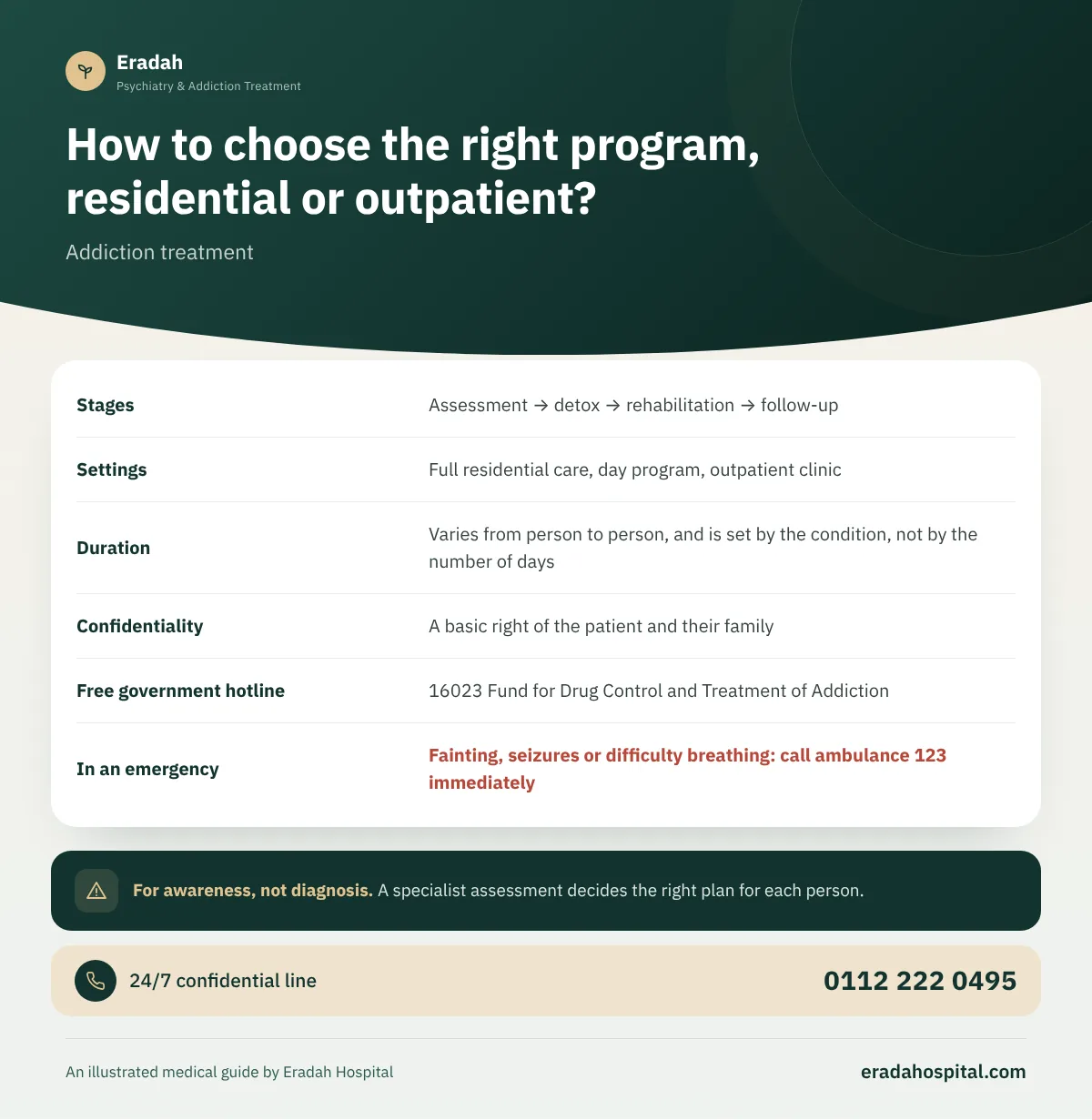
A person can move between levels, up or down; what matters is that the patient is never suddenly left to go from intensive care to nothing. We explain each program, who it suits and how it is chosen in the guide to addiction treatment programs at Eradah.
How long does drug addiction treatment take?
There is no single length that suits everyone, and “curing addiction in two weeks” is an unrealistic promise. NIDA’s principles indicate that most patients need at least three months of effective treatment before drug use clearly declines or stops, and that longer treatment is linked to better outcomes. Recovery as a whole can extend over years, with several phases of care.
The actual length depends on many factors, including:
- The type of substance: opioids, alcohol and sedatives need more careful withdrawal than others.
- How long and how heavily the person has used, and whether more than one substance is used at the same time.
- Co-occurring mental health conditions such as depression, anxiety, ADHD and psychosis.
- Previous relapses and what the patient learned from them.
- The environment: a supportive family and stable work, or surroundings full of triggers.
- Consistency: sticking with follow-up after discharge matters more than the length of the stay alone.
Each substance has its own details; the length of treatment for heroin addiction, for example, differs from hashish or shabu, and you will find it on each substance’s treatment page below.
Can you stop addiction on your own or at home?
Some people stop certain substances without a formal program, but that is not the rule, and with some substances it can be a real danger. The real obstacle is that withdrawal symptoms and intense cravings are beyond most people’s ability without medical support, and “willpower” alone does not settle this. We explain when this can work and when it is dangerous in the guide to treating addiction at home.
For this reason we do not publish any “home detox protocol.” If a person takes a prescribed medication they have become used to, they should not stop or change it except under their doctor’s supervision. Structured outpatient treatment under a specialized team, on the other hand, is a safe and suitable option for many cases, as decided by the assessment.
What is the role of medication in addiction treatment?
Medication is an important part of treatment for some patients, especially when combined with psychological and behavioral therapy, but it does not treat addiction on its own. Doctors use several general categories, and the doctor chooses what suits each case after the assessment:
- Medication to control withdrawal symptoms during detox, to reduce pain, insomnia, anxiety and the risk of seizures.
- Medication-assisted treatment for opioid addiction, including medications given under strict medical supervision to reduce cravings and prevent relapse and overdose, and others that block the effect of opioids.
- Medication that reduces cravings or relapse in alcohol addiction.
- Medication for the co-occurring mental health condition such as antidepressants, mood stabilizers and antipsychotics, avoiding as far as possible drugs that may cause a new dependence.
Treating addiction with herbs: what does medicine say?
So far there is no herb or blend that has been scientifically shown to treat addiction or to replace medically supervised detox, and some products marketed as a “natural alternative,” such as kratom and ibogaine, carry documented risks to the liver and heart. The doctor must be told about any herb or supplement the patient takes, because some interact with withdrawal medications and psychiatric medications.
We reviewed the most widespread claims one by one, along with what drug regulators say about each, in the guide Herbs and addiction treatment: the truth behind the ads.
What psychological therapies are used in rehabilitation?
Behavioral therapies are the most widely used form of addiction treatment according to NIDA, and they help the patient change their thoughts and behavior toward substance use and build a life that does not need the substance. The main ones are:
The patient learns to recognize the situations and thoughts that lead them to use, and practical ways to deal with them.
A conversation that respects the patient’s ambivalence and helps them discover their own reasons for change instead of having them imposed.
Tangible rewards for sticking with treatment and for negative test results, with strong evidence especially for stimulants.
Sharing experiences with others on the same road breaks isolation and shame and builds communication skills.
Rebuilds trust and communication at home and teaches the family how to support without controlling or giving in.
Fellowship and peer support groups for people in recovery offer belonging and ongoing follow-up after treatment.
Spiritual and religious support alongside medical treatment
Many patients and their families ask that faith have a clear place in the rehabilitation plan, and that request deserves respect. Keeping up prayer and reciting the Quran, or attending Mass and prayers at church for a Christian patient, can give a person in recovery calm, purpose and company away from the atmosphere of substance use. A pooled analysis of long-term studies published in JAMA Psychiatry in 2026 linked spirituality with lower harmful use of alcohol and drugs.
But faith works alongside detox and psychological therapy; it does not take their place. Suddenly abstaining from alcohol or sedatives without a doctor can end in seizures, and anyone who claims that ruqyah (spiritual healing recitation) is enough on its own, or asks the patient to stop psychiatric medication, puts the patient at real risk. If a relapse happens after a period of commitment, what is needed is to review the plan with the doctor, without blaming the patient for their faith. The guide to treating drug addiction with the Quran explains the religious position on seeking medical treatment, and how a family can coordinate between a religious guide and the treating doctor.
What if there is a mental illness alongside the addiction?
This is very common: depression, anxiety, ADHD, post-traumatic stress disorder (PTSD) and psychosis often accompany addiction. The principles of effective treatment stress that both disorders must be treated together under one plan, because treating one and ignoring the other raises the chance of relapse. Read the details in the guide to dual diagnosis, or learn about Eradah’s dual diagnosis program.
What is the family’s role in addiction treatment?
The family is often the first to notice and the first to suffer, and it can be the strongest motivation for treatment. Its organized involvement in treatment improves commitment and reduces relapse, provided it learns how to support without blame or threats and also looks after itself. We have prepared the Family Guide with its practical steps, and the family therapy program at Eradah.
What determines the cost of addiction treatment?
Cost varies widely between facilities and cases, and it cannot be set precisely before an assessment. Factors that affect it include:
- The level of care: full residential care differs from a day program and an outpatient clinic.
- The length of stay and of the program, and whether the patient needs intensive medical supervision.
- A co-occurring mental or physical illness that needs additional medication and follow-up.
- The lab tests and investigations needed during treatment.
- Family sessions and the follow-up program after discharge.
It is not enough to ask “how much does it cost?”; also ask “what does it include?” Does it include a psychiatrist, safe detox, real rehabilitation, and follow-up after discharge? If cost is a barrier, there are free government options that we will mention shortly. You will find detailed prices and what a program should include in the guide to the cost of addiction treatment in Egypt.
How do you choose a suitable addiction treatment facility?
Choosing a place is a critical decision, and unfortunately there are unlicensed facilities that mistreat patients. These questions can help you evaluate before you decide:
- Is the facility officially licensed, and does it have a psychiatrist who specializes in addiction?
- Can it manage detox medically and handle emergencies and seizures?
- Does it begin with an individual assessment and write a plan, or apply one program to everyone?
- Does it treat co-occurring mental illnesses, or does it stop at detox?
- Does it respect the patient’s dignity and consent, without violence, restraint or humiliation?
- Does it involve the family, and offer clear follow-up after discharge?
- Does it give you honest information about length and cost, without promising a quick cure?
International standards state that treatment must rest on informed consent and respect for the patient’s rights and dignity, and that the patient must be free to withdraw from treatment. The exceptional cases in which compulsory admission may be considered are regulated by law, and we explain them in the guide How to convince a person with addiction to get treatment.
Is addiction treatment confidential? And what options are available in Egypt?
Confidentiality is a basic right of the patient in any place that respects medical ethics, so their information is not disclosed to their employer, school or any other party without their consent, except within the limits the law requires. At Eradah we treat every call and every file with complete confidentiality.
In Egypt there are several options, each of which deserves to be known fairly:
- The Fund for Drug Control and Treatment of Addiction: its hotline 16023 operates around the clock and provides consultation and treatment free of charge and in complete confidentiality through its partner centers.
- Government mental health and addiction treatment hospitals under the General Secretariat of Mental Health at the Ministry of Health, and the mental health support line 16328.
- Licensed private centers such as Eradah, which differ in their programs and capabilities, so use the questions above to compare them.
What matters is to start from a safe, licensed place and to choose what suits the patient’s condition and the family’s circumstances, rather than waiting until things get worse. We explained the steps of the free option in detail in the guide to free addiction treatment in Egypt.
How do you choose the right addiction treatment hospital?
Before you choose a place for treatment, compare using clear criteria rather than advertisements: licensing, medical supervision, dual diagnosis treatment, the family’s role, and follow-up after discharge. These are the criteria, and how we apply them at Eradah Hospital for addiction treatment:
| Criterion | Why it matters | At Eradah Hospital |
|---|---|---|
| Licensing and medical supervision | An unlicensed place guarantees no standard of safety or privacy. | Licensed by the Egyptian Ministry of Health and Population under number 1427 and operating since 2015, under the supervision of Dr. Mahmoud El-Sawy, Consultant Psychiatrist and Addiction Specialist |
| Medical care | Withdrawal from some substances, such as alcohol, sedatives and Lyrica, can be dangerous, and opioid withdrawal pushes people toward relapse. | A doctor and nurses around the clock, and ambulance transfer to the nearest hospital if the condition needs general hospital care. |
| Dual diagnosis | Addiction often occurs together with a mental disorder, and treating only one raises the risk of relapse. | A dual diagnosis program treats both in a single plan. |
| Psychological therapy | Cognitive behavioral therapy, motivation enhancement and relapse prevention are the foundation of rehabilitation. | Individual and group sessions in a dedicated hall, led by psychologists. |
| Family and follow-up | Recovery continues after discharge, and the family’s role makes the difference. | A family program and a plan for follow-up and relapse prevention after treatment ends. |
| Environment and privacy | Calm and confidentiality encourage people to start treatment and to stay with it. | 16 rooms (single, double and triple) set in a garden, with a gym and a swimming pool, and complete confidentiality of data. |
Treatment Programs at Eradah
Each program is a stage or level of care, and the one that suits the patient is chosen after the assessment:
Medically supervised detox
Safe clearing of the substance while managing withdrawal symptoms and their complications.
Details Residential facilityResidential treatment
A complete daily program and round-the-clock supervision in a safe environment free of triggers.
Details Dual diagnosisDual diagnosis program
Treating addiction and the co-occurring mental illness together, with one team and one plan.
Details Outpatient treatmentOutpatient treatment and day program
Structured treatment without leaving home or work, for stable cases or after a residential stay.
Details FamilyFamily therapy program
Family sessions and support groups that rebuild trust and teach healthy boundaries.
Details Follow-upFollow-up and relapse prevention
A personal plan, visits and support groups that protect recovery after the program ends.
DetailsAddiction Treatment by Substance
Each substance has its own features in withdrawal, treatment and duration, and these are the most requested treatment guides:
Heroin addiction treatment
Opioid detox, supporting medication, and preventing overdose after stopping.
Details Read the guideTramadol addiction treatment
Stopping safely, the risk of seizures, and psychological treatment after withdrawal.
Details Read the guideShabu (crystal meth) addiction treatment
Dealing with psychosis, depression and intense cravings, and behavioral therapies.
Details Read the guideHashish and bango addiction treatment
When hashish use needs specialized treatment, and how rehabilitation works.
Details Read the guideStrox and Voodoo addiction treatment
The risks of synthetic cannabinoids, their psychological symptoms and the treatment plan.
Details Read the guidePregabalin addiction treatment
Why stopping must be gradual and under medical supervision.
Details Read the guideAlcohol addiction treatment
Dangerous withdrawal, supporting medication, and long-term rehabilitation.
Details Read the guideXanax addiction treatment
Safe, gradual withdrawal from sedatives and treatment of co-occurring anxiety.
DetailsGuides That Complete Your Understanding of Addiction Treatment
Separate pages that answer in detail the questions that come up before, during and after treatment:
What is addiction? Its definition, stages, how the brain changes and why it is a disease
What is addiction? Its scientific definition, the stages of addiction from experimentation to dependence, how it changes the brain’s reward and control circuits, and why it is considered a disease…
Details BasicsCauses of addiction: why do some people become addicted and others don’t?
What are the real causes of addiction? Genetics, childhood trauma, mental illness, friends and age of first use. Is addiction hereditary? And what are the protective factors…
Details WithdrawalDrug withdrawal symptoms: for each type, how long they last and when they are dangerous
What are the symptoms of drug withdrawal? A table comparing withdrawal from opioids, alcohol, sedatives, stimulants and hashish, when it starts and how long it lasts, and the warning signs…
Details MedicationAddiction treatment medications: what is used for each substance and what are their limits?
Addiction treatment medications by substance: opioids, alcohol and nicotine, why there is no approved medication for hashish and stimulants, and whether these medications cause…
Details After treatmentRelapse in addiction: its signs and stages and what to do afterward
What is relapse after recovery from addiction? Its three stages, the early warning signs of relapse, its causes, what to do if it happens, and whether it means…
Details For womenAddiction in women: why it differs from men and how it is treated
How does addiction in women differ from men? Faster progression, causes linked to trauma, anxiety and medication, a greater effect from alcohol, pregnancy risks, and barriers…
Details Spiritual supportTreating drug addiction with the Quran: the role of faith and spiritual support alongside medical treatment
Does treating drug addiction with the Quran and ruqyah work? The religious position on drugs and seeking treatment, what research says about faith and recovery, and how…
Details EmergencyReversing drug effects: what to do in cannabis or Captagon poisoning?
Is there a way to reverse drugs at home? Safe first aid for a hashish panic attack and Captagon overheating, when to call ambulance 123, and the truth about coffee…
Details Before you chooseHow do you choose a safe addiction treatment facility? Licensing, the team and warning signs
How do you choose a safe, licensed addiction treatment facility? How to verify the license, the medical team you should find, questions to ask before paying, and the warning signs…
Details The lawTreating a person with addiction against their will: what does Egyptian law allow, and what are the alternatives?
Can a person with addiction be treated against their will in Egypt? The family’s request route under the drug law, the conditions for compulsory admission under the Mental Patient Care Law, and why…
Details The lawAddiction treatment law in Egypt: is someone who seeks treatment punished?
What does Egypt’s addiction treatment law say? Exemption for those who come forward for treatment on their own, confidentiality of treatment records, drug testing for employees, and driving…
Details After treatmentWhy addiction treatment fails: 8 mistakes that send a patient back to drugs
Addiction treatment usually fails because of how treatment is delivered, not because of the patient: relying on detox alone, too short a stay, neglecting mental illness, a lack of…
Details Before treatmentFear of addiction treatment: 7 common fears and what actually happens
Fear of addiction treatment holds many people back: fear of withdrawal, of scandal, of the police, of the facility, and of life without the drug. Learn about…
Details Before treatmentCan a person with addiction recover alone? When it works and when it is dangerous
Can a person with addiction recover on their own without treatment? What studies say about natural recovery, who succeeds at it, and why stopping alone is dangerous with…
Details After treatmentDoes a person with addiction go back to normal after treatment? What returns and what takes time
Does a person with addiction go back to normal after treatment? What happens to the brain, memory, mood and relationships after stopping, what returns quickly and what takes months, and what may…
Details RecoveryBody recovery after quitting drugs: what happens to each organ and when
Body recovery after quitting drugs starts in the first days: sleep and appetite, then the liver, brain and heart. Learn what improves and when, and what needs…
Details RecoveryDrug cravings: why they happen and how to deal with them
Drug cravings can appear months and even years after stopping. Learn why they happen, which triggers set them off, and practical ways…
Details AwarenessThe end of a person with addiction: where does addiction lead, and how does treatment change the ending?
The end of a person with addiction is not a single fate: addiction without treatment can lead to overdose, illness, prison and the loss of family, but millions have recovered. Learn…
Details BasicsPhysical and psychological addiction: what is the difference, and which is harder to treat?
Physical and psychological addiction: what is the difference between physical dependence, tolerance and withdrawal, and cravings and compulsive use? And why does modern medicine see…
Details BasicsThe addictive personality: does it really exist? Traits that raise the risk of addiction
“The addictive personality” is a popular term, but science does not recognize a single personality that leads to addiction. Learn about the traits that do raise risk, such as impulsivity…
Details Myth bustingTreating addiction with herbs: the truth about blends, kratom and ibogaine
Does treating addiction with herbs work? What the evidence says about kratom, ibogaine, kudzu and herbalist blends, why they can be dangerous, and what the alternatives are…
DetailsDoes relapse mean treatment has failed?
No. NIDA notes that relapse rates in addiction are roughly between 40% and 60%, which is close to the rates at which symptoms return in chronic diseases such as diabetes, high blood pressure and asthma. A relapse does not cancel the benefit of earlier treatment, but it does mean the plan needs to be reviewed: perhaps a return to a higher level of care, treatment of a mental illness that was not detected, or a change in environment.
There is a big difference between a brief slip that the patient catches quickly, and a full relapse in which they return to their old pattern of use. The clearer the follow-up program, the faster the intervention and the less the harm.
How do you start treatment now?
- Admit that there is a problem, even if only to yourself. This is the hardest step and the most important.
- Call a specialized service for a confidential consultation: Eradah, or the free line 16023.
- Book a comprehensive medical and psychological assessment before any decision about the setting or length of treatment.
- Do not suddenly stop alcohol, sedatives or pregabalin without medical supervision.
- Involve someone you trust from your family or friends in the plan.
- Stick with follow-up after the intensive phase ends; it is what protects recovery.