What is psychosis?
Psychosis is a condition in which the brain cannot accurately distinguish what is real from what is created by the mind. The person is not “pretending” or “deliberately imagining”; they live what they see, hear and believe as complete reality.
Psychosis is a group of symptoms, not a diagnosis in itself, and it can appear in different illnesses: in schizophrenia, in manic episodes or severe depression, after the use of certain drugs, and it may even appear with severe sleep deprivation or with some physical illnesses and medications. This is why a doctor always looks for the cause before making a diagnosis.
The US National Institute of Mental Health notes that psychosis most often first appears in the late teens through the mid-twenties, the very years when a young person is building their studies, work and relationships, which is why recognizing it early is critically important.
What is the difference between hallucinations and delusions?
These are the two best-known symptoms of psychosis, and families often confuse them. The simple idea: hallucinations are a disturbance of perception, meaning the senses, while delusions are a disturbance of belief, meaning how a person interprets the world.
| Symptom | What does it mean? | What might it look like to the family? |
|---|---|---|
| Hallucinations | Sensing something that is not there, most commonly hearing voices | Talks to themselves, turns suddenly, or covers their ears |
| Delusions | A firmly held false belief that does not change with evidence or discussion | Insists that someone is watching them, plotting against them or putting something in their food |
| Disorganized thinking and speech | Jumping between thoughts with no clear connection | Speech that is hard to follow, or answers that do not fit the question |
| Disorganized behavior | Actions that make no sense or do not suit the situation | Inappropriate clothing, agitation, or periods of stillness |
| Negative symptoms | Reduced motivation, expression and interest | Withdrawal from people, neglect of hygiene and studies, speaking very little |
It is important for the family to know that arguing with a delusion does not remove it. Trying to “convince” the person that what they believe is untrue often increases their fear and their sense that the people around them have become part of the plot. More helpful is acknowledging their feelings (“I understand you're scared”) without confirming the idea itself or mocking it.
What does psychosis look like from the inside?
Many people who have been through a psychotic episode describe it starting with a vague feeling that “something has changed” in the world: sounds are louder, glances carry hidden meanings, and coincidences seem like messages aimed at them. Then these feelings gradually turn into convictions, and fear becomes the dominant feeling.
I didn't know I was ill; I was sure everyone knew a secret they weren't telling me, and that was more terrifying than anything else.
This is why many people do not seek help on their own at first: reduced insight into the illness is part of the condition itself, not stubbornness. That is why it matters for the family to notice the change and take the initiative in asking for an assessment.
Types of psychotic disorders
Eradah's guide covers two disorders from this family, each with separate pages on symptoms, treatment and more. Here is a short card for each:
Schizophrenia
SchizophreniaAlso known as: schizophrenia
A chronic disorder involving hallucinations, delusions and disordered thinking. It requires medication and long-term follow-up.
- Category
- Psychotic disorders
- How common
- About 1 in 300 people worldwide
- Typical onset
- Late adolescence to the early thirties
- Link to addiction
Very strong
When to seek help: if there is hearing of voices, unusual beliefs or sudden withdrawal. Early intervention improves outcomes.
Drug-induced psychosis
Substance-induced psychosisAlso known as: substance-induced psychosis
Hallucinations and delusions that appear during the use of substances such as crystal meth (shabu), Strox (synthetic cannabinoids) and hashish, or after stopping them.
- Category
- Psychotic disorders
- How common
- Not known precisely; more common with stimulants and synthetic cannabinoids
- Typical onset
- During use, intoxication or after stopping
- Link to addiction
Very strong
When to seek help: immediately if there are any hallucinations, intense suspicion or aggression after drug use. This is an emergency.
Psychosis
PsychosisAlso known as: psychotic episode
A partial loss of contact with reality through hallucinations, delusions or disordered thinking. It has many causes and often recovers with early treatment.
- Category
- Psychotic disorders
- How common
- 15 to 100 new cases per 100,000 people per year
- Typical onset
- Late adolescence to the mid-twenties
- Link to addiction
Strong
When to seek help: if hallucinations or unusual suspicions appear, if voices command harm, or if sudden psychosis comes with fever or confusion.
Paranoia
ParanoiaAlso known as: persecutory suspicion
Persistent suspicion, without enough evidence, that others mean harm. It ranges from passing thoughts to persecutory delusions.
- Category
- A symptom in psychotic and personality disorders
- How common
- From under 2% to about 30%, depending on the type of thought
- Typical onset
- Any age, increasing with stress and lack of sleep
- Link to addiction
Strong
When to seek help: if it appears suddenly with hallucinations or after drug use, if the person refuses to eat for fear of poison, or if they threaten to harm someone.
Hallucinations
HallucinationsAlso known as: hallucinating
Perceiving through the senses something that is not there, most famously hearing voices. It is a symptom, not a diagnosis, and some forms, such as hallucinations before sleep, are normal.
- Category
- A symptom in psychosis and other conditions
- How common
- 5.2% have experienced them at least once
- Typical onset
- Any age; when they appear in older age they call for an examination
- Link to addiction
Strong
When to seek help: if they appear suddenly with confusion or fever, after stopping alcohol, or if the voices command harm.
Delusional disorder
Delusional DisorderA firmly held false belief lasting a month or more despite evidence, with a life that otherwise seems normal away from the subject of the delusion.
- Category
- Psychotic disorders
- How common
- Rare (0.05 to 0.1% of adults)
- Typical onset
- Middle age, around 40
- Link to addiction
Moderate
When to seek help: if an idea that cannot be argued with takes over decisions and relationships, and immediately if there is any threat or stalking.
Grandiosity
GrandiosityAlso known as: grandiose delusions
An unrealistic certainty of having exceptional abilities, status or a mission. It is often a symptom of mania, psychosis or stimulant use.
- Category
- A psychotic symptom or personality trait
- How common
- About 28% of psychiatric samples
- Typical onset
- Often sudden, with mania or drug use
- Link to addiction
Strong
When to seek help: if unrealistic plans appear along with overspending or little sleep, and immediately if there is aggression or hallucinations.
Schizoaffective disorder
Schizoaffective DisorderAlso known as: affective schizophrenia
Schizophrenia-type symptoms such as hallucinations and delusions occurring together with episodes of depression or mania. Many people become stable with regular treatment.
- Category
- Psychotic disorders
- How common
- About 0.3% over a lifetime
- Typical onset
- Late adolescence and early adulthood
- Link to addiction
Strong
When to seek help: if hallucinations or delusions appear with depression or mania, and immediately if there is any talk of death or voices commanding harm.
What is the “schizophrenia spectrum and other psychotic disorders”?
Modern medical classifications, such as the DSM-5 diagnostic manual and the international ICD-11, group these disorders into one spectrum, because they share symptoms of psychosis and differ in duration, cause and pattern. The main conditions in this spectrum include:
- Schizophrenia: psychotic symptoms lasting a long time with a decline in daily functioning, and the best known disorder in the family.
- Brief psychotic disorder: a sudden, short episode after which the person usually returns to their previous state, and which may follow severe stress.
- Delusional disorder: a fixed delusion on a particular theme, such as jealousy or persecution, with daily functioning that looks relatively normal.
- Schizoaffective disorder: psychotic symptoms that overlap with clear episodes of depression or mania.
- Substance- or medication-induced psychosis: psychotic symptoms directly caused by a substance or medication, going beyond the usual effect of intoxication or withdrawal.
Psychosis can also appear within episodes of bipolar disorder or severe depression, and the doctor then treats it as part of the mood disorder.
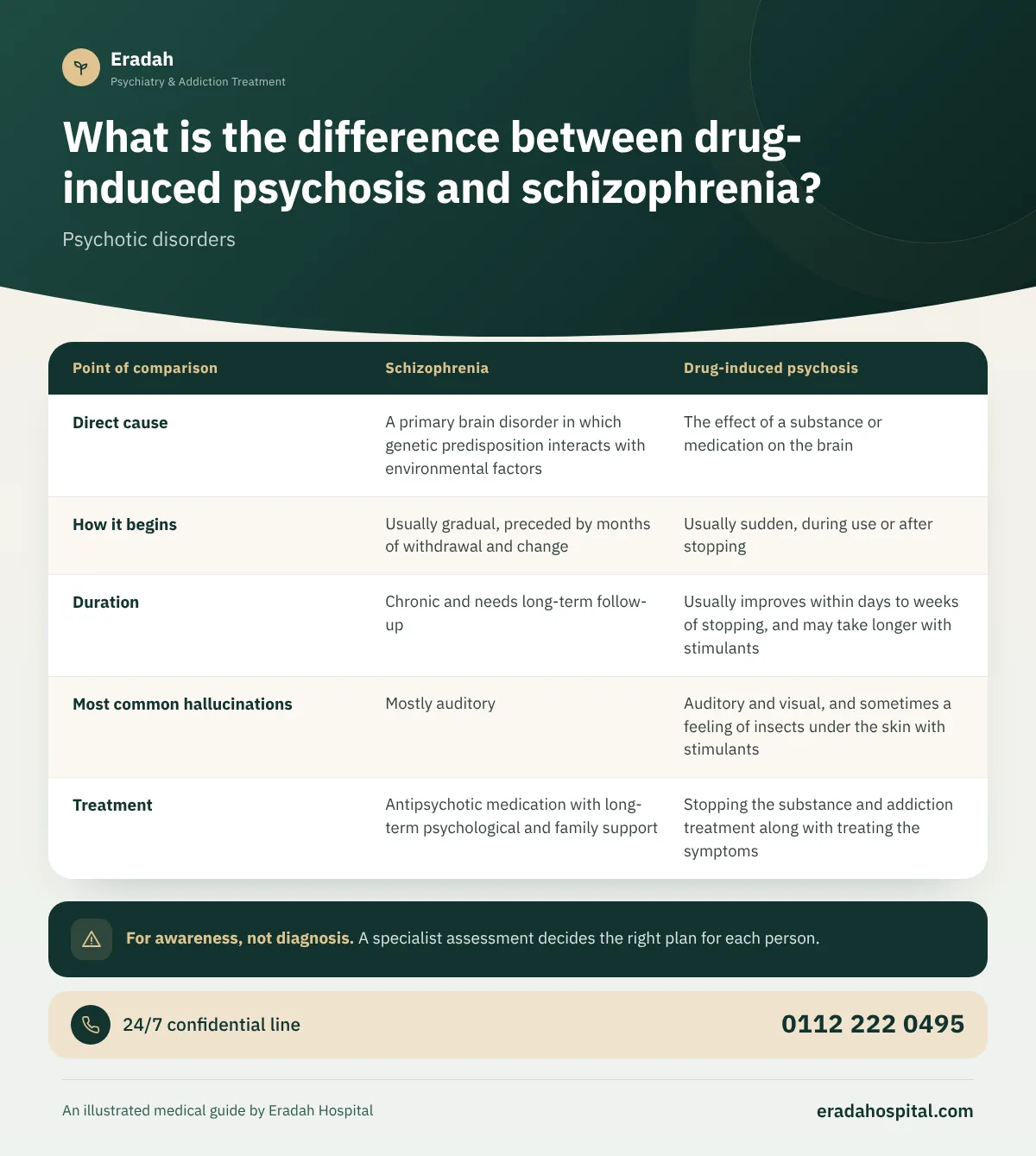
What is the difference between drug-induced psychosis and schizophrenia?
This is one of the most important questions we meet at Eradah, because many families face a son's first psychotic episode after using crystal meth (shabu), Strox or hashish. The key difference is in the cause and the course:
| Point of comparison | Schizophrenia | Drug-induced psychosis |
|---|---|---|
| Direct cause | A primary brain disorder in which genetic predisposition interacts with environmental factors | The effect of a substance or medication on the brain |
| How it begins | Usually gradual, preceded by months of withdrawal and change | Usually sudden, during use or after stopping |
| Duration | Chronic and needs long-term follow-up | Usually improves within days to weeks of stopping, and may take longer with stimulants |
| Most common hallucinations | Mostly auditory | Auditory and visual, and sometimes a feeling of insects under the skin with stimulants |
| Treatment | Antipsychotic medication with long-term psychological and family support | Stopping the substance and addiction treatment along with treating the symptoms |
The US National Institute on Drug Abuse notes that chronic methamphetamine (shabu) use can cause psychotic symptoms such as paranoia and hallucinations, which may last for months or years after stopping, and that synthetic cannabinoids (Strox and Voodoo) can cause acute psychotic episodes. You can find the details in the guide to drug-induced psychosis, and on the page about schizophrenia and addiction for when the two illnesses occur together.
Psychotic disorders in numbers
These figures come from the World Health Organization's schizophrenia fact sheet, and they reveal two problems: the illness is not as rare as many think, and the treatment gap is huge, not because treatment does not exist but because of stigma and delays in seeking help. Source: World Health Organization.
Why does early intervention change the course of the illness?
Every month that passes with untreated psychosis means more decline in studies, work and social life, and may make the response to treatment slower. This is why modern health systems use “early intervention in psychosis” programs that combine medication, psychological treatment, family support and help returning to study or work, and the US National Institute of Mental Health describes them as the established approach to treating psychosis in its early stages.
Before a full episode, early signs that deserve attention often appear:
- Growing suspicion of others or a feeling of being watched for no clear reason.
- Withdrawal from friends and family and spending long periods alone.
- Strange ideas or a sudden interest in obscure subjects.
- Neglect of personal hygiene and a sharp decline in study or work.
- Marked sleep disturbance, or staying awake for days.
- Difficulty telling reality from imagination, or in organizing thoughts.
This list is for awareness and is not a diagnostic tool. A single sign can have many causes, but more than one sign together deserves a psychiatric assessment.
Are psychotic disorders treatable?
Yes. The plan usually relies on antipsychotic medication chosen by the psychiatrist, who monitors its side effects, along with psychological therapy, family education and rehabilitation for returning to daily life. With drug-induced psychosis, addiction treatment becomes an essential part of the plan, because returning to substance use is one of the strongest causes of recurring episodes.
You can find the details on the pages for schizophrenia treatment and drug-induced psychosis treatment.
Myths that increase stigma, and the facts
| The myth | The truth |
|---|---|
| “Schizophrenia means two personalities in one person” | Schizophrenia has nothing to do with multiple personalities; it is a disorder of perception and thinking. |
| “Everyone with psychosis is violent” | Most patients are not violent, and they are more likely to be victims of violence than to commit it. |
| “It's possession or magic, not an illness” | Psychosis is a medical condition with effective treatment, and delaying treatment while looking for other explanations harms the patient. |
| “Someone who has had psychosis will never live a normal life” | Many people recover or stabilize, work and raise families with treatment and follow-up. |
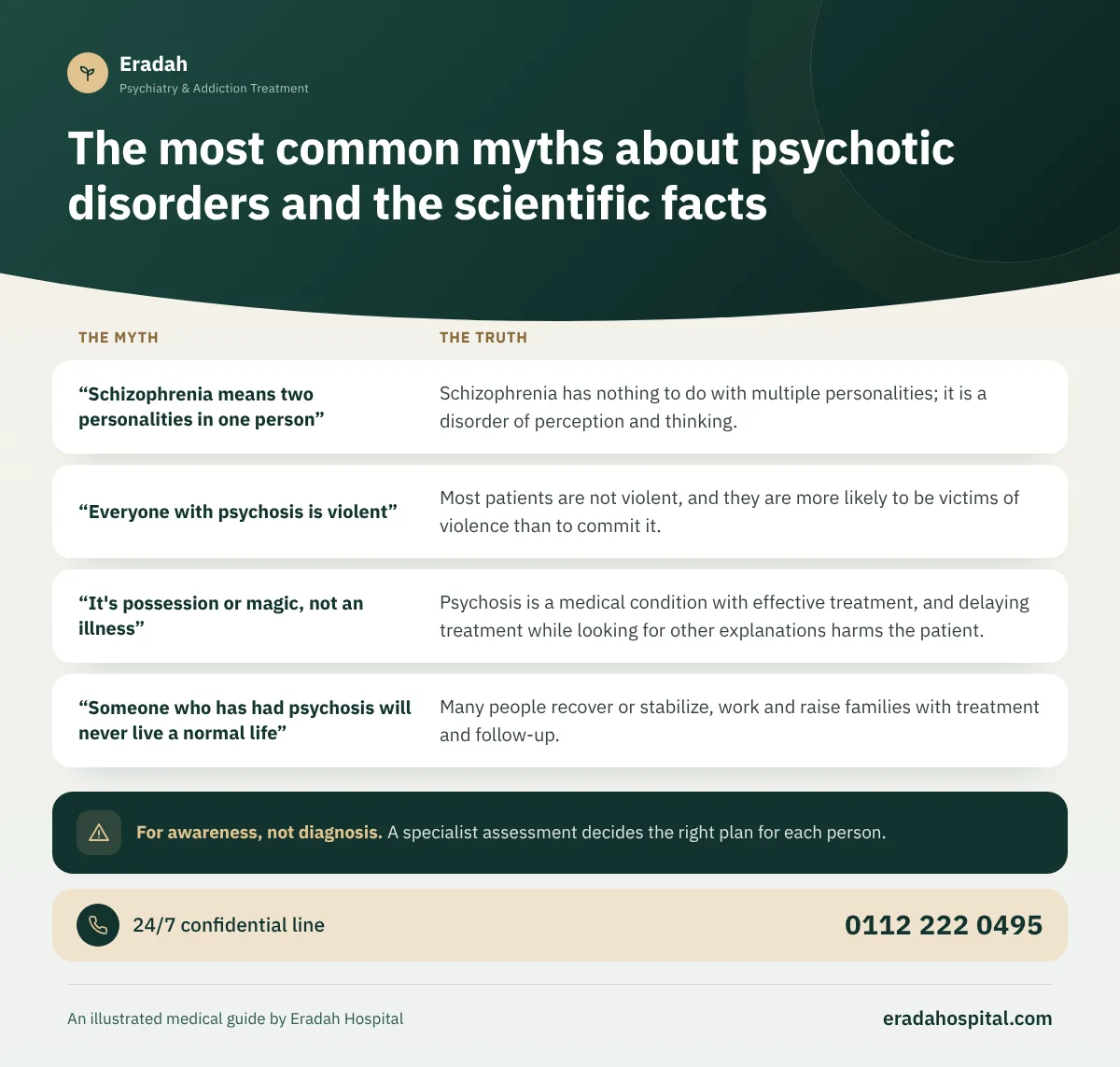
The World Health Organization stresses that the stigma surrounding schizophrenia leads to isolation and discrimination in work, education and health care. Using humane language such as “a person living with schizophrenia” instead of hurtful labels is a simple step that makes a big difference to the patient and their family.
How should a family respond to a person in a psychotic episode?
- Keep your voice and your surroundings calm, and reduce noise and the number of people in the room.
- Do not argue with hallucinations or delusions or mock them; acknowledge their feelings and reassure them that you are by their side.
- Ask simple, clear questions, and avoid sudden touch or quick movements.
- Calmly ask about any substance they have used, because that changes the treatment plan.
- Ask for a psychiatric assessment as soon as possible, and do not wait for the condition to “pass on its own.”
- Know the patient's rights; Egypt's Mental Patient Care Law No. 71 of 2009 regulates admission to hospital and protects patients' rights. This is general awareness information, not legal advice.
An acute psychotic episode or danger to self? Get help now
- Hearing voices that order the person to harm themselves or others
- Talk of death or of wanting to end life, or saying goodbye to loved ones
- Severe agitation, or terrifying fear of being pursued or plotted against that cannot be calmed
- Not sleeping for days on end, with disordered speech and behavior that makes no sense
- Refusing food and drink, or severe self-neglect
- These symptoms appearing after using crystal meth (shabu), Strox or any other substance
Stay with the person and speak calmly, without arguing about what they hear or believe, and move dangerous objects out of reach as a general precaution. Then call an ambulance (123) or go to the nearest emergency department, and you can call the mental health support line 16328, available around the clock.
Ambulance 123 Mental health support line 16328