What is dual diagnosis?
Many patients come to addiction treatment carrying another story that has not yet been told: long-standing depression, anxiety that never settles, trauma, or difficulty concentrating since childhood. When a substance use disorder occurs together with a mental health disorder in the same person, we call it “dual diagnosis” or “co-occurring disorders.”
What we mean here is two established disorders, each of which deserves its own diagnosis and treatment, not passing symptoms that occur during intoxication or withdrawal. One may be more severe than the other, and they may take turns in the lead over time, but they constantly interact: the substance changes mood, sleep and thinking, and the mental illness changes the person’s relationship with the substance.
Dual diagnosis can also include behavioral addictions such as gambling and gaming together with a mental health disorder, but this guide focuses on drugs, alcohol and medications that cause dependence, because they are the most common and the most dangerous.
How common is it for addiction and mental illness to occur together?
Having both is the rule more than the exception. The US National Institute on Drug Abuse (NIDA) notes that about half of people with a mental illness will have a substance use disorder at some point in their lives, and the reverse is also true. The US National Institute of Mental Health (NIMH) states that the two disorders often appear together because of shared risk factors.
There are no accurate, unified Egyptian figures on dual diagnosis, so we rely only on well-documented international figures. But clinical experience in psychiatry and addiction treatment centers confirms that a large proportion of patients need a careful psychiatric assessment alongside addiction treatment.
What are the most common dual diagnosis combinations?
Any mental health disorder can occur with any substance, but some pairings appear again and again in the clinic, because at first the substance seems to “treat” a particular symptom:
| Mental health disorder | Substances commonly used with it | Why? |
|---|---|---|
| Depression | Alcohol, sedatives, tramadol, hashish | Used to numb sadness or to feel energized, then withdrawal deepens the depression |
| Anxiety and panic attacks | Sedatives such as Xanax, pregabalin, alcohol | Quick relief from anxiety turns into dependence and rebound anxiety |
| Post-traumatic stress disorder (PTSD) | Alcohol, opioids, hashish | An attempt to silence memories, nightmares and constant hypervigilance |
| ADHD (attention-deficit/hyperactivity disorder) | Stimulants, hashish, nicotine | Used in search of focus or calm, while impulsivity makes experimenting easier |
| Bipolar disorder | Alcohol, stimulants | Impulsivity during mania, and self-soothing during depression |
| Schizophrenia and psychosis | Hashish, stimulants, nicotine | The substance can trigger or worsen psychosis, and it weakens adherence to treatment |
| Personality disorders | Multiple substances | Emotional swings, impulsivity and a sense of inner emptiness |
The substances listed here are examples, not a complete list. Each pairing has its own details in the mental health pages below, and in the substance pages such as hashish, crystal meth (shabu) and pregabalin.
Dual diagnosis by mental health disorder
Each disorder has its own relationship with addiction, and a guide explains how substances interact with it and how the two are treated together:
Depression and addiction
How alcohol and sedatives become a “painkiller” for sadness, and why they deepen depression.
Details Dual diagnosisBipolar disorder and addiction
Substance use during manic and depressive episodes, and its effect on mood stability and treatment.
Details Dual diagnosisGeneralized anxiety disorder and addiction
When a sedative or pregabalin becomes a way to silence constant anxiety.
Details Dual diagnosisPanic attacks and addiction
Why withdrawal and stimulants increase panic attacks, and how to break this cycle.
Details Dual diagnosisSocial anxiety and addiction
Using substances for “courage” in social situations, and how this turns into dependence.
Details Dual diagnosisPTSD and addiction
Trauma, nightmares and using substances to forget, and treating trauma and addiction together.
Details Dual diagnosisSchizophrenia and addiction
Hashish, stimulants and psychosis, and why sticking to medication matters.
Details Dual diagnosisBorderline personality disorder and addiction
Impulsivity, emotional swings and substance use, and the role of dialectical behavior therapy.
Details Dual diagnosisAntisocial personality disorder and addiction
Impulsivity, risk-taking and use of multiple substances, and how commitment to treatment is built.
Details Dual diagnosisADHD and addiction
Using substances in search of focus or calm, and how ADHD is treated safely.
Details Dual diagnosisChronic insomnia and addiction
Sleeping pills, alcohol and hashish for sleep: a temporary fix that creates deeper insomnia.
DetailsWhich comes first: addiction or mental illness?
This is the “chicken or egg” question that almost every family asks. The honest answer is: it can happen in either direction, and sometimes it cannot be determined. NIMH describes three main pathways:
Genetics, chronic stress and trauma, especially in childhood, raise the risk of both disorders without one directly causing the other.
Some disorders change the brain in a way that makes a substance more “rewarding,” or the person turns to a substance to ease their suffering, which is called “self-medication.”
Repeated substance use changes brain chemistry and can trigger depression, anxiety or psychosis in people who are predisposed to them.
It is also important to tell the difference between an independent mental disorder and symptoms caused by the substance itself, such as the depression that accompanies stimulant withdrawal, or the psychosis that appears with crystal meth (shabu). The doctor often needs to follow the patient for several weeks after stopping to see which symptoms remain. That is why we have a dedicated page on drug-induced psychosis.
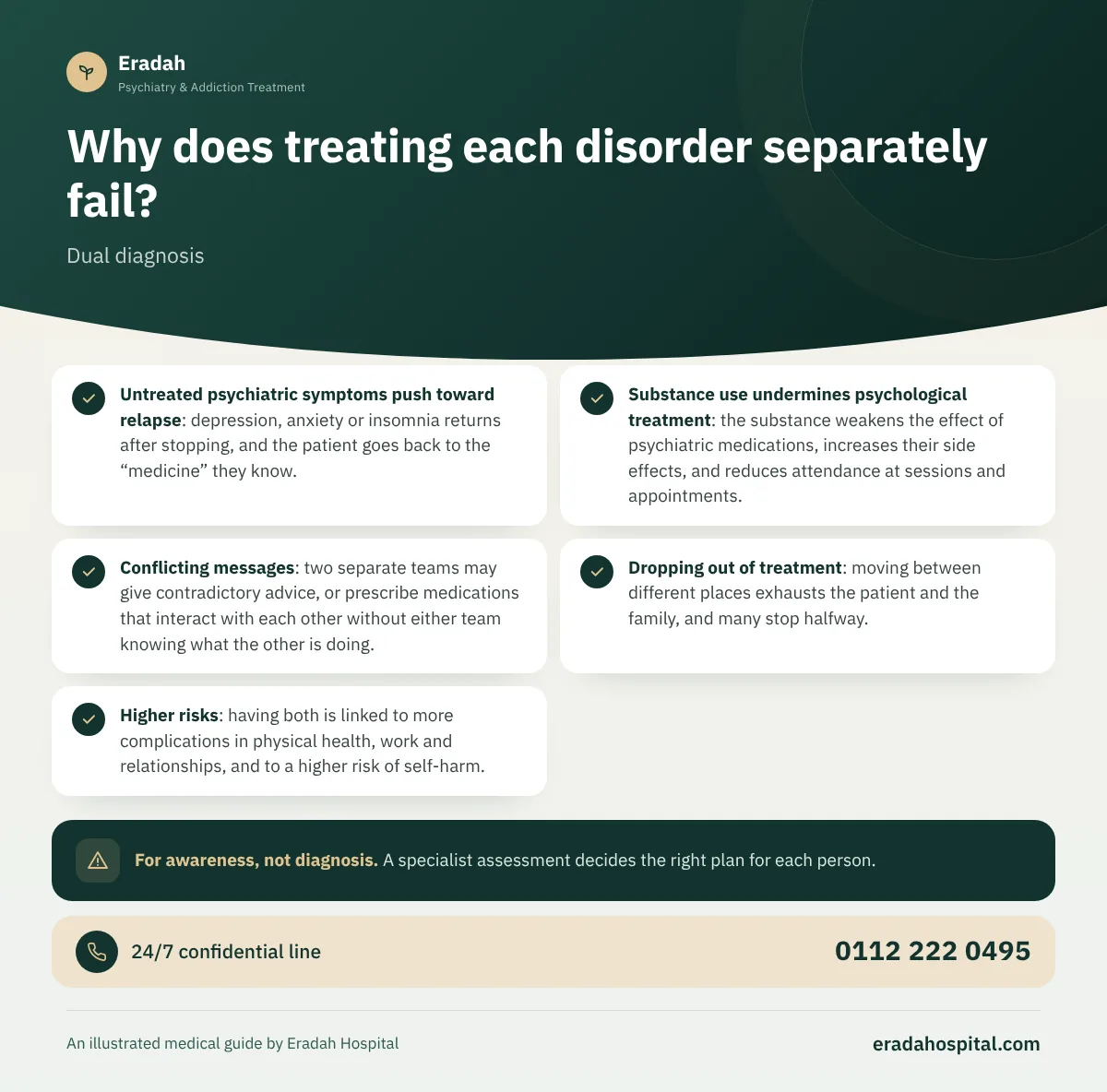
Why does treating each disorder separately fail?
For many years, patients have been passed back and forth between two doors: an addiction facility that says “treat your mental health first,” and a psychiatric clinic that says “stop using first, then come back.” The result is that the patient falls between the two. NIDA’s principles of effective treatment affirm that people with co-occurring disorders should have both disorders treated together in an integrated way.
- Untreated psychiatric symptoms push toward relapse: depression, anxiety or insomnia returns after stopping, and the patient goes back to the “medicine” they know.
- Substance use undermines psychological treatment: the substance weakens the effect of psychiatric medications, increases their side effects, and reduces attendance at sessions and appointments.
- Conflicting messages: two separate teams may give contradictory advice, or prescribe medications that interact with each other without either team knowing what the other is doing.
- Dropping out of treatment: moving between different places exhausts the patient and the family, and many stop halfway.
- Higher risks: having both is linked to more complications in physical health, work and relationships, and to a higher risk of self-harm.
What is integrated treatment for dual diagnosis?
Integrated treatment means the patient receives addiction treatment and psychological treatment at the same time, from one team, under one plan. NIMH describes it as bringing the two treatments together in one place so that the patient gets more coordinated and easier care. Its key principles include:
- A comprehensive assessment of both disorders from day one, then continuous reassessment as symptoms change.
- No wrong door: whichever side the patient starts from, they are received, assessed and treated or referred, and never turned away.
- Starting where the patient is: respecting their readiness to change, and working on motivation through motivational interviewing.
- Proven psychological therapies such as cognitive behavioral therapy, dialectical behavior therapy for borderline personality disorder, and trauma therapy once the person is stable.
- Carefully chosen medications that treat the mental illness while avoiding, as far as possible, medications that could cause a new dependence.
- Involving the family and educating them about both disorders, not about the addiction alone.
- Long-term follow-up because both disorders are chronic and need ongoing, flexible care.
In its fourth edition, the ASAM criteria set out levels of care “enhanced for co-occurring disorders” across almost all stages of treatment, meaning a good facility should be able to handle mental illness in outpatient care and in residential care alike. Learn how this works in practice in the dual diagnosis program at Eradah.
What are the signs of a mental illness behind the addiction?
No one can diagnose themselves or someone else from a list, but these signs are worth telling the doctor about clearly. This list is for awareness and is not a diagnosis.
- Using with a clear purpose: “so I can sleep,” “so I can calm down,” “so I can talk to people,” “so I can forget.”
- Sadness, anxiety or sleep problems that began years before the substance use, or in a family with a history of mental illness.
- Psychiatric symptoms that last for weeks after stopping and do not improve.
- Suspiciousness, hearing voices or strange thoughts, especially after hashish or stimulants.
- Sharp swings in mood, energy and sleep with no clear cause.
- Repeated relapses despite real motivation to stop and previous treatment programs.
- Thoughts of death or self-harm, in which case help must be sought immediately.
Does dual diagnosis increase the risk of suicide?
Yes. Having both a mental illness and substance use raises the risk of suicidal thoughts and behavior, because a substance can increase impulsivity and hopelessness and weaken the ability to stay in control during moments of crisis, and withdrawal can bring a wave of severe depression. That is why the doctor asks about these thoughts at every assessment, and this question does not plant the idea; it opens a door to help.
The important news is that these thoughts are treatable, and that a crisis is temporary even when it seems endless. If you are thinking about ending your life, or you are worried about someone you love, do not wait: call the ambulance on 123 or the mental health support line on 16328, stay close to them, and ask for an urgent assessment.
How can the family help a person with dual diagnosis?
- Treat both disorders as illnesses that need treatment, not as a moral failing or “being spoiled.”
- Tell the doctor what you notice about mood, sleep and behavior, not only about the substance use.
- Avoid saying “if he quits drugs he’ll be fine,” because a mental illness that needs treatment may remain.
- Do not give them sedatives or sleeping pills at home to calm them down, as these may increase dependence and risk.
- Watch for warning signs of suicide risk or psychosis, and do not hesitate to call emergency services.
- Take care of yourselves: caring for a person with dual diagnosis is exhausting, and family support is part of the treatment.
You will find broader guidance in the Family Guide for supporting a person with addiction, and details on the general stages of treatment on the addiction treatment page.
Suicidal thoughts or danger to self? Get help now
- Talking about wanting to die or that life is no longer worth living
- Severe hopelessness or a feeling of being a burden to those around them
- A sudden increase in substance use along with complete withdrawal from others
- Saying goodbye to people or giving away important belongings
- Hearing voices that tell them to harm themselves or others, or severe agitation after substance use
- Loss of consciousness or difficulty breathing after taking a substance or medication
Stay with the person and do not leave them alone, listen without blame or argument, and keep medications and dangerous objects out of their reach. Call the ambulance on 123 or go to the nearest emergency department, and you can call the mental health support line on 16328 around the clock.
Ambulance 123 Mental health support line 16328