What is residential treatment?
After the days of detox, the body has cleared the substance, but the habits, triggers and thoughts that led to it are still the same. Residential treatment gives the patient a period of living away from these triggers, inside a small therapeutic community and a structured day, to learn how to live without the substance before returning to his life.
In the American ASAM model of levels of care, the most widely used standard for choosing the right program, residential services sit in the middle of a continuum that starts with outpatient treatment and ends with medically managed inpatient care. The level is chosen by an assessment covering six dimensions, including physical and mental health, readiness to change, relapse risk and the patient's environment. So residential care is a fitting choice for particular cases, not a “higher grade” of treatment that suits everyone.
Who does residential treatment suit?
The doctor usually recommends residential care in one or more of these situations:
- Moderate or severe dependence with daily or near-daily use.
- Previous outpatient attempts that ended in a quick return to use.
- A home, work or social environment surrounded by substance use that is hard to get away from.
- A co-occurring mental disorder that needs daily follow-up, for which the dual diagnosis program may be suitable.
- Family, legal or financial problems that make home a turbulent place to recover for now.
- The patient's own wish for a period of complete distance from which to start again.
Conversely, someone whose condition is stable and who has a job and strong support at home may not need a residential stay and may be better suited to outpatient treatment and a day program. The deciding factor is the individual assessment, not the family's level of worry alone.
What does a day in the residential program look like?
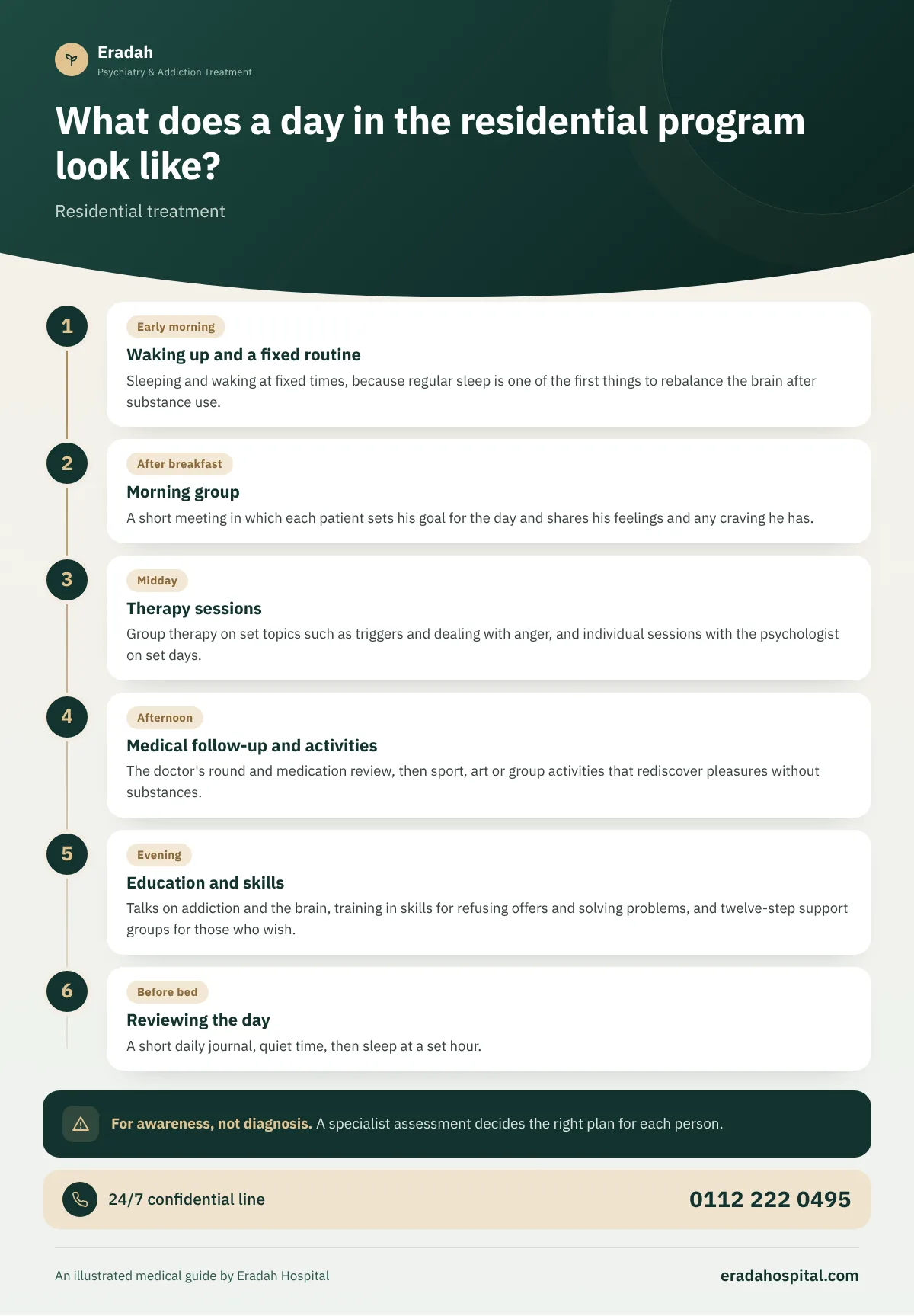
The schedule varies a little from day to day and from stage to stage, but this is an approximate model of a regular day in residential treatment programs. Eradah's treatment team sets the actual schedule and timings, and we explain it in detail at the assessment and before admission.
- Early morningWaking up and a fixed routine
Sleeping and waking at fixed times, because regular sleep is one of the first things to rebalance the brain after substance use.
- After breakfastMorning group
A short meeting in which each patient sets his goal for the day and shares his feelings and any craving he has.
- MiddayTherapy sessions
Group therapy on set topics such as triggers and dealing with anger, and individual sessions with the psychologist on set days.
- AfternoonMedical follow-up and activities
The doctor's round and medication review, then sport, art or group activities that rediscover pleasures without substances.
- EveningEducation and skills
Talks on addiction and the brain, training in skills for refusing offers and solving problems, and twelve-step support groups for those who wish.
- Before bedReviewing the day
A short daily journal, quiet time, then sleep at a set hour.
What treatments are used during a residential stay?
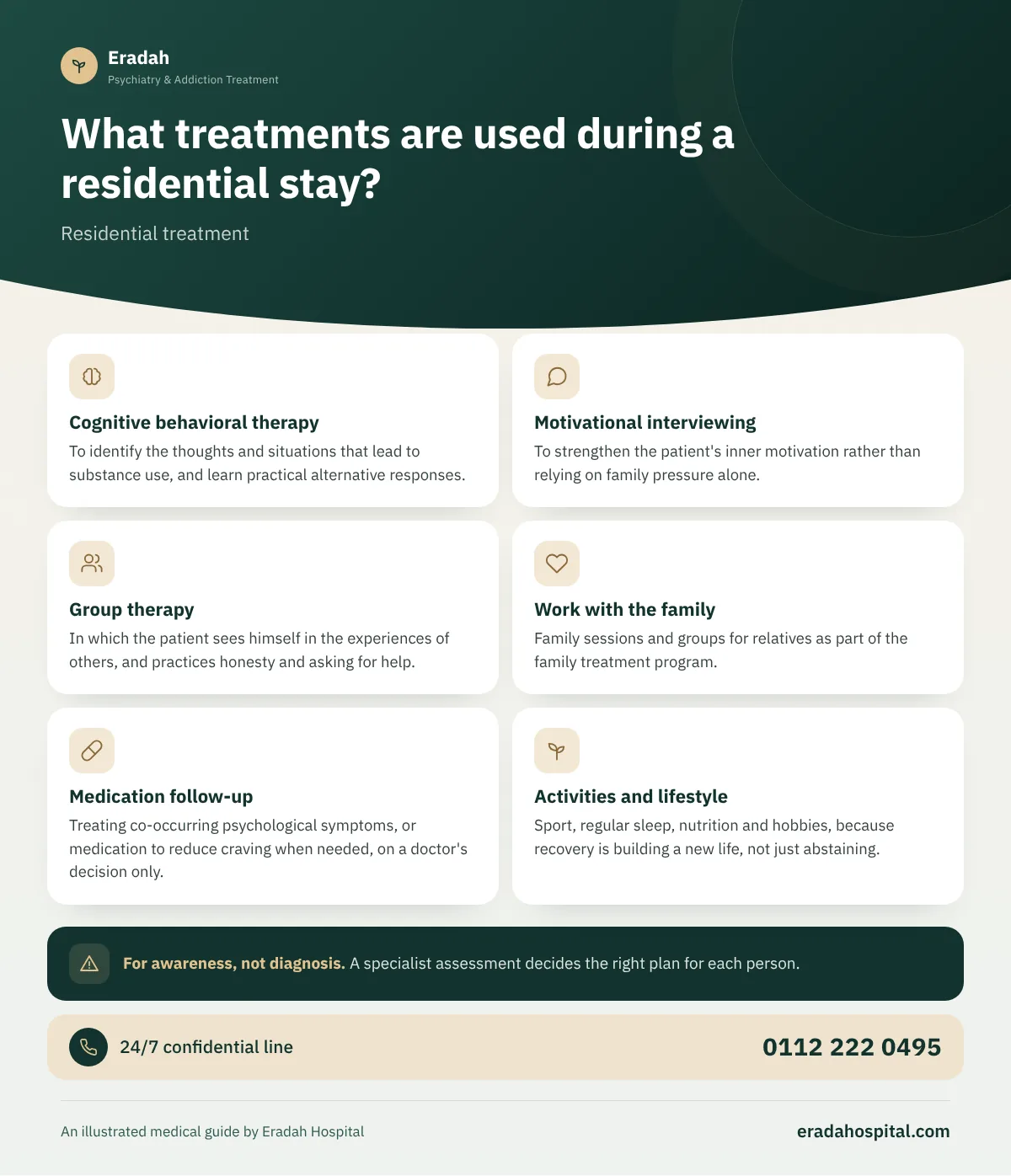
The program does not rely on a single method. NIDA's principles stress that no single treatment suits everyone and that the plan must change as the patient's needs change. Among the most important things we use:
To identify the thoughts and situations that lead to substance use, and learn practical alternative responses.
To strengthen the patient's inner motivation rather than relying on family pressure alone.
In which the patient sees himself in the experiences of others, and practices honesty and asking for help.
Family sessions and groups for relatives as part of the family treatment program.
Treating co-occurring psychological symptoms, or medication to reduce craving when needed, on a doctor's decision only.
Sport, regular sleep, nutrition and hobbies, because recovery is building a new life, not just abstaining.
What are the rules for phones, visits and leaving?
The rules are what worry patients most before admission. The table below shows what is usual in residential treatment programs and why, while the detailed rules at Eradah are set by the treatment team and explained clearly to the patient and family at the assessment, before any decision. Their aim is to protect recovery, not to punish:
| Topic | The usual rule | Why? |
|---|---|---|
| Phone | Often restricted in the first stage, then use is gradually increased | Many triggers and contacts for substance use are on the phone, and the first days are the most fragile |
| Visits | Usually after an initial period of stability, at times set by the team | So that visits take a therapeutic form and coincide with family sessions |
| Personal belongings | Checked on admission and after visits | To ensure an environment free of substances and dangerous items for everyone |
| Tests | Regular or random drug testing | Treatment principles recommend monitoring substance use during treatment, and the result is used to help, not to shame |
| Temporary leave | Depending on the stage and treatment plan | A gradual leave before the end tests skills in the real world |
| Mutual respect | No violence, no substance use and no harming others | Because a therapeutic community only works if everyone feels safe |
Residential treatment at Eradah is, in principle, voluntary for an adult patient, and no one is held beyond what is permitted by Mental Health Patient Care Law No. 71 of 2009, which regulates compulsory admission in specific cases assessed by a psychiatrist under legal safeguards. This is a general awareness overview and not legal advice.
What do you bring with you on admission?
- An ID card and any previous medical reports or tests.
- A list of all prescribed medication, in its original packaging, so the doctor can decide which to continue.
- Comfortable clothes enough for a week, plus sportswear and suitable shoes.
- Personal care items that, as far as possible, contain no alcohol.
- A book or notebook, because writing is part of the program.
- The numbers of family members the patient agrees to be in contact with.
How is confidentiality kept in the treatment program?
Many people fear that someone will find out they have been admitted. That is why we do not confirm that any patient is with us to anyone who asks about him without his consent, we do not allow photography inside the center, and no information goes to an employer or school without written consent, except as the law requires. Patients themselves are asked to respect their peers' privacy: what is said in the group stays in the group.
You can find a description of the facilities themselves, the rooms, shared spaces and activity areas, on the center page.
How long does residential treatment last?
There is no single length that suits everyone. British guidance, for example, speaks of residential rehabilitation programs that can run up to about three months for some patients with alcohol problems, and NIDA's principles indicate that most patients need at least three months of treatment across all levels to reduce or stop substance use significantly, not necessarily all of it inside the center.
That is why we set the length of stay after the assessment and review it during the program, according to the patient's progress, his mental state and the readiness of his environment. More important than the length of stay is that it is followed by a planned transition to outpatient treatment and follow-up and relapse prevention, because a sudden exit into the old life without support is one of the main causes of return to use.
The 28-day addiction treatment program: is it enough?
The phrase “28-day addiction treatment program” is spread across ads, as if recovery had a fixed date. In truth, the first four weeks can be a very good start, but they are rarely the whole treatment. The principles of the US National Institute on Drug Abuse (NIDA) stress that staying in treatment long enough is a decisive factor, and that most patients need about three months at least of treatment across its different levels.
| What can be achieved in 28 days | What takes longer | |
|---|---|---|
| The body | Getting past acute withdrawal symptoms and better sleep and eating | Fully stable sleep, energy and mood may take months |
| Understanding | Recognizing the problem and understanding personal triggers | Turning understanding into settled habits in real life |
| Mental health | Diagnosing co-occurring depression or anxiety and starting its treatment | Fine-tuning psychological and medication treatment and monitoring its effect |
| Family | Starting family sessions and changing how the family communicates | Rebuilding trust and putting agreements into practice at home |
| Relapse prevention | Writing an initial plan for high-risk situations | Testing the plan outside the center and adjusting it with the therapist |
A short stay may be enough for someone with lighter dependence and a supportive environment who moves straight on to outpatient treatment and the aftercare program. But with repeated relapses, mixing of substances, a mental illness that needs dual diagnosis treatment, or an environment full of triggers, a residential stay usually needs longer.
At Eradah we do not sell a “package” with a fixed number of days; we set the initial length after the assessment and review it during the program, then move the patient gradually to lighter levels. You can find the details of prices and what they include on the cost of addiction treatment page, and the first consultation is free and confidential.
What happens before and after discharge?
- Some weeks before discharge, a relapse prevention plan is written with the patient: triggers, warning signs, and who to call.
- Short home visits or temporary leave to test the plan in the real world.
- A closing session with the family to review the agreements for home, supported by our guide to life after leaving rehab.
- The first follow-up appointments are booked before discharge, not after.
- Joining follow-up groups at Eradah or community support groups.