What is medically supervised detox?
When the body has grown used to a substance over a long time, it resets its chemistry around it. If you stop suddenly, withdrawal symptoms appear: insomnia, anxiety, tremor, pain and nausea, and with some substances they can progress to seizures or delirium. Detox is the medical management of this stage so the patient gets through it safely and with as little suffering as possible.
Scientific references, including SAMHSA's guide to detoxification, describe this stage as three consecutive tasks: evaluation to identify the substances, the severity of dependence and any co-occurring illnesses; then stabilization, meaning treating symptoms and preventing complications; and then preparing the patient to enter treatment. The third task is as important as the first two, because the goal is for the patient to start the road to recovery, not to stop for a few days and then go back.
The word “toxins” here is figurative. The body clears the substance itself by its natural routes through the liver and kidneys, and no infusions, herbs or “blood washing” speed that up. What the program really does is protect the patient while the body and brain rebalance, and ease symptoms with medication the doctor chooses for each case.
Who needs detox at the center?
Not everyone who wants to stop needs an inpatient unit, but in some cases continuous medical supervision is the safe choice. The doctor decides this after the assessment, and the most important indicators are:
- Clear physical dependence on alcohol or on sedatives such as Rivotril and Xanax, or on pregabalin.
- A previous history of seizures or delirium when stopping.
- Using more than one substance at the same time, because overlapping withdrawal is harder to predict.
- Co-occurring physical illness, such as heart or liver disease or diabetes, or pregnancy.
- A co-occurring mental disorder, suicidal thoughts, or violent behavior during withdrawal.
- Previous failed attempts to stop at home, or an environment that does not allow distance from the substance.
The UK's NICE guidelines recommend considering inpatient detox when risks are present, such as seizures, delirium, severe co-occurring illness or use of multiple substances. Someone with mild dependence, a stable condition and strong support at home may be suited to outpatient detox with closely spaced medical visits as part of outpatient treatment, and the decision always rests with the doctor, not the family's judgment alone.
Why is detox at home dangerous?
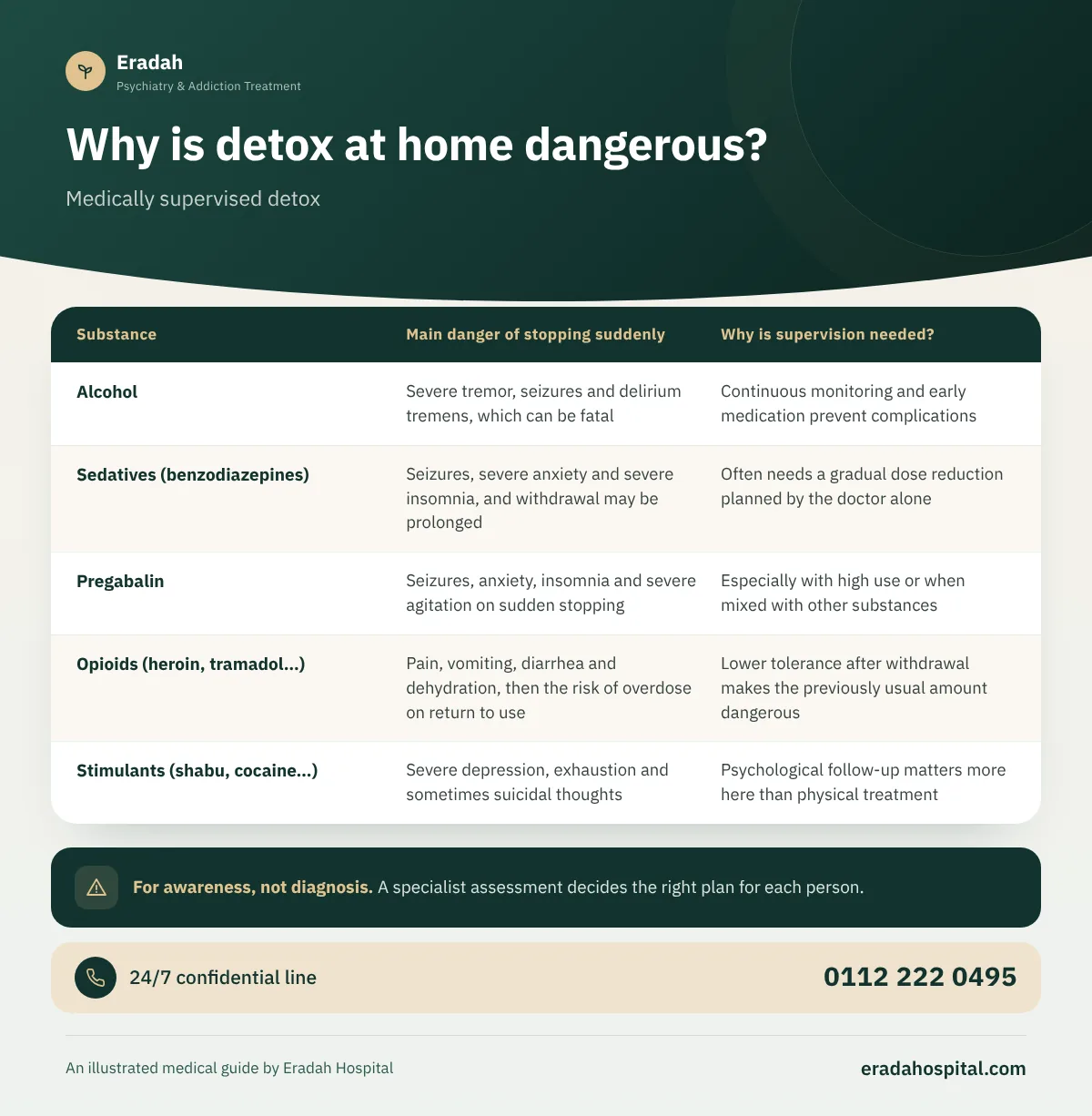
Many families try to “lock” their son in a room until the hard days pass, or rely on remedies passed around by word of mouth. This may sometimes work with certain substances, but with others it is a real gamble with a life:
| Substance | Main danger of stopping suddenly | Why is supervision needed? |
|---|---|---|
| Alcohol | Severe tremor, seizures and delirium tremens, which can be fatal | Continuous monitoring and early medication prevent complications |
| Sedatives (benzodiazepines) | Seizures, severe anxiety and severe insomnia, and withdrawal may be prolonged | Often needs a gradual dose reduction planned by the doctor alone |
| Pregabalin | Seizures, anxiety, insomnia and severe agitation on sudden stopping | Especially with high use or when mixed with other substances |
| Opioids (heroin, tramadol…) | Pain, vomiting, diarrhea and dehydration, then the risk of overdose on return to use | Lower tolerance after withdrawal makes the previously usual amount dangerous |
| Stimulants (shabu, cocaine…) | Severe depression, exhaustion and sometimes suicidal thoughts | Psychological follow-up matters more here than physical treatment |
For when treatment can safely take place while the patient is at home, see our guide to treating addiction at home. Withdrawal symptoms and their duration vary greatly from one substance to another, and the details are on the withdrawal pages for each substance, such as alcohol withdrawal, heroin withdrawal and pregabalin withdrawal. This site does not provide home protocols or doses, and you should not stop or change a prescribed medication without your doctor.
What happens during the days of detox at Eradah?
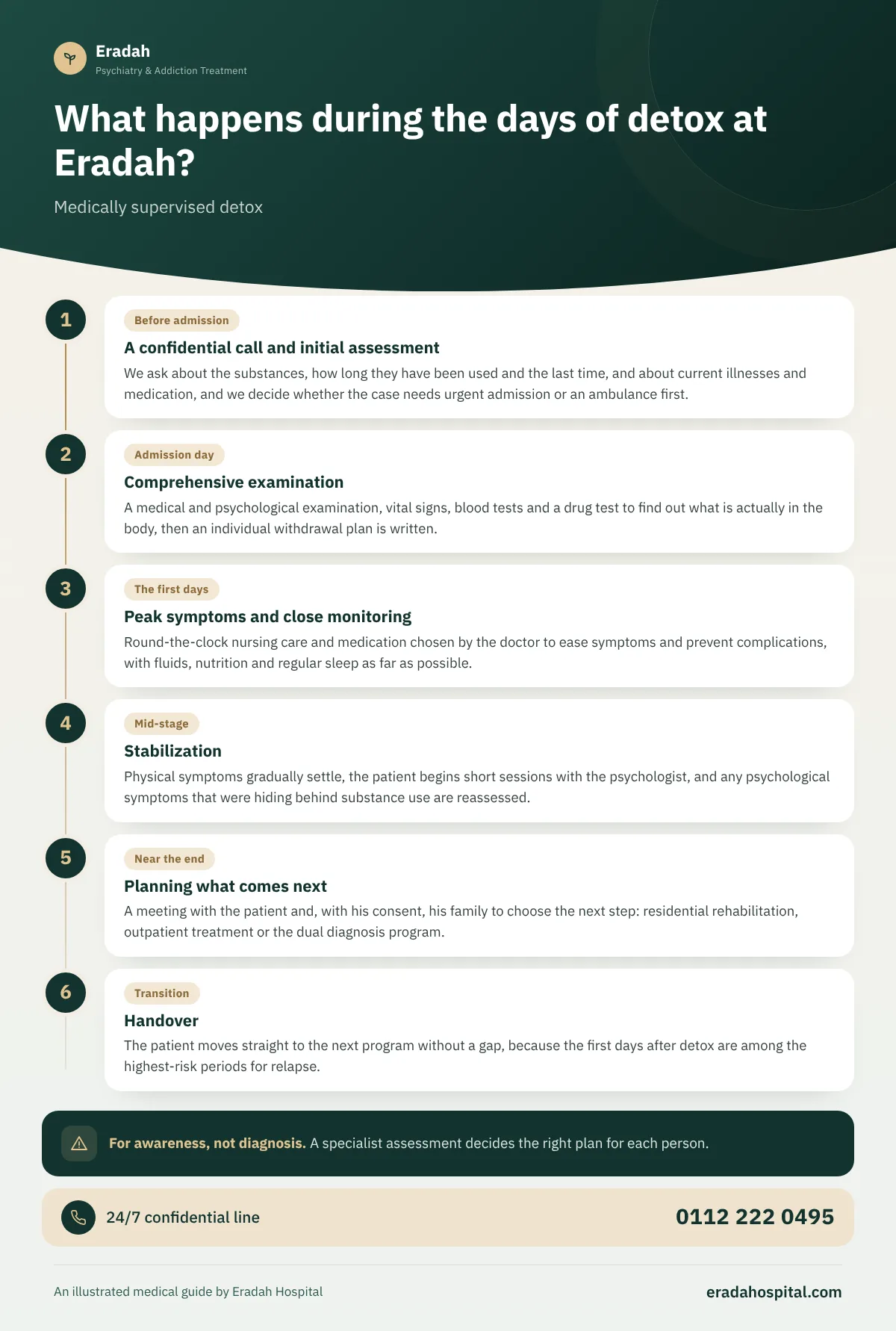
Each patient has a different plan, but the general path goes through the following stages. The timings given are approximate and change with the substance, the severity of dependence and the person's health:
- Before admissionA confidential call and initial assessment
We ask about the substances, how long they have been used and the last time, and about current illnesses and medication, and we decide whether the case needs urgent admission or an ambulance first.
- Admission dayComprehensive examination
A medical and psychological examination, vital signs, blood tests and a drug test to find out what is actually in the body, then an individual withdrawal plan is written.
- The first daysPeak symptoms and close monitoring
Round-the-clock nursing care and medication chosen by the doctor to ease symptoms and prevent complications, with fluids, nutrition and regular sleep as far as possible.
- Mid-stageStabilization
Physical symptoms gradually settle, the patient begins short sessions with the psychologist, and any psychological symptoms that were hiding behind substance use are reassessed.
- Near the endPlanning what comes next
A meeting with the patient and, with his consent, his family to choose the next step: residential rehabilitation, outpatient treatment or the dual diagnosis program.
- TransitionHandover
The patient moves straight to the next program without a gap, because the first days after detox are among the highest-risk periods for relapse.
Who supervises detox?
Assesses the case, sets the withdrawal plan, decides the medication and adjusts it daily according to the response.
Follows the liver, heart, blood sugar, blood pressure and dehydration, especially with alcohol or chronic illness.
Regular measurement of vital signs, noticing any change in consciousness or behavior, and responding immediately day and night.
Builds an early therapeutic relationship and works on motivation to continue treatment after the physical symptoms are over.
Communicates with the family with the patient's consent and arranges the move to the next program.
The team reviews the plan daily in a short meeting, under the supervision of the medical director, Dr. Mahmoud El-Sawy, Consultant Psychiatrist and Addiction Specialist. A doctor and nursing staff are at the center around the clock. Because Eradah is a center that is not part of a general hospital, if a complication appears that needs hospital care, such as seizures that do not respond to treatment, severe delirium or a heart problem, the patient is taken by ambulance to the nearest suitable hospital and the family is informed. You can meet the whole team on the medical team page.
Are medications used during detox?
Yes, in most cases, but not in the way some people imagine. Medications here are chosen to ease specific symptoms and prevent known complications: the doctor may prescribe something to prevent seizures in alcohol and sedative withdrawal, something to ease opioid pain and cramps, or something to help sleep and calm anxiety for a short time, along with vitamins that are essential for people who drink heavily.
Every medication is written at an individual dose, reviewed daily and then tapered gradually, and the patient does not leave with open-ended sedative medication and no plan. In some cases of opioid addiction, the doctor may feel that long-term medication treatment suits better than complete withdrawal, depending on what is available and licensed in Egypt, and this is discussed openly with the patient.
What happens after detox ends?
No. The principles of the US National Institute on Drug Abuse (NIDA) state plainly that medically assisted detox is only the first stage, and that on its own it does little to change substance use in the long term. The body stops asking for the substance within days, but the craving, habits, triggers and pressures that led to it remain.
That is why we consider the real success of detox to be the patient's move to the next step: residential treatment for those who need a protected environment, outpatient treatment for those in a stable condition, or the dual diagnosis program if a co-occurring mental disorder appears, followed by follow-up and relapse prevention. The full picture of the treatment stages is in our guide to addiction treatment.
What does the family do during detox?
- Attend on admission day if you can, and bring a list of any medication the patient takes and any previous medical reports.
- Do not bring the patient any medication or “painkillers” from outside the center, however much he asks.
- Expect difficult calls in the first days. Anxiety and distress are part of withdrawal, not a rejection of treatment.
- Do not promise to take him out early. Agree on one consistent message with the team.
- Start yourself too: the family treatment program helps you prepare for what comes next.
Danger signs during withdrawal? Call an ambulance (123) immediately
- Seizures, an epileptic fit or loss of consciousness
- Severe confusion or not knowing where or when they are
- Hallucinations, or severe tremor with heavy sweating and a high temperature
- Chest pain, a very fast heartbeat or difficulty breathing
- Non-stop vomiting or diarrhea with signs of dehydration
- Talk of wanting to die or harm themselves
Do not leave the person alone, place them on their side if they lose consciousness, and do not give them any substance or medication “to calm them.” Call an ambulance (123) or go to the nearest emergency department, and if suicidal thoughts appear, also call the mental health support line 16328.
Ambulance 123 Mental health support line 16328