You Discovered Your Son or Husband Is Using Drugs: What Do You Do in the First Hours?
The moment of discovery is one of the hardest a family goes through: shock, fear, anger, guilt, and many questions about “where did we go wrong?” These feelings are completely natural, but decisions made under their influence are often the worst ones. So our first piece of advice is simple: do not act at the peak of your anger.
If the person is under the influence right now, this is not the time for a conversation or blame. First make sure he is safe: Is he conscious? Is he breathing normally? Can he be woken? If you see any danger sign, call an ambulance (123) right away. If he is stable, put the conversation off until he is sober and you are calmer.
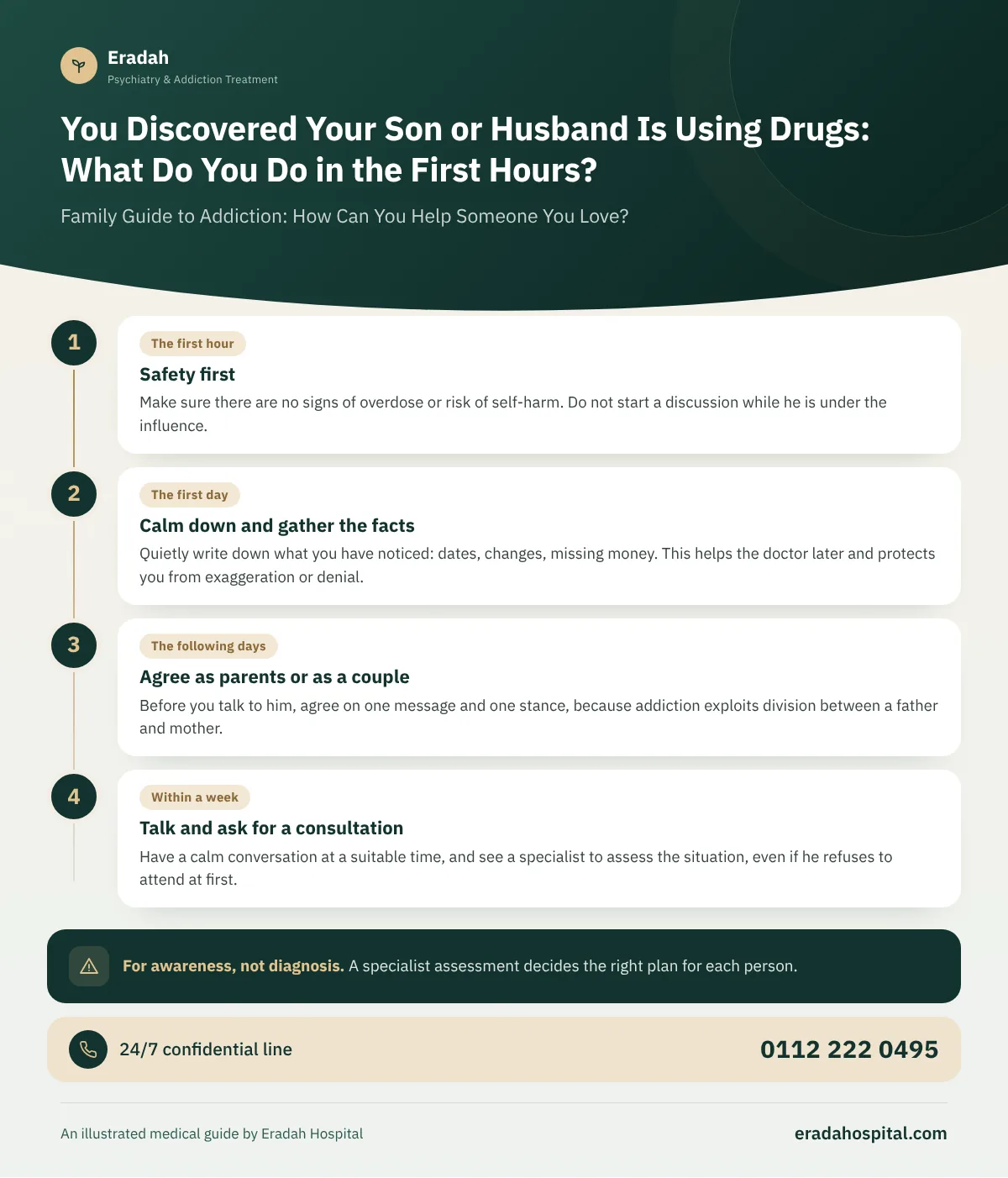
- The first hourSafety first
Make sure there are no signs of overdose or risk of self-harm. Do not start a discussion while he is under the influence.
- The first dayCalm down and gather the facts
Quietly write down what you have noticed: dates, changes, missing money. This helps the doctor later and protects you from exaggeration or denial.
- The following daysAgree as parents or as a couple
Before you talk to him, agree on one message and one stance, because addiction exploits division between a father and mother.
- Within a weekTalk and ask for a consultation
Have a calm conversation at a suitable time, and see a specialist to assess the situation, even if he refuses to attend at first.
And do not look for someone to “blame” in the family. Addiction affects children of loving, close-knit families just as it affects others, because its causes combine genetics, temperament, environment, friends and psychological stress. When a mother blames a father, or the reverse, the family wastes energy at the very time it needs all of it.
Is Addiction a Lack of Morals or an Illness That Needs Treatment?
The US National Institute on Drug Abuse (NIDA) defines addiction as a chronic, treatable disease that changes the brain’s reward and self-control circuits, so a person keeps using despite knowing the harm. This does not remove his responsibility for his actions, but it explains why advice and promises alone are not enough, and why many people swear they will stop and then go back.
When a family understands this, the way it responds changes. Instead of seeing their son as “depraved” or “weak-willed,” they see a sick person who needs treatment, support and clear boundaries at the same time. Addiction, like other chronic illnesses, can be treated and recovery is possible, but it is a journey, not a one-moment decision, and it may include setbacks. To understand the stages of treatment, see Addiction Treatment: Stages and Programs.
You are not responsible for causing the addiction, you cannot control it alone, and you cannot cure it by yourself; but you can make the road to treatment shorter.
This sentence sums up a well-known principle in family support groups such as Al-Anon. It frees parents from guilt and from the illusion of total control, and directs their energy to what they can actually change: how they respond, their boundaries, and their own self-care.
What Mistakes Make Addiction Worse?
Many reactions that seem “firm” or “loving” backfire. The table below sets the most common ones next to a more helpful alternative, based on what evidence-based family training programs recommend:
| Common reaction | Why it harms | A more helpful alternative |
|---|---|---|
| Hitting or violence | Breaks trust, puts everyone at risk, and drives him to run away from home | Clear boundaries without violence, and asking for help when there is danger |
| Locking him in the house or tying him up | Real danger during withdrawal, especially from alcohol and sedatives, and it does not treat the addiction | Medical assessment and supervised detox |
| Threatening to throw him out or cut him off, then not following through | Teaches him that words mean nothing | Only say what you actually intend to do, and say it calmly |
| Blaming, insulting and comparing him with others | Increases shame, and shame fuels drug use and secrecy | Talk about the behavior and its effect, not about his character |
| Paying his debts, covering for his absences and lying for him | Shields him from the natural consequences, so he delays deciding | Help him with treatment, not with continuing to use |
| Hiding it from the doctor and close family | Isolates the family and delays treatment | Involve people who can really help, while protecting his privacy |
Another common mistake is constant searching and watching every move. A family may sometimes need to pay attention and ask questions, but turning the home into an interrogation room exhausts everyone and pushes the person to hide more. It is more helpful to focus on the behavior and its effects that you can see, and to save your energy for steps that bring him closer to treatment.
How Do You Talk to Someone Who Uses Drugs Without Losing Him?
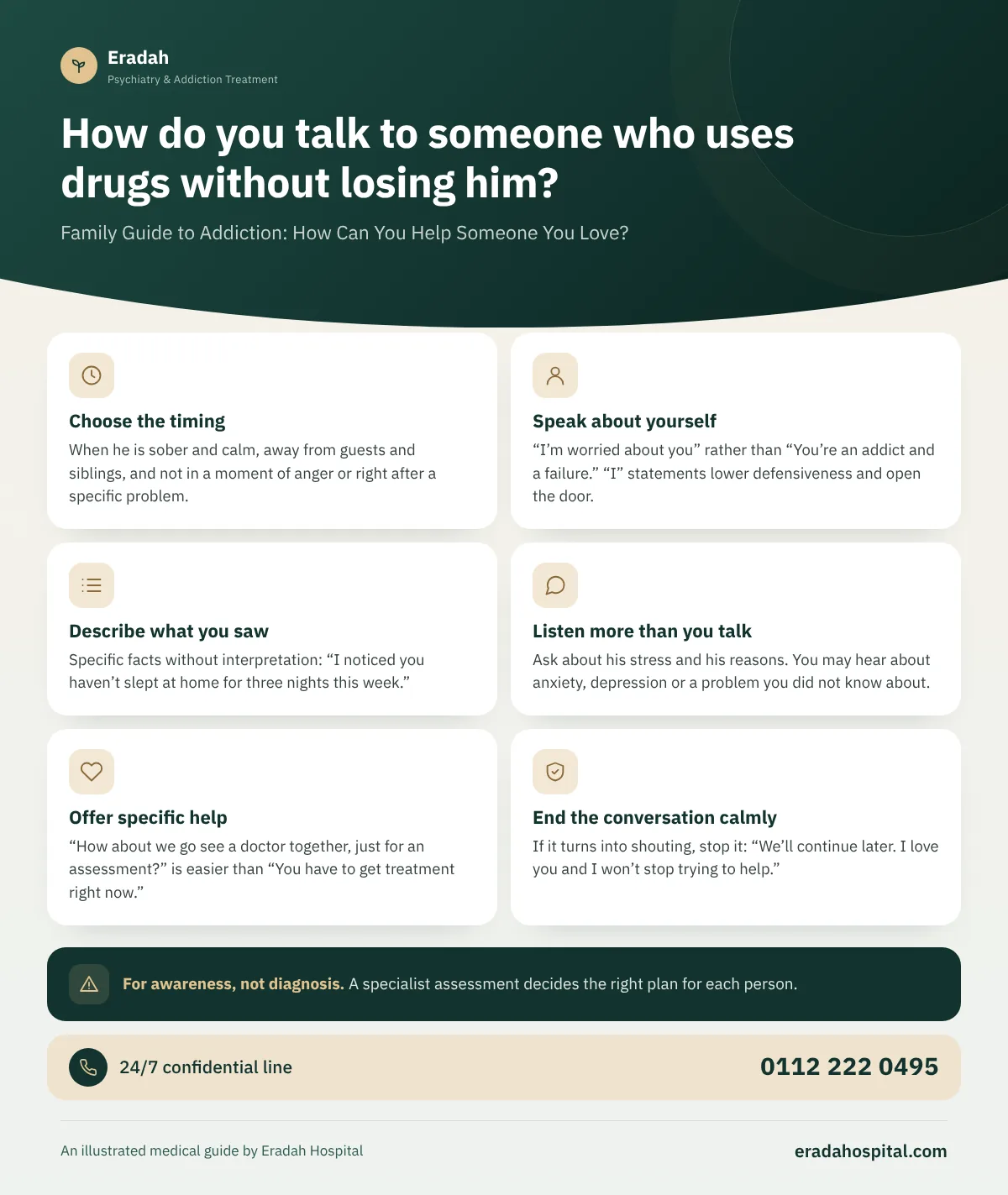
The goal of the first conversation is not for him to confess everything, or to agree immediately to enter a treatment facility. The goal is for him to know that you noticed, that you are worried because you love him, and that the door to help is open. These simple rules make the conversation more likely to work:
When he is sober and calm, away from guests and siblings, and not in a moment of anger or right after a specific problem.
“I’m worried about you” rather than “You’re an addict and a failure.” “I” statements lower defensiveness and open the door.
Specific facts without interpretation: “I noticed you haven’t slept at home for three nights this week.”
Ask about his stress and his reasons. You may hear about anxiety, depression or a problem you did not know about.
“How about we go see a doctor together, just for an assessment?” is easier than “You have to get treatment right now.”
If it turns into shouting, stop it: “We’ll continue later. I love you and I won’t stop trying to help.”
Some phrases that help: “I’m not here to judge you, I’m here because I’m afraid for you,” “I noticed you’ve seemed tired and tense lately, and I want to understand what’s going on,” and “Whatever happens, we’re with you, but we won’t pretend everything is fine.” You will find more phrases, and how to steer the conversation toward accepting treatment, in the guide How to Convince a Person with Addiction to Get Treatment.
If he denies it despite clear evidence, do not get into an argument about “whether you use or not.” Say what you saw and how you feel, and let him think. Denial is a well-known part of addiction, and it often softens with repeated calm conversations and when abstinence is met with a warmer relationship at home.
What Is Codependency and Why Does It Harm the Family?
“Codependency” is a term for a pattern many parents and spouses fall into with good intentions: the whole family’s life revolves around the person who uses drugs, and one person takes on rescuing him from every crisis, covering his mistakes and controlling the details of his day, until they forget themselves, their own needs and the rest of the family.
- You feel you are solely responsible for his stopping, and that any relapse is a personal failure of yours.
- You lie to relatives, work or school to cover for him, and you pay the costs of his drug use.
- You avoid any conversation that might “upset him” and live in constant worry about what will happen today.
- You have neglected your health, your work and your other children or your spouse because all your time is his.
- You swing between intense anger and complete leniency without a clear plan.
You can break out of this pattern without abandoning him: you can love and support him without carrying the consequences of his choices, and set clear boundaries and stick to them. These skills are learned through training and support, and they are the core of Eradah’s family treatment program, which includes sessions for the family alone and together with the patient.
Why Must You Take Care of Yourself First?
The UK National Health Service (NHS) guidance for families affirms that the worry and distress felt by the relatives of someone who uses drugs are real and deserve help, and that when a family receives support it is better able to support their son. This is not selfish: an exhausted mother and a broken father cannot hold up through a journey that may be long.
- Sleep and eat regularly, and keep up your work and relationships as far as you can.
- Talk to someone you trust, a specialist, or a family support group.
- Set aside time for your other children or your partner, because they are affected too.
- Do not decide everything alone: involve the other adult in the family in the plan.
- Watch for signs of depression or severe anxiety in yourself, and seek treatment for them without embarrassment.
- Remember that your own recovery is possible even if he has not yet started treatment.
Research on the family training program known as CRAFT shows that parents who receive this training improve in their mental well-being and in their relationship with their son, whether or not he has entered treatment yet. In other words, the time you invest in yourself is an essential part of helping him, not something taken away from it.
How Do You Protect Your Other Children at Home?
Siblings and children see and hear more than we think, even if nothing has been said to them. Total secrecy leaves them alone with their imagination and fear, while an age-appropriate explanation reassures them. You can say to a young child: “Your brother has an illness called addiction, the grown-ups are helping him, and it is not your fault.”
- Keep the household routine as far as possible: school, meals and sleep.
- Do not make the younger brother a monitor or an informant on his brother.
- Keep medications, alcohol and any dangerous substances out of everyone’s reach.
- Do not allow any child to be subjected to violence or to witness it, and seek protection when needed.
- Watch for changes in the children themselves: declining grades, withdrawal, anger or imitation.
If the person using drugs is the father or mother, protecting the children is a priority that cannot wait. Do not leave them alone with him while he is under the influence, do not let him drive them in the car, and ask trusted relatives or a specialist for help.
Dealing with Someone Who Uses Shabu: Safety Before Conversation
What sets dealing with someone who uses shabu (crystal meth) apart is the possibility of suspiciousness and aggression, especially after days without sleep. That is why a safety plan comes before a persuasion plan: no confrontation while he is under the influence or sleepless, no arguing over strange suspicions or accusations, keep sharp objects and car keys out of reach, and agree with the rest of the family on a safe place to go if there is danger. When he is calm, offer one specific step: an assessment with a psychiatrist.
We explain how to act during the days of sleeplessness, crash and suspicion, and how to protect money and children, in the guide Dealing with a Person Who Uses Shabu. Psychosis linked to shabu can continue after stopping and needs specialist assessment, so see Drug-Induced Psychosis and the stages of shabu addiction treatment.
Dealing with Someone Who Uses Hashish: Don’t Underestimate It, Don’t Exaggerate It
The hardest part of dealing with someone who uses hashish is that many people see it as “mild,” so the conversation turns into an endless argument over the word “addict.” It is more helpful to move the conversation from the substance to its tangible effects: sleeping until the afternoon, falling grades, or missing work, along with clear rules about money at home and rewarding good days with shared time. And do not give him sleeping pills of your own for the insomnia of the first weeks after stopping.
You will find phrases that open the conversation instead of closing it, and how to handle insomnia, irritability and suspiciousness, in the guide Dealing with a Person Who Uses Hashish. Most cases are treated without admission through outpatient treatment and family involvement.
Dealing with Someone Who Uses Captagon: Sleeplessness, Irritability and Exams
Captagon often begins with an excuse that seems acceptable to the person: studying on the night before an exam, a long work shift, or a long trip. So dealing with someone who uses Captagon starts with understanding the need the pill is meeting and finding a safe alternative for it, then choosing a time for the conversation after he has slept and eaten rather than in the “crash,” with clear limits: no driving after nights without sleep, and no money without knowing where it is going.
We detail the cycle of sleeplessness, crash and craving, and how to help him in the first days of stopping, in the guide Dealing with a Person Who Uses Captagon.
Where Does the Road to Treatment Begin?
A family does not need to know everything about drugs or to “guarantee” its son’s agreement before it acts. The first step can be a consultation for the family alone: you tell what is happening, and the specialist helps you gauge the seriousness and choose the next step. This table shows what generally suits each situation:
| The situation | Suggested step |
|---|---|
| Suspicion without certainty | Observe calmly, review the guide to signs of drug use, and talk to him without accusing |
| Confirmed use and he refuses help | A family consultation and training in how to talk and encourage; do not wait for him to “hit rock bottom” |
| He agrees to an assessment | Act the same day if possible: a medical and psychological assessment to determine the level of care |
| Severe psychiatric symptoms along with drug use | Urgent assessment by a psychiatrist; this may be dual diagnosis |
| Recently left a treatment facility | A clear follow-up plan, and see the guide After Leaving Rehab |
One option available in Egypt is the hotline of the Fund for Drug Control and Treatment of Addiction, 16023, which is free and handles calls confidentially. You can also contact the Eradah team for a free, confidential first consultation, either for the family alone or together with the patient. It is also helpful to know that treatment does not require full inner motivation from the first day; NIDA guidance indicates that treatment does not have to be entirely voluntary to work, and that motivation often grows during it.
Detailed family guides
For each stage a family goes through, there is a separate guide that answers its practical questions in detail:
Signs of Drug Use: How Do You Know Your Son Is Using?
Behavioral, physical, school and financial signs, what is not a sign, the limits of home analysis, and what to do after suspecting.
Details Stage 2How do you persuade a person with addiction to accept treatment?
The evidence-based CRAFT approach, phrases to say and ones to avoid, the right timing, and when involuntary admission is considered.
Details Stage 3After Leaving Rehab: A Family Guide
The first ninety days at home, rebuilding trust, money, triggers, and the difference between a slip and a relapse.
Details Treatment programEradah’s Family Treatment Program
Family therapy sessions, groups for parents, and training in boundaries, communication and confronting codependency.
Details For wivesDealing with an Addicted Husband: How Do I Help Him and Protect Myself and My Children?
My husband is addicted, what do I do? Practical steps for dealing with an addicted husband without confrontation, mistakes that make the problem worse, how to protect yourself and your children, and does an addict love…
Details For parentsTeen addiction: early signs, the family’s role and treatment
Why are teenagers more vulnerable to addiction? The early signs of teen addiction and how they differ from normal changes at this age, what the family should do, and what the treatment is…
Details PreventionDrug Prevention: A Guide for Families and Schools to Protect Children
How do you protect your children? A drug prevention guide for families and schools: what to say at each age, what actually works according to research, and the mistakes that…
Details Mental illnessDealing with a Person with Mental Illness at Home: A Practical Family Guide
How do you deal with a person with mental illness at home? Talking without conflict, medication, a crisis plan, his rights under Egyptian law, stigma, and when it becomes necessary…
Details GlossaryDrug names in Egypt: a glossary of street names and what they mean
What do shabu, Strox, Voodoo, “powder” and tamol mean? A glossary of drug names in Egypt as they circulate on the street, and the real substance behind each…
Details For wivesHow Do I Know My Husband Is Addicted? Behavioral, Physical and Financial Signs
How do I know my husband is addicted? Signs of addiction in a husband’s behavior, sleep, money, intimate relationship and body, what is not a sign, the limits of home analysis, and how…
Details For childrenMy Father Is Addicted: How Do I Deal with Him and Protect Myself and My Siblings?
My father is addicted, what do I do? A guide for children of a person with addiction: why it is not your fault, how to talk to him safely, protect yourself, your siblings and your future, when to call for help, and where…
Details MarriageMarrying a Person in Recovery: Questions to Ask Before Deciding and Signs of Real Recovery
Is marrying a person in recovery from addiction a sound decision? Signs of real and worrying recovery, questions to ask before committing, medical tests, the risk of relapse,…
Details MarriageThe Effect of Addiction on Married Life: Trust, Money, Children and Violence
The effect of addiction on married life: how it destroys trust, money and intimacy and affects children, its link to domestic violence, and how treatment helps…
Details Understand himHow Does a Person with Addiction Think? Denial, Justification and Cravings from the Inside
How does a person with addiction think, and why does he deny, lie and go back despite promises? What happens in his brain, denial, justification and preferring the moment, and how to talk to him in a way that reaches him…
Details SignsWhat Does a Person with Addiction Look Like? Eyes, Face and Body by Type of Drug
What does a person with addiction look like? Signs in the eyes, face, skin, teeth and weight by type of drug, why a person with addiction may look completely normal, and when the appearance is…
Details AdolescencePsychological Changes in Teenagers: What Is Normal and What Is a Concern
Psychological changes in teenagers: why mood swings, pulling away from parents and staying up late happen, and the difference between normal change and signs of depression and anxiety…
DetailsWhen Is the Situation an Emergency?
Most steps in this guide allow time to think and move gradually, but some situations cannot wait even a minute. Overdose, seizures, an acute psychotic episode with aggression, serious talk of ending one’s life, and violence in the home all call for getting help immediately. You will find details on handling poisoning on the page Overdose: Signs and What to Do.
Overdose, or danger to himself or others? Call an ambulance (123) immediately
- Loss of consciousness, or he is hard to wake even when called and shaken
- Very slow or irregular breathing, unusual snoring, or bluish lips
- Seizures, chest pain, or a very high temperature with agitation
- Hallucinations or severe suspicion with aggression or threats of harm
- Talk of wanting to die or saying goodbye to family
- Actual violence in the home that puts any family member in danger
Call an ambulance (123) immediately and do not wait for him to “come around on his own.” If he is unconscious but breathing, place him on his side and stay beside him until the ambulance arrives, and do not give him anything by mouth. If there is a risk of suicide, do not leave him alone, and you can call the mental health support line (16328). If there is violence, move yourself and the children to a safe place first.
Ambulance 123 Mental health support line 16328