What is outpatient addiction treatment?
Not everyone with an addiction needs to leave home and work for weeks. Many patients can recover while living their lives, provided they commit to a structured program with appointments, goals and follow-up, not just an occasional doctor's visit.
The ASAM model of levels of care describes outpatient treatment in steps of rising intensity: from the ordinary outpatient clinic, to intensive outpatient treatment, to the highest-intensity day program, which approaches residential care in hours but lets the patient sleep at home. SAMHSA's guide no. 47 is devoted to intensive outpatient treatment and describes it as an effective option for many patients when delivered through a structured program with an individual plan.
Outpatient treatment usually follows one of two tracks. The assessment at Eradah determines the suitable track, its intensity and its schedule, and you can move between them as you progress:
| Item | Outpatient clinic | Intensive day program |
|---|---|---|
| Intensity | Usually one to two sessions a week | Several hours a day for several days a week; the team sets the actual hours |
| Suits | Mild cases, or the final stage after intensive care | Stable moderate cases, or a direct transition after residential care |
| Work and study | Usually continue as normal | May need reduced hours or temporary leave |
| Components | Individual session, medical follow-up, regular testing | Daily groups, individual sessions, activities, medical follow-up, tests |
| Duration | Usually months, with gradually wider spacing | Weeks, then a move to the outpatient clinic |
Who does outpatient treatment suit?
Outpatient treatment generally suits someone who meets most of these conditions. The list is a guide, and the decision follows a medical assessment.
- Has no dangerous physical withdrawal, or has completed detox safely.
- Is mentally stable, with no thoughts of self-harm and no active psychotic symptoms.
- Has a real motivation to change, even if sometimes hesitant.
- Lives in a relatively safe environment, with family or someone close who is ready to support them.
- Can keep to appointments and tests.
- Has not had repeated quick returns to use after previous outpatient attempts.
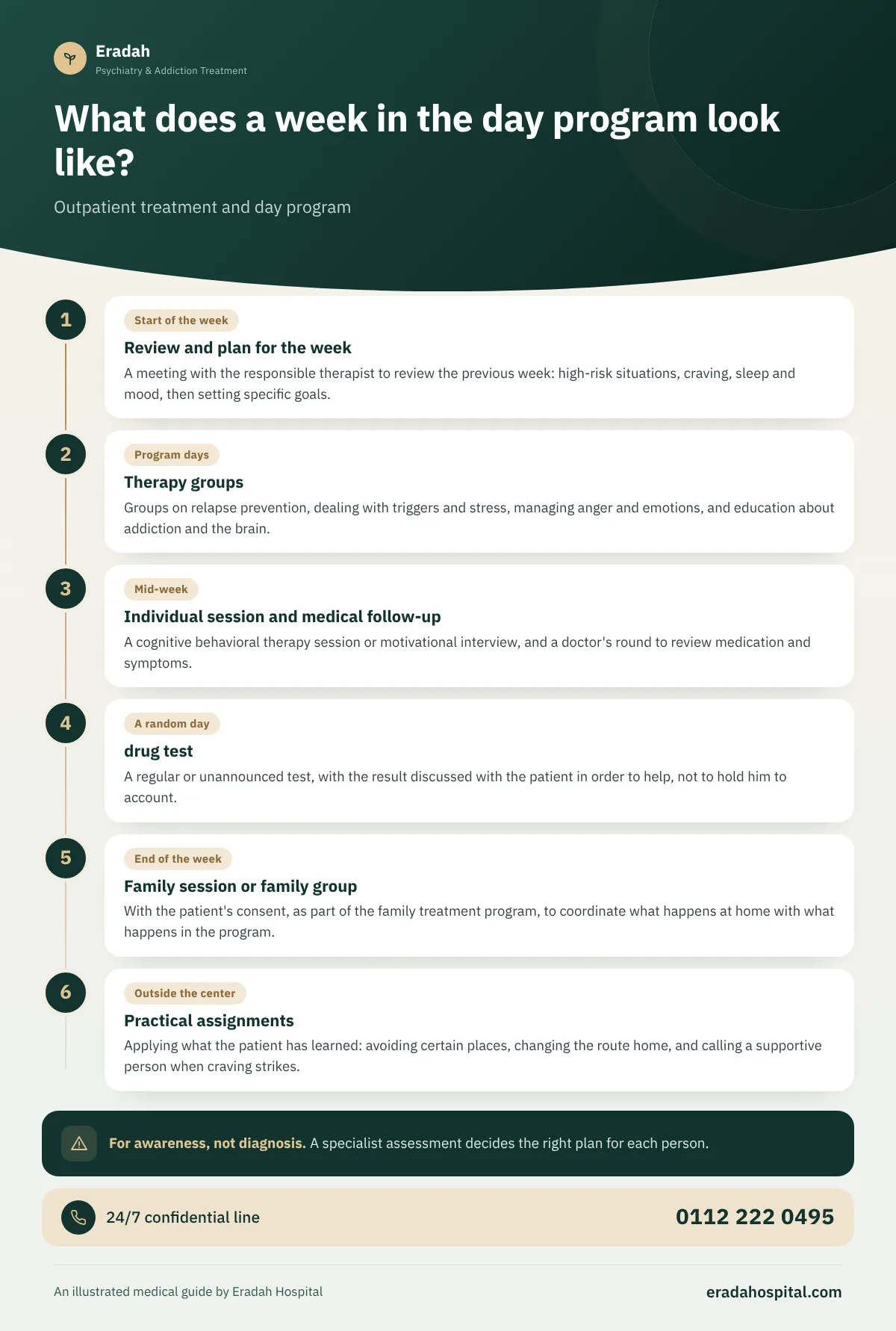
What does a week in the day program look like?
This is an approximate model of a week on the intensive track, and the actual appointments are agreed with the patient to suit his circumstances as far as possible:
- Start of the weekReview and plan for the week
A meeting with the responsible therapist to review the previous week: high-risk situations, craving, sleep and mood, then setting specific goals.
- Program daysTherapy groups
Groups on relapse prevention, dealing with triggers and stress, managing anger and emotions, and education about addiction and the brain.
- Mid-weekIndividual session and medical follow-up
A cognitive behavioral therapy session or motivational interview, and a doctor's round to review medication and symptoms.
- A random daydrug test
A regular or unannounced test, with the result discussed with the patient in order to help, not to hold him to account.
- End of the weekFamily session or family group
With the patient's consent, as part of the family treatment program, to coordinate what happens at home with what happens in the program.
- Outside the centerPractical assignments
Applying what the patient has learned: avoiding certain places, changing the route home, and calling a supportive person when craving strikes.
What treatments are used in outpatient care?
To analyze situations of substance use step by step, and build an alternative plan for each high-risk situation.
To deal with the natural ambivalence between wanting to stop and being attached to the substance.
Rewarding attendance and negative tests with recognition or agreed privileges, an approach NICE guidelines recommend.
Sharing experiences and practicing difficult situations with people at the same stage.
To treat a co-occurring mental disorder or reduce craving, on the doctor's decision and under his follow-up.
Because the patient returns home every day, home is part of treatment, not outside it.
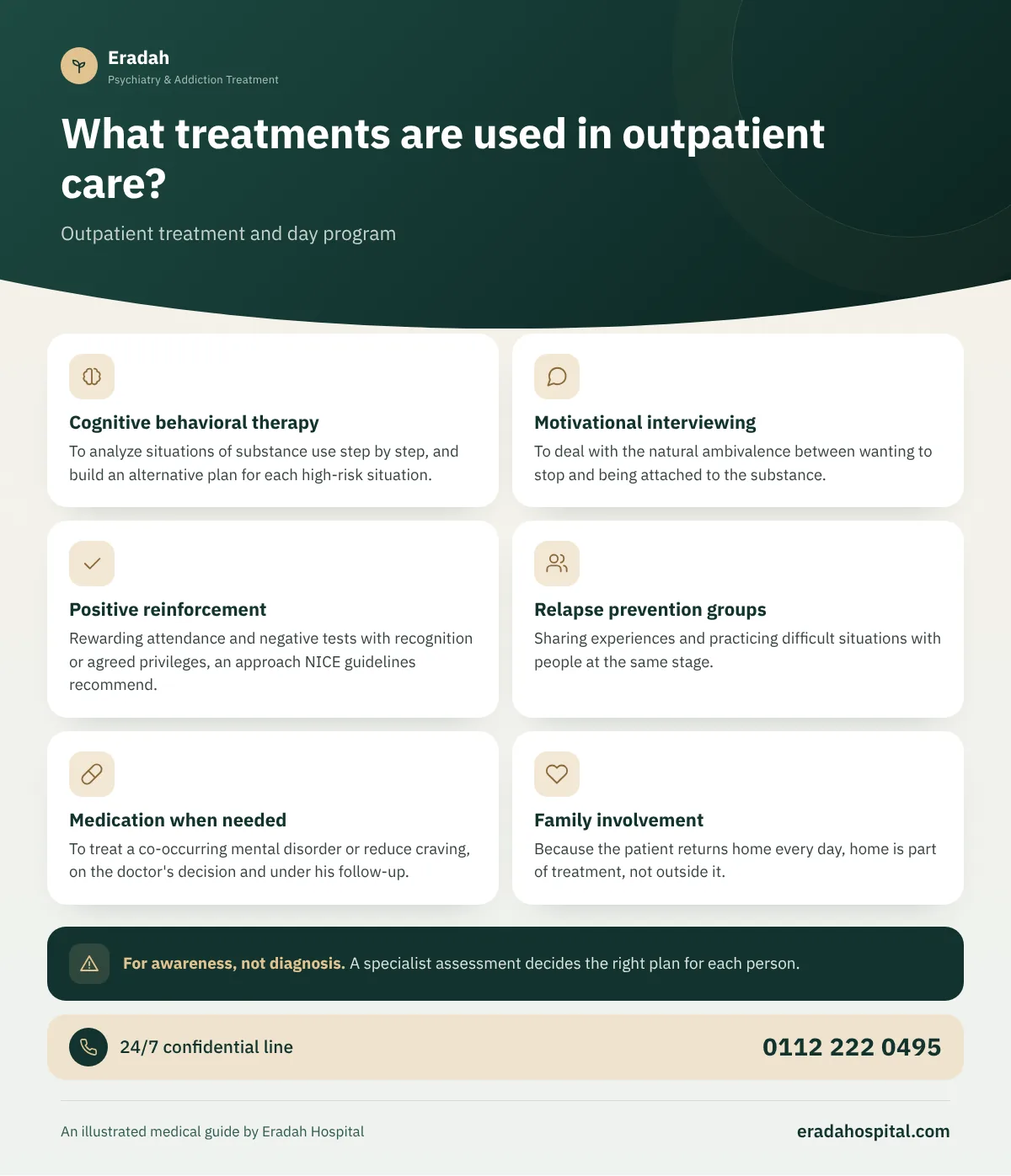
NIDA's principles state that behavioral therapy, in its individual, group and family forms, is the most commonly used form of addiction treatment, and that monitoring substance use during treatment through testing helps the patient resist cravings and shows early when the plan needs adjusting.
What is the difference between outpatient and residential treatment?
| Item | Outpatient treatment and day program | Residential treatment |
|---|---|---|
| Where you sleep | At home | At the center |
| Work and study | Usually continue | Usually pause for a time |
| Environment | The patient faces his real triggers from day one | A protected environment away from triggers |
| Supervision | Only during program hours | around the clock |
| Suits | Milder or stable cases with strong support | More severe cases, an unsafe environment, or failed outpatient treatment |
| Key advantage | Learning skills and applying them in real life immediately | A chance for complete distance to rebuild |
The right question is “which suits me best right now?” rather than “which is better?” Many patients start with residential care and continue as outpatients, and some start as outpatients and then need a short stay if they struggle. The general framework for choosing between levels of care is in our guide to addiction treatment.
Is outpatient treatment suitable after leaving residential care?
It is one of its most important uses. A sudden move from a protected, round-the-clock environment to ordinary life with no support is one of the riskiest moments in treatment. That is why we plan discharge from residential care so that the patient begins the day program or the outpatient clinic straight away, with appointments then gradually spreading out until he reaches follow-up and relapse prevention.
What is expected of the patient in outpatient treatment?
- Keeping appointments, and giving notice in advance of any absence.
- Attending without being under the influence of any substance, otherwise he is reassessed the same day.
- Accepting regular and unannounced tests.
- Being honest about any use or intense craving, which is discussed therapeutically, not punitively.
- Not using, or talking about sources of substances, with fellow group members.
- Respecting the confidentiality of what others say in groups.
If use is repeated or the condition worsens, that does not mean the patient is thrown out of the program; more often the current level of care is not enough, so a move to a higher level for a time is discussed, followed by a return. The treatment team explains the detailed rules of the program at the assessment and before starting.