"Every place says it's the best. Who do I believe?" Many families ask this at a difficult moment, often under time pressure. The good news is that the answer does not require medical expertise. There are clear standards that any family can check for themselves before handing their son over to any facility, including us.
Why does choosing an addiction treatment center call for caution?
Because the market includes places with no license and no doctor. In February 2026, the Ministry of Health and Population announced, according to the National Media Authority, the closure of 15 unlicensed addiction and psychiatric treatment centers in the city of Obour alone. Violations it recorded included the absence of a technical director, practicing without a license, inadequate infection control, and irregular medical records.
In December 2025, the Ministry closed a facility in Al-Moriouteya after a mass escape by its residents and allegations of mistreatment, and referred those running it to the public prosecutor. In a statement published by Masrawy, it said its 2025 campaigns closed more than 112 unlicensed facilities in the first half of the year alone. Asking questions before admission is a necessity.
How can you check an addiction treatment center's license?
Article 3 of the Mental Health Patient Care Law No. 71 of 2009 states that a mental health facility may not operate without a license from the Ministry of Health and registration in the records of the regional mental health council. The license is valid for five years and renewable, and the facility must be managed by a psychiatrist who is responsible for any violations that occur there. So ask about three specific things:
- The license number and the body that issued it, and ask to see it during your visit.
- The name and specialty of the medical director, and whether he is a psychiatrist registered with the Medical Syndicate.
- Is the doctor actually on site, or does he visit once a week?
In the same statement, the Ministry of Health urged families to verify any facility's license before dealing with it, and to report violations through the National Council for Mental Health hotline, 01207474740, by phone call or WhatsApp.
Who should you find inside the center?
Addiction is an illness that affects body and mind together, so "supervisors" or people in recovery are not enough, however good their intentions. The minimum is a team that includes a psychiatrist who leads the plan and decides on medication, round-the-clock nursing, psychologists who provide individual and group sessions, and a social worker who works with the family. You have every right to ask how many staff there are compared with the number of patients, and who answers at night if an emergency happens.
Medical detox: the question you never compromise on
Withdrawal from some substances can be life-threatening, especially alcohol, sedatives, pregabalin, and combinations of several substances, because it can cause seizures or delirium. So ask: who supervises detox? What medications are available? What happens if the patient's condition worsens in the middle of the night? A place that claims to treat "with absolutely no medication" or with isolation alone exposes the patient to an unnecessary risk. You can find what happens in this phase for each substance in our guide to drug withdrawal symptoms.
What should an addiction treatment program include?
- A comprehensive assessment at the start, covering physical, psychological, and social health, on which a written plan is built and explained to you and to the patient.
- Evidence-based psychological treatment such as cognitive behavioral therapy, motivational enhancement, and relapse prevention, not just moralizing lectures.
- Treatment of the co-occurring mental illness. Depression, anxiety, and psychosis often occur together with addiction, which is why dual diagnosis matters.
- A family program with sessions and counseling, such as the family treatment program.
- A plan for after discharge with clear follow-up appointments, because the first weeks at home are the most vulnerable period.
The international standards for the treatment of substance use disorders issued by the World Health Organization and the United Nations Office on Drugs and Crime stress that treatment must be ethical, respect the patient's rights, dignity, and informed consent, and be based on scientific evidence rather than personal improvisation.
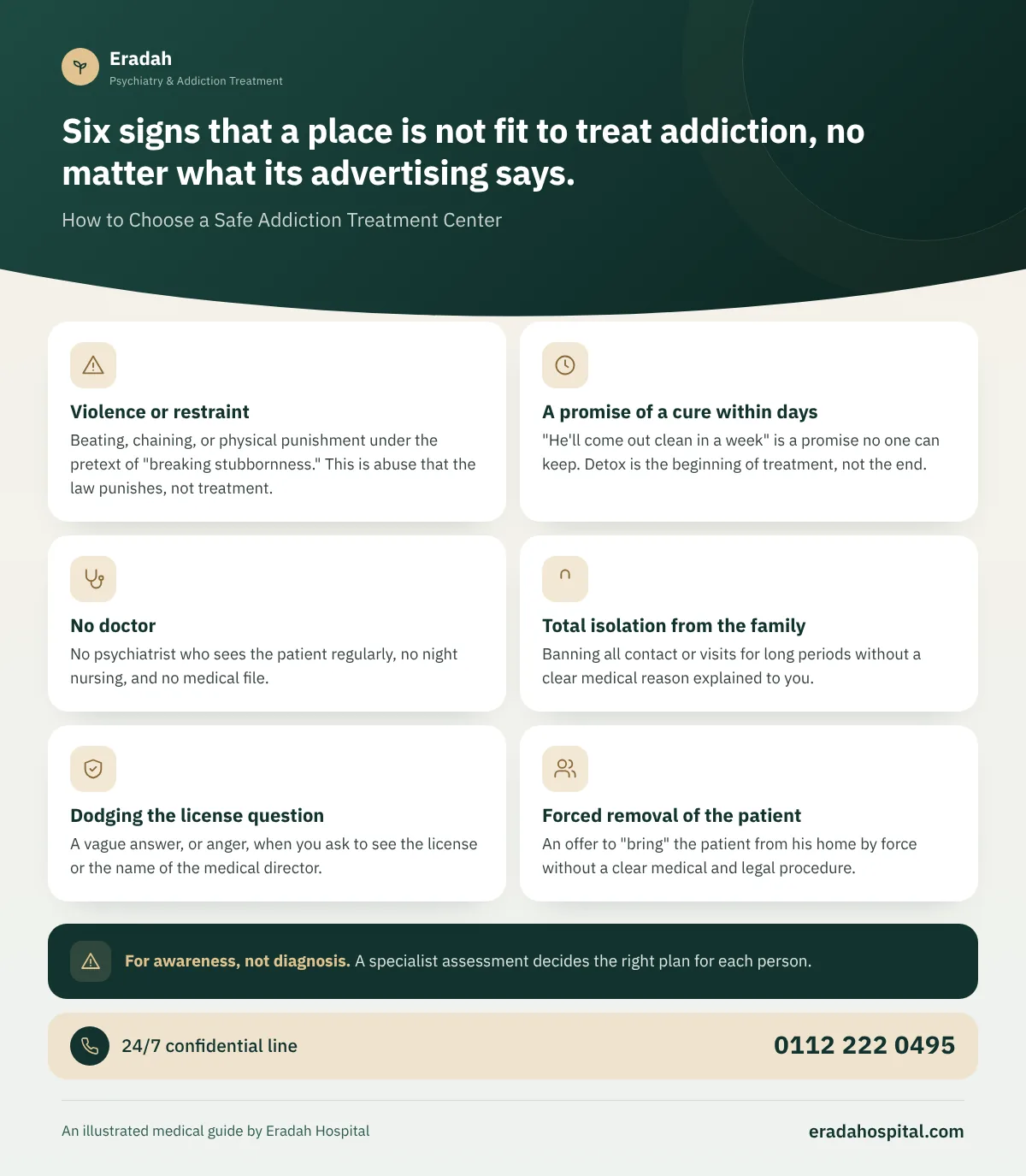
Red flags in an addiction treatment center
Beating, chaining, or physical punishment under the pretext of "breaking stubbornness." This is abuse that the law punishes, not treatment.
"He'll come out clean in a week" is a promise no one can keep. Detox is the beginning of treatment, not the end.
No psychiatrist who sees the patient regularly, no night nursing, and no medical file.
Banning all contact or visits for long periods without a clear medical reason explained to you.
A vague answer, or anger, when you ask to see the license or the name of the medical director.
An offer to "bring" the patient from his home by force without a clear medical and legal procedure.
What looks important and what actually matters
| What catches the eye | What actually matters |
|---|---|
| Lots of ads and luxurious photos | A valid license and a known medical director |
| A swimming pool and spacious rooms | A doctor and nursing staff around the clock |
| Online testimonials from people "in recovery" | A written plan and an individual assessment |
| A very low price or a "special offer" | A clear statement of what the price includes and the early-discharge policy, detailed in the cost of addiction treatment |
| Promises of high success rates | Honesty about the length of treatment and the possibility of relapse |
Questions to ask on the first call or visit
- What is the license number? Who is the medical director?
- How is detox done for a case like ours? Who monitors the patient at night?
- Is there treatment for depression, anxiety, or psychosis if it appears?
- What does a full day in the program look like?
- What is the family's role? How often can we contact and visit?
- What happens if the patient wants to leave?
- What is the follow-up plan after the stay ends? Does it cost extra?
How do we at Eradah answer these questions?
We present our official details on the About Eradah page: a center licensed by the Ministry of Health and Population under No. 1427 since 2015, under the medical management of a consultant in psychiatry and addiction treatment whom you can get to know on the medical team page. We also say clearly what we do not offer: we are an independent center, not part of a hospital, so if a patient needs general hospital care he is transferred by ambulance. Residential treatment is for men only; women are offered a free first consultation and we help direct them to the appropriate facility. The first consultation is free and confidential for everyone. Ask all of the questions above, then compare freely.