When does a patient need a psychiatric hospital instead of a clinic?
Most psychiatric disorders are treated in an outpatient clinic: regular visits to the doctor, psychological therapy, and medication when needed, while the patient lives at home and goes to work. But there are times when the condition is too severe to be followed once a week or every two weeks, and inpatient care in a psychiatric hospital is the right choice.
A residential stay is a higher level of care for a defined period. Its aim is for the patient to become stable safely and then return to outpatient follow-up; it is not a punishment and not “the end of the road.” The psychiatrist decides the right level after assessment, and the situations in which we most often recommend a residential stay are:
| The situation | Why might a residential stay be needed? | When might a clinic be enough? |
|---|---|---|
| Acute psychotic episode | Hallucinations or delusions that lead to dangerous behavior, or complete refusal to eat or take medication | Mild symptoms, with medication adherence and a family able to follow up |
| Severe depression with a safety risk | Suicidal thoughts, or being unable to eat, sleep and care for oneself | Moderate depression with no safety risk, and support at home |
| Manic episode | Impulsivity, reckless spending and little sleep for days, with behavior that puts the patient and family at risk of harm | Mild manic symptoms that respond quickly to a treatment adjustment |
| Dual diagnosis | A psychiatric disorder with substance use that is hard to stop in the same environment | Limited substance use, a stable psychiatric condition and strong support |
| Adjusting medication under observation | Changing medications with severe symptoms or side effects that need daily monitoring | A simple change that can be followed in close-together visits |
The reverse is also true: we do not recommend a residential stay just because the family is tired or frightened, if the patient is safe and can be treated at home. Care in the least restrictive setting possible is a core principle of modern psychiatry, and of the World Health Organization's standards for the quality of mental health services and patients' rights.
What psychiatric conditions do we treat?
At Eradah we see the following conditions for assessment and for outpatient or residential treatment, depending on severity. Each has a detailed guide on the site explaining symptoms, causes and treatment:
Depression
Especially severe depression, or depression with suicidal thoughts or inability to care for oneself.
Details Mood disordersBipolar disorder
Acute manic episodes and depressive episodes, and adjusting mood-stabilizing treatment.
Details Psychotic disordersSchizophrenia
Acute psychotic episodes, and regaining stability after stopping treatment.
Details Psychotic disordersDrug-induced psychosis
Psychotic symptoms after using hashish or stimulants, or during withdrawal.
Details AnxietyObsessive-compulsive disorder (OCD)
Severe cases that disrupt daily life and have not improved with outpatient treatment.
Details AnxietyPost-traumatic stress disorder (PTSD)
Nightmares and intrusive memories, and the depression or substance use that often accompany them.
Details PersonalityBorderline personality disorder
Repeated crises, impulsivity and self-harm, within a long-term psychotherapy plan.
Details AnxietyGeneralized anxiety
Severe chronic anxiety, especially with reliance on sedatives.
Details OtherEating disorders
Assessment and guidance, including deciding whether the condition first needs care in a general hospital.
DetailsWhen a psychiatric disorder occurs together with addiction to a substance or a behavior, this is a case of dual diagnosis, which we treat with one team and one plan in the dual diagnosis program. The stages of addiction treatment itself are in the addiction treatment guide. You can browse all disorders in the psychiatric conditions section.
What makes a good psychiatric hospital?
When a family looks for a psychiatric hospital, they find many advertisements and even more promises. The truth is that a good facility is not recognized by words but by standards that can be verified. These are the criteria we believe every family should ask about, along with what we offer at Eradah for each, in facts you can check for yourself:
| Criterion | Why does it matter? | At Eradah |
|---|---|---|
| License | A license means the facility is subject to oversight and complies with the Mental Health Care Law | Licensed by the Ministry of Health and Population under no. 1427, operating since 2015, and you can ask to see the license when you visit |
| Psychiatric medical leadership | Diagnosis and decisions about medication and admission are the responsibility of a psychiatrist, not only a supervisor or a “recovered” person | Medical Director Dr. Mahmoud El-Sawy, Consultant Psychiatrist and Addiction Specialist (meet the medical team) |
| Doctor and nurses 24 hours | Psychiatric crises and medication effects do not wait for working hours | A doctor and nurses on site around the clock |
| Safety | An environment that reduces opportunities for self-harm, and medication that is stored and dispensed under supervision | Regular review of the environment, medication dispensed by nursing on the doctor's prescription, and ambulance transfer to the nearest hospital for any physical emergency |
| Treatment, not only medication | Medication alone is rarely enough; the patient needs to understand their condition and learn skills | Individual and group psychological therapy, plus activities and exercise in a garden, a gym and a swimming pool |
| Involving the family | The family is who will live with the patient after discharge | Sessions and counseling within the family therapy program |
| A plan for after discharge | The riskiest period after a residential stay is the first weeks at home | Follow-up appointments set before discharge as part of follow-up |
| Dignity and privacy | A person with a mental illness has full human rights, and stigma keeps many from treatment | No photographing of patients, no one's presence is disclosed except to whom they designate, and no violence or humiliation |
We advise asking any facility, Eradah included, about the limits of what it offers. Eradah, for example, is an independent center, not part of a hospital; so if a patient needs care available only in a general hospital, such as a serious physical emergency, they are transferred by ambulance to the nearest suitable hospital, and our team stays in touch with the family. We say this plainly because being frank about limits is part of trust.
The cost of a psychiatric stay in brief
The price of a psychiatric hospital cannot be given as a single number, because it varies with the length of stay, the level of observation required, medical supervision, medication, tests and psychological therapy, and whether there is accompanying addiction. So before comparing, ask: what does the price include, is it daily or monthly, and what does follow-up after discharge cost? We explain these factors, and the difference between public and private facilities, in the guide to psychiatric hospital prices in Egypt.
Egypt also has public hospitals run by the General Secretariat of Mental Health at a lower cost, and they are a suitable option for many people. At Eradah, the cost of a psychiatric stay depends on the condition and the nature of the illness, and we explain it in detail after assessment; we do not currently work with medical insurance or installment plans. The prices published on the cost of addiction treatment page relate to the addiction treatment program. The first consultation is free and confidential through the Contact page.
Does Eradah admit women?
Residential treatment at Eradah is for men only, and there is currently no women's residential unit. We know this is a hard answer for a mother, wife or daughter looking for a safe place, so we do not close the door: women and their families can get the free first consultation, and we help you understand the situation and refer you to the right facility for treatment. Contact us in whatever way is most comfortable for you, by phone or WhatsApp.
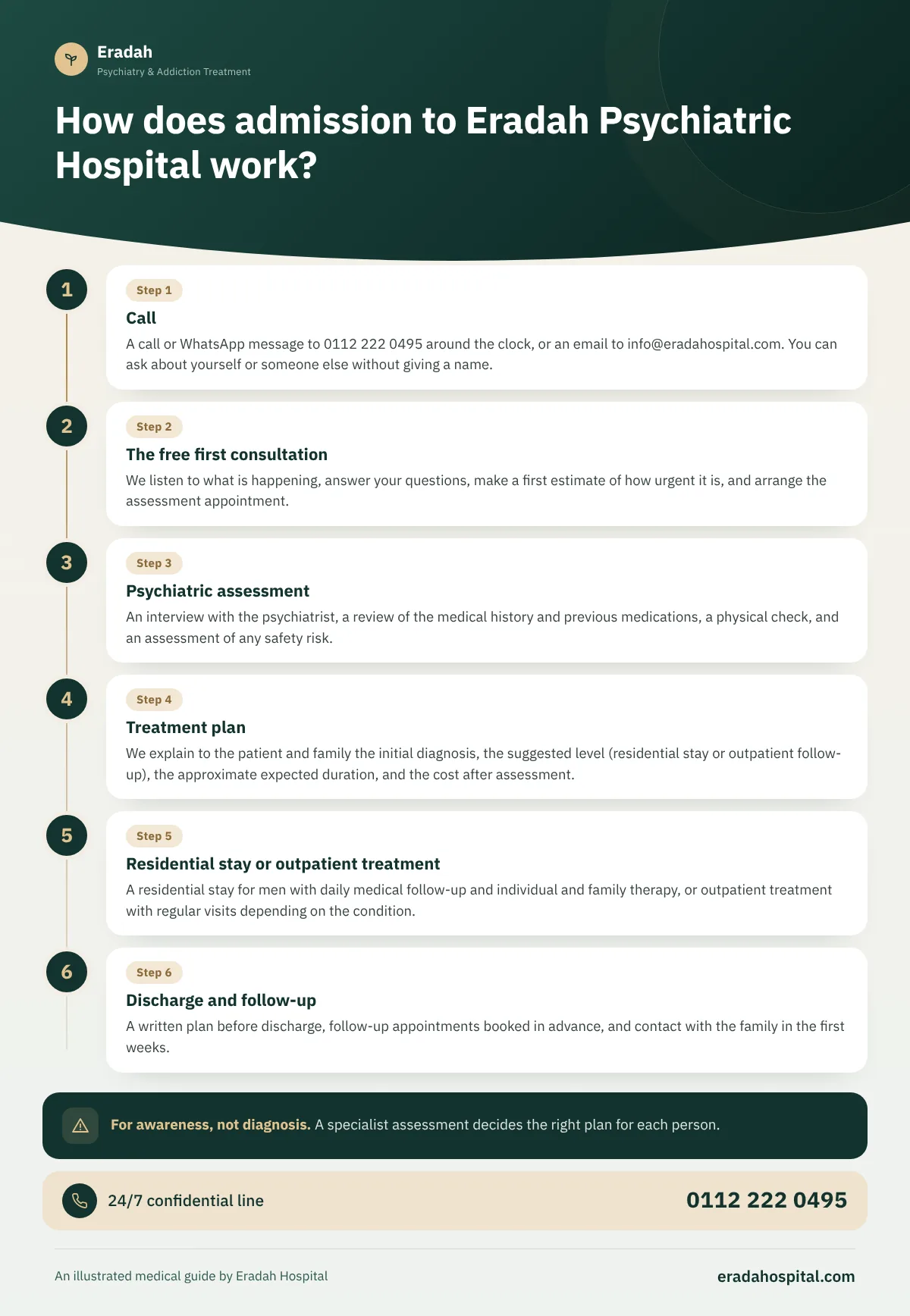
How does admission to Eradah Psychiatric Hospital work?
We make sure the family knows every step before it happens, and that the decision to stay is made only after a real assessment:
- Step 1Call
A call or WhatsApp message to 01122220495 around the clock, or an email to info@eradahospital.com. You can ask about yourself or someone else without giving a name.
- Step 2The free first consultation
We listen to what is happening, answer your questions, make a first estimate of how urgent it is, and arrange the assessment appointment.
- Step 3Psychiatric assessment
An interview with the psychiatrist, a review of the medical history and previous medications, a physical check, and an assessment of any safety risk.
- Step 4Treatment plan
We explain to the patient and family the initial diagnosis, the suggested level (residential stay or outpatient follow-up), the approximate expected duration, and the cost after assessment.
- Step 5Residential stay or outpatient treatment
A residential stay for men with daily medical follow-up and individual and family therapy, or outpatient treatment with regular visits depending on the condition.
- Step 6Discharge and follow-up
A written plan before discharge, follow-up appointments booked in advance, and contact with the family in the first weeks.
Details of life during a residential stay, from the daily schedule to phone and visiting rules and what to bring with you, are on the residential treatment page, and you can find a description and photos of the facility on the Center page.
What is the difference between voluntary and involuntary admission?
Mental Health Care Law No. 71 of 2009 regulates the admission of patients to psychiatric facilities in Egypt and protects their rights during treatment. In general:
This is the rule: an adult patient agrees to treatment and a residential stay after the reason and the plan have been explained. It is the route we always aim for, because treatment the patient is convinced of works better.
A limited exception decided by a psychiatrist under the conditions of the law, when there is a severe psychiatric disorder whose sufferer refuses treatment, with a likelihood of serious imminent deterioration or a serious risk to their life or safety or that of others.
The law guarantees the patient rights including dignified treatment, knowing the reason for admission and the treatment plan, and appealing the admission decision before the bodies the law specifies.
Compulsory admission is not used as a way to settle a family dispute or to force someone into addiction treatment alone. If someone you love refuses treatment and there is no emergency, start with dialogue; the guide How do you persuade a person with addiction to accept treatment? can help, since many of its methods also work with someone who refuses psychiatric treatment. This is a general awareness presentation and not legal advice; the psychiatrist explains to the family what applies to their case at assessment.
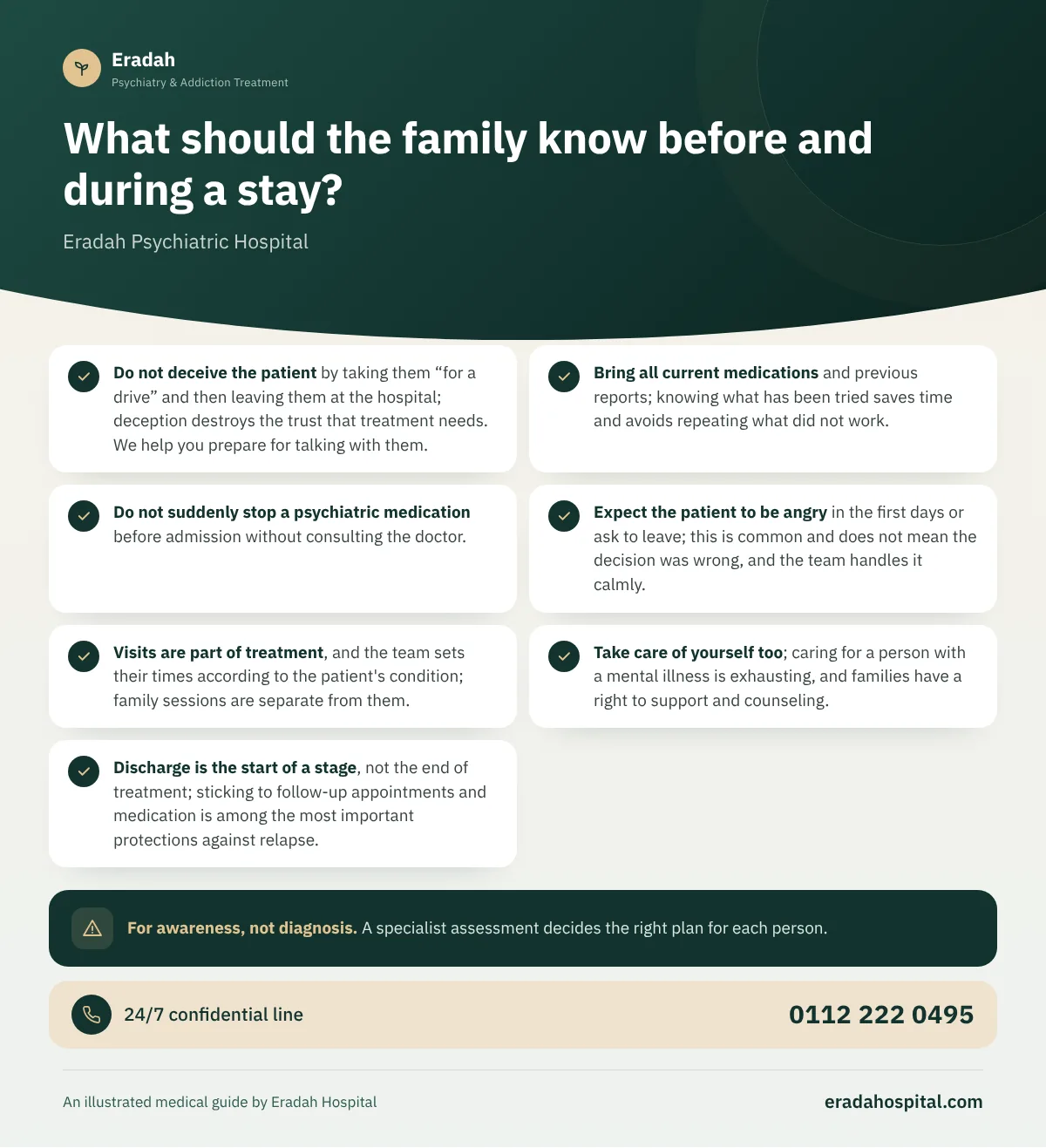
What should the family know before and during a stay?
- Do not deceive the patient by taking them “for a drive” and then leaving them at the hospital; deception destroys the trust that treatment needs. We help you prepare for talking with them.
- Bring all current medications and previous reports; knowing what has been tried saves time and avoids repeating what did not work.
- Do not suddenly stop a psychiatric medication before admission without consulting the doctor.
- Expect the patient to be angry in the first days or ask to leave; this is common and does not mean the decision was wrong, and the team handles it calmly.
- Visits are part of treatment, and the team sets their times according to the patient's condition; family sessions are separate from them.
- Take care of yourself too; caring for a person with a mental illness is exhausting, and families have a right to support and counseling.
- Discharge is the start of a stage, not the end of treatment; sticking to follow-up appointments and medication is among the most important protections against relapse.
On cost: we do not show figures on the site because they depend on the condition, the nature of the illness and the length of stay required, and we explain them in detail after assessment. We do not currently offer installment plans or work with medical insurance companies, and we say so early so your decision is clear from the start.
What should you do in a psychiatric emergency?
If there is immediate danger to the person's life or to those around them, the priority is safety now, not searching for a facility. Suicidal thoughts are not a sign of weakness or “attention-seeking,” and asking about them directly does not plant the idea in anyone's head; it opens the door to help. A crisis, however heavy it seems, can pass, and treatment helps many people get their lives back.
Suicidal thoughts, or an acute psychotic or manic episode? Do not wait for an appointment
- Talking about wanting to die or being a burden on others
- Suddenly saying goodbye to family or giving away important things
- Hearing voices that tell them to harm themselves or others
- Intense suspicion that someone is following or wants to harm them, with agitation
- Not sleeping for days, with impulsive, reckless behavior and rapid speech
- Stopping eating and drinking, or complete withdrawal from their surroundings
Stay with the person and do not leave them alone, listen calmly without arguing or blaming, and keep anything that could hurt them out of reach. Call ambulance 123 or go to the nearest emergency room, you can call the mental health hotline 16328 around the clock, and then contact us once they are safe.
Ambulance 123 Mental health support line 16328Once the person is safe, contact us on 01122220495 so we can arrange an assessment as soon as possible. Anyone having suicidal thoughts right now can call the mental health hotline 16328 to speak with a professional.