What is video game addiction?
Video game addiction, or gaming disorder as the World Health Organization calls it, is a persistent pattern of playing on a phone, computer or game console, in which gaming moves from being entertainment the person chooses to a behavior that controls them and crowds out everything else.
The International Classification of Diseases defines it by three pillars: impaired control over starting, duration and stopping play, increasing priority given to gaming until it takes precedence over other interests and daily activities, and continuation or escalation despite negative consequences. This must cause marked distress or real impairment in studies, work, family or relationships.
A point many overlook is that the disorder revolves around a specific activity, gaming, not around the device. A person may play on a home console they do not carry with them, and still fit the whole picture; whereas another may hold their phone all day without playing at all, and that is a different problem we explain in the guide to smartphone addiction.
When does a love of games turn into addiction?
Doctors distinguish three degrees on one spectrum, each handled differently. The move between them is gradual, which is why following the trend over months is more useful than judging a day or a week:
| Point of comparison | Healthy gaming (a hobby) | Hazardous gaming | Gaming disorder (addiction) |
|---|---|---|---|
| Control | Plays and stops when they decide to | Sometimes goes over the time they intended | Repeatedly unable to stop or cut down |
| Place of gaming in life | One of many interests | Starting to crowd out sleep or studying | Has become the most important thing, and hobbies and relationships have declined |
| Consequences | No notable consequences | Early signs of harm to sleep, grades or spending | Clear and continuing harm to studies, work or family |
| Reaction to the harm | Adjusts their behavior easily | Admits the problem and tries to cut down | Continues or increases despite realizing the harm |
| Duration | — | Weeks or months | A continuing pattern usually lasting 12 months or more |
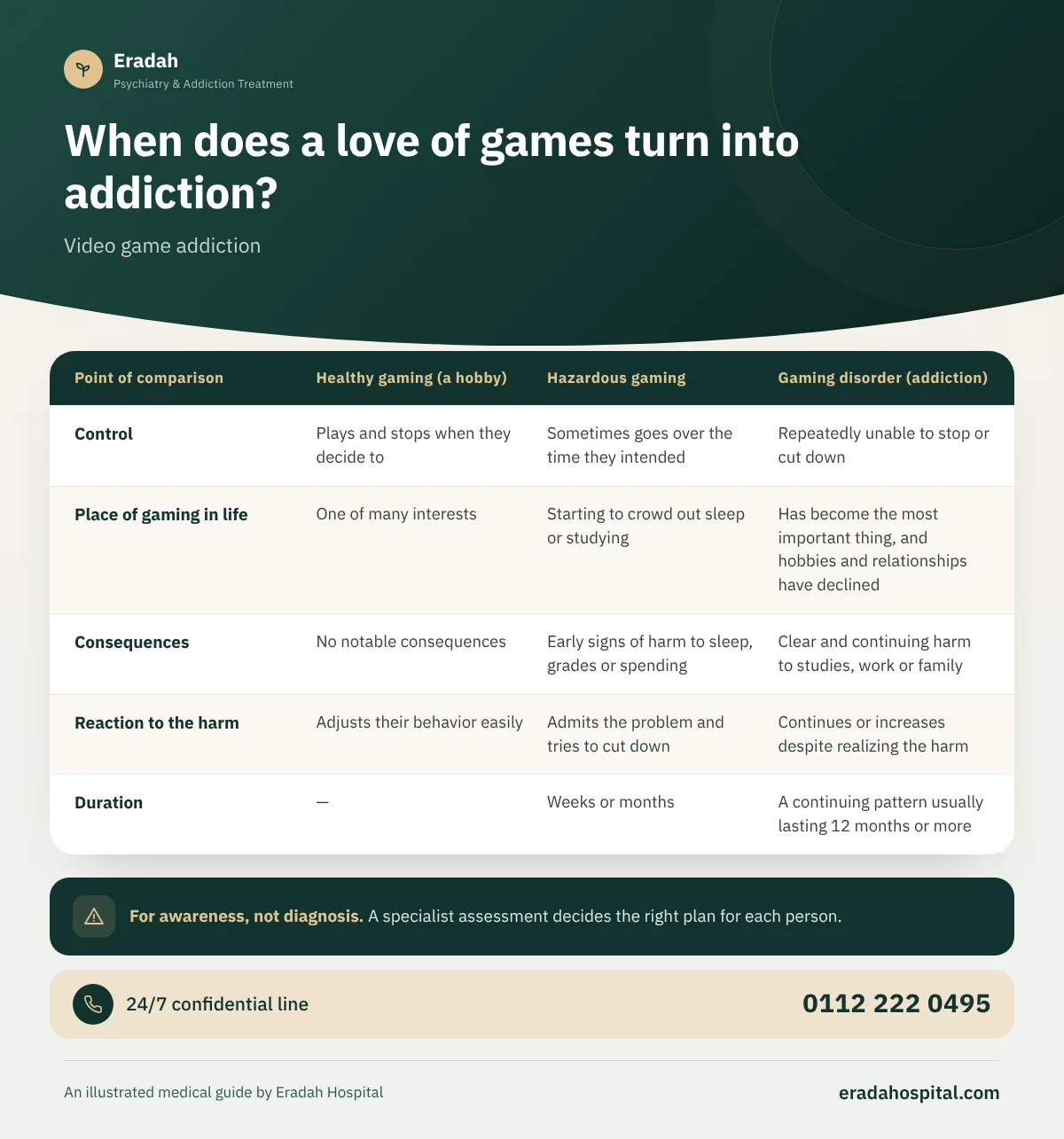
The World Health Organization also has an intermediate category it calls “hazardous gaming” (code QE22), a pattern that raises the risk of physical or psychological harm without reaching the level of a disorder. This stage is the best time to intervene, because changing habits is much easier then.
Is gaming addiction a medically recognized illness?
Yes, and it is one of the few behavioral addictions to have received official recognition. The World Health Organization included it in the eleventh revision of the International Classification of Diseases, ICD-11, under “disorders due to addictive behaviors,” alongside gambling disorder, and this classification officially came into effect in January 2022.
| Classification | Name | Status | Notes |
|---|---|---|---|
| ICD-11 (World Health Organization) | Gaming disorder (6C51) | Official diagnosis | Has two types: predominantly online, and predominantly offline |
| ICD-11 | Hazardous gaming (QE22) | A factor influencing health | An early warning, not a disease diagnosis |
| DSM-5 (American Psychiatric Association) | Internet gaming disorder | A condition needing further research | Nine proposed criteria, of which five are required within a year |
The difference between the two classifications is a disagreement over whether research is sufficient to set final criteria; doctors do not disagree about the existence of the problem itself. The practical result is the same: a person with this pattern deserves an assessment and specialist help. The details of the proposed criteria and the self-assessment questions are on the page about the signs of video game addiction.
How common is video game addiction?
Figures differ widely between studies depending on the country, the age of the sample and the measurement tool, and are higher in teenage samples. There are no unified national Egyptian figures, but the spread of smartphones and online multiplayer games among children and young people makes awareness of the problem a necessity for every family.
Sources: Stevens and colleagues, systematic review and meta-analysis (2021) with its correction (2023), and the World Health Organization’s questions and answers page on gaming disorder.
What happens in the brain during compulsive gaming?
Winning a level or getting a reward inside the game activates the brain’s reward circuit and releases dopamine, which cements the wish to repeat. This is normal and happens with any pleasurable activity. But modern games deliver rewards at a fast, continuous and unpredictable pace, which is the strongest reinforcement pattern known in psychology.
With repetition in some people, the game’s own cues (an alert sound, or the time of an in-game event) become triggers for craving, while the role of the frontal brain areas responsible for restraint and planning weakens, areas that are not yet fully mature in teenagers. Imaging studies suggest a partial similarity to what happens in substance addiction, although this research is still developing.
Who is most at risk of gaming addiction?
Those who play the most and are least able to restrain themselves because of brain development, with males more at risk than females.
They are drawn to fast excitement and immediate reward, and find it hard to stop.
Gaming becomes a way to escape painful feelings instead of facing them.
They find in the game a community and acceptance they lack in real life.
Having one of these factors does not mean addiction is inevitable, but it calls for closer attention. On the page about the causes of video game addiction we explain how game design interacts with these psychological and family factors.
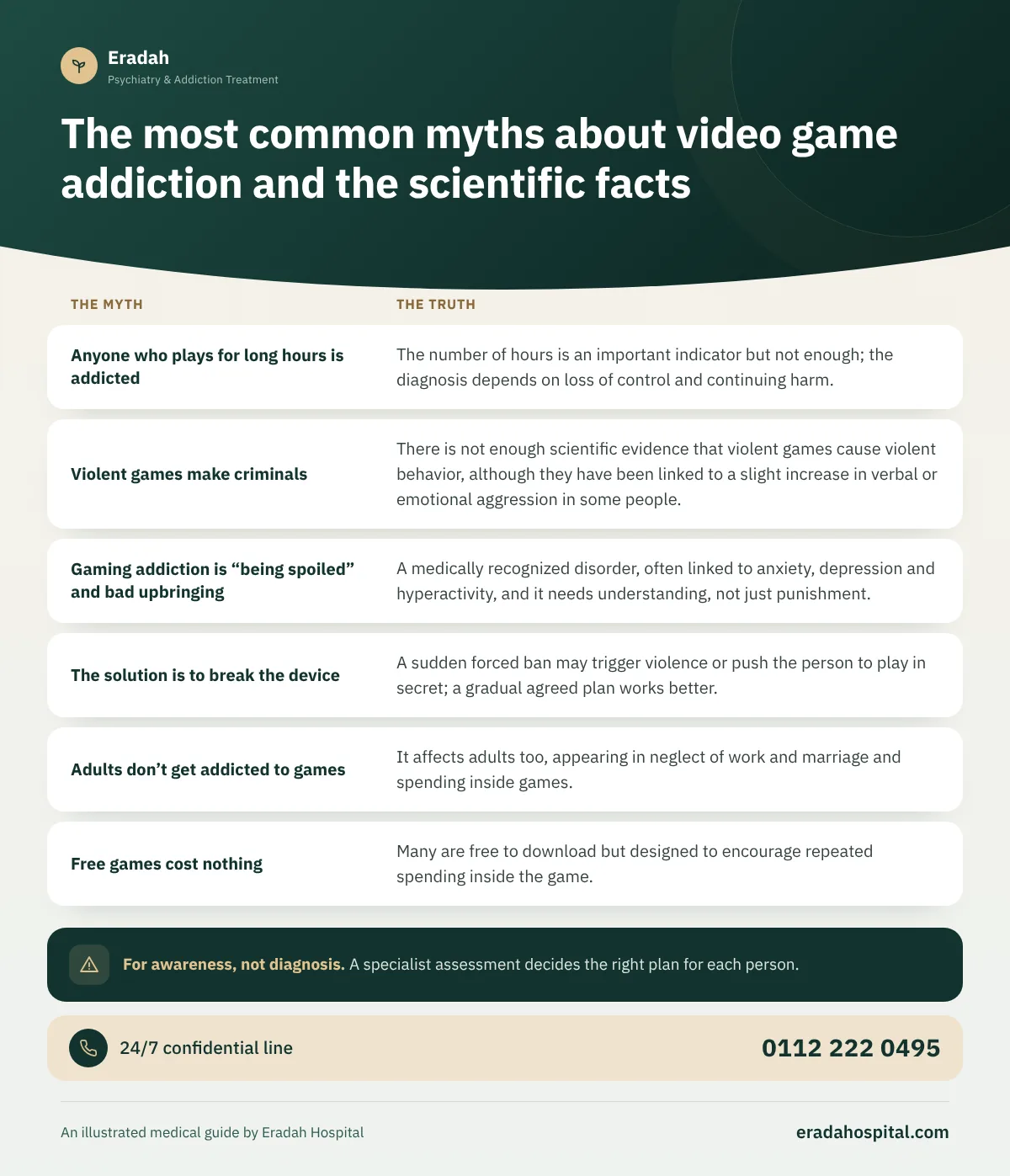
Common myths about gaming addiction and the facts
| The myth | The truth |
|---|---|
| Anyone who plays for long hours is addicted | The number of hours is an important indicator but not enough; the diagnosis depends on loss of control and continuing harm. |
| Violent games make criminals | There is not enough scientific evidence that violent games cause violent behavior, although they have been linked to a slight increase in verbal or emotional aggression in some people. |
| Gaming addiction is “being spoiled” and bad upbringing | A medically recognized disorder, often linked to anxiety, depression and hyperactivity, and it needs understanding, not just punishment. |
| The solution is to break the device | A sudden forced ban may trigger violence or push the person to play in secret; a gradual agreed plan works better. |
| Adults don’t get addicted to games | It affects adults too, appearing in neglect of work and marriage and spending inside games. |
| Free games cost nothing | Many are free to download but designed to encourage repeated spending inside the game. |
How does gaming addiction differ from smartphone addiction and gambling?
These problems overlap in real life, but telling them apart helps in understanding what the person specifically needs:
| Problem | Focus of attachment | Medical status | Point of overlap |
|---|---|---|---|
| Video game addiction | The activity of gaming itself on any device | Official diagnosis in ICD-11 | — |
| Smartphone addiction | The device, repeated checking and notifications | Not an official diagnosis | Phone games are part of use for some people |
| Social media addiction | Browsing, comparison and interaction | Not an official diagnosis | Gamer communities and live streaming |
| Gambling and betting addiction | Betting money on an uncertain outcome | Official diagnosis in ICD-11 | Paid loot boxes carry a gambling-like character |
The role of the family: how to guide your children without a daily war
In its recent guidance, the American Academy of Pediatrics does not ask families merely to count minutes, but focuses on the quality of content, parental involvement, and protecting sleep by keeping devices out of bedrooms and late at night. These are practical ideas that protect the child without turning the home into a battlefield:
Playing together opens a door to conversation, and shows you what they play and whom they talk to.
Agree together on playing times, place and spending rules, and apply them to adults too.
Night-time gaming is one of the biggest thieves of sleep among teenagers.
Choose games suited to the age, and turn on parental controls and spending limits.
Sports, friends and hobbies fill the void the game occupies.
Falling grades, isolation or irritability matter more than a number on a screen.
If calm attempts fail, or the gaming is accompanied by violence, isolation or persistent sadness, this is a signal to seek a specialist assessment, not more punishment. Many teenagers play to escape a deeper problem that needs treatment.
Video game addiction guide: everything you need to know
We have gathered everything about video game addiction in 4 pages, each answering one question in detail. Choose what you are looking for:
Signs of video game addiction
The behavioral, psychological and physical signs in children, teenagers and adults, and the nine criteria proposed in DSM-5, with non-diagnostic self-assessment questions.
Causes of video game addiction
How games are designed to keep you playing, the role of loot boxes and daily rewards, and the psychological and family factors and protective factors.
Harms of video game addiction
Its effect on sleep, the body, mental health, studies, relationships, money and child development, and the truth about the link between violent games and aggression.
Video game addiction treatment
Practical steps for cutting down, device settings, cognitive behavioral and family therapy, when you need a specialist, and how to prevent relapse.
Suicidal thoughts, violence or severe collapse? Get help now
- Talk about wanting to die or about life being meaningless, especially after being stopped from playing or losing an account or a “level”
- Violent outbursts in which they hurt themselves or others or smash things when the device is taken away
- Going without eating or sleeping for many hours in a row in front of the game, with severe exhaustion or dizziness
- Complete withdrawal from family and school or work for weeks, with obvious despair
- Hidden debts or large spending inside games followed by panic or threats of self-harm
Stay calm and do not get into a fight or physical confrontation over the device; stay close to the person, ask calmly how they are feeling, and listen without blame. If there is a risk to their life or others’ lives, call the ambulance on 123 or go to the nearest emergency room, or call the mental health support line 16328 (24 hours), and remove anything they could harm themselves with.
Ambulance 123 Mental health support line 16328