“He just needs a few days in a clinic and he'll come back like before.” Many families say this in their first call, as if treatment were a place a person enters and leaves cured. In truth, addiction treatment is closer to a plan with several stages, each with its own program and a specific goal, and the patient moves between them according to their condition and progress. In this guide we explain Eradah's addiction treatment programs: what each one offers, who it suits, and how the right one is chosen for each person.
What are addiction treatment programs?
Addiction treatment programs are the different forms in which treatment is delivered. They differ in the intensity of medical supervision, where the patient stays, and the number of treatment hours per week. The standards of the American Society of Addiction Medicine (ASAM), one of the best-known references in the field, divide care into graded levels, starting with outpatient treatment and ending with intensive medically supervised residential care. The level is chosen after assessing several dimensions, including the risk of withdrawal, physical health, mental health, the risks of substance use itself, and the patient's surroundings.
The international standards for the treatment of substance use disorders issued by the World Health Organization and the United Nations Office on Drugs and Crime stress that effective treatment is a continuum of care, in which the patient moves between levels without interruption, rather than a single short intervention. That is why Eradah's programs do not work in isolation: each program hands the patient over to the next. For a broader picture of the stages and the role of medication and psychological therapy, see our guide to addiction treatment.
Eradah's addiction treatment programs and who each one suits
| Program | What it offers | Who it suits |
|---|---|---|
| Medically supervised detox | Stopping the substance in a fully equipped setting, with monitoring of vital signs, treatment of withdrawal symptoms and prevention of complications | People who are physically dependent on alcohol, sedatives, opioids or pregabalin, or who use several substances together |
| Residential treatment | Several weeks at the center with a daily schedule combining individual and group psychological therapy, medical follow-up and activities | People for whom outpatient treatment did not work, who live in an environment that pushes them toward substance use, or who need protection from early relapse |
| Outpatient treatment and day programs | Weekly clinic sessions, or an intensive day program several days a week with a return home each evening | Milder or stable cases with family support, and people who have finished residential treatment and need a gradual transition |
| Dual diagnosis program | Treating addiction and the co-occurring mental disorder together, with one team and one plan | People with depression, anxiety, psychosis or a personality disorder alongside substance use |
| Family program | Family sessions with the patient, support groups for relatives, and counseling for the family on its own | The family of every patient in any program, throughout treatment and afterward |
| Follow-up and relapse prevention | A written relapse prevention plan, plus follow-up visits, tests and support groups that gradually become less frequent | Everyone who has completed the intensive phase of treatment, for months or longer |
Alongside these programs, many people in recovery also find peer support groups, the best known being the 12-step program of Narcotics Anonymous fellowships. These are a useful addition to the support network after treatment, not a replacement for it.
How does a patient move between programs?
- The startConsultation and assessment
A free, confidential first consultation, then a medical and psychological assessment that identifies the substance, the severity of dependence and any co-occurring disorder, and recommends the right program.
- Days to weeksDetox when needed
For people who are physically dependent on the substance, under medical supervision that prevents complications and eases withdrawal symptoms.
- WeeksIntensive rehabilitation
Residential or day-program care depending on the case, with individual and group psychological therapy and a medication plan set by the doctor, and with the family involved.
- Gradual transitionReturning to daily life
Reducing the intensity of the program step by step, from residential care to a day program and then the outpatient clinic, instead of an abrupt discharge.
- Months or longerFollow-up and relapse prevention
Visits, tests and support groups that become less frequent over time, and a written plan that identifies triggers and warning signs.
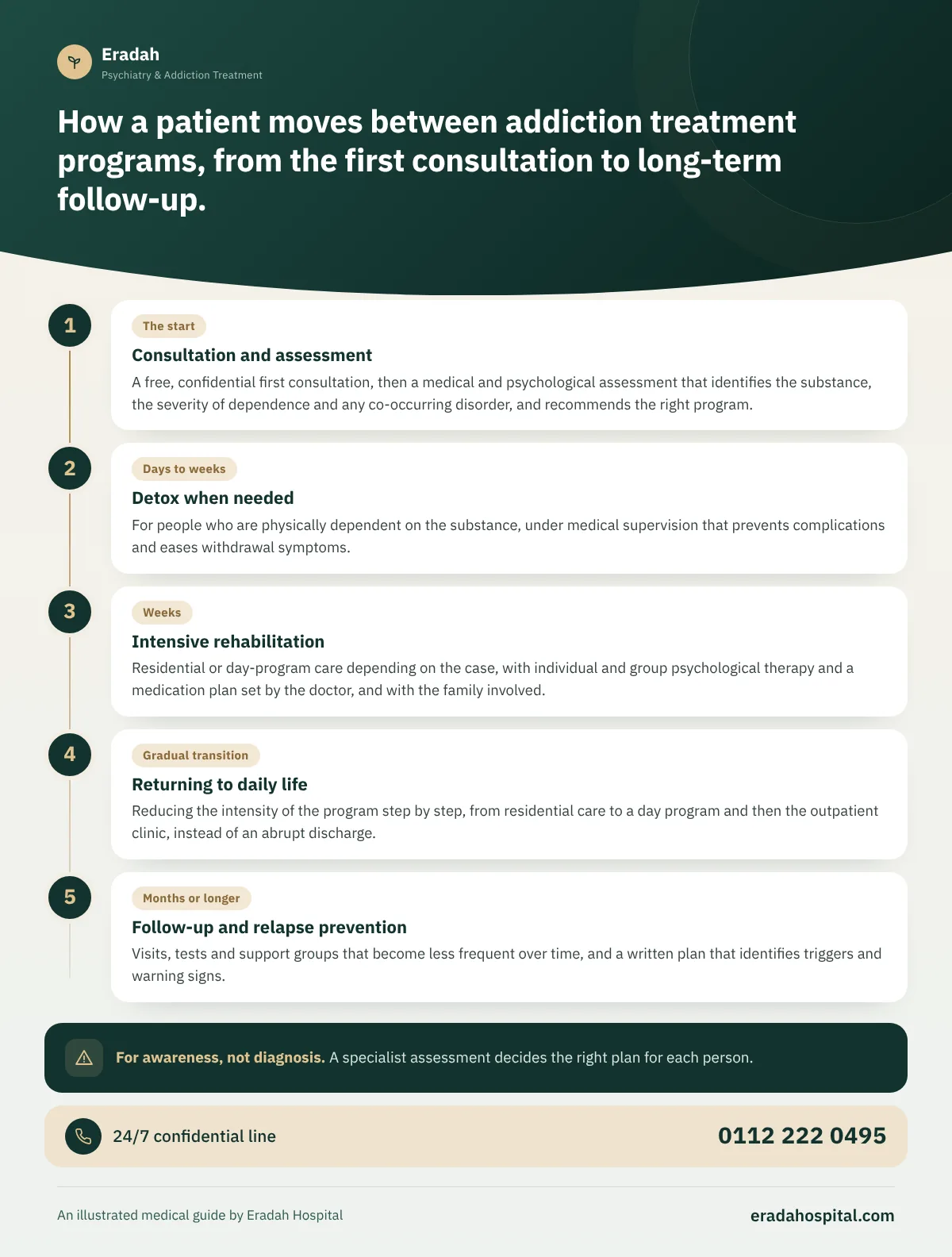
Not every patient goes through every stage. Someone who is not physically dependent on the substance, as in some cases of hashish use or behavioral addiction, may start directly with outpatient treatment and skip detox. The plan is also reviewed during treatment: a patient may move to a more intensive level if they struggle, or to a less intensive one once they are stable.
How is the right addiction treatment program chosen?
The treatment team decides on the program after the assessment, not on the wishes of the patient or the family alone. The most important factors considered are:
- The type of substance and the risk of withdrawal from it. Alcohol and sedative withdrawal can cause seizures that require medical supervision.
- The severity and duration of dependence, and the number of previous attempts to stop and how they ended.
- The presence of a co-occurring mental disorder, suicidal thoughts or psychotic symptoms.
- Physical health, such as liver or heart disease or complications of injecting.
- The environment at home and at work, and how available the substance is, as well as friends linked to it.
- The patient's readiness for treatment and the level of family support available.
If the condition is stable and the environment is supportive, outpatient treatment may be enough. If withdrawal is dangerous, previous attempts have failed or the environment encourages substance use, residential treatment is the better place to start. We explain the differences in detail on the outpatient treatment and day programs page. And when addiction occurs together with a mental illness, treating both at once in dual diagnosis care reduces the risk of relapse.
How long do addiction treatment programs take?
There is no single duration that suits everyone, but in its principles of treatment the US National Institute on Drug Abuse states that staying in treatment for long enough is critical, that most patients need about three months at least of treatment to reduce or stop substance use significantly, and that the best outcomes are linked to longer periods. This time does not necessarily mean staying at the center throughout; it is the total across the different levels.
- Detox: from a few days to a few weeks, depending on the substance and the case.
- Residential rehabilitation: several weeks, set after the assessment and reviewed during the program.
- Day program and outpatient clinic: weeks to months, and it may be the starting point or the stage after residential care.
- Follow-up and relapse prevention: months or longer, with visits gradually becoming less frequent.
Who do Eradah's addiction treatment programs accept?
- Men: in all programs, including detox and residential treatment.
- Women: a free, confidential first consultation, then referral to a service suited to their situation, because residential treatment at Eradah is currently for men only.
- Children and teenagers: assessment, treatment and follow-up without residential stay, with the family involved.
- Behavioral addiction: such as gambling, video games and pornography. It is treated with psychological therapy and does not require detox.
- Families on their own: relatives can ask for consultation and counseling even before the patient agrees to treatment.
The family's role in treatment programs
The family is not a visitor on the treatment journey but a partner in it. In the family program, relatives learn how to set clear boundaries without harshness, how to avoid codependent patterns that unintentionally prolong addiction, and how to support their loved one in recovery after discharge. The program begins when the patient enters any level of treatment and continues through follow-up. And if the patient is still refusing treatment, the Family Guide explains practical steps for dealing with them and encouraging them.
How do you start one of Eradah's addiction treatment programs?
The first step is a call or a message, which can be about yourself or about someone you love, without giving their name. A free, confidential first consultation is then arranged, followed by a medical and psychological assessment, and you are then given a clear plan with the proposed program, its approximate duration and what happens afterward. All information is handled with complete confidentiality. To get in touch, call or message us on WhatsApp at 01122220495, available around the clock, or use the confidential call request form.