What is heroin?
Heroin, whose scientific name is diacetylmorphine, is an opioid made by chemically processing morphine. Morphine itself is the main active compound in opium, which is extracted from the pods of the opium poppy.
Heroin was first made in the nineteenth century and was initially marketed as a cough medicine and painkiller, before it became clear that it was even more addictive than morphine itself. Its medical use was therefore banned in most countries of the world, including Egypt.
Heroin belongs to the opioid family along with morphine, codeine, tramadol and fentanyl. They all act on the same receptors in the brain, but heroin is distinguished by how quickly it reaches the brain, a speed that makes it extremely dangerous and quick to cause addiction.
Street names for heroin: "powder" and "bisa"
The best-known name for heroin in Egypt is "powder", after its form as a white or brown powder. Other names appear on the street for powders sold as cheap heroin, such as "bisa"; these are often adulterated with unknown substances of unknown strength, which makes them more dangerous, not less.
Forms and names of heroin
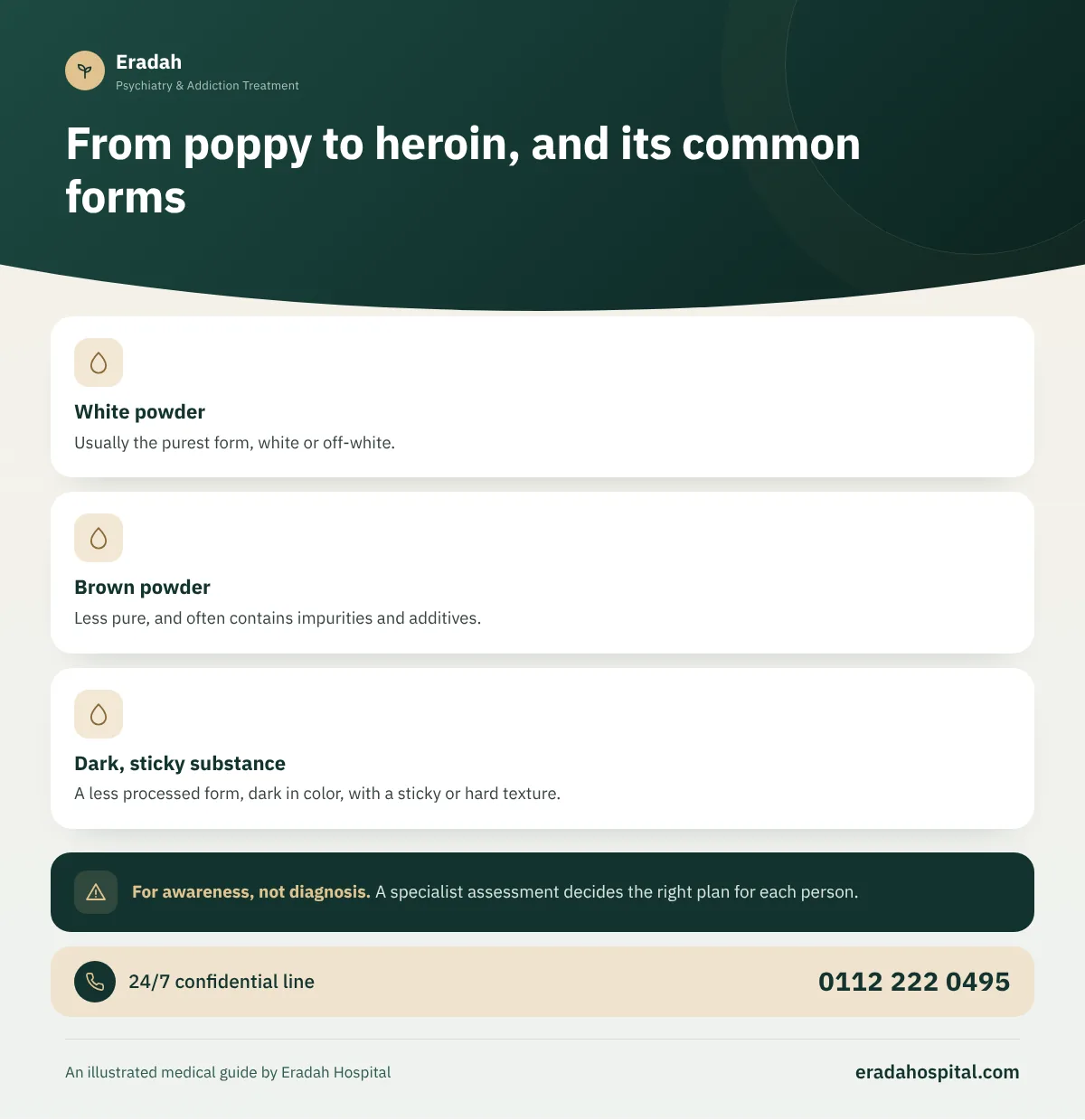
Heroin appears in more than one form depending on how it is made and how pure it is, and it is often cut with other substances to increase the quantity, which means the person using it does not know its real strength:
Usually the purest form, white or off-white.
Less pure, and often contains impurities and additives.
A less processed form, dark in color, with a sticky or hard texture.
How does heroin affect the brain and body?
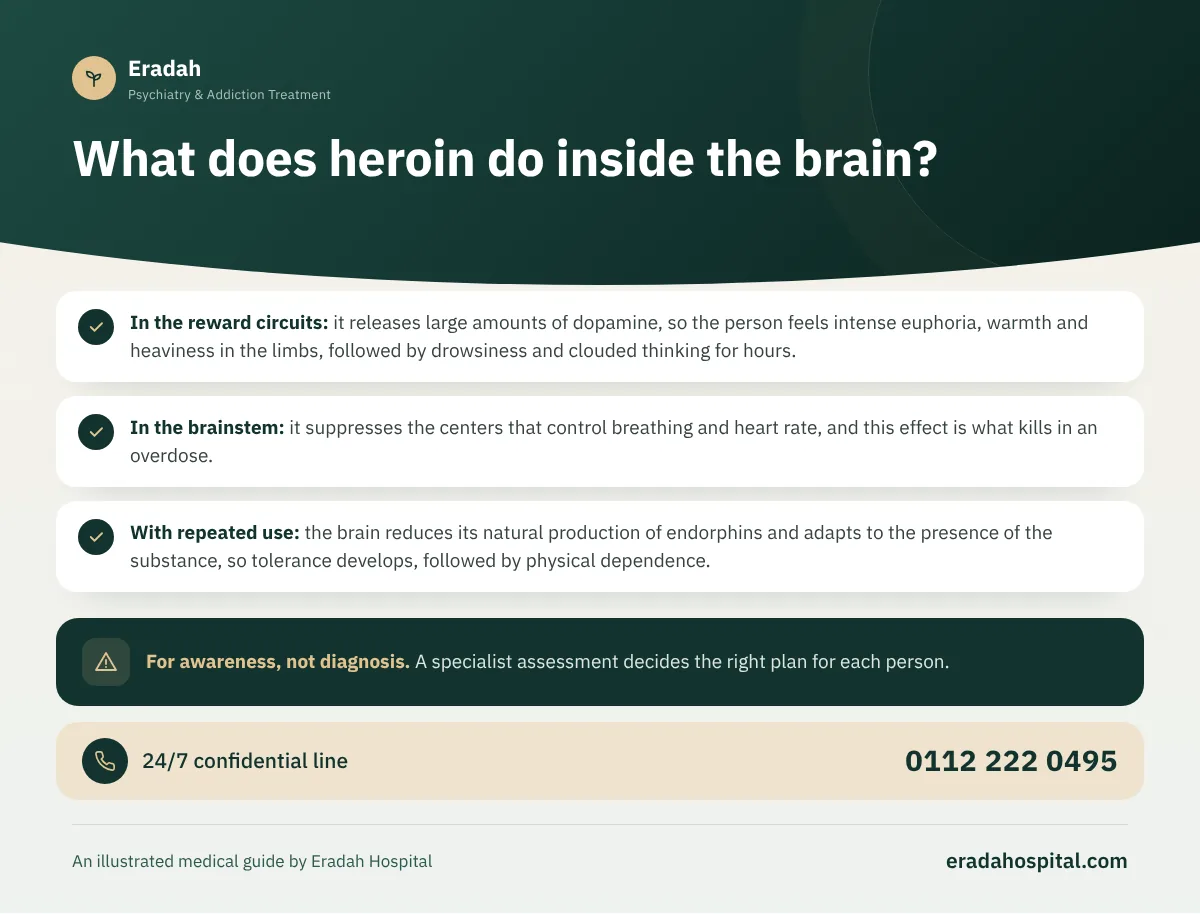
Once heroin enters the body it crosses the blood-brain barrier very quickly, then is converted to morphine, which binds to opioid receptors spread throughout the brain, spinal cord and digestive tract. This has two main effects:
- In the reward circuits: it releases large amounts of dopamine, so the person feels intense euphoria, warmth and heaviness in the limbs, followed by drowsiness and clouded thinking for hours.
- In the brainstem: it suppresses the centers that control breathing and heart rate, and this effect is what kills in an overdose.
- With repeated use: the brain reduces its natural production of endorphins and adapts to the presence of the substance, so tolerance develops, followed by physical dependence.
The danger of heroin lies not in the euphoria but in the fact that the gap between the amount that produces euphoria and the amount that stops breathing narrows with each use.
Does heroin have any medical use?
In Egypt and most countries of the world, no medical use of heroin is permitted. However, some countries, such as the United Kingdom, still use a pharmaceutical form of it under its scientific name, "diacetylmorphine" (diamorphine), as a powerful painkiller for severe pain, such as cancer pain and in palliative care, inside hospitals, by prescription and under strict control.
There is a fundamental difference between the two forms: the medical drug is pure and of known composition, given by a medical team to a specific patient while their breathing and condition are monitored. Street heroin, by contrast, is of unknown purity, is often adulterated with other substances, and is taken with no monitoring at all. So the existence of a limited medical use in some countries never means that heroin is "safe".
Heroin compared with other opioids
Many people confuse heroin with other opioids. They all act on the same receptors in the brain, but they differ in source, medical use, potency and danger:
| Substance | Source | Medical use | Overdose risk |
|---|---|---|---|
| Heroin | Semi-synthetic, made from morphine | Not used medically in Egypt | Very high |
| Morphine | Natural, from opium | Relief of severe pain in hospitals | High |
| Tramadol | Fully synthetic | Prescription painkiller | Moderate, with a risk of seizures |
| Fentanyl | Fully synthetic | Anesthesia and very severe pain | Very high even in a tiny amount |
That is why a person who becomes accustomed to one of these substances is more likely to move on to others, and mixing them with each other or with sedatives and alcohol multiplies the risk of breathing stopping.
The difference between heroin, crystal meth and cocaine
Heroin and crystal meth do not differ only in how dangerous they are; they work in opposite directions. Heroin is an opioid depressant that slows the brain and breathing, while crystal meth (shabu) and cocaine are stimulants that speed up the heart and nerves. That is why the signs of use, overdose, withdrawal and treatment all differ:
| Heroin | Crystal meth (methamphetamine) | Cocaine | |
|---|---|---|---|
| Type | A depressant opioid derived from morphine | A fully synthetic stimulant | A stimulant extracted from the coca plant |
| Predominant effect | Euphoria, then drowsiness, heaviness and slowness | Alertness, energy, reduced sleep and appetite | Euphoria, energy and excessive confidence |
| Duration of effect | Several hours | Long, because it stays in the brain longer | Short: from minutes to about an hour |
| Pupils | Very small | Dilated | Dilated |
| Most dangerous feature of an overdose | Breathing stops | High temperature, heart rhythm disturbance and stroke | Heart attack, stroke or sudden seizures |
| Emergency medication that reverses the effect | Naloxone | None | None |
| Approved medications for treating addiction | Available, such as buprenorphine and methadone | No approved medication so far | No approved medication so far |
In a brain-imaging study published in the journal NeuroImage, methamphetamine entered the brain quickly but left it slowly, while cocaine entered and left quickly, which explains the long duration of crystal meth's effect and the spread of its harm in the brain. The US National Institute on Drug Abuse (NIDA) confirms that there is currently no medication approved by the US Food and Drug Administration for treating crystal meth or cocaine addiction, and that treatment relies on effective behavioral therapies. With heroin, by contrast, medications are a core part of the plan. Withdrawal differs too: heroin withdrawal is physically painful, with aches, diarrhea and sweating, while stimulant withdrawal is dominated by exhaustion, depression, long sleep and cravings.
Because of these differences, the plan always starts with a careful assessment of what the patient is actually using, followed by detox suited to the substance. You will find the stages in heroin addiction treatment and crystal meth addiction treatment.
The legal status of heroin in Egypt
Heroin is completely prohibited in Egypt and is listed in Table 1 attached to Law No. 182 of 1960 on drug control, and no medical use of it is permitted. The Fund for Drug Control and Treatment of Addiction offers free, confidential treatment through hotline 16023, alongside specialized centers.
This is general educational information and not legal advice.
The heroin guide: everything you need to know
We have gathered everything about heroin into 8 pages, each answering one question in detail. Choose what you are looking for:
Harms of heroin
Its effects extend from the heart, lungs and liver to the brain, mental state and social life, and injecting raises the risk of viral infections.
Causes of heroin addiction
Why does heroin addiction develop so quickly? The role of the substance itself, genetics, trauma, mental health conditions and environment.
Symptoms of heroin addiction
The physical and behavioral signs a family may notice in a person who uses heroin, and the criteria for diagnosing addiction.
Heroin withdrawal symptoms
They begin within hours of the last dose and peak in the first days. The timeline, and why medical supervision is needed.
Heroin addiction treatment
From assessment and detox to approved medications, psychological rehabilitation and relapse prevention, and how long each stage lasts.
How long heroin stays in the body
How long it remains in urine, blood, saliva and hair, and which factors affect this.
Dealing with a person addicted to heroin: a family guide to safety and treatment
Dealing with a person addicted to heroin or "powder": how a family prepares for an overdose, why relapse is dangerous after a period of stopping, the dangers of injecting, and the medication and psychological treatment options.
Heroin and sex: why it extinguishes desire, and does it return after treatment?
Heroin and sex: how heroin lowers the male hormone and desire, its effect on fertility and the menstrual cycle, the risk of infection, and what happens to sexual function with treatment and recovery.
Opioids in numbers
Sources: UNODC World Drug Report 2025, and the World Health Organization fact sheet on opioid overdose.
Common myths about heroin, and the facts
Mistaken ideas about heroin circulate that delay seeking help or encourage experimenting. These are the best known:
| The myth | The truth |
|---|---|
| "Sniffing or smoking doesn't cause addiction, only injecting does" | Every route causes addiction; the substance is the same and reaches the same receptors in the brain, and the risk of overdose exists with every route. |
| "I'll just try it once" | No one knows in advance how their brain will respond, and the substance in circulation is of unknown purity and may be mixed with something far stronger. |
| "I can stop whenever I want" | With repeated use, physical dependence and changes in self-control circuits develop, so stopping without treatment becomes very hard even with a sincere desire to stop. |
| "An addict is a person with a weak will" | Addiction is a chronic brain disease recognized by international medical bodies, and it is treated like other chronic diseases. |
| "Someone who recovers once will never go back" | Recovery is a journey that needs follow-up. The risk of relapse is real, especially in the first months, and it can be greatly reduced by treatment and ongoing support. |
Correcting these ideas within the family, especially with teenagers and young people, is one of the simplest and most effective tools of prevention.
Found out your son is using heroin? Start here
Shock, anger and fear are natural feelings, but your first reaction shapes much of what comes after. These practical steps can help:
- Take time to calm down before any confrontation, and do not talk to him while he is under the influence.
- Learn about heroin, its symptoms and its withdrawal so you understand what he is going through.
- Speak with worry, not accusation, and focus on your love for him and on the behavior, not on who he is.
- Do not give him cash, and do not cover up the consequences of his use, as this prolongs the problem.
- Seek specialist family counseling, even if he refuses treatment at first.
- Learn the signs of an overdose, and save the ambulance number (123).
You will find more detail on the physical and behavioral signs on the page about symptoms of heroin addiction.
Signs of a heroin overdose: call ambulance (123) immediately
- Pupils that are extremely small, like pinpoints
- Very slow, irregular or stopped breathing
- Blue lips and fingernails
- Loss of consciousness, with no response to calling or touch
- Gurgling or unusual snoring sounds
Call ambulance (123), place the person on their side so they do not choke, and stay with them until help arrives. The drug naloxone reverses the effect of an overdose if given in time, and it is available in emergency departments.
Call the ambulance 123