What is a personality disorder?
Each of us has a personality: a distinctive way of thinking, feeling and behaving. But when that way becomes rigid, does not adapt to different situations, repeats itself almost everywhere and causes clear distress or problems, doctors speak of a “personality disorder.”
The UK's National Health Service describes a person with a personality disorder as someone who thinks, feels, behaves or relates to others in ways that differ markedly from what is usual. The difference between a “trait” and a “disorder” lies in how intense and fixed the trait is and how it affects life, not in whether it exists. Self-confidence is a trait; a constant need for admiration combined with an inability to see other people's needs may be part of a disorder.
These patterns usually appear in late adolescence or early adulthood. They are not a passing episode like depression or anxiety but an ongoing way of relating to oneself and the world. This is why a doctor takes care before making a diagnosis, especially in teenagers whose personalities are still forming.
Is a personality disorder a “flaw in character”?
One of the most painful things for people with these conditions and their families is being seen as “bad,” “spoiled” or “badly raised.” The scientific reality is different: medical references indicate that personality disorders most likely result from a mix of inherited genes and early environmental experiences, such as neglect, abuse or loss in childhood.
Differences in emotion regulation, impulse control and sensitivity to stress, some of which a person inherits.
Painful or unsafe experiences teach a child ways of surviving that later become rigid patterns.
What once protected the child may harm the adult today, and healthier alternatives can be learned.
What are the three clusters of personality disorders?
The DSM-5 diagnostic manual divides personality disorders into ten types arranged in three clusters according to their dominant character. The international ICD-11 classification has moved to rating the severity of the disorder (mild, moderate, severe) with a description of the prominent traits, while keeping the borderline pattern as a separate descriptor.
| Group | Dominant character | Disorders included |
|---|---|---|
| Cluster A | Odd, eccentric and withdrawn | Paranoid personality disorder, schizoid personality disorder, and schizotypal personality disorder |
| Cluster B | Dramatic, emotional and impulsive | Antisocial, borderline, histrionic and narcissistic personality disorders |
| Cluster C | Anxious and fearful | Avoidant, dependent and obsessive-compulsive personality disorders |
Eradah's guides focus on three Cluster B disorders, because they are the most researched and the most asked about by families, and the most closely linked to substance use and crises at home. Note that “obsessive-compulsive personality disorder” is different from obsessive-compulsive disorder, despite the similar name.
Types of personality disorders
Each of these three disorders has a full guide and separate pages. Here is a short card for each:
Also known as: borderline personality
Sharp swings in emotions, relationships and self-image, with impulsivity and an intense fear of abandonment.
- Category
- Personality disorders
- How common
- Affects a small share of people and is often diagnosed in young adults
- Typical onset
- Adolescence or early adulthood
- Link to addiction
Very strong
When to seek help: when sharp swings threaten relationships and work, and immediately in cases of self-harm or threats of it.
Also known as: narcissistic personality, narcissist
An exaggerated sense of self-importance and a constant need for admiration, with poor empathy for others.
- Category
- Personality disorders
- How common
- Uncommon and hard to estimate precisely
- Typical onset
- Early adulthood
- Link to addiction
Moderate
When to seek help: if crises keep recurring at work and in relationships, or are accompanied by depression or substance use.
Also known as: psychopathic personality
A persistent disregard for the rights of others and for the law, with impulsivity and a lack of guilt.
- Category
- Personality disorders
- How common
- Uncommon, and more so in men
- Typical onset
- Conduct problems before age 15; not diagnosed before 18
- Link to addiction
Very strong
When to seek help: when violence, risk-taking or legal trouble keep recurring, especially alongside substance use.
Avoidant personality
Avoidant Personality DisorderAlso known as: avoidant personality disorder
A constant fear of rejection and criticism with feelings of inadequacy, leading the person to keep away from others even though they long for connection.
- Category
- Personality disorders
- How common
- About 2.1% (United States)
- Typical onset
- Early adulthood
- Link to addiction
Moderate
When to seek help: if fear of rejection keeps you from school, work or any relationship, or you have turned to a substance to calm anxiety.
Dependent personality disorder
Dependent Personality DisorderAlso known as: dependent personality
An excessive need to be taken care of by others and to have them make decisions for you, with intense fear of being alone or separated.
- Category
- Personality disorders
- How common
- Less than 1% of people
- Typical onset
- Early adulthood
- Link to addiction
Moderate
When to seek help: if fear of being alone keeps you in a harmful relationship or stops you from making any decision on your own.
Histrionic personality
Histrionic Personality DisorderAlso known as: histrionic personality disorder
A constant need to be the center of attention, with rapidly shifting emotions and dramatic, exaggerated expression.
- Category
- Personality disorders
- How common
- Less than 2% of people
- Typical onset
- Early adulthood
- Link to addiction
Weak
When to seek help: if emotional crises recur or depression appears when attention is absent, and immediately if there is any threat of self-harm.
Obsessive-compulsive personality disorder
Obsessive-Compulsive Personality DisorderAlso known as: obsessive personality
A constant preoccupation with order, perfection and control, without flexibility, to the point that checking gets in the way of finishing the work itself.
- Category
- Personality disorders
- How common
- About 4.7% on average
- Typical onset
- Early adulthood
- Link to addiction
Weak
When to seek help: if perfectionism is costing you your job or your marriage, or symptoms of depression appear.
Schizoid personality disorder
Schizoid Personality DisorderAlso known as: schizoid personality
A lasting detachment from close relationships and emotional coldness, without hallucinations or delusions.
- Category
- Personality disorders
- How common
- About 0.9% on average
- Typical onset
- Early adulthood
- Link to addiction
Weak
When to seek help: if signs of depression or severe self-neglect appear, and immediately if hallucinations or unusual thoughts appear.
What is the difference between borderline, narcissistic and antisocial personality disorders?
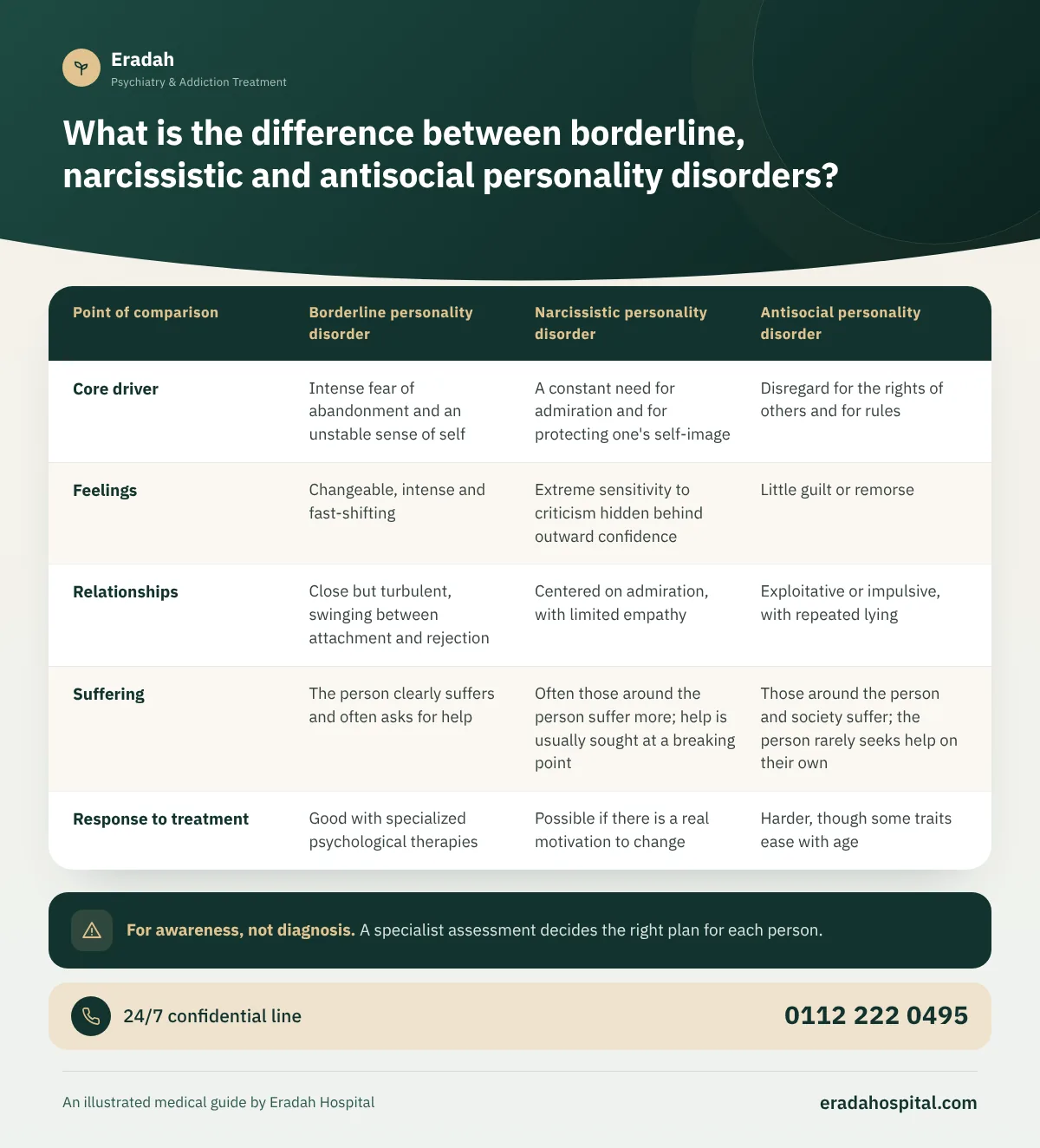
The three disorders share impulsivity and difficulty in relationships, which is why their names get mixed up in everyday conversation and on social media. But the inner driver of each is different:
| Point of comparison | Borderline personality disorder | Narcissistic personality disorder | Antisocial personality disorder |
|---|---|---|---|
| Core driver | Intense fear of abandonment and an unstable sense of self | A constant need for admiration and for protecting one's self-image | Disregard for the rights of others and for rules |
| Feelings | Changeable, intense and fast-shifting | Extreme sensitivity to criticism hidden behind outward confidence | Little guilt or remorse |
| Relationships | Close but turbulent, swinging between attachment and rejection | Centered on admiration, with limited empathy | Exploitative or impulsive, with repeated lying |
| Suffering | The person clearly suffers and often asks for help | Often those around the person suffer more; help is usually sought at a breaking point | Those around the person and society suffer; the person rarely seeks help on their own |
| Response to treatment | Good with specialized psychological therapies | Possible if there is a real motivation to change | Harder, though some traits ease with age |
You can find the details in the guides to borderline personality disorder, narcissistic personality disorder and antisocial personality disorder.
How common are personality disorders?
The same reference notes that personality disorders affect men and women in broadly similar proportions, that some of them, such as borderline and antisocial personality disorders, tend to ease with age, and that the severity of the disorder lessens in many people over time. The figures are approximate and vary between studies.
Why should we not call everyone we disagree with a “narcissist”?
Terms like “narcissist,” “psychopath” and “borderline” have spread on social media until they are used to describe anyone who is selfish, hurtful or moody. This does harm in two ways: it is unfair to people who truly live with the disorder and adds to their stigma, and it distracts from the more important question: is this relationship safe and healthy?
A diagnosis needs a psychiatrist who assesses the person directly over a period of time and rules out other explanations such as depression, bipolar disorder or the effects of substance use. Checklists circulating online may help you understand what you are going through, but they are not enough to pass judgment on anyone.
What is the truth about treating personality disorders?
The common idea that “personality can't change” is inaccurate. Medical references confirm that many people with personality disorders improve over time and that psychological therapy is the foundation of treatment, while medication is used for accompanying depression, anxiety or impulsivity, not to treat the disorder itself. The UK's National Institute for Health and Care Excellence guidelines advise against relying on medication as the main treatment for borderline personality disorder.
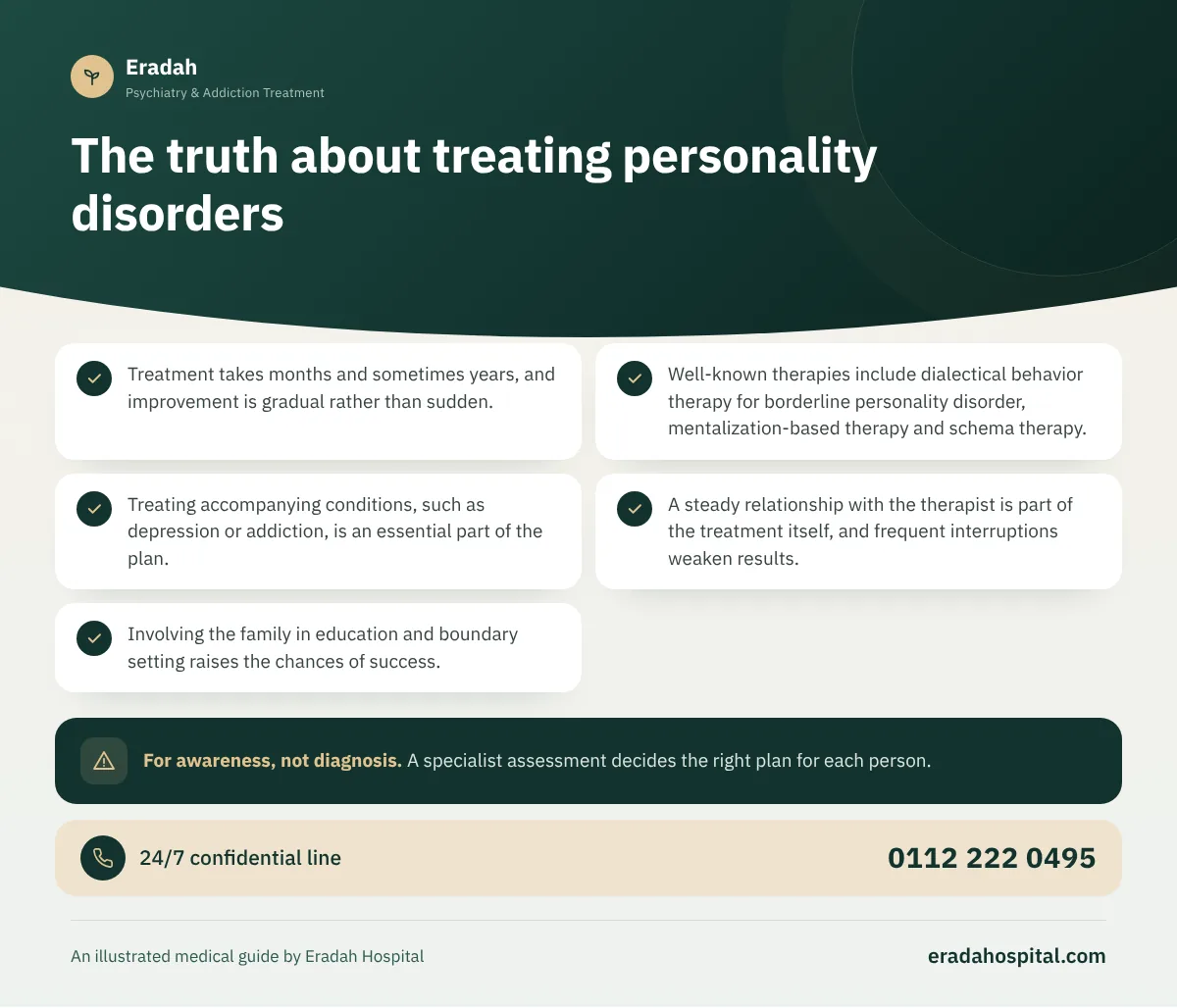
- Treatment takes months and sometimes years, and improvement is gradual rather than sudden.
- Well-known therapies include dialectical behavior therapy for borderline personality disorder, mentalization-based therapy and schema therapy.
- Treating accompanying conditions, such as depression or addiction, is an essential part of the plan.
- A steady relationship with the therapist is part of the treatment itself, and frequent interruptions weaken results.
- Involving the family in education and boundary setting raises the chances of success.
You can find the details for each disorder on the pages for borderline personality disorder treatment, narcissistic personality disorder treatment and antisocial personality disorder treatment.
Why are personality disorders linked to addiction?
The US National Institute on Drug Abuse notes that borderline and antisocial personality disorders are among those that occur at high rates together with substance use disorders. Impulsivity, thrill-seeking and difficulty tolerating painful emotions make a substance seem like a “quick fix,” and then substance use in turn increases impulsivity and mood swings and weakens treatment results.
This is why a person with both conditions needs integrated treatment that addresses the addiction and the personality disorder at the same time, as explained on the pages for borderline personality disorder and addiction and antisocial personality disorder and addiction.
How can a family set healthy boundaries?
Living with a person who has a personality disorder is exhausting, and families often swing between complete leniency and cutting off contact. Healthy boundaries are a third path that protects both sides:
- State clearly and calmly what you will and will not accept, such as insults, violence or substance use in the home, and what you will do if it happens again.
- Follow through on what you said; a boundary that is not enforced teaches that pressure works.
- Avoid arguing when anger is running high, and postpone the conversation to a calmer time.
- Encourage treatment without turning it into a threat or a punishment, and offer practical help in getting to it.
- Look after your own mental health too, and seek specialized support for the family.
- Your safety comes first: if things reach violence or threats, move away and get help immediately.
For day-to-day dealings with a narcissistic partner or relative in particular, read our guide on how to deal with a narcissistic person.
Suicidal thoughts or danger to yourself or others? Get help now
- Talk about wanting to die or about life having no meaning
- Self-harm or threats of it, especially after an argument or a breakup
- Saying goodbye to loved ones or giving away important belongings
- Fits of intense rage with a clear threat to another person's safety
- Using large amounts of alcohol or substances during an emotional crisis
- Sudden withdrawal and silence after a period of severe turmoil
Do not leave the person alone, listen without blame or lecturing, and move dangerous objects out of reach as a general precaution. Call an ambulance (123) or go to the nearest emergency department, or call the mental health support line 16328, available around the clock. If the danger is directed at you, first move to a safe place.
Ambulance 123 Mental health support line 16328