You may need a drug test because you are about to start a job, because your family is worried about a son or husband, or because you are in recovery and want to show your commitment. In every case the same questions come up: Will it show up? After how many days? And is the result accurate? This guide answers them clearly and refers you to each substance’s page for details.
What is a drug test?
A drug test is a laboratory test that looks for the substance itself or for the by-products the body turns it into after use. The test does not detect “drugs” in general; it looks for specific groups chosen in advance, so what is not requested in the test usually does not show up even if it is present. That is why a “drug test” differs from lab to lab in the number of substances it covers.
A reliable test usually goes through two stages: a quick, inexpensive initial screening test based on antibodies, then, when a positive result appears, a confirmatory test using precise instruments such as gas or liquid chromatography with mass spectrometry (GC-MS or LC-MS), which identifies the specific substance and its concentration.
Types of drug tests: urine, blood or hair?
| Sample type | What does it detect? | Approximate detection window | When is it usually used? |
|---|---|---|---|
| Urine | By-products of the substance after the body breaks it down | One day to several days, and longer with chronic use of some substances | Employment, monitoring during treatment, and home testing |
| Blood | The active substance in the bloodstream | Usually hours to a day or two | Accidents and emergencies, and assessing current impairment |
| Saliva | The substance after recent use | Roughly hours to two days | Rapid roadside or workplace testing |
| Hair | Substance deposited in the hair shaft as it grows | Up to about 90 days for a sample about 3 cm long | Learning the pattern of use over weeks and months |
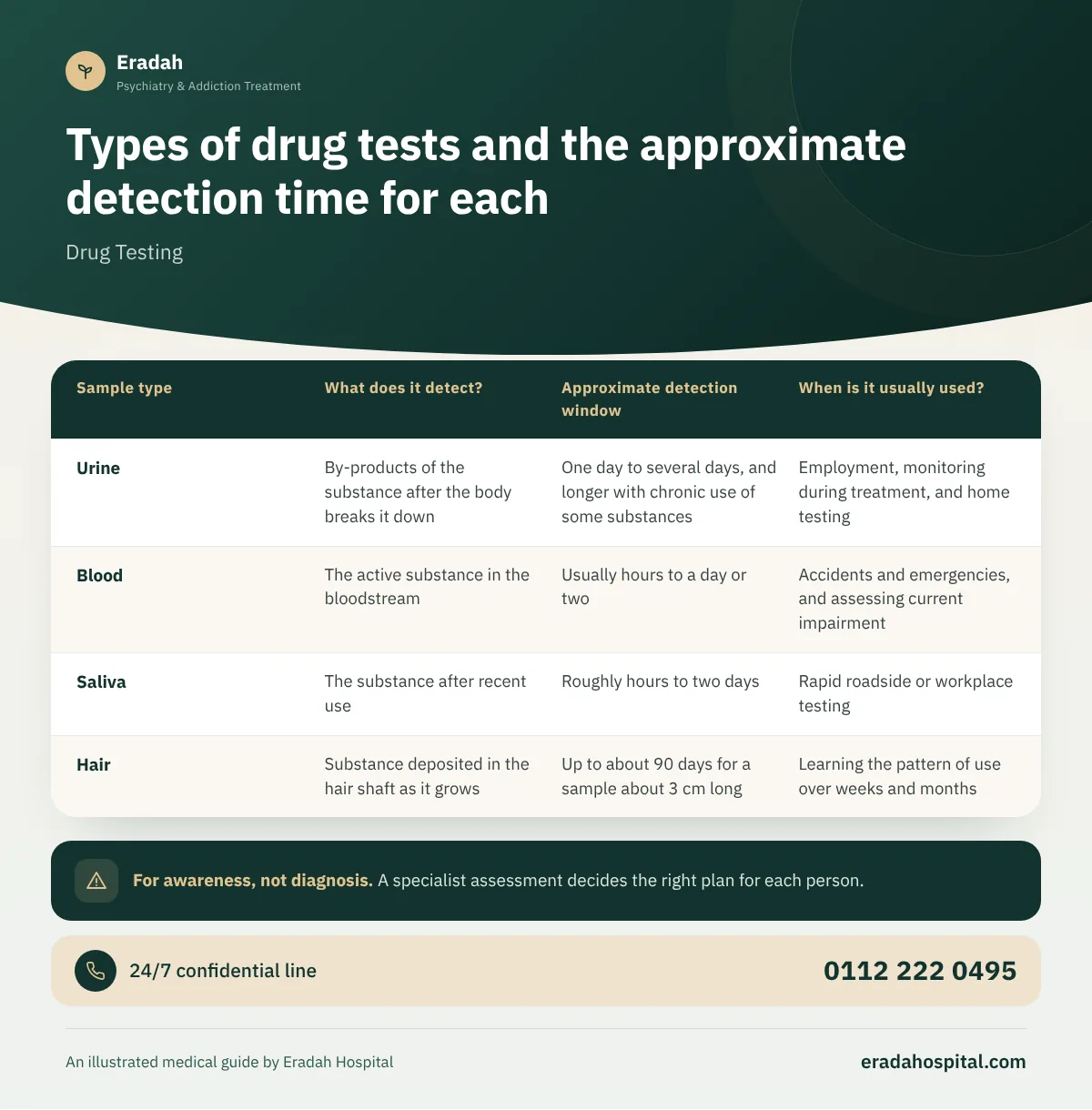
A hair test usually does not detect use in the last few days, because the hair needs time to grow and emerge from the scalp. Urine reflects only the most recent days, so a doctor may combine more than one type depending on the question that needs answering.
What is the 7-panel drug test? And what does it include?
“7-panel,” “5-panel” or “10-panel” describes the number of substance groups the initial test looks for in a single sample. It has no single fixed makeup; each lab chooses the groups according to the type of test strips it uses, but the panels used in Egypt often include groups such as:
- Cannabis (hashish and bango) through the THC metabolite.
- Natural opiates such as morphine, heroin and codeine.
- Tramadol, which has its own separate strip because it does not show up on the usual opiate strip.
- Benzodiazepines such as Xanax and Rivotril.
- Amphetamines and methamphetamine (shabu).
- Cocaine.
- Some labs may add barbiturates, methadone or synthetic cannabinoids.
Note that some substances do not show up on the usual panels unless they are requested by name, such as pregabalin, Strox and some newer substances. If the purpose is medical, it is better for the doctor to specify exactly what is needed.
After how many days does a drug test show?
There is no single time for everyone, because it varies with the substance, the amount, the length of use, body weight, and liver and kidney function. But these are approximate ranges for a urine test, and you will find the full details on each substance’s page on how long it stays in the body:
| Substance | Approximate detection time in urine | Details |
|---|---|---|
| Hashish and bango | From 3 days with occasional use to weeks with chronic daily use | How long hashish stays in the body |
| Tramadol | About 1 to 3 days | How long tramadol stays in the body |
| Heroin and morphine | About 1 to 3 days | How long heroin stays in the body |
| Shabu and amphetamines | About 1 to 4 days | How long shabu stays in the body |
| Cocaine | About 2 to 4 days | How long cocaine stays in the body |
| Benzodiazepines | Days, and possibly weeks with long-acting types | How long Valium stays in the body |
| Alcohol | Hours in the standard test, and longer in tests for its specific by-products | How long alcohol stays in the body |
Does a positive result always mean drug use?
No. The initial test relies on a chemical reaction that can be affected by substances similar in structure to the one being looked for, producing a false positive. Well-known examples are some cold medicines containing pseudoephedrine on the amphetamine strip, and some antibiotics on the opiate strip, along with other medications we explain in detail in the guide to medications that show up in drug tests.
Conversely, a negative result does not always mean no use; the use may have been long ago and outside the detection window, the substance may not be included in the panel, or the sample may have been diluted. That is why no major medical or family decision should be built on a single strip.
Drug testing for employees in Egypt
Law No. 73 of 2021 regulates drug testing for employees of the state’s administrative apparatus and its affiliated bodies, at hiring, before promotion, and by surprise during work. Samples are taken at accredited facilities, and a positive result is confirmed by a confirmatory test before any consequence follows, taking into account medications the employee takes with a prescription.
If you take a medication that may show up in the test, such as some painkillers or anxiety and sleep medications, keep the prescription and your treating doctor’s report, and submit them before the test. Do not suddenly stop a psychiatric medication or painkiller out of fear of the test without consulting your doctor, because suddenly stopping some of them causes dangerous withdrawal symptoms.
Is a home drug test accurate?
Home test strips sold in pharmacies work on the same principle as the initial test, and are useful as a quick first indicator, but they have limits: the reading can be wrong if the instructions and timing are not followed, they do not cover every substance, they can be affected by medications, and they cannot be relied on officially. If a positive line appears, the next step is a laboratory test, then a calm conversation rather than an angry confrontation.
And for families in particular: a test is a means, not a goal. If the worry is based on a clear change in behavior, sleep, friends and money, review the signs of drug use, and think about how to approach the conversation before the test itself, because a test imposed by force may close the road to treatment.
Does a drug test require fasting? And how do you prepare for it?
- A urine or blood drug test usually does not require fasting, unless another test that needs it is requested with it.
- Do not drink excessive amounts of water beforehand; a sample that is too dilute may be rejected and a repeat requested.
- Bring your ID card and a list of your medications and prescriptions.
- The sample is usually collected under supervision to ensure it is genuine, and the lab checks its temperature and density.
- Ask when the result will be ready: the initial test may show within minutes or hours, and the confirmatory test may take days.
What comes after a true positive result?
A confirmed positive result is an opportunity to start the conversation, and the road after it is still open. Not everyone who has used a substance has an addiction, and not everyone with an addiction needs the same thing. The right step is a medical and psychological assessment that determines whether this is occasional use that needs education and follow-up, or dependence that needs addiction treatment at the appropriate level. At Eradah, a family can begin with the free, confidential consultation before taking any step.