“I want my son back the way he was.” A sentence that carries all the love and all the fear. The honest answer is that a person in recovery often does not come back exactly “as he was,” because he has been through an experience that changed him. But he can become someone who works, loves, laughs and sleeps, and perhaps someone more mature and more aware of himself. The question of whether a person returns to normal after addiction treatment deserves a detailed answer that separates what returns quickly from what needs patience.
Does a person with addiction really return to normal after treatment?
The US National Institute on Drug Abuse explains that addiction is a treatable disease and that its treatment is like the treatment of other chronic illnesses: it is not a “final cure” but management of the condition, which lets a person deal with the effects of addiction on the brain and behavior and regain control of their life. In other words, “returning to normal” is possible, but it resembles the life of a person whose high blood pressure is well controlled: completely normal, as long as they keep up their follow-up.
In a 2017 study by Kelly and colleagues of US adults, the researchers estimated that tens of millions of people had overcome problems with alcohol and drugs in different ways, and 46% of those who had overcome them described themselves as “in recovery.”
Does the brain return to normal after drugs?
In a study published in the Journal of Neuroscience in 2001, Nora Volkow and colleagues scanned the brains of people recovering from methamphetamine using PET imaging. They found that dopamine transporters, a marker of the health of nerve terminals, rose after long abstinence by 19% in the caudate nucleus and 16% in the putamen. The National Institute on Drug Abuse presents these images as an example of “the brain’s remarkable ability to recover, at least in part.”
But the same study notes that performance on some cognitive tests did not improve to the same degree, meaning that chemistry recovers faster than some functions. This is why a person in recovery needs time, and sometimes cognitive rehabilitation. The page on dopamine and addiction explains what happens to the reward circuit.
What returns first after stopping?
- The first weeksThe body
Withdrawal symptoms ease, and sleep and appetite gradually begin to settle.
- The first monthsMood
Mood swings lessen, but periods of anxiety, flatness or longing may remain.
- Within the first yearThinking
The ability to concentrate, plan and control impulses improves with continued abstinence.
- In the longer termLife
Rebuilding trust, relationships and work. It is the slowest part, but the deepest.
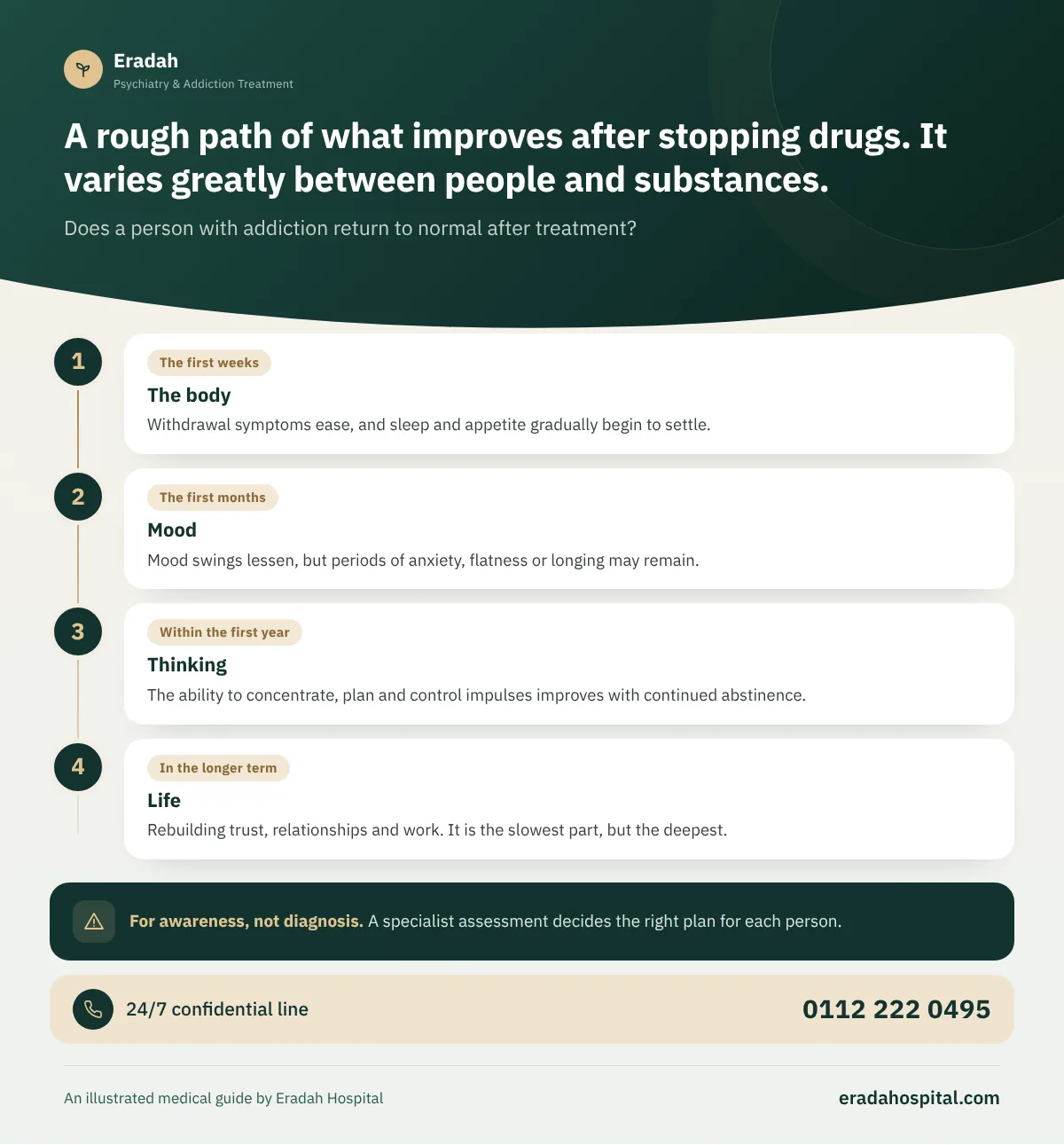
This path is approximate and varies greatly depending on the substance, length of use, age and co-occurring illnesses.
Prolonged symptoms: why does a person in recovery struggle after months?
Many people are surprised when waves of insomnia, anxiety, flatness or longing appear months after stopping, and they conclude that they have “not recovered.” In truth, the brain regains its balance in stages, and, as the National Institute on Drug Abuse explains, cues linked to use can trigger strong cravings even years later. Knowing this in advance protects against despair and makes follow-up during this period essential.
Does a person return to normal in personality and behavior?
Much of what families see during addiction, such as lying, irritability and withdrawing from the home, is not the “real personality” but the behavior of the illness: seeking the substance, the swings of intoxication and withdrawal, and the fear of being found out. With stopping and treatment, most of this eases. But if there were traits or mental health conditions before the addiction, such as severe impulsivity, anxiety or depression, they need their own treatment and do not disappear just by stopping.
What may not return after addiction?
Such as cirrhosis of the liver, while hepatitis C is today cured by treatment in most cases.
Some forms need ongoing psychiatric follow-up and treatment.
These need time and patience to make up for, and some cannot be made up.
It remains, and needs attention and continuous follow-up.
Work and relationships after treatment
Many people in recovery return to their jobs and studies, and some start a new path. Trust with the family does not come back through words but through days: keeping appointments, being transparent about money, and being present at home. At this stage the family needs a practical guide, which you can find in After leaving the treatment center.
How can the family help a person in recovery return to life?
- Celebrate small progress, and do not compare it with life before the addiction.
- Give him gradual responsibilities that restore a sense of worth.
- Encourage follow-up and treatment of any co-occurring depression or anxiety.
- Learn the early signs of relapse without becoming a permanent watchman.
- Take care of yourself, because recovery is a journey for the family too, and the family program offers space for that.