What Does Leaving the Treatment Facility Mean for the Family?
Discharge day is a day of mixed feelings: joy and relief, and a hidden fear that everything will go back to the way it was. Many families treat it as “the day of cure,” expecting the problem to be over as soon as he is home. The truth is that the facility has finished the physically hardest stage, but real recovery is built in daily life, and at home in particular.
The US Substance Abuse and Mental Health Services Administration (SAMHSA) defines recovery as a process of change in which a person improves his health and life, lives a self-directed life and strives to reach his full potential, and it names four dimensions that support it: health, a stable home, purpose and meaning, and community and supportive relationships. The family is present in all four.
NIDA guidance notes that staying in treatment long enough is a decisive factor in outcomes, and that recovery from addiction often needs more than one treatment episode and long-term follow-up. So the most important thing we want you to take away is that follow-up after discharge is not optional, and its details are in the follow-up and relapse prevention program.
What Do the First Ninety Days After Rehab Look Like?
Each stage of the first three months has its own challenges. This is a general picture that helps a family anticipate what may happen, with details varying from person to person:
- The first weekWelcome and settling
A calm welcome, without big celebrations or many visitors. He may be tired, anxious or sleeping poorly, and that is expected. Set up a simple daily routine together.
- Weeks 2–4Building routine
Follow-up appointments and sessions come before any other commitment. Regular sleep, meals and physical activity, and staying away from places of drug use and his old friends.
- The second monthThe first tests
A gradual return to study or work, and facing real pressures. A sudden intense craving or mood swings may appear, and he needs support, not blame.
- The third monthOverconfidence
Many feel they have “fully recovered,” so they attend sessions less or test themselves with old friends. This is when you need to be more watchful, not less.
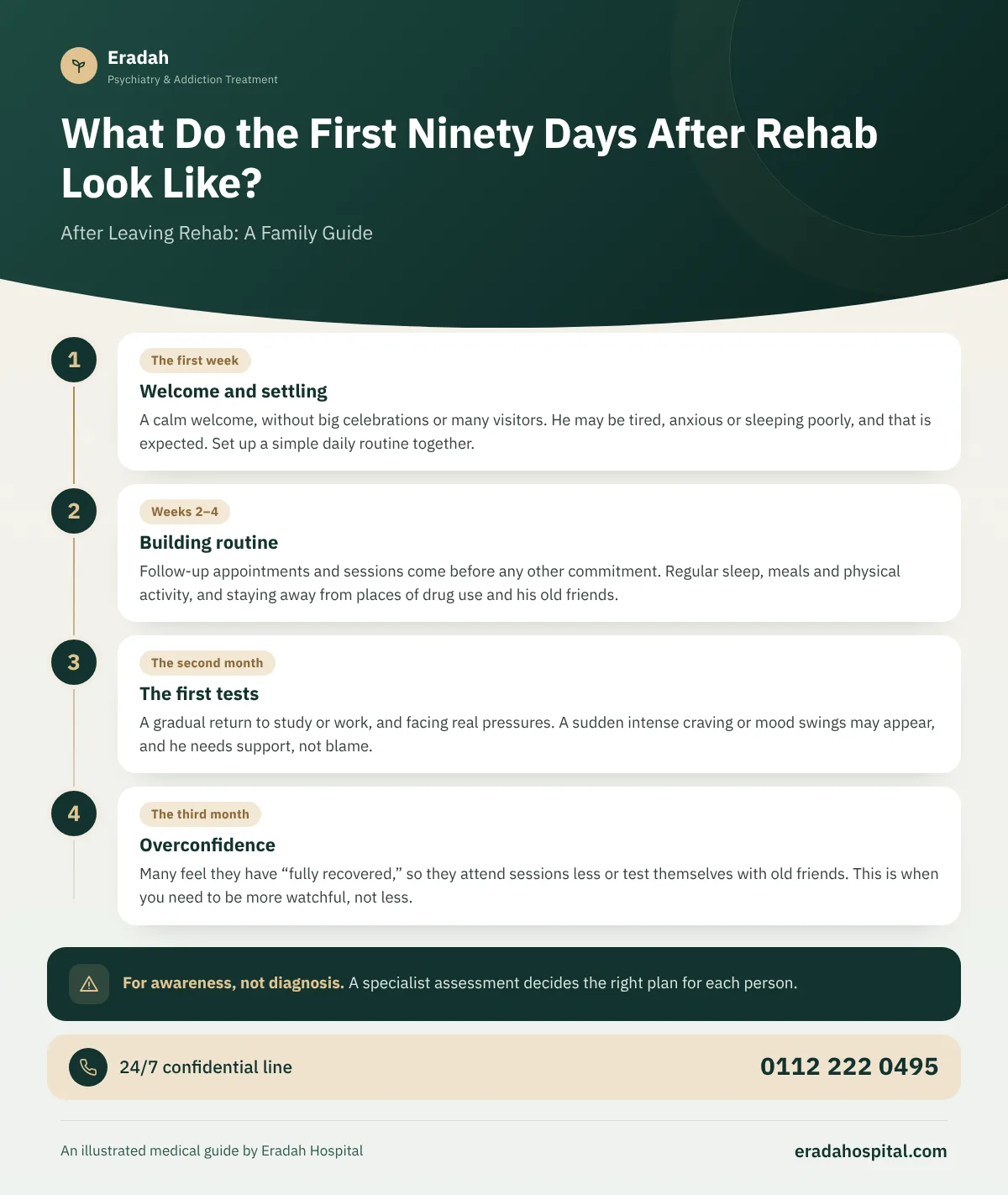
After the first three months the risks do not end, but they decline gradually as new habits take hold and alternative relationships and goals are built. The treatment team determines the appropriate length of follow-up for each case.
How Do You Prepare the Home Before He Returns?
The home he returns to may be full of memories and triggers without the family noticing. These are practical steps before discharge day:
- Remove alcohol from the home completely, even if it was not his main problem.
- Keep the family’s medications, especially painkillers, sedatives, sleeping pills and cough medicines, locked away.
- Quietly get rid of any tools or items linked to drug use in his room or car.
- Agree on which relatives know, and what to say to people who ask, to protect his privacy.
- Arrange a comfortable place to sleep and a clear daily routine from the first day.
- Get the treatment team’s phone numbers, and know the first follow-up appointments in advance.
More important than preparing the place is preparing the family itself: agree among yourselves on how to respond, and do not make one parent the “nice one” and the other the “police.” Conflicting messages confuse a person at a stage when he needs clarity.
How Do You Rebuild Trust After Years of Lying?
It is natural for a family not to trust quickly after repeated experiences of lying and disappointment. It is also natural for him to feel uncomfortable with constant suspicion. So do not trust suddenly, and do not monitor every step; it is better for trust to be built gradually and through actions:
Such as times to be home and attending sessions. Keeping them builds trust step by step.
Encourage him to tell you when he feels a craving, and receive it with appreciation, not panic or accusation.
With each month of commitment, give him more room with money, time and decisions.
Suffocating monitoring sends the message “we will never trust you,” and any testing, if it is needed, should be part of the treatment plan and by agreement.
Some helpful phrases at this stage: “I’m proud of your commitment this week,” “I know trust takes time from both of us, and I’m trying like you,” and “If you feel pressure or a craving, I’d rather you tell me, and I won’t be angry.” Avoid reopening past mistakes in every disagreement; constantly reminding him of them creates shame, and shame is one of the biggest triggers for relapse.
How Should a Family Handle Money After Treatment?
Money is one of the most sensitive points, because it was usually the means of drug use and a source of lying and conflict. The aim is for control of money to return to him gradually and under a clear agreement, not for him to live without money forever:
- At first: a set allowance for basic needs, and it is better to pay for transport and subscriptions directly rather than give cash.
- A written agreement: it sets the amount, what it covers, and how it increases gradually with commitment.
- Old debts: don’t pay them all at once; discuss a clear plan that he helps carry as far as he is able.
- Bank cards, gold and valuables: keep them somewhere safe in the first months without making it an insult.
- Work: a gradual return to work or study restores his sense of worth, but check the timing with the treatment team first.
If the person in recovery is the husband or father, it can be agreed that the wife or a trusted person manages the finances temporarily, with full transparency and a stated plan for returning responsibility to him.
What Triggers Might Push Him Toward Relapse at Home?
A trigger is anything that awakens the desire to use: a place, a person, a feeling or a situation. Some are inside the home itself, and the family can reduce them:
| The trigger | What a family can do |
|---|---|
| Arguments and shouting at home | Lower the tension, postpone heated discussions, and seek family therapy when needed |
| Free time and boredom | A daily routine, physical activity, hobbies and simple tasks at home |
| Old friends from his drug-using days | Don’t host them, and support making new friends and attending support groups |
| Hunger, anger, loneliness and tiredness | Regular meals, enough sleep, calm family time, and listening to his feelings |
| Occasions and celebrations | A plan in advance: who goes with him, when he leaves, and what he says if something is offered |
| Blame and reminding him of the past | Focus on what he is doing now, and praise his commitment |
| Medications or alcohol at home | Remove or lock them away as described above |
Recovery programs use a common acronym for four states that weaken resistance: hunger, anger, loneliness and tiredness. A family’s attention to these simple states can prevent many moments of weakness. Deeper psychological triggers such as anxiety and depression need specialist treatment, especially in cases of dual diagnosis.
What is the difference between a slip and a relapse?
One of the most important things a family must understand is that going back to use is not a single event of a single degree. There is a big difference between a passing slip and a full relapse, and how the family responds to a slip may decide whether it stops there or turns into a relapse:
| Point of comparison | Slip | Relapse |
|---|---|---|
| Definition | Passing use, once or for a very short period | A return to the previous pattern of use |
| The person’s stance | Usually regretful and wants to return to the plan | May deny, give up, or move away from treatment |
| The risk | Present, especially the risk of overdose | Higher, with the return of health and social harms |
| What the family does | Stay calm and contact the treatment team right away | Urgent assessment; he may need a higher level of care |
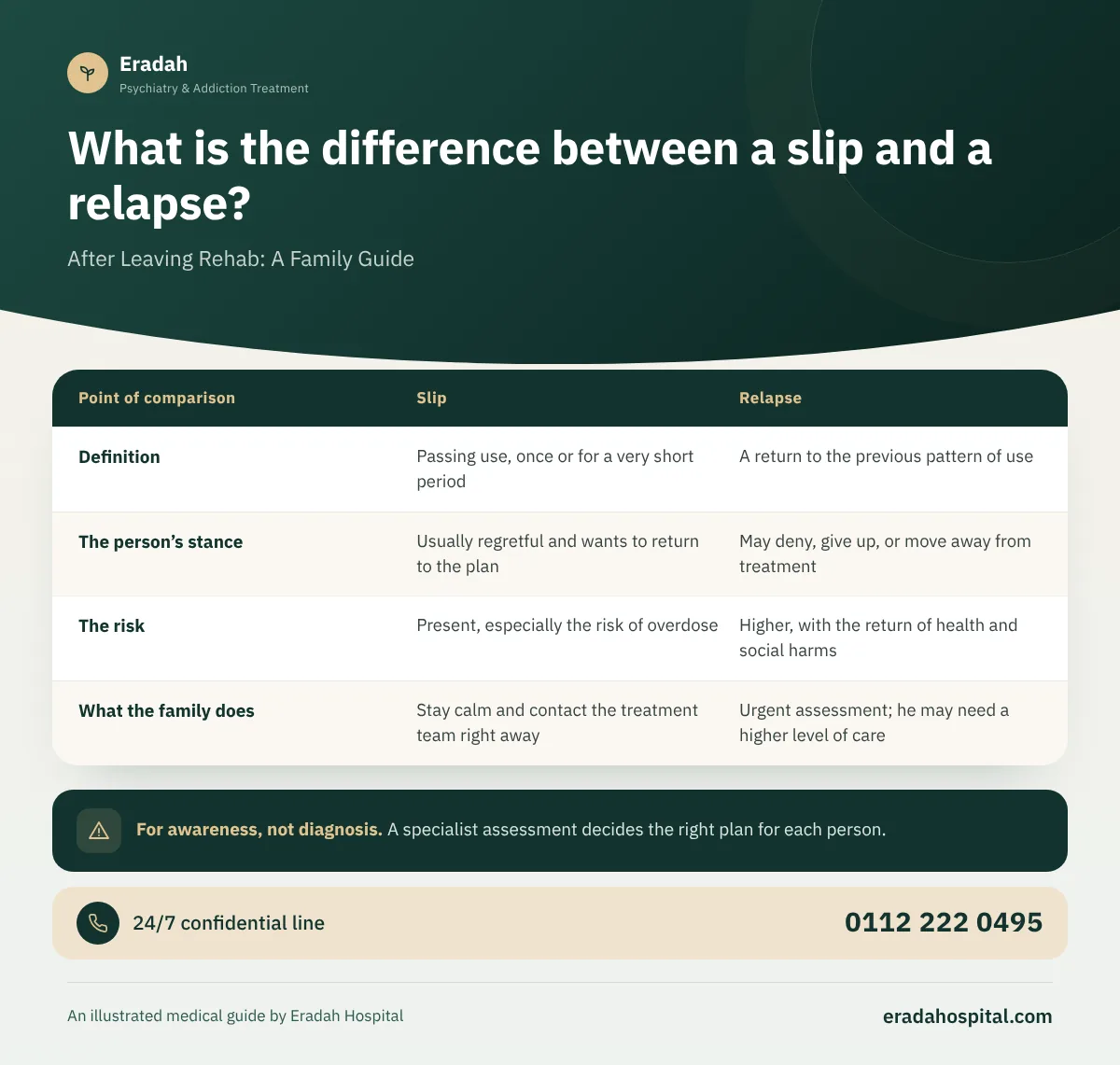
NIDA notes that relapse rates in addiction are similar to those of other chronic illnesses such as high blood pressure and asthma, and puts them at roughly 40% to 60%. In those illnesses, relapse means treatment needs to be resumed or adjusted, and does not mean it has failed. This fact helps a family not to collapse or give up if what it fears happens.
What Warning Signs Come Before a Relapse?
Relapse usually does not begin at the moment of use, but days or weeks before it. Specialists describe three roughly successive stages, whose early signals a family can notice:
Irritability, withdrawal, little sleep, neglecting meals, missing sessions, and bottling up feelings without talking about them.
Repeatedly talking about the days of use with nostalgia, downplaying (“once won’t hurt”), or getting in touch with old friends.
Looking for opportunities and places, asking for money without a reason, unexplained absences, and then the use itself.
When you notice these signs, it is best to talk about them directly and calmly: “I noticed you missed the last session and that you’re tense, would you like to talk?” And tell the treatment team early, because stepping in at the emotional or thinking stage is much easier than after use.
What Does the Family Do If He Goes Back to Using?
If use has actually happened, the family’s first reaction matters a great deal. Anger, shouting and throwing him out push him to hide, while calm and a quick return to the plan shorten the slip:
- Make sure he is safe first: after a period of abstinence the body’s tolerance falls, so using the old amount becomes dangerous, especially with opioids, sedatives and alcohol.
- Don’t judge him while he is under the influence: put off the talk until he is sober.
- Contact the treatment team immediately: don’t wait for him to “stop on his own” or for days to pass.
- Talk to him without exaggerating or minimizing: “What happened is worrying, but it doesn’t erase what you’ve achieved. Let’s get back to the plan.”
- Review the plan together: What led to the slip? What needs to change in the routine, the follow-up or the level of care?
- Keep your boundaries: support does not mean leniency; the agreements you made still stand.
The treatment team may decide the case needs a short return to residential care or more intensive follow-up. This is a normal adjustment of treatment, as in any chronic illness, so do not regard it as failure or punishment.
How Does the Family Take Care of Itself During Recovery?
After discharge, the family lives in an exhausting state of anticipation: every delay raises fear and every mood change raises suspicion. This exhaustion is real and needs care, and NHS guidance affirms that when a family receives support it is better able to help:
- Take part in family therapy sessions, because the family is also recovering from difficult years.
- Don’t let the whole of home life revolve around his recovery; gradually go back to your own lives and interests.
- Give siblings time and attention, because they too went through a period of neglect or fear.
- Talk to a specialist or a family support group if you feel lasting worry or sadness.
- Celebrate small achievements with him: a month of commitment, a return to study, or a repaired relationship.
And remember that your goal is not to be the “guards” of his recovery, because that is his responsibility together with his treatment team. Your role is to be a safe, supportive home with clear boundaries, one that makes continuing in recovery easier than going back to drug use. To return to the basics of how to respond, go back to the family guide to addiction.
He went back to using and signs of overdose appeared? Call an ambulance (123) immediately
- Doesn’t respond, or is hard to wake after use
- Very slow or irregular breathing, or unusual snoring
- Lips or limbs turning bluish and cold skin
- Seizures, severe confusion or chest pain
- Talk of hopelessness or wanting to die after a relapse
Call an ambulance (123) immediately. If he is unconscious but breathing, place him on his side and stay with him until the ambulance arrives, and do not give him anything by mouth. Remember that after a period of abstinence the body loses much of its tolerance, so the amount he could handle before becomes dangerous. If there is hopelessness or a risk of self-harm, do not leave him alone, and you can call the mental health support line (16328).
Ambulance 123 Mental health support line 16328