How do the reward system and dopamine work in addiction?
The reward system is designed to help us survive: when we eat, drink or connect with people we love, dopamine cells release a “burst” that tells the brain: this matters, remember it and repeat it. The US National Institute on Drug Abuse says that drugs produce much larger surges of dopamine than the small bursts linked to healthy rewards.
The result is that the brain “learns” with unnatural force: it links the substance to the people, places and feelings around it, and gives it priority over food, sleep and family. A single dose does not create the problem; what creates it is this repeated learning that reshapes the neural circuits.
Three main brain regions are involved in addiction: the basal ganglia, where reward and habit formation take place; the extended amygdala, which is responsible for stress and anxiety when the substance is absent; and the prefrontal cortex, which is responsible for planning and impulse control and whose function weakens with addiction.
Why does a person with addiction crave a substance that no longer brings pleasure?
Scientists distinguish between “wanting” and “liking”. Dopamine is mainly tied to wanting and seeking, while other chemicals take part in enjoyment itself. With addiction, wanting swells while enjoyment declines: many people in recovery say that in the final stage they used “to feel normal,” not to enjoy it.
I didn’t feel anything when I used, but I couldn’t stop thinking about it. — A description often repeated by people in recovery during therapy sessions
This explains why it is not enough for a person to be “convinced” that the substance is harming them; acquired craving works at a deeper level than conscious decision, and it needs treatment that rebuilds learning, not just advice or blame.
How does each drug affect dopamine?
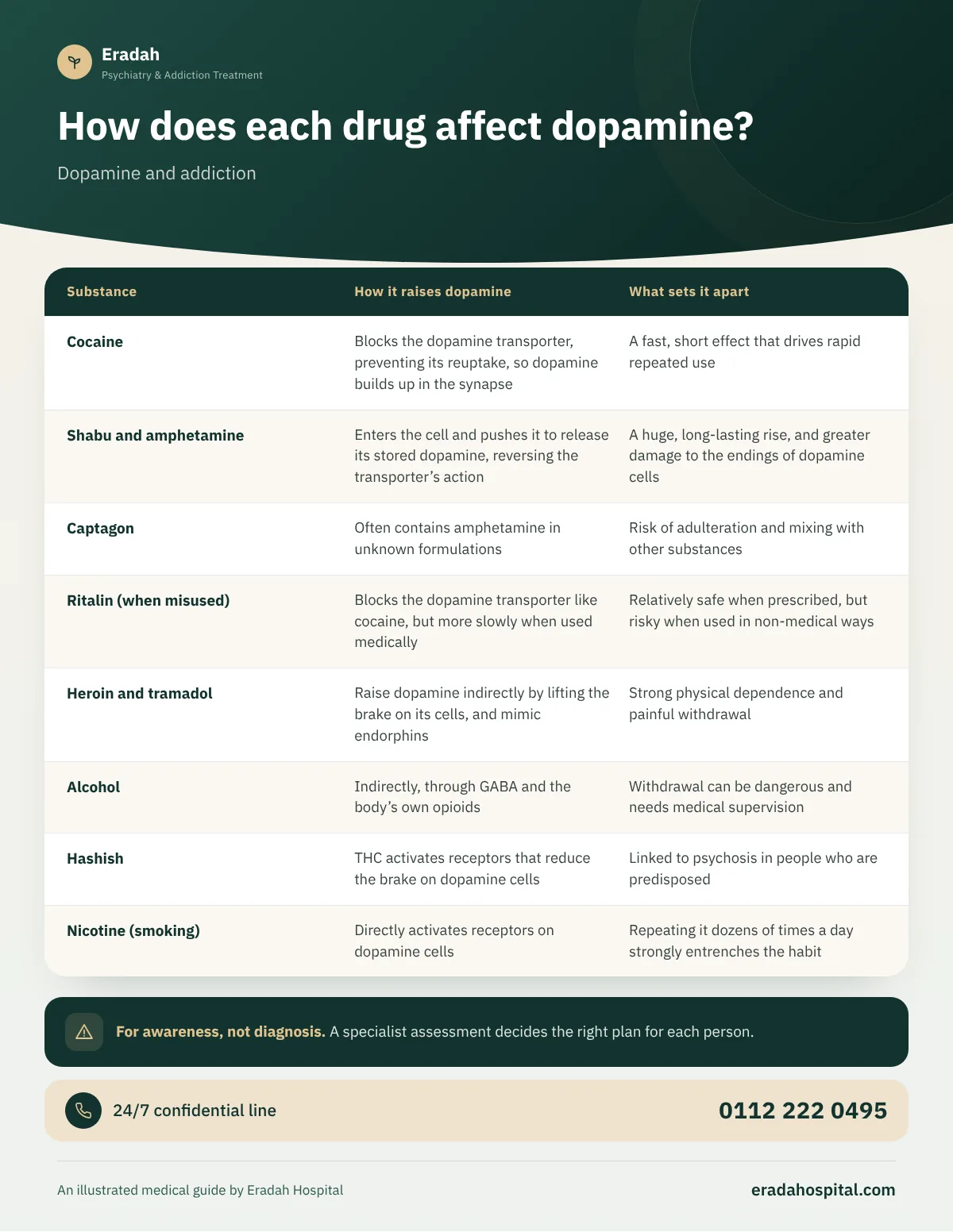
The routes differ, but the shared result is a rise in dopamine in the nucleus accumbens. The table explains the mechanism of each group in simplified form:
| Substance | How it raises dopamine | What sets it apart |
|---|---|---|
| Cocaine | Blocks the dopamine transporter, preventing its reuptake, so dopamine builds up in the synapse | A fast, short effect that drives rapid repeated use |
| Shabu and amphetamine | Enters the cell and pushes it to release its stored dopamine, reversing the transporter’s action | A huge, long-lasting rise, and greater damage to the endings of dopamine cells |
| Captagon | Often contains amphetamine in unknown formulations | Risk of adulteration and mixing with other substances |
| Ritalin (when misused) | Blocks the dopamine transporter like cocaine, but more slowly when used medically | Relatively safe when prescribed, but risky when used in non-medical ways |
| Heroin and tramadol | Raise dopamine indirectly by lifting the brake on its cells, and mimic endorphins | Strong physical dependence and painful withdrawal |
| Alcohol | Indirectly, through GABA and the body’s own opioids | Withdrawal can be dangerous and needs medical supervision |
| Hashish | THC activates receptors that reduce the brake on dopamine cells | Linked to psychosis in people who are predisposed |
| Nicotine (smoking) | Directly activates receptors on dopamine cells | Repeating it dozens of times a day strongly entrenches the habit |
Why does tolerance develop, and what does addiction do to dopamine receptors?
When the brain is repeatedly flooded with dopamine, it defends its balance: it reduces the number or sensitivity of D2 receptors, and it may also reduce dopamine release itself. Imaging studies have shown lower D2 receptors in people with addiction to different substances compared with others, and this reduction was linked to weaker activity in the frontal cortex that handles self-control.
The result is twofold: the person needs a larger amount to get the same effect, which is tolerance, and natural rewards lose their power to make them happy, so they become unenthusiastic or “flat.” In this way, substance use shifts from seeking pleasure to escaping emptiness and pain.
What happens to dopamine after stopping drugs?
After stopping, the reward system stays for a while in a “low” state: receptors are few and the substance is no longer there. This shows up as flatness and loss of pleasure, tiredness, disturbed sleep and mood swings, symptoms that can last weeks or months after the acute physical symptoms have passed. Some specialists call this “protracted withdrawal.”
- The first daysThe crash
After stimulants in particular: exhaustion, long sleep, hunger, depression and an intense craving for the substance.
- The first weeksFlatness
Physical improvement, while enjoyment remains difficult and concentration and mood stay unsettled.
- The first monthsGradual recovery
A gradual return of enjoyment in simple things with treatment, sleep and exercise, while sensitivity to triggers remains.
- After a year or moreClearer stability
In a study of people recovering from methamphetamine, dopamine transporters improved markedly after 12 to 17 months of abstinence.
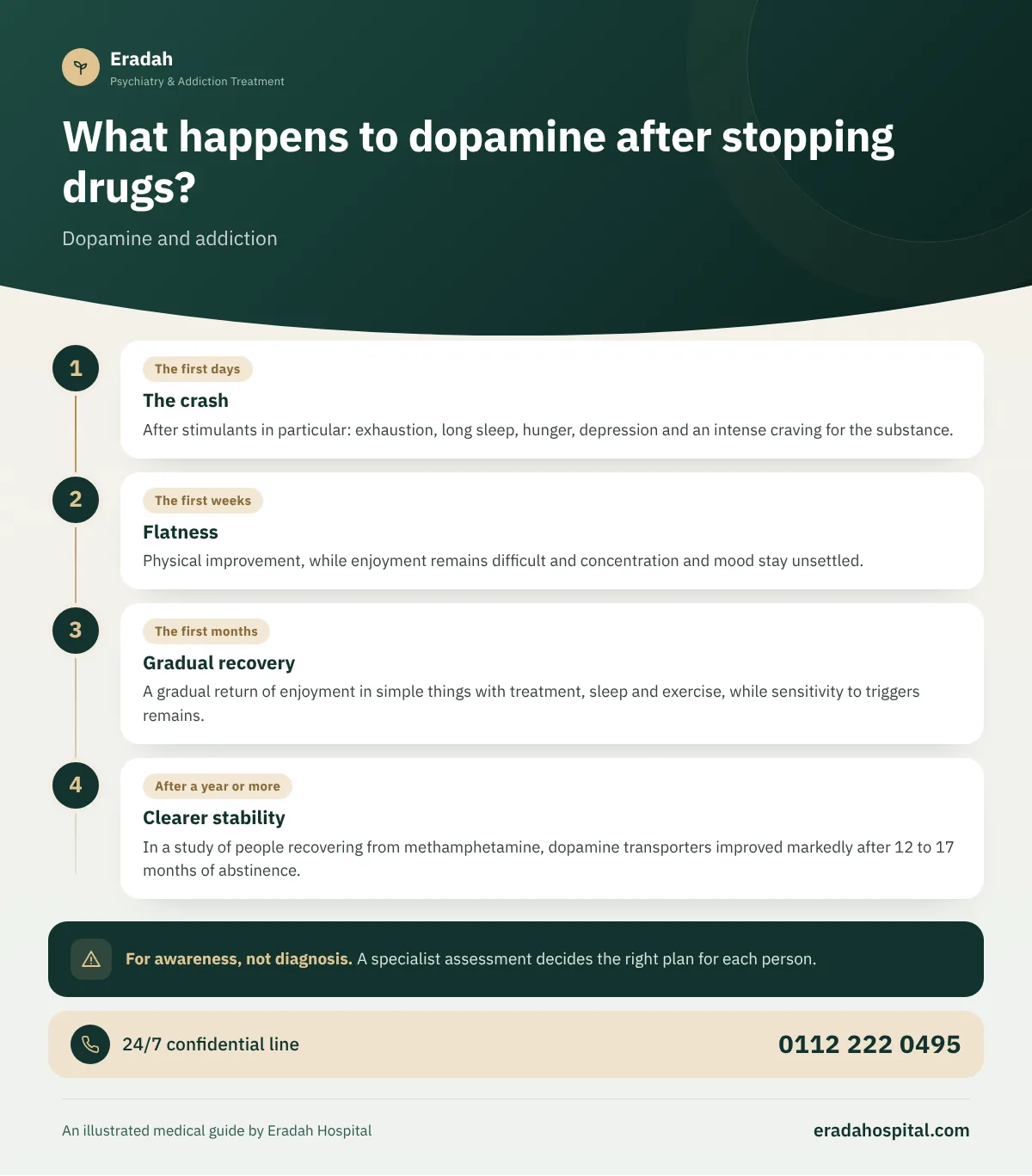
The time frames are approximate and vary with the substance, the length of use, general health and whether treatment is received. Details for each substance are on the withdrawal pages, such as shabu withdrawal and heroin withdrawal.
Why do places and people trigger cravings and relapse?
With repetition, dopamine activity shifts from the moment of use to the cues that come before it: a smell, a song, a street, a friend, or even a sum of money in your pocket. These cues set off a dopamine surge and an urgent craving before the substance is even present. The US National Institute on Drug Abuse notes that these associations can last a long time, even in people who stopped years ago.
Returning to the same place or the same company is one of the strongest triggers of craving.
Stress, sadness, boredom and loneliness push the brain toward the “old solution.”
The weekend or payday night can become a cue in itself.
The belief that “just once won’t hurt” ignores that the brain is still sensitive.
Importantly, a craving is a wave that rises and then falls within a limited time if it is not acted on. In treatment, a person in recovery learns to recognize their triggers, stay away from them, and deal with the wave when it comes, without its appearance meaning failure.
Is dopamine involved in behavioral addiction?
Yes, to varying degrees. In an early imaging study in 1998, dopamine release in the striatum rose while people played a video game. Also, the appearance of gambling and compulsive shopping in some Parkinson’s patients who take dopamine agonists is strong evidence of its role in compulsive behavior.
Some modern technologies use what is known as unpredictable intermittent reward: a notification that might carry something important, a loot box that might contain a prize, a bet that might win. This is the strongest pattern of learning and the hardest to extinguish. But the difference from drugs is important: behavioral rewards do not raise dopamine with the same force and do not cause dangerous physical withdrawal.
- Gambling and betting addiction: the clearest behavioral addiction in terms of evidence, and it exploits the “near miss.”
- Video game addiction: fast, continuous rewards and endless levels.
- Pornography addiction: endless novelty and powerful triggers.
- Social media addiction and phone addiction: likes and notifications on an unpredictable schedule.
- Compulsive shopping: the thrill of anticipation before getting the item is greater than the pleasure of owning it.
Do dopamine and the brain recover after addiction?
Yes, and there is evidence. In an imaging study of people recovering from methamphetamine, dopamine transporters were clearly low in the first months of abstinence, then rose after 12 to 17 months without use until they approached the level of non-users. But the researchers noted that improvement in mental and motor functions was not to the same extent, meaning that recovery is real but gradual, and may be partial in some areas.
This depends on neuroplasticity: the brain’s ability to rebuild its connections over time and with new experiences. Every day of abstinence, regular sleep, physical activity, a healthy relationship and a new skill strengthens alternative circuits that compete with the old ones. That is why we tell families that the “real person” returns gradually, and needs patience.
How does treatment help rebalance dopamine?
There is no pill that “resets dopamine,” but there are proven treatments that act on the reward system in different ways:
| Treatment | How it helps | For whom |
|---|---|---|
| Cognitive behavioral therapy | Teaches recognizing triggers, managing cravings and changing the thoughts that lead to use | All types of addiction |
| Contingency management (incentive system) | Provides tangible rewards for abstinence confirmed by tests, redirecting the reward system | One of the best-supported treatments for stimulant addiction |
| Medications by substance | Regulated substitutes or blockers for opioids, and medications for alcohol and nicotine addiction chosen by the doctor | Opioids, alcohol and smoking |
| Treating co-occurring conditions | Treating depression, ADHD and anxiety reduces the need for “self-medication” | Patients with dual diagnosis |
| Exercise, sleep and activities | Provide regular natural rewards during the period of flatness | Supports every treatment plan |
At Eradah, we build the treatment plan on an understanding of what is happening in the brain: safe detox when needed, then individual and group psychotherapy, treatment of the psychiatric conditions that accompany addiction, and a realistic relapse prevention plan that includes the family.
How can the family help their loved one during the dopamine flatness phase?
- Understand that flatness and low enthusiasm in the first months are part of the brain’s recovery, not laziness or ingratitude.
- Encourage small healthy rewards: a walk together, a family meal, an old hobby, without pressure or comparison.
- Help keep triggers away: old contact numbers, places, and cash on hand at the beginning.
- Celebrate progress however small; appreciation is a reward the recovering brain needs.
- Learn the early signs of relapse and respond to them calmly and with a plan, not by shouting.
- Look after yourselves and seek support for the family; recovery is a long journey for everyone.
Stimulant overdose or acute psychosis? Call an ambulance (123) immediately
- Chest pain or pressure, a fast irregular heartbeat, or shortness of breath after using cocaine, crystal meth (shabu) or Captagon
- A very high body temperature with heavy sweating or dehydration, and agitation that does not settle
- Seizures, loss of consciousness, or signs of a stroke: a drooping face, a weak arm, sudden slurred speech
- Severe suspiciousness, hallucinations and aggressive behavior that may put the person or others in danger
- Severe muscle stiffness with a high temperature and confusion after starting an antipsychotic or suddenly stopping Parkinson’s medicines
Call an ambulance (123) immediately and do not wait for it to “calm down on its own.” Stay with the person in a quiet, cool, dimly lit place, speak calmly without arguing or restraining them by force, and if they lose consciousness, place them on their side. Tell the paramedics honestly what the person took; this speeds up treatment and is not meant to blame anyone. If there are thoughts of self-harm, call the mental health support line 16328.
Ambulance 123 Mental health support line 16328