“I want to quit, but I’m scared.” Five words that sum up the state of many who call us for the first time. A fear of something unclear that grows the longer the decision is delayed. Fear of addiction treatment is not weakness, but a natural reaction to a big decision. This guide sets each fear against the facts.
Why is a person with addiction afraid of treatment?
The US National Institute on Drug Abuse says that stigma, meaning the negative view and prejudice toward people with addiction, is often among the reasons people who need help do not seek it. A systematic review published in 2024 on men specifically adds that stigma and discrimination, and negative beliefs about help-seeking tied to traditional male roles, are among the most prominent barriers, and that men in general are less likely than women to seek help.
In Egypt the picture is gradually changing. According to a statement by the Fund for Drug Control and Treatment of Addiction published by Masrawy in June 2026, the patient himself was the most frequent caller to the hotline at 35%, followed by siblings and then mothers.
Fear of withdrawal symptoms
This is the most common fear, especially for someone who tried to stop on his own and lived through harsh days. The truth is that withdrawal inside a medical setting is very different: doctors use medications that ease the symptoms, monitor fluids, sleep and blood pressure, and deal with complications before they grow. Some kinds of withdrawal, like that from alcohol and sedatives, are too dangerous to be left to the home in the first place. You can find what happens day by day in medically supervised detox.
Fear of scandal and what people think
“If anyone finds out I went into a rehab center, my reputation will be in the dirt.” The practical answer here is confidentiality: Egyptian law makes treatment data a secret, with penalties for disclosing it, as the guide to the addiction treatment law in Egypt explains. A respectable place does not reveal its patients’ identities to anyone, and does not contact the workplace or relatives without the patient’s permission.
More important, addiction is an illness that changes the brain, and seeking its treatment is not fundamentally different from treating diabetes or high blood pressure. Stigma is real, but it does not make the illness lighter. It makes it last longer.
Fear of the police and legal consequences
One of the best-known fears in Egypt: “They’ll report me.” The truth, as the law guide explains, is that Article 37 bis (a) of the Anti-Narcotics Law does not bring a criminal case against a user who comes forward on his own to seek treatment. And the Fund for Drug Control hotline 16023 provides free, confidential treatment. This is a general awareness overview and does not replace consulting a lawyer in special cases.
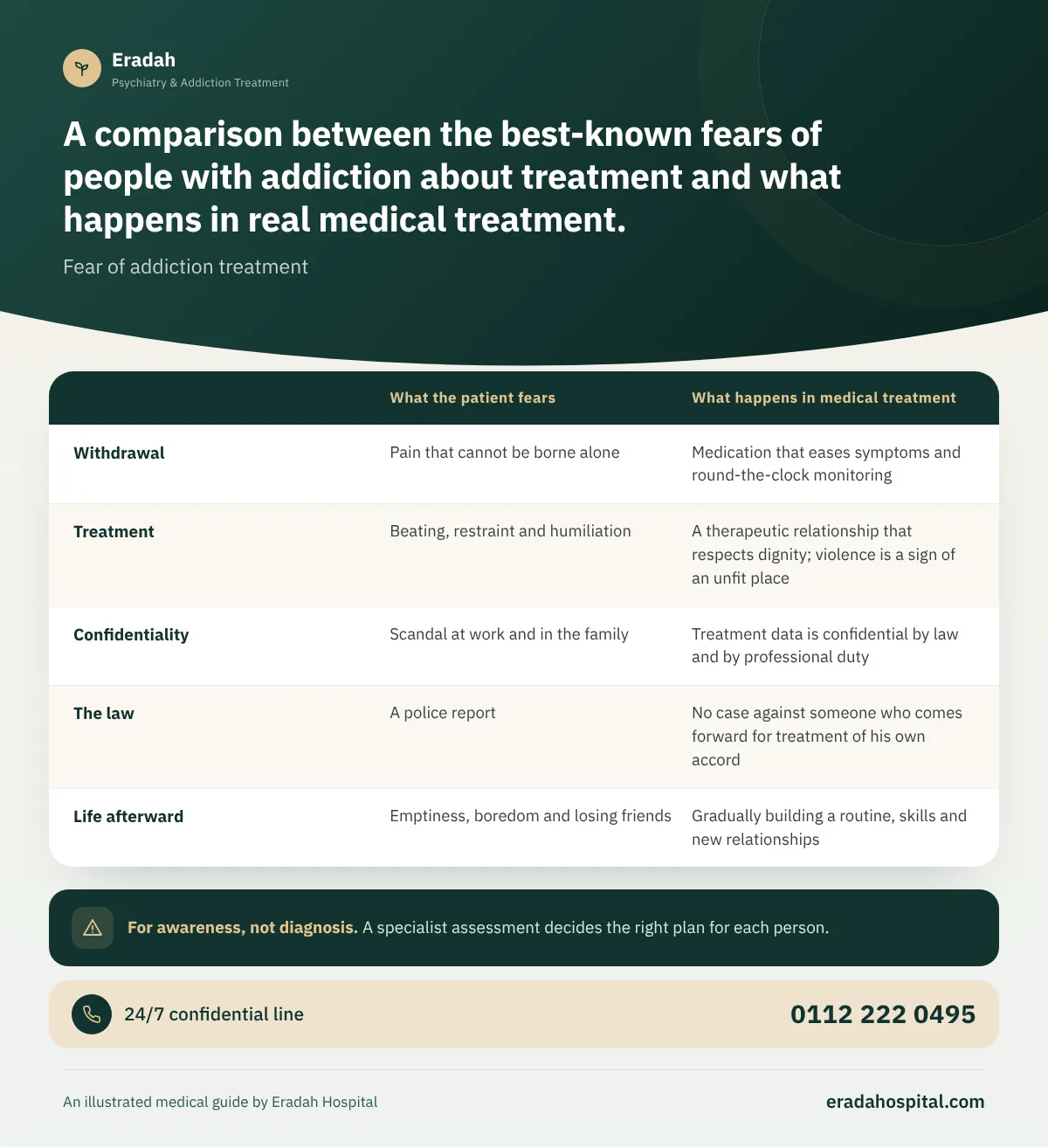
Fear and fact: a quick comparison
| What the patient fears | What happens in medical treatment | |
|---|---|---|
| Withdrawal | Pain that cannot be borne alone | Medication that eases symptoms and round-the-clock monitoring |
| Treatment | Beating, restraint and humiliation | A therapeutic relationship that respects dignity; violence is a sign of an unfit place |
| Confidentiality | Scandal at work and in the family | Treatment data is confidential by law and by professional duty |
| The law | A police report | No case against someone who comes forward for treatment of his own accord |
| Life afterward | Emptiness, boredom and losing friends | Gradually building a routine, skills and new relationships |
Fear of rehab centers because of frightening stories
Some of these stories are unfortunately true, but they are stories of unlicensed places, not stories of treatment. The page on choosing a treatment center presents examples of violating facilities that the Ministry of Health closed. A safe place is recognized by its license, the presence of psychiatrists, a written plan, and no use of violence. The full criteria are in how to choose a safe addiction treatment center.
Fear of life without the substance
This fear is deeper than the others, and is rarely said aloud: “How will I live without it? How will I sleep? How will I deal with people?” The substance was doing a job: calming anxiety, silencing sadness, or filling an emptiness. Good treatment does not strip away this function and leave the person exposed. It teaches other ways to sleep, to calm down and to cope, and treats the underlying anxiety or depression if there is any.
Fear of failure
“What if I go in and come back again?” Relapse is possible, and the National Institute on Drug Abuse says its rates are similar to those of other chronic illnesses, and that it means the treatment needs adjusting, not that it failed. An attempt that was not completed is not a total loss, since every day without the substance teaches the brain and body something.
How do you overcome the fear of addiction treatment?
- Start with a question, not a decision: call and inquire without committing to anything.
- Write down all your fears, and ask about them one by one in the consultation.
- Ask to know the plan: how many days of detox? What medications? What are visits like?
- Bring someone you trust to the first visit.
- Remember that the options are not only residential care; there is outpatient treatment for those whose condition allows.
A family that wants to help without adding to the fear will find a practical approach in how to persuade a person with addiction to accept treatment.