"If I go for treatment, will they file a report against me?" This fear alone delays thousands of people from getting treatment, and it is often based on incomplete information. Here we present the texts as published and explain what they mean in practice for the patient and his family, in simple language, without overstating either reassurance or alarm.
What is Egypt's addiction treatment law?
Egypt has no standalone law called an "addiction treatment law." Instead, there is a group of articles within the Law on Narcotics Control, Regulation of Their Use, and Trafficking in Them, No. 182 of 1960, most of them added by Law No. 122 of 1989. Its idea is to treat a person who uses drugs and asks for treatment as a patient, through three doors: coming forward for treatment voluntarily, a family request for treatment, and committing a convicted person to a treatment center instead of punishment.
Is a person with addiction held accountable if he asks for treatment himself?
Article 37 bis (a) provides that no criminal case is brought against a person who uses drugs and comes forward of his own accord for treatment before the competent committee, and he remains under treatment in treatment centers or facilities designated for that until the committee decides otherwise. The text sets two important conditions:
- If the patient leaves the center or stops attending treatment before the committee's decision, he is required to pay the cost of treatment.
- This exemption does not benefit someone who was in possession of a drug and did not hand it over to the competent authority when entering the center or attending treatment.
In practice, the Fund for Drug Control and Treatment of Addiction provides treatment free of charge and in confidence through its hotline, 16023. In a statement published by Masrawy in June 2026, the Fund said it had served 69,845 patients in the first five months of the year. You can find the steps of this route in our guide to free addiction treatment.
What if the family requests his treatment?
Article 37 bis (b) provides that no criminal case is brought against a person who uses drugs if his spouse, parent or grandparent, or child or grandchild asks the competent committee to treat him. If he agrees, he is admitted to a treatment center or required to attend treatment by decision of the committee. If he refuses, the committee refers the matter through the prosecution to the criminal court sitting in chambers, to order his admission or require him to undergo treatment. This is a formal procedure, entirely different from taking a person by force to an unlicensed place.
Can a court order treatment instead of prison?
Yes. Article 37 punishes possession of a drug for personal use, but allows the court, instead of carrying out the sentence, to order that a person proven to have an addiction be committed to a treatment center for medical, psychological, and social treatment. His stay may not be less than six months or more than three years, or the length of the sentence imposed, whichever is shorter. If he violates the duties of his treatment or the commitment proves futile, the case returns to the court.
Is addiction treatment data confidential?
Yes, by the text of the law. Article 37 bis (c) treats all information that comes to the knowledge of those working in the treatment of people with addiction and drug use as secrets whose disclosure is punishable by the penalty for disclosing secrets in Article 310 of the Penal Code. The Mental Health Patient Care Law adds that no one outside the treatment team may see the patient's documents without his written permission, and Article 49 punishes with a fine of no less than 10,000 and no more than 20,000 Egyptian pounds anyone who discloses a secret of a mental health patient.
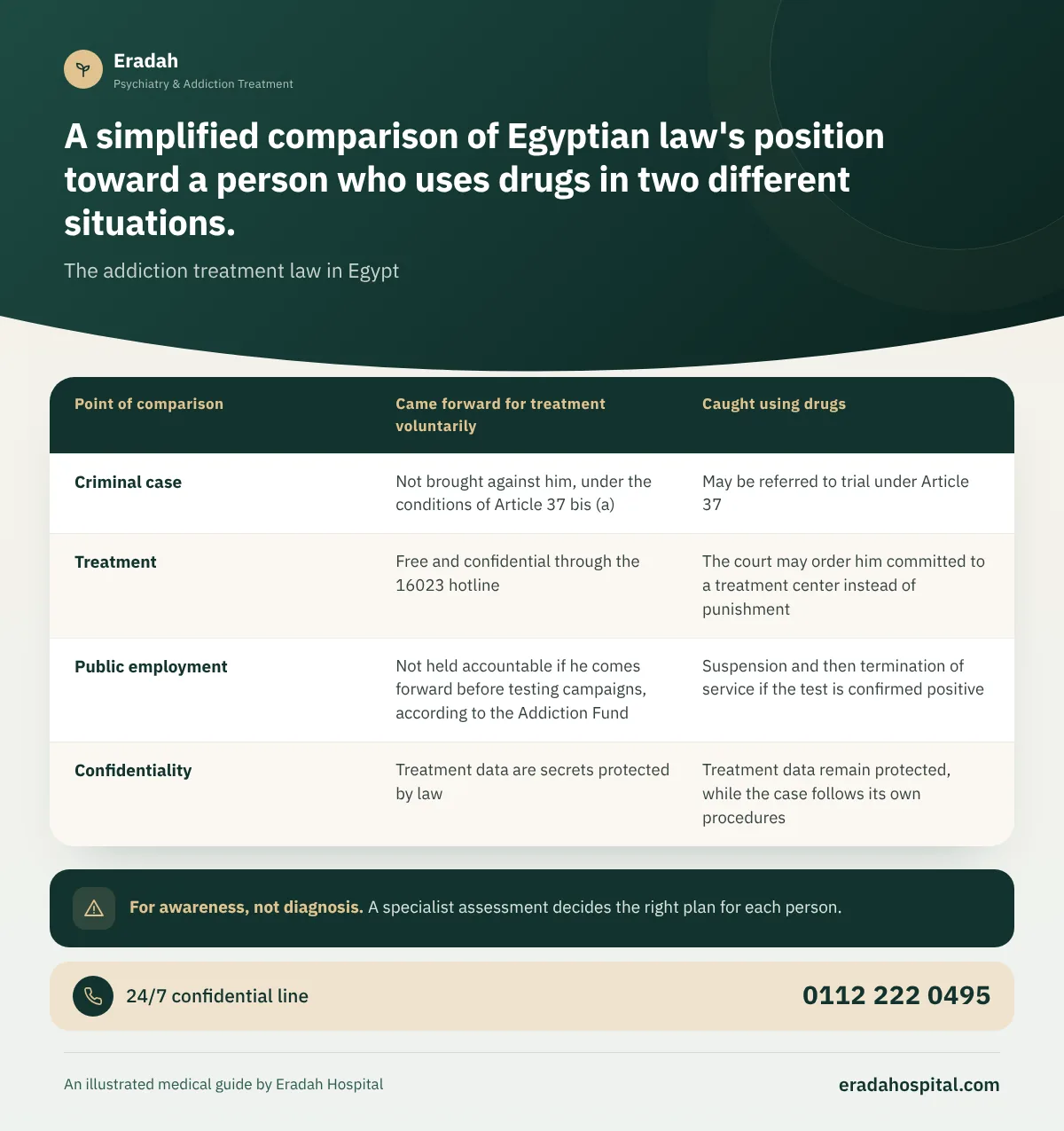
Comparison: someone who came forward for treatment and someone caught using
| Point of comparison | Came forward for treatment voluntarily | Caught using drugs |
|---|---|---|
| Criminal case | Not brought against him, under the conditions of Article 37 bis (a) | May be referred to trial under Article 37 |
| Treatment | Free and confidential through the 16023 hotline | The court may order him committed to a treatment center instead of punishment |
| Public employment | Not held accountable if he comes forward before testing campaigns, according to the Addiction Fund | Suspension and then termination of service if the test is confirmed positive |
| Confidentiality | Treatment data are secrets protected by law | Treatment data remain protected, while the case follows its own procedures |
The workplace drug testing law
Law No. 73 of 2021 requires proof of not using drugs to hold jobs in the state administrative apparatus and in private institutions of public benefit, and to remain in them. Testing is carried out by surprise at the workplace by committees from the Addiction Control Fund, the General Secretariat of Mental Health, and the Forensic Medicine Authority, according to Telegraph Masr. According to what Al-Watan published about its provisions:
- The employee discloses all medications he takes before the test, and you can find which ones may have an effect in our guide to medications that show up in a drug test.
- If the sample is positive, it is sealed, and the employee is suspended from work with half his pay withheld until the confirmatory test result appears.
- The employee may, at his own expense, ask to appeal to the Forensic Medicine Authority within 24 hours of the result, and the costs are refunded to him if it comes back negative.
- If the positive result is confirmed, his service ends by operation of law, and refusing the test or deliberately evading it is grounds for termination.
What matters for anyone who wants treatment: the head of the Addiction Control Fund confirmed, according to Masrawy in June 2026, that requests for treatment from employees who use drugs continue to be received free of charge and in confidence without legal accountability, provided they come forward voluntarily before testing campaigns reach their workplaces.
Driving under the influence of drugs
Article 76 of the Traffic Law punishes with imprisonment of no less than one year anyone who drives a vehicle under the influence of a drug or intoxicant. The penalty increases if injury or death results, along with withdrawal of the driver's license, according to Parlamany. The danger is not limited to illegal drugs; some sedative and sleeping medications also impair driving, so ask your doctor before driving.
What does the law not protect you from?
The exemption covers drug use and seeking treatment only. It does not extend to trafficking or promotion, nor to other independent crimes such as theft, violence, or driving under the influence, nor to someone who possesses a drug and does not hand it over when entering treatment. If a case is already pending, the first step is a lawyer who explains your position. This is a general educational overview of published texts, not legal advice; how the law applies varies with the details of each case, and the right decision needs a lawyer.