Why does a person with addiction refuse treatment?
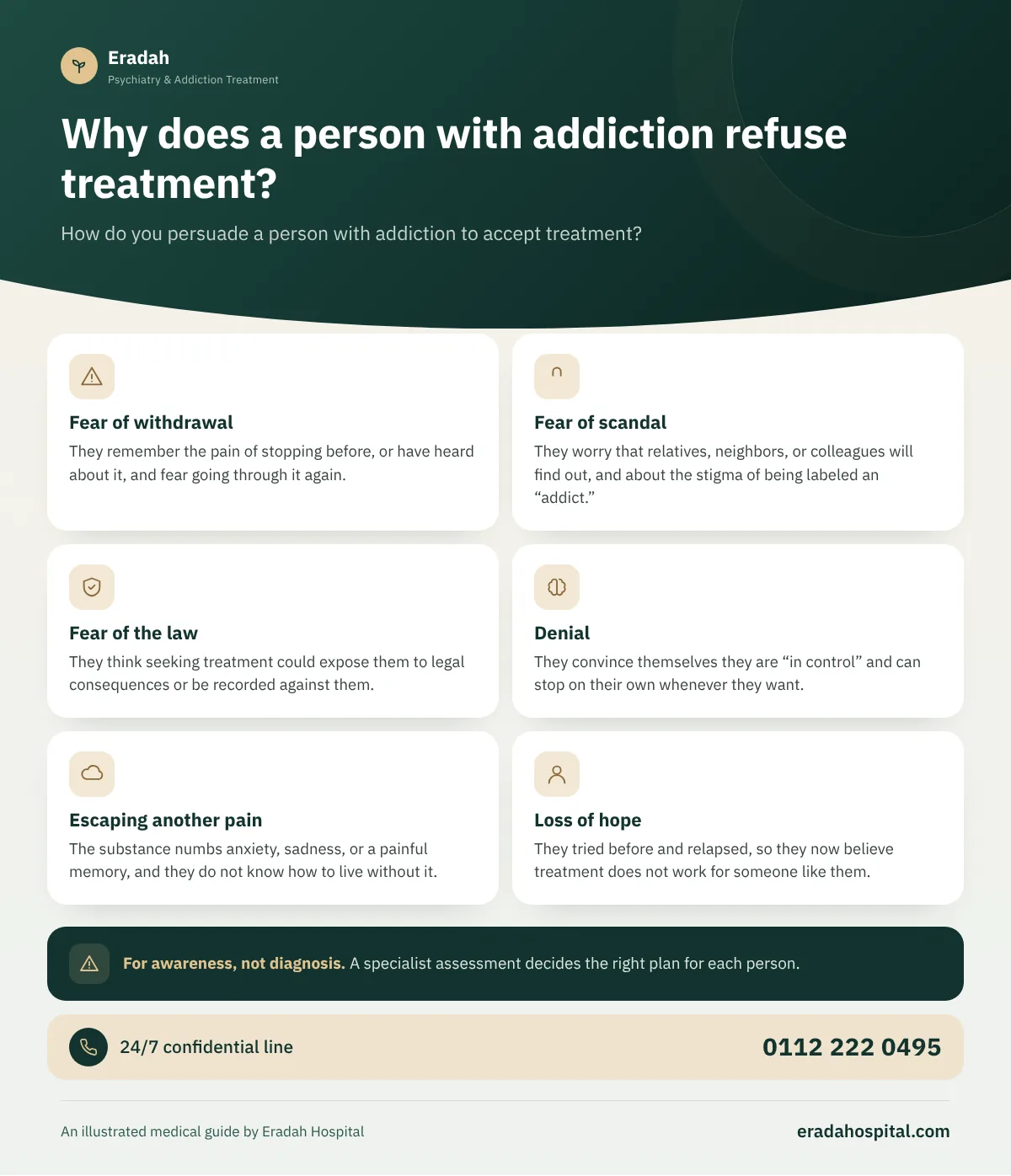
Before you look for the words that will persuade them, understand why they refuse. Refusal is seldom pure stubbornness or “not caring.” A person who uses substances is often caught in a real inner conflict: part of them wants to stop, and part of them fears what comes after.
They remember the pain of stopping before, or have heard about it, and fear going through it again.
They worry that relatives, neighbors, or colleagues will find out, and about the stigma of being labeled an “addict.”
They think seeking treatment could expose them to legal consequences or be recorded against them.
They convince themselves they are “in control” and can stop on their own whenever they want.
The substance numbs anxiety, sadness, or a painful memory, and they do not know how to live without it.
They tried before and relapsed, so they now believe treatment does not work for someone like them.
Once you know which of these fears is driving them, the conversation gets easier. Someone who fears withdrawal needs to know that medically supervised detox is safer and more comfortable than they imagine. Someone who fears scandal needs to hear about confidentiality. And someone who has lost hope needs to know that relapse is common during recovery and does not mean the end of it.
What is the CRAFT approach, and does it really work?
CRAFT stands for Community Reinforcement and Family Training. It is a program developed by researchers at the University of New Mexico to train the parents and spouses of people who refuse treatment. The American Psychological Association (APA) describes it as having three goals: getting the person to enter treatment, reducing their substance use even before treatment, and improving the well-being of the family itself.
The core idea is that the family is closest to the person and has the most influence on them. Using principles of behavioral science, a family can make life without drugs more appealing than life with them, instead of entering a conflict that pushes the person to hold on to substance use. A study published in 1999 compared three ways of training the families of people with alcohol problems who were refusing treatment:
Later studies of families of people who use other drugs showed similar results, with about two thirds of families succeeding on average. In every approach, the emotional well-being of the parents themselves improved. Source: Miller, Meyers, and Tonigan, Journal of Consulting and Clinical Psychology, 1999; and an American Psychological Association summary. These results come from research settings and may differ in real life.
How do you apply CRAFT principles at home?
It is best to learn this approach with a trained professional, but a family can start with its basic principles today. Here are the steps in simplified form:
- Understand the pattern of use: When do they use? With whom? After which situations or feelings? What comes before the days when they do not use? This map shows you the triggers and the openings.
- Put safety first: If there is a history of violence, plan how to protect yourself and the children before taking any step, and do not confront them alone while they are under the influence.
- Change how you talk: Use short, positive sentences that start with “I,” describe the behavior rather than the person, and acknowledge their feelings before you ask anything of them.
- Reward abstinence: On days when they are sober, show interest and warmth, suggest activities they enjoy, and make time with them pleasant.
- Withdraw the reward when they use: When they use, step away calmly from the gathering or activity, without shouting or lecturing, so that they feel the difference themselves.
- Let natural consequences happen: Do not clean up after them, lie for them, or pay off debts from their substance use, as long as this does not put them at serious risk.
- Take care of yourself: Rebuild your life and your interests. A steady family has more influence than an exhausted one.
- Invite them to treatment at the right moment: Arrange a place and an appointment in advance, so that “yes” becomes an immediate step rather than a postponed promise.
These principles do not mean being lenient with substance use or accepting it. They mean stopping the battles that change nothing and spending your energy on what actually makes a difference. You will need patience: change usually shows over weeks, not days.
What should you say to persuade them, and what should you avoid?
The same words can open a door or close it. Here are practical examples of common phrases that do harm, with alternatives closer to the CRAFT approach and motivational interviewing:
| Instead of saying | Try saying |
|---|---|
| “You’re an addict and a failure, and you’ve thrown your life away.” | “I’m worried about you. I’ve noticed you’re not sleeping or eating the way you used to.” |
| “If you were a real man, you would have stopped.” | “I know stopping is hard, and asking for help takes nothing away from you.” |
| “You’ve embarrassed us in front of everyone.” | “What matters to me is you, not what people say, and your treatment will be confidential.” |
| “Either you get treatment or you leave the house.” | “I’m ready to go with you tomorrow, just for an assessment, and we’ll decide together afterward.” |
| “You always lie.” | “I feel confused when I hear different stories, and I want to be able to trust you again.” |
| “Why are you doing this to us?” | “It seems something is bothering you. Would you like to tell me about it?” |
| “You’re just like your father,” or “like your uncle.” | “You’re not alone, and many people have recovered from this illness.” |
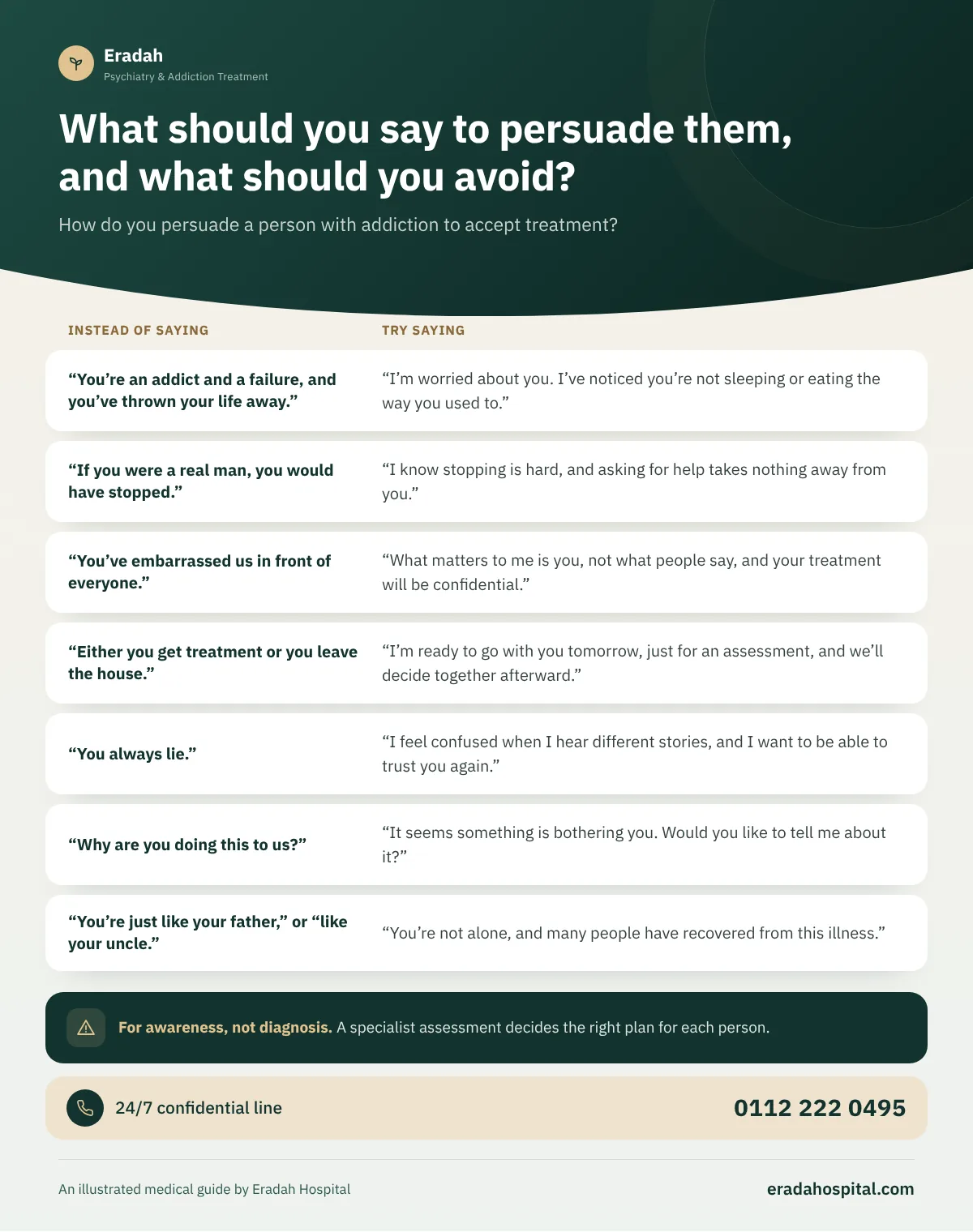
Notice that the alternatives are all short, speak about your own feelings and what you have seen, and end with a specific offer or an open question. Avoid long lectures: a person who feels cornered stops listening after the first sentence.
“I’m not asking you to decide right now to go into a facility. I’m only asking that we hear a doctor’s opinion once, and I’ll be with you every step of the way.”
What is the best time to raise the subject of treatment?
Timing is half the success. The same conversation can be rejected at one moment and accepted at another. The CRAFT approach focuses on what it calls “windows of opportunity,” moments when the person is more ready to listen:
- After a bad experience caused by substance use, when they feel regretful or frightened, such as a problem at work, an accident, or a major argument.
- When they themselves complain about being tired, about sleep or money, or say “I’m fed up.”
- When they ask why your way of treating them has changed, after you have started using a calmer approach.
- At a quiet, private time when they are sober, away from the rest of the family and from guests.
On the other hand, avoid raising the subject when they are under the influence, during withdrawal and irritability, in front of other people, in the middle of an argument, or when you are angry yourself. If one opportunity is lost, others will come; what matters is that you are ready with the appointment and the place when they do.
Does group confrontation (an “intervention”) work?
Films and TV shows have popularized the image of the “intervention”: family and friends suddenly gather, confront the person with written letters, and give them a choice between treatment and being cut off. This method looks powerful, but research does not support it as a first choice:
- In the comparison study mentioned above, the rate of entering treatment with it was less than half the CRAFT rate.
- Many families back out of carrying it out in the first place because it feels harsh or they fear the reaction.
- The person may feel humiliated and betrayed, withdraw from the family or become more secretive, and may even become violent.
- Even if they agree under pressure, they may quickly drop out of treatment if no real motivation has been built.
This does not mean a family should avoid being clear or setting limits. But a calm, gradual approach built on encouragement works better in most cases than a sudden confrontation.
What exactly should you offer when they agree?
The most common way a moment of agreement is lost is when the family says, “OK, we’ll look for a place,” and then days pass and the person changes their mind. So prepare your offer in advance:
Know in advance where they will go and when, ideally within a day or two of their agreeing.
Start with an “assessment” or a “consultation,” not “months in a facility.” The doctor is the one who decides the level of treatment.
Explain that medical treatment is covered by patient confidentiality, and that you will choose who gets to know.
There is outpatient treatment and residential treatment, depending on the case, and the decision comes after the assessment.
Tell them you will go with them and that they will not face this alone.
It is also helpful to know that Egyptian Anti-Narcotics Law No. 182 of 1960 and its amendments provides that criminal proceedings are not brought against a person who uses drugs and comes forward on their own for treatment, or whose spouse or a close relative asks for their treatment, under conditions and procedures set by the law. The hotline of the Fund for Drug Control and Treatment of Addiction, 16023, also offers free, confidential consultations and treatment. This is general educational information and not legal advice; consult a lawyer about your situation.
When is involuntary admission for treatment used in Egypt?
Many families ask whether they can have their son admitted to a facility against his will. The answer is that involuntary admission is a limited exception regulated by the Mental Health Patient Care Law No. 71 of 2009, and is not an ordinary way to treat addiction. In general, the law requires that a psychiatrist makes the decision, that there is a mental disorder whose sufferer refuses treatment, and that there is a likelihood of imminent, severe deterioration in their condition, or a serious and imminent danger to their life or safety or to the lives of others.
The law sets safeguards for the patient’s rights: fixed time limits for continued stay, re-evaluation by doctors, notification of oversight bodies, and the right to file a grievance. Drug use alone, without a clear mental disorder or imminent danger, is not usually enough. As for psychosis, severe agitation, or suicide risk linked to substance use, these should be taken to a psychiatrist or emergency care immediately, and they are the ones who judge the appropriate step. This is a general overview and does not replace consulting a psychiatrist or a lawyer.
What if the refusal continues for months?
Some people need more time, and that does not mean your effort was wasted. In research, the emotional well-being of families improved even when their loved one had not yet entered treatment, and many patients accept treatment after months of their family changing its approach. During this stage:
- Keep going with family counseling or a family therapy program, which supports you and develops your approach.
- Hold your boundaries calmly and consistently, and do not give them up under pressure or threats.
- Do not cut off human contact: a check-in message or an invitation to lunch keeps the door open.
- Watch for warning signs, and know in advance what to do in an overdose or a mental health crisis.
- If they clearly suffer from depression or anxiety, they may agree to see a psychiatrist “for a sleep problem” or “for stress” before they agree to talk about addiction.
And remember that winning the argument does not matter; what matters is that you remain the person they turn to when they decide. For more on day-to-day coping and protecting yourself, see the guide for families of a person with addiction.
When should you not wait to persuade them?
Everything above assumes the situation can allow time. But there are cases where waiting is a real danger, and you need an ambulance or emergency care immediately, whether or not they agree:
Urgent danger that cannot wait for persuasion? Call the ambulance on 123
- Loss of consciousness, or slow or irregular breathing after using
- Seizures, or severe confusion with a high fever
- Hallucinations or severe suspicion with threats of harm or violent behavior
- Serious talk of wanting to die or saying goodbye to family
- Going without sleep for days with agitation and dangerous impulsiveness
In these situations there is no room for conversation or persuasion: call the ambulance on 123 or go to the nearest emergency department. Do not leave them alone if they are a danger to themselves, keep dangerous objects out of their reach, and you can call the mental health support line on 16328. If there is violence, move yourself and the children to a safe place first.
Ambulance 123 Mental health support line 16328