What is pregabalin?
Pregabalin is a chemically manufactured medicine belonging to a group known as gabapentinoids, the same group as the drug gabapentin. In Egypt and the Arab world it is mostly known by its best-known brand name, "Lyrica", along with many other brand names for the same substance.
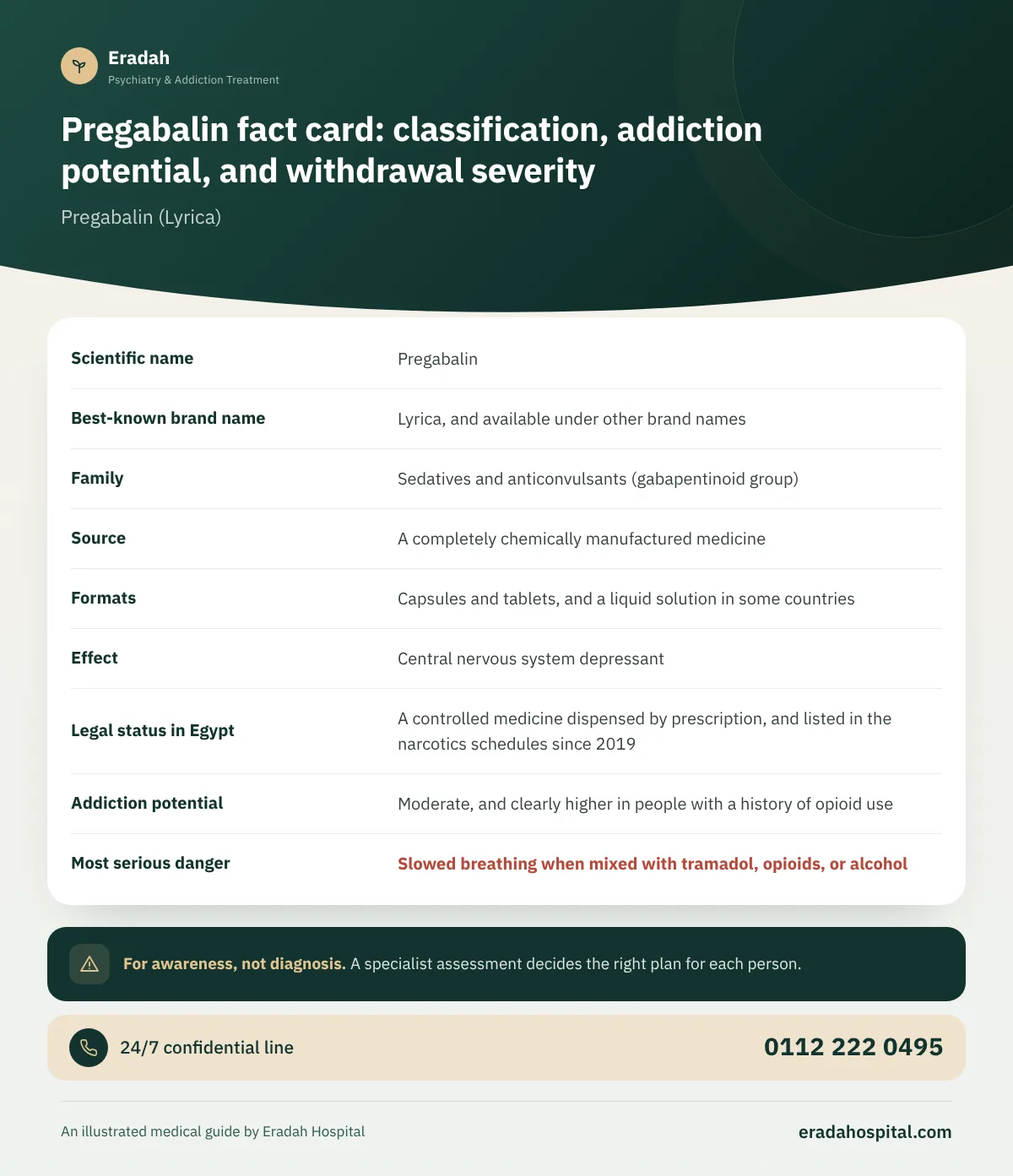
Pregabalin reached the market in the middle of the first decade of the 2000s and spread quickly because it helped many patients with chronic nerve pain that does not respond to ordinary painkillers. At first it was not classified as a high-risk drug for addiction, but over the years reports of its misuse increased around the world, and many countries tightened control over its dispensing.
Although its name suggests similarity to a calming neurotransmitter in the brain known as GABA, it does not act directly on the receptors of this neurotransmitter as traditional sedatives such as Xanax do. It has a different mechanism, which we explain below.
What are the medical uses of pregabalin?
Pregabalin is a genuine medicine with an established place in medicine, and it should not be seen only as a narcotic. It is prescribed after the doctor's assessment for several conditions, which differ slightly from country to country depending on licensing:
Such as nerve pain caused by diabetes, the pain that follows shingles, and nerve pain after spinal cord injuries.
An add-on treatment for partial seizures in adults, added to other medicines.
Approved for this purpose in Europe, the UK, and other countries, but not approved for it in the United States.
Approved for its treatment in some countries such as the United States.
How does pregabalin affect the brain and body?
Pregabalin binds to a specific part of the calcium channels at the ends of nerve cells called the "alpha-2-delta" subunit. This binding reduces calcium entering the cell, so the cell releases less of the excitatory neurotransmitters, such as glutamate and norepinephrine. The result is a calming of the excess nerve signals responsible for pain, seizures, and anxiety.
- In therapeutic use: It relieves nerve pain, reduces seizures, and calms anxiety in some patients.
- In large amounts: It causes a feeling of relaxation, euphoria, and detachment, with dizziness, drowsiness, and unsteadiness, and this is what leads some people to misuse it.
- With repeated use: The nervous system adapts to its presence, so tolerance and physical dependence develop, and unpleasant symptoms appear if it is stopped suddenly.
One of the features of pregabalin is that it is hardly metabolized in the liver; it leaves the body unchanged through the kidneys, and its half-life is about six hours in people with healthy kidneys. For this reason, people with kidney disease and older adults need closer monitoring, because the drug builds up more in their bodies.
Pregabalin alone is rarely fatal, but mixing it with tramadol, opioids, or alcohol turns it into a real danger to breathing.
Why is pregabalin misused?
Some people misuse pregabalin by taking larger amounts than the doctor prescribed, or without a prescription at all, in search of relaxation or euphoria or to escape anxiety and insomnia. Studies note that this pattern is much more common in people with a history of opioid use, as some use it to strengthen the effect of the opioid or to ease its withdrawal symptoms.
In Egypt, in recent years the name pregabalin has been linked to mixing it with tramadol, which is an extremely dangerous mixture. The page on causes of pregabalin addiction explains the factors that make one person more vulnerable than another.
Is pregabalin banned in Egypt? The legal status
In Egypt, pregabalin is a controlled medicine dispensed by prescription. In 2019 the Ministry of Health and Population issued a decision adding pregabalin and its preparations to the narcotics schedules attached to Law No. 182 of 1960, based on the recommendation of a specialized scientific committee on addiction treatment, after its misuse increased. This means that possessing or trading it outside the regulated medical framework exposes a person to legal liability.
Internationally, the UK reclassified pregabalin and gabapentin in April 2019 as Class C controlled substances after they were linked to drug-related deaths, and in the United States it is listed among controlled medicines in Schedule V. The Fund for Drug Control and Treatment of Addiction offers free, confidential treatment through hotline 16023.
This is general educational information and not legal advice.
Pregabalin guide: everything you need to know
We have gathered everything about pregabalin into 12 pages, each answering one question in detail. Choose what you are looking for:
Harms of pregabalin
From dizziness, weight gain, and blurred vision to slowed breathing when mixed with opioids, and its effects on memory, mood, pregnancy, and driving.
Causes of pregabalin addiction
Why does a nerve pain medicine turn into an addiction? The role of opioid history, anxiety, insomnia, easy access, and environment.
Symptoms of pregabalin addiction
The physical and behavioral signs the family notices, the diagnostic criteria, and the difference between medical use and misuse.
Pregabalin withdrawal symptoms
Insomnia, anxiety, nausea, and sweating that begin within a day or two of stopping, and may reach seizures; this is why gradual medical tapering is needed.
Pregabalin addiction treatment
A comprehensive assessment, safe medical tapering, treatment of the original pain or anxiety and any opioid dependence, then psychological therapy and relapse prevention.
How long pregabalin stays in the body
It leaves the body relatively quickly through the kidneys, and it does not show up on the usual routine test but needs a special test.
Pregabalin and sex: what does Lyrica do to desire and erection?
Pregabalin and sex: what the Lyrica label says about reduced desire and erection and delayed orgasm, the truth about using it for premature ejaculation, its effect on fertility, and the danger of combining it with tramadol.
Pregabalin alternatives: how does the doctor choose the right medicine for you?
Alternatives to pregabalin depending on why it was prescribed: other nerve pain medicines, creams, and physiotherapy, alternatives for anxiety, and why you should not substitute gabapentin or tramadol on your own.
Lyrolin: a short guide to the pregabalin medicine in circulation in Egypt
Lyrolin is pregabalin itself under a brand name in circulation in Egypt: its medical uses, its most common side effects, why it is misused with tramadol, and how to stop it safely.
The difference between pregabalin and tramadol: a comparison for patients and families
The difference between pregabalin and tramadol: how each works, which is more dangerous in addiction and overdose, the difference in withdrawal symptoms, and why combining them is dangerous.
The difference between pregabalin and gabapentin: which suits you and why?
The difference between pregabalin and gabapentin for the patient: why the doctor chooses one of them, the difference in licensed uses, side effects, and misuse risk, and whether switching between them is acceptable.
Pregabalin for anxiety: effectiveness, risks, and its place among treatments
Pregabalin for anxiety: what trials and guidelines say about its effectiveness in generalized anxiety, why it is not the first choice, the risks of dependence, and safer alternatives.
Pregabalin compared with similar medicines
Many people confuse pregabalin with other sedative or painkilling medicines. This is a simplified comparison to aid understanding, and it does not replace consulting a doctor:
| Medicine | Group | Medical use | Main danger when misused |
|---|---|---|---|
| Pregabalin | Gabapentinoids | Nerve pain, epilepsy and, in some countries, anxiety | Slowed breathing when mixed with opioids, and dependence |
| Gabapentin | Gabapentinoids | Nerve pain and epilepsy | Similar to pregabalin but absorbed more slowly |
| Tramadol | Opioids | Painkiller for moderate to severe pain | Addiction, seizures, and slowed breathing |
| Xanax | Benzodiazepines | Anxiety and panic attacks | Rapid dependence and withdrawal that may cause seizures |
| Rivotril | Benzodiazepines | Epilepsy and panic attacks | Dependence and a long withdrawal that can cause seizures |
The most dangerous common factor among these medicines is that mixing any of them with another or with alcohol multiplies the depression of the nervous system and breathing, even if each substance alone seems "tolerable".
Common misconceptions about pregabalin
| The common belief | The truth |
|---|---|
| "It's a medicine from the pharmacy, so it doesn't cause addiction" | Being a medicine does not mean it is safe without supervision; misusing it causes physical and psychological dependence. |
| "It's milder than tramadol, so it's not dangerous" | Its greatest danger appears when it is mixed with tramadol or opioids, which clearly increases the risk of stopped breathing. |
| “It can be stopped at any time” | Stopping suddenly after regular use can cause anxiety, insomnia, and sweating, and may cause seizures in some patients. |
| "It treats tramadol addiction" | It is not a treatment for addiction, and using it on your own to ease withdrawal opens the door to a new dependence. |
Found out your son is misusing pregabalin? Start here
You may find strips or boxes of pregabalin in your son's room without a prescription, or notice unusual drowsiness, dizziness, and slurred speech. Your first reaction matters, and these are practical steps:
- Stay calm first, and do not start the conversation while they are under the influence.
- Check whether the medicine was prescribed to them by a doctor; they may be taking it for a genuine medical reason.
- Talk to them with concern rather than accusation, and ask why they use it: pain, anxiety, insomnia, or friends.
- Be aware that tramadol or other substances may be present with it; the mixture is the most dangerous.
- Do not force them to stop suddenly at home; ask for a medical assessment for a safe tapering plan.
- Remember the ambulance number, 123, and learn the danger signs listed at the end of the page.
You will find the physical and behavioral signs in detail on the page Symptoms of pregabalin addiction.
Signs of pregabalin poisoning or overdose: call an ambulance on 123 immediately
- Extreme drowsiness, or difficulty waking the person, with no response to calling
- Slow, shallow, or irregular breathing, especially if the medicine was mixed with tramadol, opioids, or alcohol
- Blue or pale lips and fingernails
- Severe confusion, agitation, hallucinations, or unintelligible speech
- Seizures, or sudden swelling of the face, lips, and throat with difficulty swallowing or breathing
Call an ambulance on 123 immediately, place the person on their side so they do not choke, do not give them anything by mouth, stay with them until help arrives, and keep the medicine packs they took to show the doctor. If opioids or tramadol were part of the mixture, the emergency team may use the drug naloxone to reverse their effect.
Call the ambulance 123