“Every time I feel like a failure I stay home, and the longer I stay home the more of a failure I feel.” This sentence sums up what cognitive behavioral therapy treats: a cycle in which thoughts, feelings and actions feed one another. The core idea is simple, but applying it takes practice and a qualified therapist.
What is cognitive behavioral therapy?
Cognitive behavioral therapy, abbreviated CBT, is a type of talking therapy based on the idea that the way we interpret situations affects our feelings and actions, and that some of these interpretations are automatic and distorted without our noticing. The therapist does not try to convince you to think positively; instead, they teach you to examine a thought as a doctor examines a symptom: what is the evidence for it? What is the alternative explanation? What happens if you act differently?
It differs from therapies that focus on exploring childhood for many years: it deals mainly with current problems, has clear agreed goals, and progress is measured step by step.
How does cognitive behavioral therapy work?
The therapist explains to the patient that suffering often comes not from the situation alone but from a repeating cycle that can be drawn on a sheet of paper:
- 1The situation
An ordinary event: a message that has not been answered, a look from your manager, or a gathering with old friends from your using days.
- 2The automatic thought
A quick, untested interpretation: “He must be upset with me,” “I can't do it,” “One cigarette won't make a difference.”
- 3The feeling and the body
Anxiety, sadness or craving, with palpitations, tension or insomnia.
- 4Behavior
Avoidance, withdrawal, substance use or procrastination, which brings temporary relief.
- 5Result
The temporary relief confirms the original thought, so the cycle returns stronger next time.
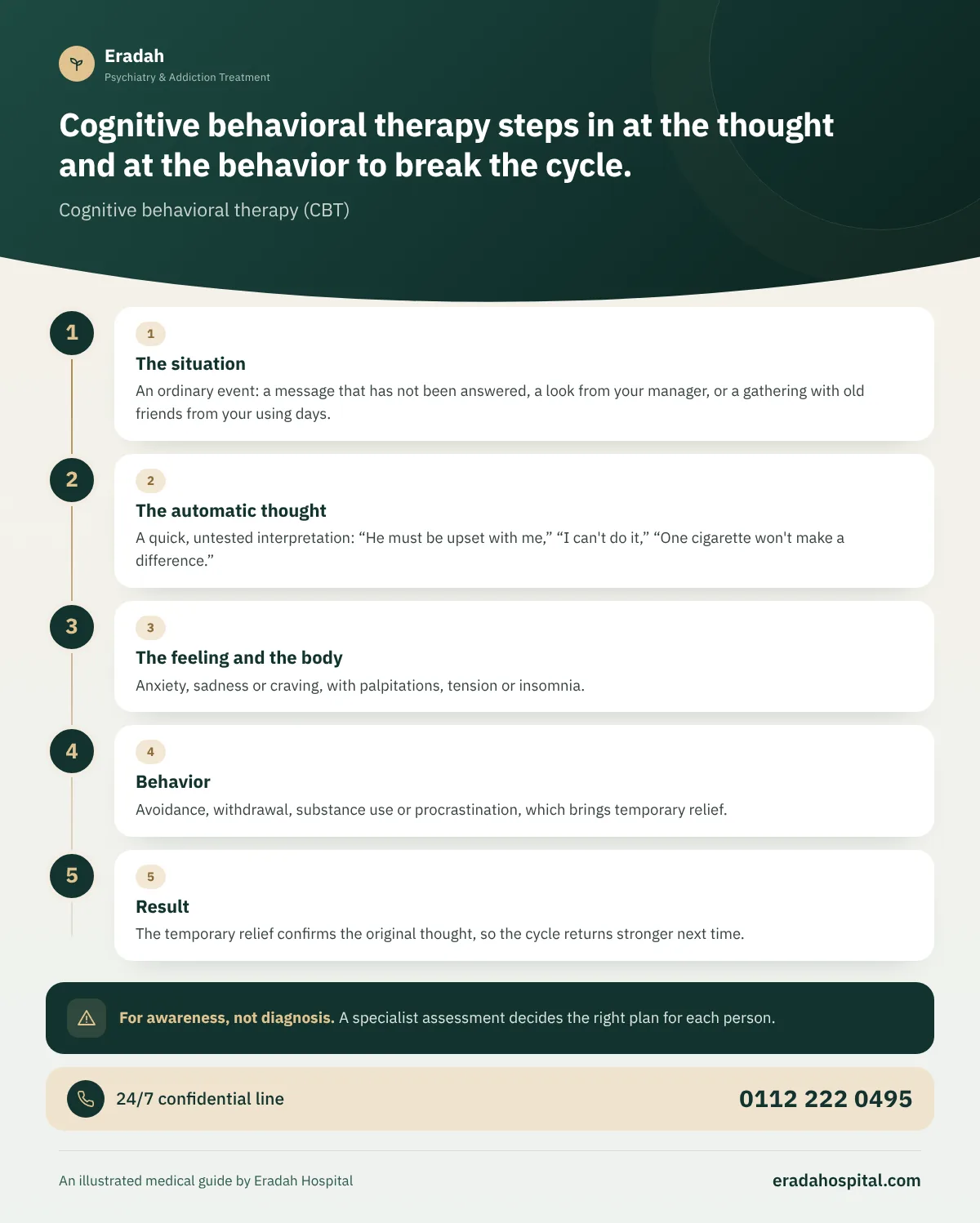
The “cognitive” side works on the link of thought, and the “behavioral” side works on the link of action, such as gradual exposure to feared situations or scheduling enjoyable activities for someone with depression. Changing either link weakens the whole cycle.
What conditions does it treat?
According to the UK's National Health Service, cognitive behavioral therapy is recommended for conditions including depression, anxiety of various types including social anxiety and obsessive-compulsive disorder, post-traumatic stress disorder, and eating disorders, and as part of the treatment of bipolar disorder and personality disorders. It also helps with sleep problems, chronic pain and alcohol and drug problems. A study published in 2012 reviewed hundreds of meta-analyses and found that the strongest evidence for its effectiveness concerns anxiety disorders, stress, anger problems and bulimia.
Cognitive behavioral therapy in addiction treatment
In addiction treatment, the patient learns to draw a personal map: which situations, people and feelings come before substance use? Then they practice specific skills: refusing an offer, riding out a craving until it passes, solving problems instead of escaping them, and spotting the thoughts that justify “just one time”. A study published in 2009 analyzed the results of 53 randomized trials in adults with alcohol or drug addiction and found a small but consistent positive effect, clearest with cannabis and fading gradually over the months. That is why it is used together with other treatments rather than alone, and is a core part of plans to prevent relapse.
What happens inside a cognitive behavioral therapy session?
The journey starts with an assessment in which the therapist identifies the problem and the goals. In a typical session, what has happened since the last session is reviewed, then a difficult situation that really happened is chosen and analyzed: what did you think? What did you feel? What did you do? Then a small experiment or task is agreed for before the next session. The NHS stresses that practice between sessions is essential for the therapy to work, and you may be asked to record your progress in a notebook or form.
The best-known tools of cognitive behavioral therapy
Writing down the situation, the thought and the feeling, then looking for evidence for and against.
Testing the thought in reality instead of arguing with it in your head.
Scheduling enjoyable and useful activities to break the inertia of depression.
Facing feared situations step by step without escaping.
Skills for letting the wave of craving pass without giving in to it.
Breaking a big problem into small, doable steps.
Does cognitive behavioral therapy suit everyone?
The therapy requires active participation and willingness to experiment, and it can be hard at first because it asks you to face what frightens you. It is not suitable on its own for someone with acute psychosis or an acute suicidal crisis before stabilization. In cases of intense emotional swings and self-harm, the doctor may prefer dialectical behavior therapy, which is a developed version of it. It can be delivered individually or in a group.
When and where to begin?
If symptoms disrupt your work, relationships or sleep for more than two weeks, or substance use returns whenever you face stress, that is a signal to seek an assessment. At Eradah, cognitive behavioral therapy is used within residential treatment and outpatient treatment, and is combined with medication when addiction and mental illness occur together in dual diagnosis.