What are opioids?
Opioids are any substances that act on the body’s opioid receptors, whether extracted directly from the poppy plant, made from it chemically, or manufactured entirely in laboratories.
The origin of the family is opium, the dried sap of the poppy seed pod, which contains active substances, chiefly morphine and codeine. Heroin was later made from morphine, and pharmaceutical companies then developed fully synthetic painkillers such as tramadol, fentanyl and methadone.
Some writers use the word “opiates” for natural substances only and “opioids” for everything that acts on the same receptors, but the common medical practice today is to use a single name for the whole family, because its members share the same mechanism of action and the most serious harms.
This family includes medicines that are indispensable in hospitals for severe pain, cancer pain and anesthesia, as well as substances that are illegal and have no medical use in Egypt. The real difference between treatment and addiction is not determined by the name of the substance alone; medical supervision and the purpose of use are what make the difference.
How do opioids affect the brain and body?
The body naturally makes opioid-like substances, such as endorphins, that help it bear pain and stress. Opioids mimic these substances but with far greater strength. They bind to opioid receptors in the brain, spinal cord and gut, relieving pain and triggering a large release of dopamine in the reward circuit, so the person feels euphoria and relaxation.
Strong pain relief and a feeling of warmth, relaxation and detachment from worries.
Opioid receptors in the brainstem control breathing, which is why breathing can slow until it stops.
With repeated use the brain needs more for the same effect, and withdrawal appears when use stops.
Severe constipation, pinpoint pupils, drowsiness, nausea, and weakened hormone function with continued use.
The problem is that the body develops tolerance to the euphoria faster than to the respiratory depression. The person who uses them takes more to reach the same effect, while the risk of stopped breathing remains, and it rises sharply after a break in use during which the body loses its tolerance.
What are the types of opioids by source?
Doctors usually classify opioids into three groups according to their source. This classification does not mean that natural ones are less dangerous; the risk depends on the strength of the substance, how it is used, and whether it is mixed with others.
| Group | Meaning | Examples from this family |
|---|---|---|
| Natural opioids | Substances found in the poppy plant itself | Opium, morphine, codeine |
| Semi-synthetic opioids | Made by chemically modifying a natural substance | Heroin, made from morphine |
| Fully synthetic opioids | Made in laboratories without needing the plant | Tramadol, tapentadol, fentanyl, methadone |
One of the newest members of the family is tapentadol, an opioid painkiller dispensed by prescription for severe pain. Like other opioids, it carries a risk of tolerance, dependence and withdrawal if used without medical supervision.
There is another classification by use: medicines for pain relief such as morphine, tramadol, codeine and medical fentanyl; medicines used to treat addiction itself such as methadone; and substances with no medical use in Egypt such as heroin and raw opium.
Types of opioids
Each substance in the opioid family has a complete guide and separate pages on its harms, symptoms and treatment. Here is a brief profile of each:
Heroin
HeroinAlso known as: diacetylmorphine
A semi-synthetic opioid made from morphine, among the fastest drugs to cause addiction and the most closely linked to overdose.
- Classification
- Semi-synthetic opioid
- Medical use
- Not used medically in Egypt
- Addiction potential
Very high- Withdrawal
Very high
Main risk: respiratory arrest in overdose
Tramadol
TramadolAlso known as: Tamol
An opioid painkiller prescribed for moderate to severe pain, and one of the most misused medications in Egypt.
- Classification
- Synthetic opioid (medication)
- Medical use
- Painkiller for moderate to severe pain
- Addiction potential
High- Withdrawal
High
Main risk: seizures, especially at high doses
Morphine
MorphineThe main active ingredient in opium, used in hospitals to relieve severe pain under close supervision.
- Classification
- Natural opioid
- Medical use
- Relief of severe pain in hospitals
- Addiction potential
Very high- Withdrawal
Very high
Main risk: respiratory depression
Codeine
CodeineA relatively weak opioid found in some cough medicines and painkillers, misused in large doses.
- Classification
- Natural opioid
- Medical use
- Some cough medicines and painkillers
- Addiction potential
Moderate- Withdrawal
Moderate
Main risk: liver damage from the paracetamol (acetaminophen) in some tablets
Fentanyl
FentanylA synthetic opioid about 50 times stronger than heroin; a tiny amount can be enough to stop breathing.
- Classification
- Synthetic opioid
- Medical use
- Anesthesia and very severe pain
- Addiction potential
Very high- Withdrawal
Very high
Main risk: fatal overdose from a tiny amount
Methadone
MethadoneA long-acting opioid used medically for pain and within treatment programs for opioid addiction.
- Classification
- Long-acting synthetic opioid
- Medical use
- Pain treatment and opioid addiction treatment programs
- Addiction potential
High- Withdrawal
High
Main risk: it builds up in the body and can disturb heart rhythm
Opium
OpiumThe dried latex of the opium poppy capsule, and the origin of the opioid family from which morphine and codeine are extracted.
- Classification
- Raw natural opioid
- Medical use
- Not used medically in its raw form
- Addiction potential
High- Withdrawal
High
Main risk: respiratory depression, which increases with sedatives
Tapentadol
TapentadolA modern synthetic opioid painkiller prescribed for severe pain, which carries a risk of dependence and addiction like other opioids.
- Classification
- Synthetic opioid (medication)
- Medical use
- Painkiller for severe acute and chronic pain
- Addiction potential
High- Withdrawal
High
Main risk: respiratory depression, especially with sedatives and pregabalin
Nalbuphine
NalbuphineAlso known as: Nalbuphine, Nubain
An injectable opioid painkiller with a dual action, misused in gyms and able to trigger withdrawal in people who use opioids.
- Classification
- Mixed-action opioid (medication)
- Medical use
- Injectable painkiller for severe pain
- Addiction potential
Moderate- Withdrawal
Moderate
Main risk: respiratory depression with sedatives, and sudden withdrawal
Pethidine
PethidineAlso known as: Meperidine, Demerol
An older synthetic opioid painkiller for acute pain, now used less because its toxic breakdown product builds up and causes seizures.
- Classification
- Synthetic opioid (medication)
- Medical use
- Severe acute pain and childbirth
- Addiction potential
High- Withdrawal
High
Main risk: seizures from its toxic breakdown product, and fatal interactions
Oxycodone
OxycodoneAlso known as: OxyContin, Percocet, hydrocodone
A strong semi-synthetic opioid painkiller linked to the opioid crisis, whose tablets are sometimes counterfeited with fentanyl.
- Classification
- Semi-synthetic opioid (medication)
- Medical use
- Moderate to severe pain
- Addiction potential
High- Withdrawal
High
Main risk: respiratory depression and counterfeit tablets
Krokodil
KrokodilAlso known as: Desomorphine, crocodile drug
A home-made opioid mixture prepared from codeine, notorious for skin ulcers and bone decay caused by its toxic impurities.
- Classification
- Home-made opioid
- Medical use
- Not used medically
- Addiction potential
High- Withdrawal
High
Main risk: tissue death, amputation and decay of the jawbone
Buprenorphine
BuprenorphineAlso known as: Subutex, Suboxone
A partial opioid agonist medication for treating opioid addiction that eases withdrawal and cravings, and can be misused outside a prescription.
- Classification
- Partial opioid agonist (medication)
- Medical use
- Opioid addiction treatment and pain
- Addiction potential
Moderate- Withdrawal
Moderate
Main risk: respiratory depression with sedatives or alcohol
Bisa and Shado
Street heroinAlso known as: Bisa, Shado
Two street names for powders of unknown composition, usually sold as cheap heroin; Shado may also refer to a synthetic cannabis mixture.
- Classification
- Street heroin
- Medical use
- Not used medically
- Addiction potential
High- Withdrawal
High
Main risk: overdose because the strength is unknown
Comparison of the best-known opioids
| Substance | Source | Medical use | Status in Egypt | Main risk |
|---|---|---|---|---|
| Opium | Natural, raw | Not used in its raw form | Prohibited | Potency varies, and it is adulterated with toxic substances |
| Morphine | Normal | Severe pain and cancer pain | A strictly controlled medication | Respiratory depression |
| Codeine | Normal | Mild to moderate pain and cough | By prescription | Converted to morphine to a degree that varies between people |
| Heroin | Semi-synthetic | Not found in Egypt | Prohibited | Overdose and infection |
| Tramadol | Synthetic | Moderate to severe pain | By prescription and under control | Seizures and serotonin syndrome |
| Fentanyl | Synthetic | Anesthesia and severe pain | Tight control | Enormous potency, and it is mixed in without the user’s knowledge |
| Methadone | Synthetic | Pain and opioid addiction treatment | Licensed medical setting | Accumulation and delayed respiratory depression |
The table shows that the members of the family differ greatly in strength and duration of action: fentanyl is about 50 to 100 times stronger than morphine, while methadone stays in the body much longer than heroin. But all of them share the ability to depress breathing and cause dependence.
Opioids by the numbers: why are they the deadliest?
The World Health Organization estimates that opioids account for the largest share of drug use-related deaths in the world:
The organization also notes that fewer than 10% of those who need treatment for opioid dependence receive it, and that mixing with alcohol or sedatives clearly raises the risk of death. In North America, illicitly manufactured fentanyl has become the leading cause of overdose deaths.
Source: the World Health Organization’s fact sheet on opioid overdose.
Why does an opioid painkiller turn into addiction?
Many people with opioid addiction in Egypt did not start with heroin but with a painkiller such as tramadol or a cough medicine containing codeine. Sometimes it began for real pain, to boost work capacity, or on a friend’s advice. With repetition, tolerance develops, then stopping becomes painful, so the person continues to avoid withdrawal rather than to feel euphoria.
- Using the painkiller for longer than prescribed or without a doctor’s follow-up.
- Believing the medicine is “safe” simply because it is dispensed by a pharmacy.
- Using it to ease stress, sadness or exhaustion rather than pain.
- A personal or family history of addiction, or an untreated mental health condition.
Common myths about opioids
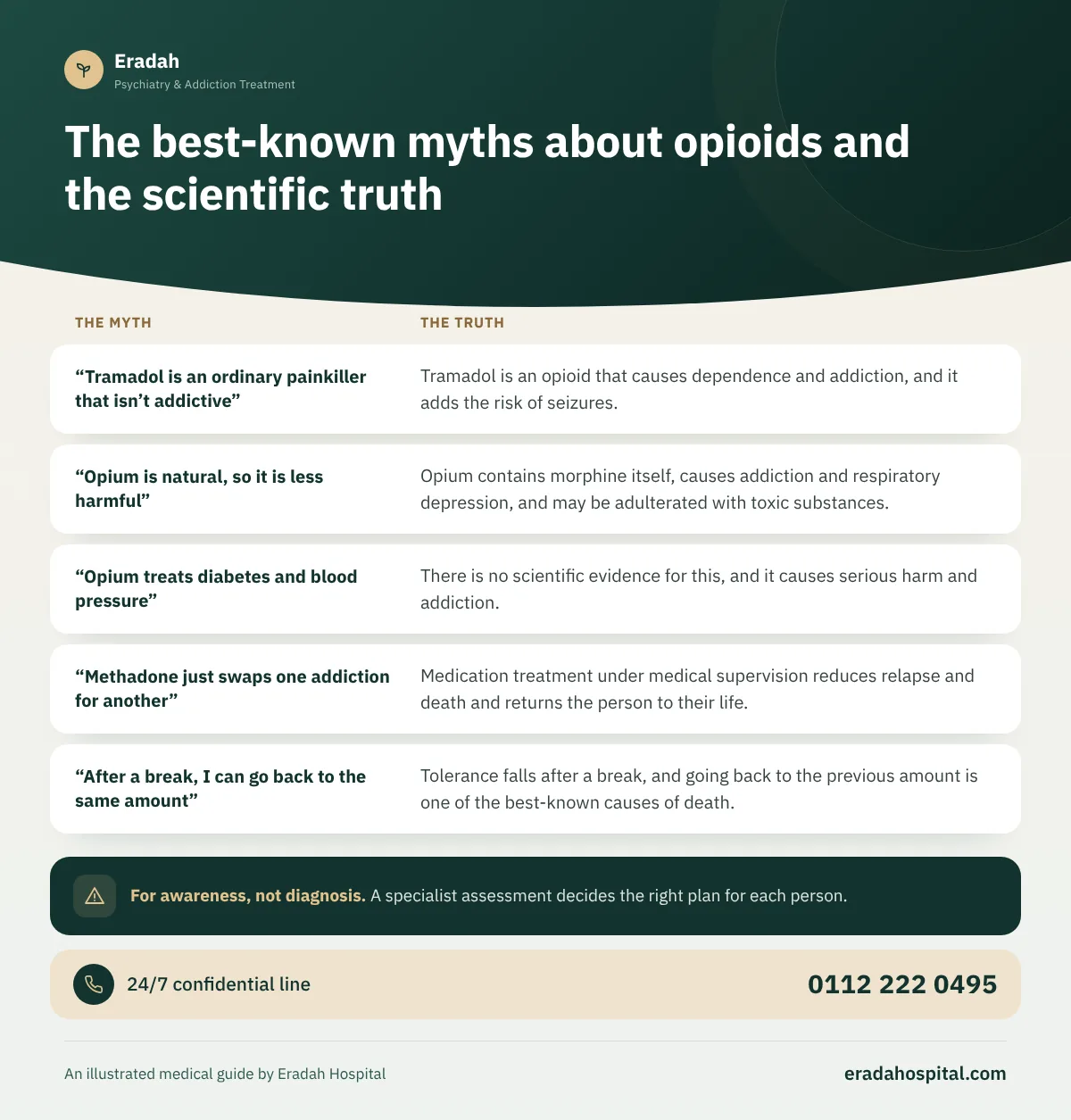
| The myth | The truth |
|---|---|
| “Tramadol is an ordinary painkiller that isn’t addictive” | Tramadol is an opioid that causes dependence and addiction, and it adds the risk of seizures. |
| “Opium is natural, so it is less harmful” | Opium contains morphine itself, causes addiction and respiratory depression, and may be adulterated with toxic substances. |
| “Opium treats diabetes and blood pressure” | There is no scientific evidence for this, and it causes serious harm and addiction. |
| “Methadone just swaps one addiction for another” | Medication treatment under medical supervision reduces relapse and death and returns the person to their life. |
| “After a break, I can go back to the same amount” | Tolerance falls after a break, and going back to the previous amount is one of the best-known causes of death. |
What dangers do all opioids share?
- Overdose and stopped breathing, with the risk multiplying when combined with sedatives, alcohol and pregabalin.
- Physical dependence and painful withdrawal when use stops.
- Chronic constipation, hormonal disruption, and reduced sexual desire.
- With injection: viral hepatitis, HIV, and heart and skin infections.
- Depression and anxiety, and decline in work, study and family relationships.
- Legal problems with prohibited substances or with possessing medicines without a prescription.
The details vary from one substance to another: tramadol adds the risk of seizures, compound codeine may harm the liver because of the paracetamol it contains, and methadone can disturb the heart rhythm. Read the details in harms of heroin, harms of tramadol and harms of fentanyl.
Is opioid withdrawal dangerous?
Opioid withdrawal is very painful but rarely life-threatening in an otherwise healthy person, unlike alcohol and sedative withdrawal. Its symptoms include anxiety, insomnia, muscle and bone pain, sweating, runny nose, diarrhea, vomiting and cravings. It can become dangerous with severe dehydration, chronic illness or pregnancy.
The greater danger is relapse after stopping, because the body loses its tolerance, so the amount previously used can now stop breathing. The duration of withdrawal depends on how long the substance acts: it starts quickly with heroin, and starts later and lasts longer with methadone. Details are in heroin withdrawal symptoms, tramadol withdrawal and methadone withdrawal.
How is opioid addiction treated?
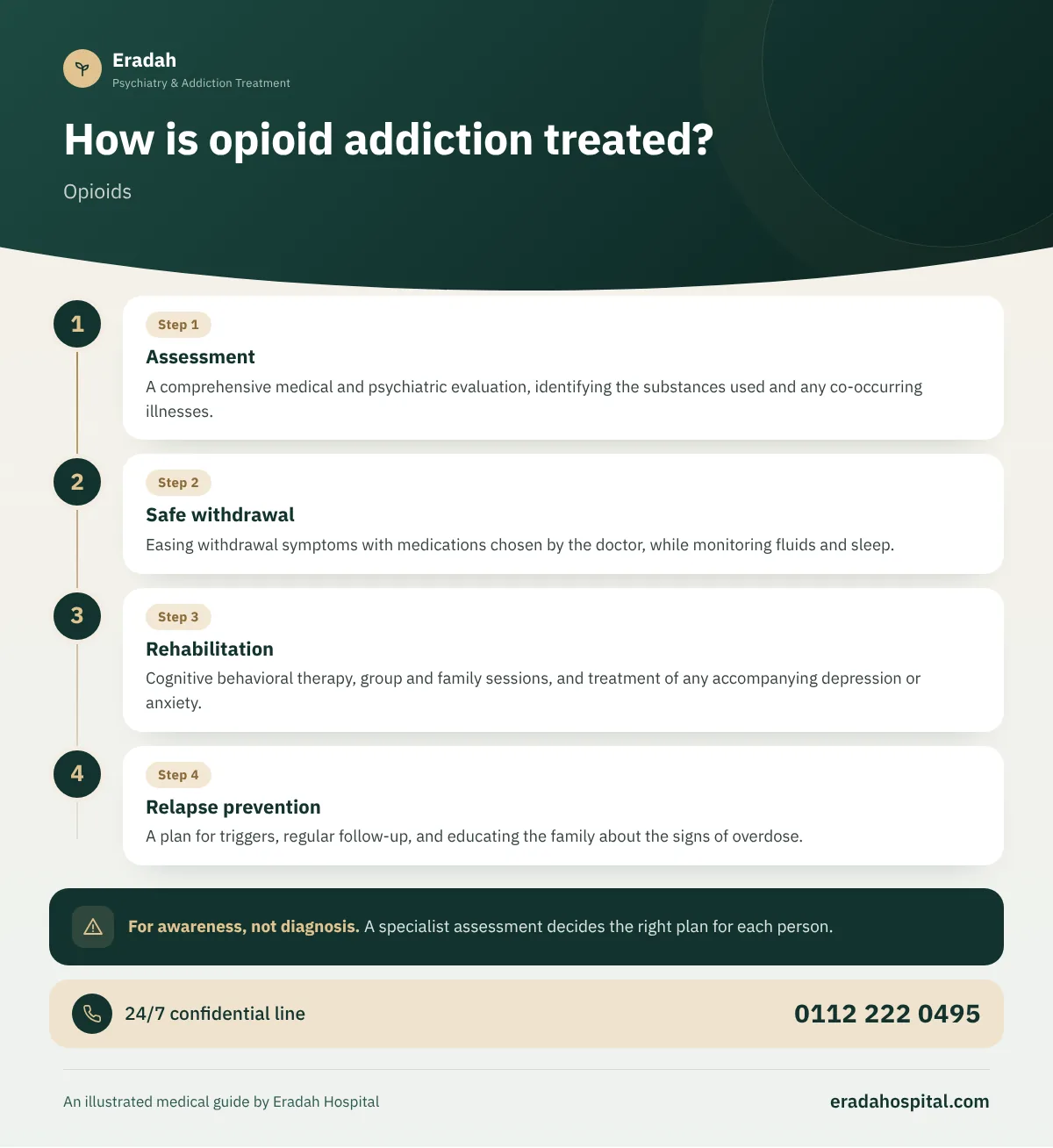
Opioid addiction is among the types of addiction with scientifically proven treatments. Treatment combines safe withdrawal under medical supervision, medications chosen by the doctor, such as methadone and buprenorphine to reduce cravings and prevent relapse, or naltrexone after withdrawal is complete, and long-term psychological and family therapy.
- Step 1Assessment
A comprehensive medical and psychiatric evaluation, identifying the substances used and any co-occurring illnesses.
- Step 2Safe withdrawal
Easing withdrawal symptoms with medications chosen by the doctor, while monitoring fluids and sleep.
- Step 3Rehabilitation
Cognitive behavioral therapy, group and family sessions, and treatment of any accompanying depression or anxiety.
- Step 4Relapse prevention
A plan for triggers, regular follow-up, and educating the family about the signs of overdose.
Read more in heroin addiction treatment, tramadol addiction treatment and opium addiction treatment.
Withdrawal and treatment for the whole opioid family
Two guides that bring together what all opioids share when use stops and in treatment:
Opioid withdrawal symptoms: stages, duration by type, and when it is dangerous
Opioid withdrawal symptoms from tramadol, heroin, methadone and codeine: early and late symptoms, and why the duration differs between types,…
Details TreatmentOpioid addiction treatment: approved medications, stages and length of treatment
Treatment of opioid addiction to tramadol, heroin and painkillers: detox, and approved medications such as methadone, buprenorphine and naltrexone,…
DetailsDo all opioids show up on a drug test?
Not all of them show up on the same test. The traditional rapid opioid test is designed mainly to detect morphine and its metabolites, so it picks up heroin, morphine, codeine and opium, while tramadol, fentanyl and methadone usually need their own specific tests. A positive rapid test needs laboratory confirmation, and detection times are approximate and vary by laboratory.
Details are in heroin testing and tramadol testing.
How can the family deal with the risk of opioids?
- Keep opioid painkillers locked away, and dispose of any leftovers after treatment ends, in coordination with the pharmacist.
- Watch for signs: unexplained drowsiness, pinpoint pupils, constant constipation, and missing medicines or money.
- Talk calmly and without accusation, focusing on your concern for their health rather than on punishment.
- Learn the signs of overdose, and know that calling an ambulance immediately can save a life.
- Seek specialist advice early; treatment works best the sooner it starts.
This is general educational material and not personal legal or medical advice.
Signs of opioid overdose: call ambulance (123) immediately
- Very small, pinpoint pupils
- Loss of consciousness, or no response to calling out or shaking
- Very slow, weak or stopped breathing, or snoring and gurgling sounds
- Blue lips and fingernails and cold skin
- Seizures, especially with tramadol
- Slow or weak pulse
Call ambulance (123) immediately, place the person on their side in the recovery position, and stay with them until help arrives. Emergency departments have an antidote called naloxone that temporarily reverses the effects of opioids, but it can wear off before the substance does, so the person must stay under observation in the hospital. Do not use cold water, coffee or any home remedy.
Call the ambulance 123