“On the first day I said I wouldn’t talk; I’m not like them.” Then the person hears someone else’s story and finds themselves in it. That moment, discovering you are not alone, is what makes group therapy a powerful tool in recovery from addiction and mental illness.
What is group therapy?
Group therapy is a structured treatment session led by a trained psychotherapist, or two, with a limited number of participants, meeting at a fixed time. It has specific goals set by the therapist: teaching a skill, working through emotions, practicing communication, or preventing relapse. The US National Institute on Drug Abuse notes that residential and outpatient programs usually offer individual and group sessions together.
Types of group therapy
| Type | What happens in them | Examples |
|---|---|---|
| Psychoeducation | Information about the illness, treatment and the brain | What does a drug do to dopamine? |
| Skills development | Hands-on training in specific skills | Refusing an offer, anger management, emotion regulation |
| Group cognitive behavioral therapy | Analyzing thoughts and behaviors together | Identifying craving triggers |
| Processing and support | Sharing feelings and experiences in depth | Guilt, loss, relationships with family |
| Relapse prevention | Building a personal exit plan | What do I do at my first invitation? |
Why does group therapy help?
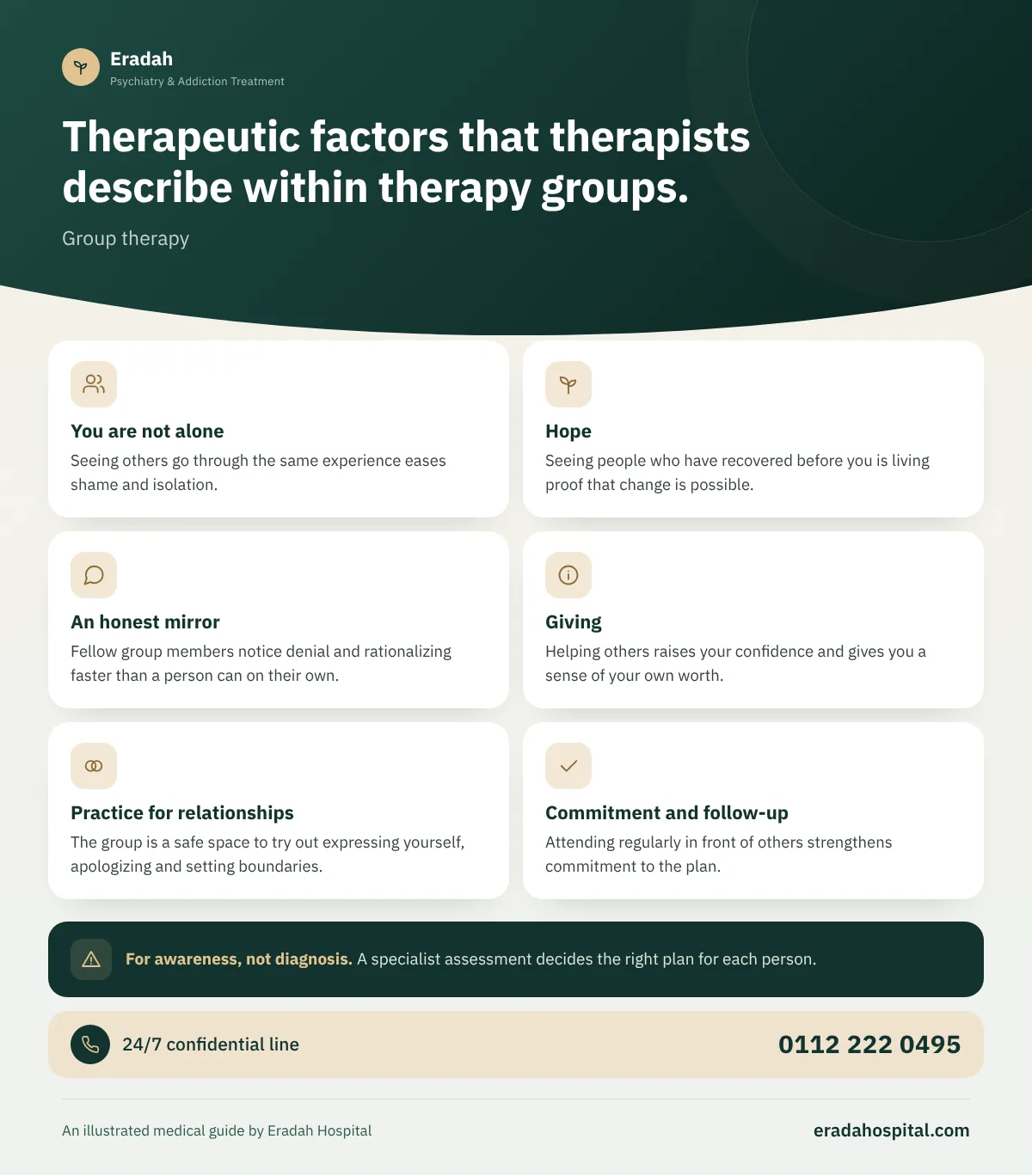
Seeing others go through the same experience eases shame and isolation.
Seeing people who have recovered before you is living proof that change is possible.
Fellow group members notice denial and rationalizing faster than a person can on their own.
Helping others raises your confidence and gives you a sense of your own worth.
The group is a safe space to try out expressing yourself, apologizing and setting boundaries.
Attending regularly in front of others strengthens commitment to the plan.
Group therapy in addiction treatment
Addiction is an illness that thrives on secrecy and isolation, which is why group therapy has a central place in addiction treatment. In a group, the patient learns to talk about cravings instead of hiding them, hears how other people’s relapses began with small steps, and practices refusal skills. The US National Institute on Drug Abuse notes that group support is one of the behavioral approaches used to treat crystal meth (shabu) addiction, along with cognitive behavioral therapy and motivational interviewing.
As for the evidence, a 2019 analysis of 33 randomized trials found a small effect in favor of group therapy on abstinence, with a clearer improvement in mental state compared with no treatment. The researchers cautioned that the findings should be interpreted carefully because of limitations in the data. A review published in 2004 had concluded that studies generally show no difference in outcomes between group and individual therapy.
Group therapy in mental health conditions
Group therapy is used in depression, social phobia, post-traumatic stress disorder and other conditions. In depression specifically, a 2014 analysis of 35 studies found that group cognitive behavioral therapy was better than no treatment, though higher-quality studies are needed to compare it with more intensive treatments. For people with social anxiety, the group itself is practical training in the situations they fear.
What should you expect in your first group therapy session?
- The therapist introduces themselves and explains the group’s rules.
- Each participant introduces themselves as much as they wish, and no one is forced to speak.
- The session topic or the skill of the day is introduced.
- Those who wish share their experience, and others comment respectfully without hurtful advice.
- The session ends with a summary and sometimes a small task.
The difference between group therapy and support groups
Group therapy is led by a trained therapist as part of a treatment plan, whereas fellowship groups, such as twelve-step program groups, are led by people in recovery themselves, free of charge. The two complement each other: the first during treatment, and the second extending for years afterward as part of aftercare.
Group therapy at Eradah
At Eradah, groups are a daily part of residential treatment and part of outpatient treatment, alongside individual sessions and medical follow-up. Groups are also set aside for families as part of the family treatment program.