What Is Social Anxiety Disorder?
Social anxiety disorder, also called social phobia, is a mental health condition in which a person feels intense and disproportionate fear of situations where they are under the gaze of others, for fear of seeming anxious, weak or "strange", or of being ridiculed or rejected.
It is not about disliking people or wanting to be alone; many people with the condition wish they had wide friendships and a natural share in life, but fear stands as a barrier between them and what they want. That is why social anxiety disorder is described as a "silently painful" disorder; the person seems calm on the outside while fighting an inner battle at every encounter.
Psychiatry classifies it among the anxiety disorders in the diagnostic manual DSM-5 and the International Classification of Diseases (ICD-11), and doctors require that the fear be persistent over a long period, usually six months or more, and cause clear distress or disrupt the person's daily life.
What Is the Difference Between Ordinary Shyness and Social Anxiety Disorder?
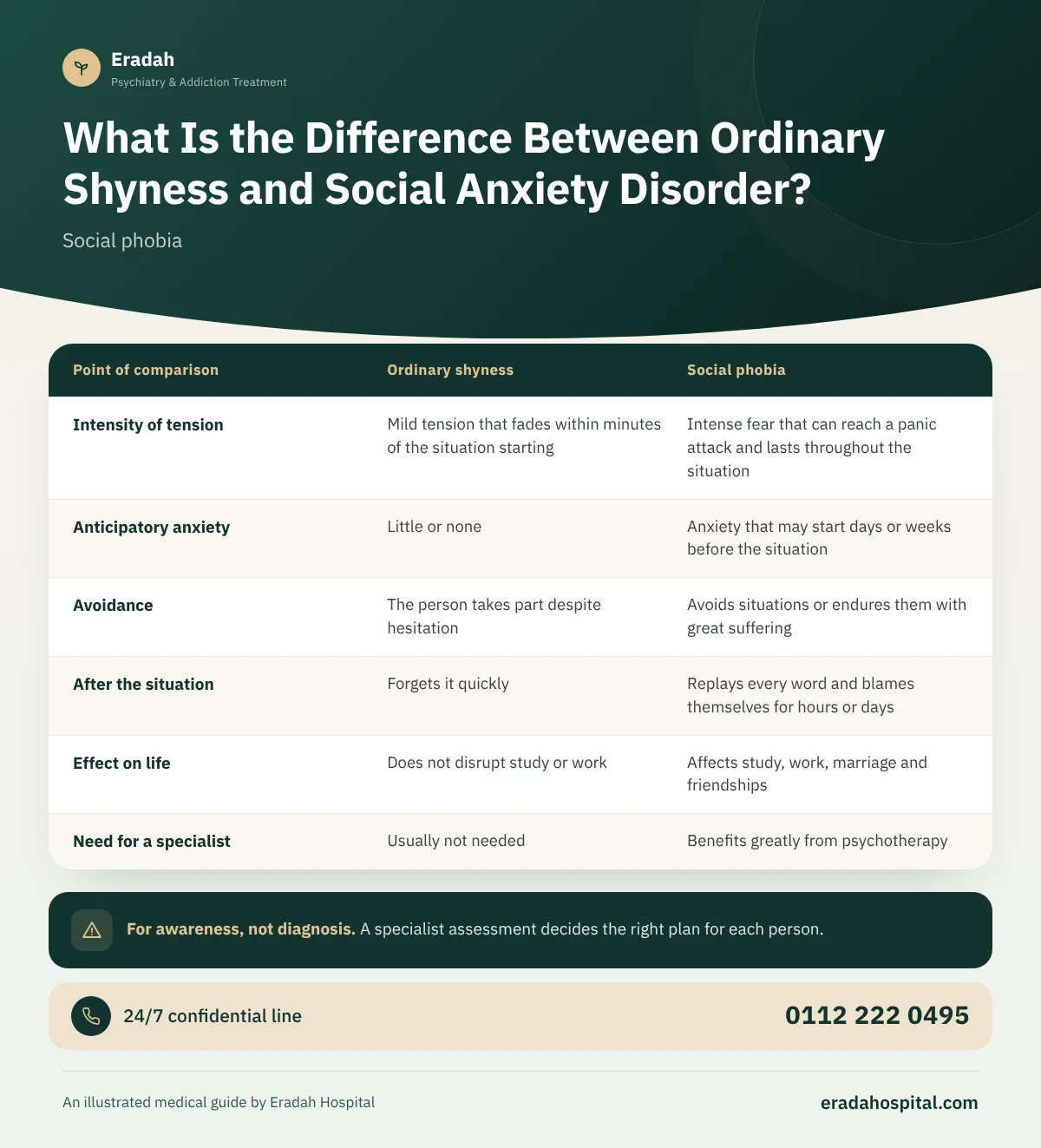
Shyness is a normal personality trait shared by many people, and it doesn't need treatment. Social anxiety disorder, on the other hand, is a disorder that causes suffering and changes the course of life. The kind of feeling is not different between them; what differs is its intensity, its duration and its consequences:
| Point of comparison | Ordinary shyness | Social phobia |
|---|---|---|
| Intensity of tension | Mild tension that fades within minutes of the situation starting | Intense fear that can reach a panic attack and lasts throughout the situation |
| Anticipatory anxiety | Little or none | Anxiety that may start days or weeks before the situation |
| Avoidance | The person takes part despite hesitation | Avoids situations or endures them with great suffering |
| After the situation | Forgets it quickly | Replays every word and blames themselves for hours or days |
| Effect on life | Does not disrupt study or work | Affects study, work, marriage and friendships |
| Need for a specialist | Usually not needed | Benefits greatly from psychotherapy |
What Does Social Anxiety Feel Like from the Inside?
People with the condition often describe their experience as a cycle of three stages that repeats with every important social situation:
Hours or days of thinking about everything that might go wrong, imagining the embarrassment, and trying to get out of it with any excuse.
Intense self-focus: is my face red? Is my voice shaking? So less attention goes to what others are actually saying.
"Dissecting" the conversation in the mind, focusing on small mistakes, and feeling shame even if the situation went well.
"I knew the answer, but just raising my hand in the lecture meant thirty eyes would look at me, so I stayed silent and hated myself afterward." (A common expression repeated by many people with social anxiety disorder, not a quote from a particular patient.)
This excessive self-focus makes the person see themselves from the outside as they imagine others see them, and their imagined image is often much worse than reality; the blushing or trembling they feel so strongly is rarely noticed by others to the same degree.
How Common Is Social Anxiety Disorder, and When Does It Start?
Social anxiety disorder is one of the most common anxiety disorders in the world, and it appears in women at a slightly higher rate than in men, though men in our societies are less inclined to seek help for it. The World Health Organization estimates that anxiety disorders of all kinds affect hundreds of millions of people worldwide, and that fewer than a third of them receive treatment.
There are no documented, published Egyptian figures on the prevalence of social anxiety disorder specifically; the figures above are from the US National Institute of Mental Health and the World Health Organization.
What Is Performance Anxiety, and Is It a Type of Social Anxiety Disorder?
Yes. The diagnostic manual DSM-5 defines a special form called "performance-only social anxiety disorder", in which the person is not afraid of ordinary social encounters, only of performance situations: giving a speech or presentation, an oral exam, playing music or singing in front of an audience, or even writing or signing in front of an official.
A person with this type may be sociable and well liked among their friends, but freeze completely when asked to stand in front of people, and may lose promotions or study opportunities because of it. The general form of social anxiety disorder, by contrast, extends to many situations: meeting people, phone calls, eating in front of others, and entering a crowded place.
What Happens in the Brain in Social Anxiety Disorder?
In the brain there is a small region called the amygdala that works as an alarm system detecting danger. Imaging studies show that this region and its surroundings are more active in people with social anxiety disorder when they see angry or critical faces, so the brain treats a "look" or a "comment" as a real threat.
Neurotransmitters such as serotonin and dopamine take part in this process, which partly explains why some medications help. More importantly, though, the brain is flexible: with gradual exposure and training, the alarm system learns that social situations are not a danger, and gradually calms down.
How Does Social Anxiety Disorder Differ from Similar Conditions?
| The situation | Focus of the fear or problem | The key difference |
|---|---|---|
| Panic attacks | Fear of the attack itself and its physical symptoms | In social anxiety disorder the fear comes from people's judgment, and the attack is a result, not a cause |
| Generalized anxiety disorder | Broad worry about many things: health, money and family | The anxiety in social anxiety disorder is confined to social evaluation |
| Depression | Loss of pleasure, energy and desire for people | A person with social anxiety disorder wants connection but fears it |
| Avoidant personality disorder | A deep, pervasive sense of inadequacy and across-the-board avoidance | Overlaps with severe social anxiety disorder and is considered a deeper, broader form of it |
| Autism spectrum | Difficulty understanding social cues since childhood | A person with social anxiety disorder understands cues well but fears being evaluated |
Social anxiety disorder may occur together with another disorder, such as depression or panic attacks, which is why telling them apart needs a specialist assessment, not an online test.
Common Myths About Social Anxiety Disorder and the Facts
| The myth | The truth |
|---|---|
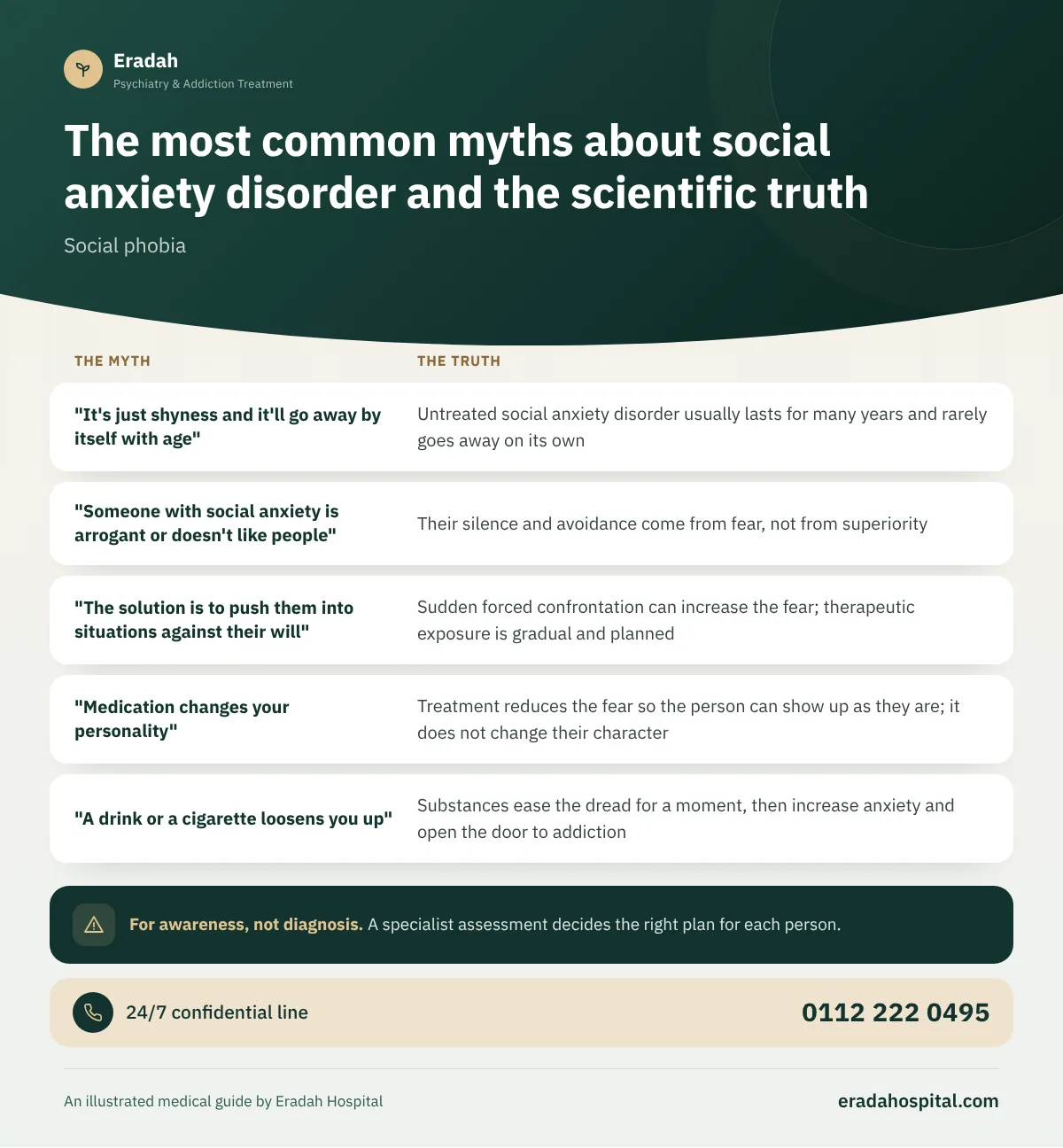
| "It's just shyness and it'll go away by itself with age" | Untreated social anxiety disorder usually lasts for many years and rarely goes away on its own |
| "Someone with social anxiety is arrogant or doesn't like people" | Their silence and avoidance come from fear, not from superiority |
| "The solution is to push them into situations against their will" | Sudden forced confrontation can increase the fear; therapeutic exposure is gradual and planned |
| "Medication changes your personality" | Treatment reduces the fear so the person can show up as they are; it does not change their character |
| "A drink or a cigarette loosens you up" | Substances ease the dread for a moment, then increase anxiety and open the door to addiction |
How Can a Family Support a Son or Daughter with Social Anxiety Disorder?
Most cases of social anxiety disorder begin at school and university age, when the family is the closest to notice the change. The parents' role is decisive in turning this into early treatment instead of years of suffering:
- Don't mock their shyness in front of relatives or compare them with their "bold" siblings or peers.
- Don't always speak for them in restaurants or at the doctor; gently encourage them to take small steps.
- Praise the attempt, not the result: just greeting the guests is an achievement worth appreciating.
- Watch out if they start to refuse to go to school or university or isolate themselves in their room for long periods.
- Quietly watch for any turn to alcohol, pills or hashish before occasions.
- Consult a psychiatrist early; asking for help protects their future, and there is no scandal in it.
When should you see a psychiatrist?
Not every social tension needs a doctor. But a visit becomes necessary if you notice one or more of the following:
- The fear stops you from things that matter to you: study, work, proposing marriage or travel.
- You spend days worrying before a simple situation, or hours blaming yourself afterward.
- You need alcohol, a sedative or "something to settle you" to be able to go out or speak.
- Isolation has begun to bring persistent sadness, loss of hope or thoughts of death.
A psychiatrist or a specialist therapist assesses the condition, tells it apart from similar disorders, then draws up a plan that suits you, and the first consultation can start in complete confidentiality.
Can Social Anxiety Disorder Be Cured?
Yes, to an encouraging degree. Cognitive behavioral therapy designed for social anxiety disorder is among the most successful psychological treatments, and suitable medication helps many people too. Most of those who complete treatment describe clear improvement: they speak in meetings, make friends and advance in their work, even if a normal amount of nervousness remains in big situations.
The most important element in improvement is starting. The longer avoidance continues, the more entrenched the fear becomes, and the earlier treatment begins, especially in adolescence and young adulthood, the easier and faster its effect.
Social Anxiety Guide: Everything You Need to Know
We have gathered everything about social anxiety disorder into 5 pages, each answering one question in detail. Choose what you are looking for:
Symptoms of social anxiety disorder
The psychological, physical and behavioral signs before, during and after situations, and how they appear in children, teenagers and adults, with self-assessment questions.
Causes of social phobia
The role of genetics, innate temperament and amygdala activity, parenting styles and experiences of bullying and embarrassment, and risk and protective factors.
Harms of social anxiety disorder
What happens without treatment: setbacks in study and work, isolation and depression, turning to alcohol and sedatives, and the effect on marriage and family.
Treatment of social anxiety disorder
Cognitive behavioral therapy and gradual exposure are the foundation, with SSRI medications when needed, the length of treatment and a relapse prevention plan.
Social anxiety and addiction
Why some people with the condition turn to alcohol, hashish and pregabalin to cope with the dread of people, and how both disorders are treated together.
Suicidal thoughts or danger to self? Get help now
- Talking about wanting to die or being a "burden" on those around them
- Severe hopelessness and a feeling that there is no way out of isolation and fear
- Complete withdrawal from people and refusing to leave the room for days
- Suddenly saying goodbye to family or getting rid of treasured belongings
- Heavy drinking or taking sedatives along with talk of the end
Stay with the person and don't leave them alone, and listen without blame or dismissing their feelings. Call an ambulance on 123 or take them to the nearest emergency room if danger is imminent, contact the mental health support line on 16328, and move medications and dangerous objects out of their reach.
Ambulance 123 Mental health support line 16328