“I left the facility scared of the first day of my life out there.” This fear is exactly what the twelve-step program tries to answer: where do you go when treatment ends? And who do you talk to when the craving comes in the middle of the night?
What is the 12-step program?
It is a set of principles for personal recovery, written by the founders of Alcoholics Anonymous. The fellowship describes itself as a community of people who come together to solve their drinking problem, with no fees, and membership is open to anyone who wants to stop. Members use the twelve steps to maintain their abstinence. The idea later spread to drug addiction and compulsive behaviors such as gambling, with the word “alcohol” changed to the problem concerned.
How did the twelve-step program begin?
The historical record of Alcoholics Anonymous states that it began with a meeting between two men struggling with alcohol addiction, Bill Wilson and Dr. Bob Smith, in Akron, Ohio, and that June 10, 1935, known as the day of Dr. Bob’s last drink, is celebrated as the fellowship’s founding day. The basic idea was simple: a person with addiction understands another person with addiction, and helping someone else stop protects the helper from going back.
The steps of the 12-step program in simple language
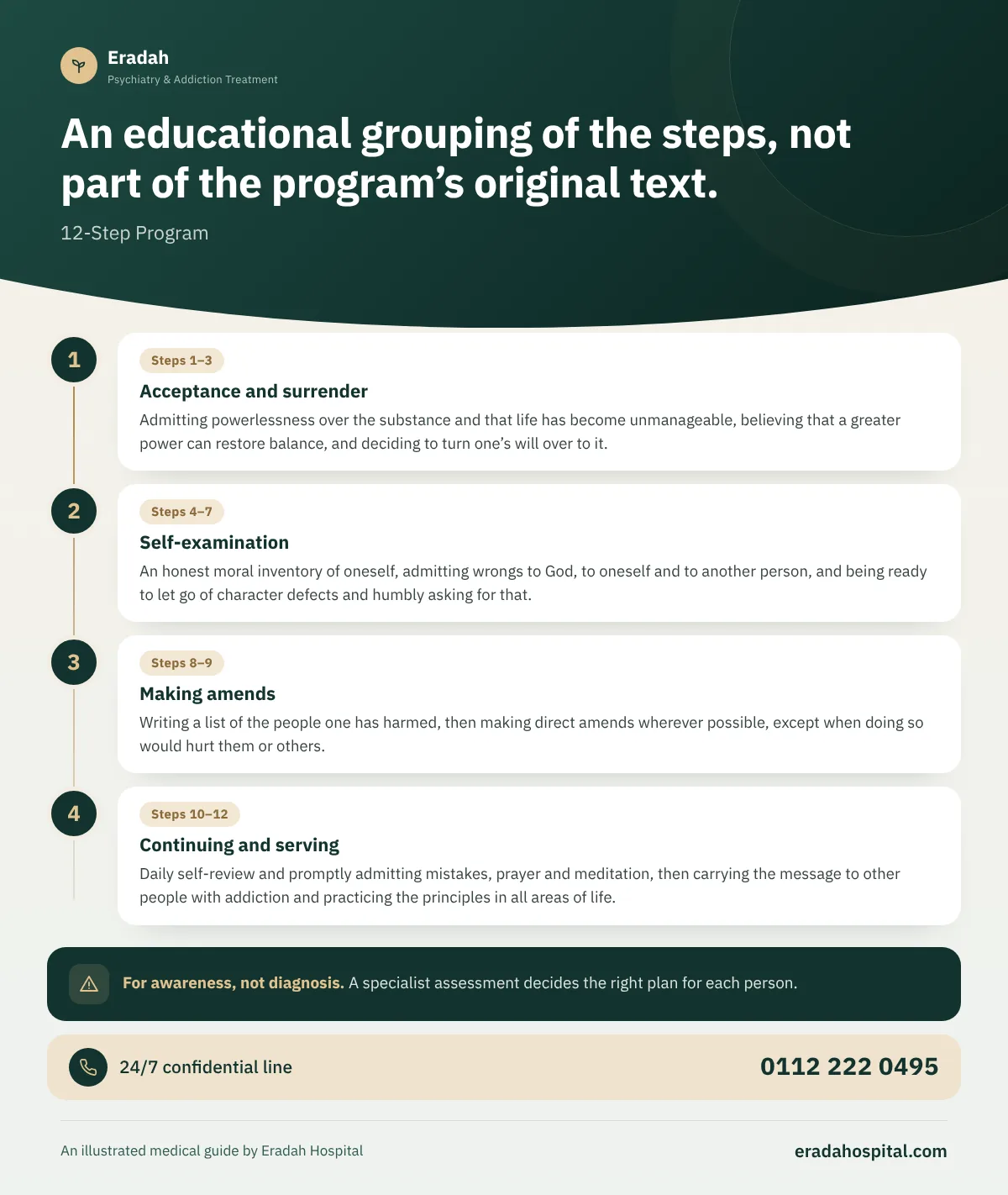
The original text of the steps is written in spiritual language, and each member understands the “higher power” in the way that fits his or her faith. This is a simplified wording divided into four stages for clarity:
- Steps 1–3Acceptance and surrender
Admitting powerlessness over the substance and that life has become unmanageable, believing that a greater power can restore balance, and deciding to turn one’s will over to it.
- Steps 4–7Self-examination
An honest moral inventory of oneself, admitting wrongs to God, to oneself and to another person, and being ready to let go of character defects and humbly asking for that.
- Steps 8–9Making amends
Writing a list of the people one has harmed, then making direct amends wherever possible, except when doing so would hurt them or others.
- Steps 10–12Continuing and serving
Daily self-review and promptly admitting mistakes, prayer and meditation, then carrying the message to other people with addiction and practicing the principles in all areas of life.
How do fellowship meetings work?
- Regular meetings: members talk about their experiences without interruption or judgment.
- The mentor or “sponsor”: a member who has been in recovery longer accompanies the new member through the steps.
- Anonymity: first names only, and what is said is not repeated outside.
- Independence: the fellowship says it is not affiliated with any group, cause or religious denomination.
Is the 12-step program effective?
For many years the evidence for its effectiveness was personal stories, and then came the 2020 Cochrane review, which analyzed 27 studies involving more than 10,000 participants. It found that structured treatment programs that encourage taking part in the fellowship increased rates of continuous abstinence from alcohol after 12 months compared with other treatments such as cognitive behavioral therapy, and the effect continued to 24 and 36 months, while being similar to them in other outcomes, with possible savings in health care costs. The US National Institute on Alcohol Abuse and Alcoholism confirms that support groups add an important layer of support when combined with medical treatment.
Criticisms and limits of the program
Not everyone is comfortable with the program’s spiritual character, and some find the idea of “powerlessness” difficult. The quality of meetings also varies from group to group. This is why it is seen as one option, not the only path, and it can be combined with psychotherapy and medication without conflict; medicines prescribed by a doctor to treat addiction are not a “relapse.”
The 12-step program as part of a treatment plan
At Eradah, patients are introduced to the philosophy of the steps during residential treatment, and are encouraged to keep going to support groups after discharge as part of aftercare, alongside individual sessions and the family treatment program, because recovery that lasts needs more than one tool.