One of the biggest worries for employees and patients before a drug test is: “I take a medicine for a cold, or for sleep, or for my nerves. Will it show up?” The answer requires telling apart two completely different situations: a medicine that is chemically similar to a drug and so fools the test strip, and a medicine that actually contains a controlled substance and so legitimately shows up.
Why does a medicine show up in a drug test?
The initial test relies on antibodies that recognize the shape of a particular molecule. When the medicine’s molecule or its byproducts are close in shape to the target drug, the strip may “make a mistake” and show a positive line. This is called cross-reactivity. The confirmatory test, by contrast, separates and precisely weighs molecules, so it knows the difference between a medicine and a drug even when they look alike.
The second situation is different: medicines that really do contain a substance detected by the test, such as some painkillers and preparations containing codeine, or anxiety medicines from the benzodiazepine class. Here the result is not “false,” and the prescription is what proves the use is therapeutic.
The best-known medicines that may give a positive result
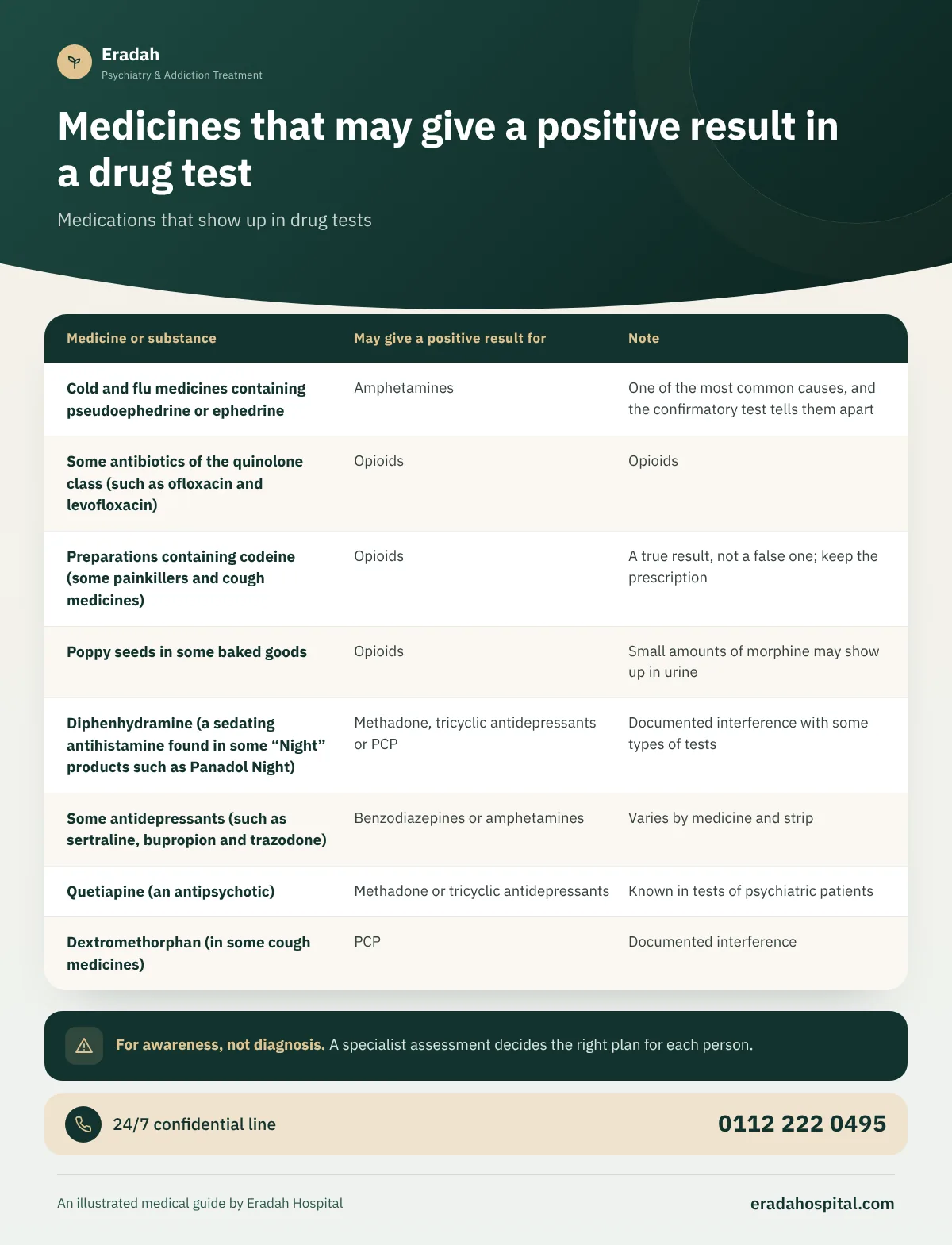
The following table summarizes the best-known interactions documented in the medical literature. A medicine being on the list does not mean it will always give a positive result; that depends on the dose, the type of strip and the lab:
| Medicine or substance | May give a positive result for | Note |
|---|---|---|
| Cold and flu medicines containing pseudoephedrine or ephedrine | Amphetamines | One of the most common causes, and the confirmatory test tells them apart |
| Some antibiotics of the quinolone class (such as ofloxacin and levofloxacin) | Opioids | Opioids |
| Preparations containing codeine (some painkillers and cough medicines) | Opioids | A true result, not a false one; keep the prescription |
| Poppy seeds in some baked goods | Opioids | Small amounts of morphine may show up in urine |
| Diphenhydramine (a sedating antihistamine found in some “Night” products such as Panadol Night) | Methadone, tricyclic antidepressants or PCP | Documented interference with some types of tests |
| Some antidepressants (such as sertraline, bupropion and trazodone) | Benzodiazepines or amphetamines | Varies by medicine and strip |
| Quetiapine (an antipsychotic) | Methadone or tricyclic antidepressants | Known in tests of psychiatric patients |
| Dextromethorphan (in some cough medicines) | PCP | Documented interference |
| “Legal” cannabis products and CBD oil | Hashish (THC) | May actually contain some THC |
| Selegiline (a Parkinson’s disease medicine) | Amphetamines | Part of it is converted in the body into amphetamine derivatives |
Medicines people ask about often
Night Calm: its active ingredient is zopiclone, a “Z-drug” sleeping pill; it is usually not included in standard test panels and does not normally interfere with the benzodiazepine strip, but it can be detected with a special test if one is requested. Panadol Night contains the antihistamine diphenhydramine, which may interfere with some strips, as shown in the table. Solpadeine: formulations differ, and some contain codeine; if so, it may show up on the opioid strip. Zolam: a brand name for alprazolam, the same substance as Xanax, so it shows up on the benzodiazepine strip as a true positive.
Ordinary painkillers such as paracetamol alone do not show up in a drug test, whereas opioid painkillers such as tramadol and tapentadol do show up if the test covers them. Pregabalin usually does not show up on traditional panels unless it is requested by name.
What should you do before the test if you take medicines?
- Write a list of everything you have taken in the last two weeks: prescription medicines, over-the-counter cold medicines and painkillers, and supplements and herbs.
- Bring the prescription or a report from your treating doctor stating the medicine’s name, dose and duration of use.
- Tell the person collecting the sample about your medicines before it is taken, and ask for them to be recorded on the form.
- If an unexpected positive result appears, ask for a confirmatory test before any decision is made.
- Do not try to “cleanse” the body with water or drinks; a diluted sample may be rejected and arouse suspicion.
I got a positive result and I haven’t used drugs: what do I do?
Stay calm first; an initial result is not a final verdict. Ask for a confirmatory test on the same sample or on a new one, and provide proof of the medicines you take. If needed, ask your doctor for a written report explaining the possibility of interference. In official workplaces, the confirmatory test is usually what is relied on before any consequence is set.
But if you are using a medicine that can cause dependence, such as sedatives and sleeping pills or opioid painkillers, without medical follow-up or in doses that rise over time, what matters more than the test result is knowing whether the use has turned into a dependence that needs intervention. You can talk to a specialist at Eradah in complete confidence.