"I'll quit on my own, I don't need anyone." Many people have said it, and some really did succeed. Others failed many times before asking for help, and a few paid a heavy health price because they suddenly stopped a substance that should never be stopped abruptly. The question "can a person with addiction recover alone?" deserves an honest answer, without exaggeration or minimizing.
Can a person with addiction really recover alone?
In a study published by John Kelly and colleagues in 2017 on a sample representing American adults, 9.1% answered "yes" to the question: "Did you ever have a problem with alcohol or drugs that you no longer have?" Of these, 53.9% said they had used an "assisted" route at some point, most often mutual-support groups at 45.1%, then formal treatment at 27.6%. That means nearly half recovered without reporting any organized help.
But the same study shows who needs help most: people with a previous addiction diagnosis were far more likely to use assisted routes, as were those with a psychiatric diagnosis, and people with opioid problems were more likely to than people with alcohol problems, while people with cannabis problems were less likely to.
Who usually succeeds in recovering alone?
- Someone whose problem was milder and had not reached severe physical dependence.
- Someone with a supportive family, a job, and a routine that protects him.
- Someone without an untreated co-occurring mental disorder.
- Someone who really changed his environment: friends, places, and money.
- Someone who started early, before the addiction lasted for years.
As for someone whose addiction has lasted years, or whose attempts have repeatedly failed, or who mixes more than one substance, or who has depression, anxiety, or thoughts of self-harm, help is not a luxury in his case.
When is stopping alone dangerous?
The MedlinePlus encyclopedia describes delirium tremens as a severe form of alcohol withdrawal that can cause sudden confusion, fever, hallucinations, and seizures, which is why alcohol withdrawal needs medical assessment. You can find the details of withdrawal for each substance in drug withdrawal symptoms.
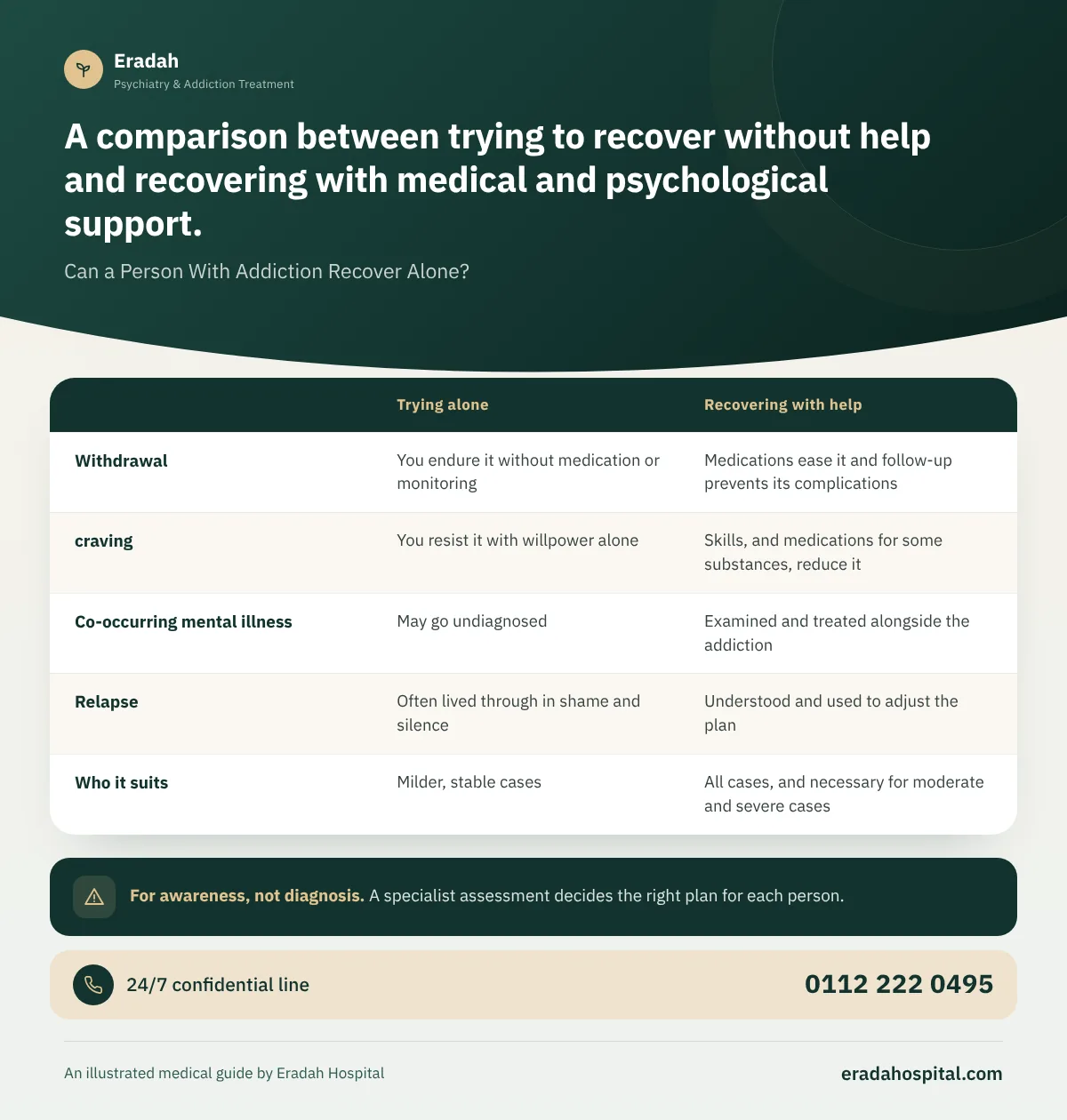
Recovering alone or with help?
| Trying alone | Recovering with help | |
|---|---|---|
| Withdrawal | You endure it without medication or monitoring | Medications ease it and follow-up prevents its complications |
| craving | You resist it with willpower alone | Skills, and medications for some substances, reduce it |
| Co-occurring mental illness | May go undiagnosed | Examined and treated alongside the addiction |
| Relapse | Often lived through in shame and silence | Understood and used to adjust the plan |
| Who it suits | Milder, stable cases | All cases, and necessary for moderate and severe cases |
Help does not necessarily mean a treatment center
Many people refuse help because they imagine it as a long stay behind closed doors. But help comes in degrees: a doctor's visit, outpatient treatment with regular sessions, support groups such as the 12-step program, a medication that reduces craving, or a short stay for detox followed by follow-up. The decision is built on assessment, not fear.
The difference between "recovering alone" and "treatment at home" is that the latter can be medically supervised; the details are in addiction treatment at home.
Signs that you need help
- You have tried to stop more than once and gone back.
- You get physical withdrawal symptoms when a dose is late.
- You mix more than one substance, or use alcohol or sedatives daily.
- You have depression, severe anxiety, or thoughts of self-harm.
- The substance has caused losses at work, in the family, or with the law.
If you decide to try alone: safety rules
- Consult a doctor at least once before stopping, especially with alcohol, sedatives, and opioids.
- Tell someone you trust about your plan, so he is close by in the first days.
- Get rid of the substance and the numbers of those who used to supply it.
- Decide in advance when you will ask for help: for example, if you use once, or if severe symptoms appear.
- If you return to opioids after stopping, do not go back to the old amount, and know the signs of overdose.
And if suicidal thoughts appear at any time, call the ambulance at 123 or the mental health support line, 16328.