“Can we treat him at home?” is one of the questions families ask us most, and it is often preceded by fear of what people will say, of the cost of a residential stay, or of the patient’s own refusal. The honest answer: some cases can genuinely be treated while living at home, and in others stopping at home is a real risk to life. The decision depends on the type of substance, the severity of dependence, and the condition of the body and mind, not on wishes or resources, and this is what a medical assessment determines before any step.
Can addiction be treated at home?
Yes in specific cases, and no in others. The confusion arises because the phrase “treatment at home” is used for two completely different things. The first meaning is that the patient lives at home while receiving regular treatment from a specialized team: clinic visits, medication prescribed by a doctor, psychological sessions, and follow-up for the family. This is a globally recognized form of care called outpatient treatment, and many cases succeed with it.
The second meaning is that the family decides to “lock” the patient in a room until “the substance leaves his body,” or that the patient stops suddenly on his own without a doctor. This is not treatment, and with some substances it can be life-threatening. Locking someone up also destroys trust and does not treat the causes of addiction, and most people who go through it return to use quickly.
Detox at home versus treatment from home: what is the difference?
The patient lives at home, attends regular sessions and medical visits, and takes medication by prescription on a set schedule. Suitable for stable cases after assessment.
The patient stops the substance at home with a medication plan set by the doctor and daily or near-daily follow-up. Suitable for a few carefully selected cases.
Cutting off the substance abruptly or “locking someone in” a room. Not safe, especially with alcohol, sedatives and pregabalin, and not recommended in any case.
When is treatment while staying at home a possible option?
Doctors lean toward outpatient treatment when most of these conditions are met, not just one of them:
- Dependence is mild to moderate, and the substance is not one with dangerous withdrawal, or there is a clear, supervised tapering plan.
- There is no history of seizures, delirium or hallucinations on stopping in previous attempts.
- The person is physically stable: no severe heart, liver or kidney disease, and no pregnancy.
- There are no suicidal thoughts, psychosis or severe unstable mental disorder.
- The patient himself is convinced of the treatment and keeps appointments, rather than being forced.
- There is a supportive adult at home, available throughout the first period of stopping, and the substance is not available in the home.
- The doctor or hospital can be reached quickly if symptoms get worse.
When is stopping at home dangerous?
By contrast, medical guidelines recommend residential care or inpatient supervision, even if only for a few days at the start, when any of these signs are present:
- Heavy daily alcohol dependence, or a past history of withdrawal seizures or delirium tremens.
- Use of sedatives or pregabalin in high doses or for a long time, or mixing them with alcohol or opioids.
- Use of more than one substance at the same time, which is common in Egypt with tramadol, pregabalin and hashish.
- A history of overdose or loss of consciousness, or use by injection.
- Psychosis, suspiciousness and aggression, suicidal thoughts, or severe depression.
- Uncontrolled chronic physical illness, advanced age, or pregnancy.
- Failed earlier attempts to stop at home, or a home environment full of triggers or conflict.
Does it differ by type of substance?
Yes, greatly. The danger of withdrawal is not the same across substances, and the following table is a simplification of what the medical evidence says and does not replace an individual assessment:
| Substance | Withdrawal risk at home | Usually best suited |
|---|---|---|
| Alcohol | Can be life-threatening: seizures and delirium tremens in severe cases | Medical supervision; outpatient care may be enough for mild dependence with a medication plan and daily follow-up |
| Sedatives and pregabalin | Sudden stopping can cause seizures and hallucinations | Gradual reduction over weeks under a doctor’s supervision, and much of it can be done as an outpatient |
| Opioids such as tramadol and heroin | Withdrawal itself rarely kills, but it is painful, and dehydration and relapse afterward raise the risk of overdose | Medical detox with supportive medication, then rehabilitation; residential care is better with mixed use or injection |
| Stimulants such as crystal meth (shabu) | Usually no dangerous physical withdrawal, but severe depression, suicidal thoughts or psychosis can occur | Outpatient if mental state is stable; residential care with psychosis or risk to self |
| Hashish and bango | Unpleasant but usually not dangerous symptoms: insomnia, irritability and loss of appetite | Outpatient treatment suits most cases |
| Strox and Voodoo | Unpredictable: seizures or psychosis may occur with heavy use | Careful assessment; residential care preferred with heavy daily use |
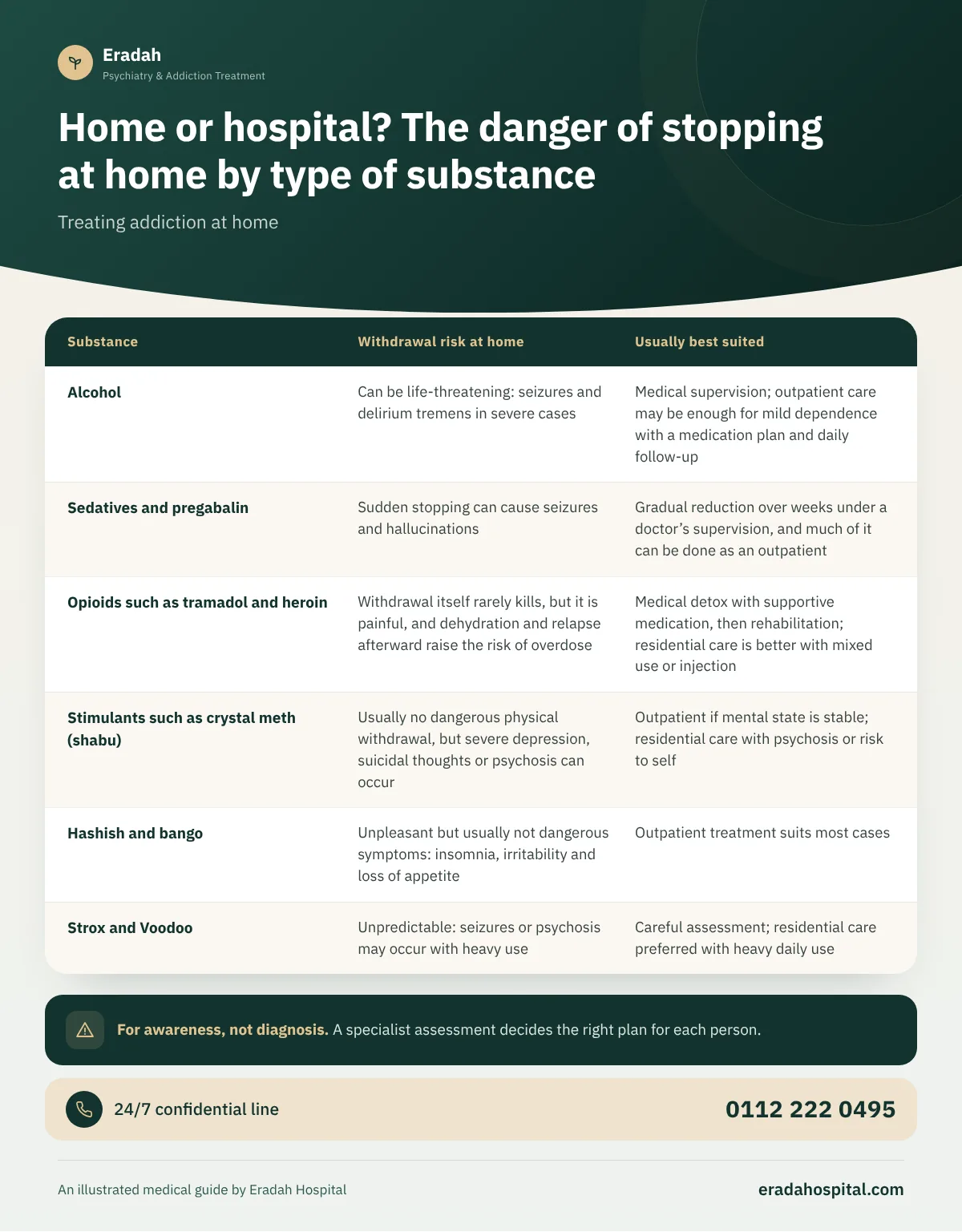
Note that the table covers physical withdrawal only. Even with the “milder” substances, the success of treatment still depends on psychological rehabilitation and follow-up, because detox alone does not prevent a return to use.
Treating tramadol addiction at home: when is it possible and what are the conditions?
Many people ask about treating tramadol addiction at home because its withdrawal is mostly not fatal. That is relatively true, but the real danger lies in three things: seizures when tramadol is mixed with pregabalin or sedatives, psychological collapse, and overdose when someone returns to use after stopping. The official US Food and Drug Administration drug label warns against stopping it suddenly in people who are physically dependent on it, because rapid discontinuation has been linked to severe withdrawal symptoms, uncontrolled pain, and even suicide.
- A medical assessment confirming that tramadol is the only substance and that there is no history of seizures or severe depression.
- A written plan from the doctor: gradual reduction or supportive medication that he alone determines, with no pills “from the pharmacist.”
- Near-daily follow-up in the first week, and an adult at home who keeps the prescribed medication and dispenses it according to the schedule.
- A plan for pain if the tramadol began for a medical reason, because untreated pain pushes people back to use.
- Psychological sessions and follow-up after the physical symptoms end, not settling for “cleaning the body.”
Why be careful about returning to use after a few days of stopping? Because the body loses its tolerance quickly, so the amount the person used to take can now be enough to cause a seizure or suppress breathing. This is why the family should know the signs of overdose before starting.
If these conditions are not met, it is safer to spend the first days in a detox program and then continue from home. You can find the timeline of symptoms in tramadol withdrawal symptoms.
Treating alcohol addiction at home: why does it need special caution?
Of all substances, treating alcohol addiction at home needs the greatest caution, because alcohol withdrawal can be life-threatening. According to the StatPearls medical reference, withdrawal seizures can appear within a few hours of stopping, and alcohol withdrawal delirium, the most severe form of withdrawal, can appear between day 3 and day 8, affects about 3% to 5% of those who go through withdrawal, and can be fatal.
Even so, this does not mean everyone who drinks needs a residential stay. The guidelines of the UK’s National Institute for Health and Care Excellence (NICE) make community withdrawal, meaning withdrawal at home with regular follow-up, the usual option for mild and moderate dependence, and advise considering a residential stay when any of the following is present:
- Drinking very large amounts every day.
- A history of epilepsy, withdrawal seizures, or delirium tremens in earlier attempts.
- A need to withdraw from alcohol and sedatives at the same time.
- Co-occurring mental or physical conditions, such as severe depression, psychosis, malnutrition, or chronic heart or liver disease.
Even when home is suitable, the doctor’s role remains indispensable: withdrawal medication and its schedule, thiamine (vitamin B1) to protect the brain, and liver tests. Then comes the relapse prevention stage with supportive medication and psychological therapy, as in alcohol addiction treatment. For the detailed timing of symptoms, see alcohol withdrawal symptoms.
Treating hashish addiction at home: a practical plan with a specialist’s supervision
Treating hashish addiction at home is the most likely to succeed among substances, because its withdrawal is unpleasant but usually not dangerous. But “at home” does not mean “alone.” The most successful plan combines stopping with regular sessions with a specialist, because the real challenge is psychological and social more than physical.
- An initial assessment with a psychiatrist to rule out other substances, anxiety, depression or psychotic symptoms.
- Setting a stop date, getting rid of the substance and its paraphernalia, and telling a supportive person about the plan.
- Expecting the difficult days in advance: insomnia, irritability, loss of appetite and disturbing dreams, which are usually temporary.
- A steady daily routine: set sleep and wake times, physical activity, and fewer stimulants in the evening.
- Weekly cognitive behavioral or motivational therapy sessions, and a written plan for moments of craving and for friends linked to use.
- Reviewing the plan with the specialist after a few weeks: what worked, where the weak moments were, and whether the plan needs adjusting.
It also helps to prepare replacements for what hashish used to do in the person’s day: another way to relax after work, an activity to fill late-night hours, and people to spend time with who do not use. Emptiness is among the strongest causes of relapse in the first months.
The family can support the plan without becoming a monitor, as the guide for families of people with addiction explains. For details on symptoms and how long they last, see hashish withdrawal symptoms, and the structured alternative is the outpatient treatment program.
What does safe treatment at home look like if the doctor decides on it?
When the doctor judges that a case is suitable for treatment while living at home, he does not say “just stay home.” He sets out a clear plan that usually follows these steps:
- Before startingA comprehensive medical and psychological assessment
Examination and tests, the history of use and mixed substances, previous attempts to stop, co-occurring conditions, then a written decision: outpatient or residential.
- The first daysA medication plan and close follow-up
Medication with doses and a schedule set by the doctor alone, a daily visit or contact at the start, and an adult present at home.
- The first weeksPsychological sessions and gradual tapering
Individual and family sessions, gradual reduction of medication when needed, and monitoring of sleep, eating and mood.
- After stabilizationRehabilitation and relapse prevention
An outpatient or day program, a written plan for triggers and weak moments, and regular follow-up for months.
What is the family’s role if treatment is at home?
- Remove any substance or non-prescribed medication from the home, and keep prescribed medication in a locked place, with one person dispensing it according to the schedule.
- Do not give any medication “to calm him” on your own, and do not change doses, even if the insomnia or pain gets worse.
- Make sure an adult is available in the first days, and that the doctor’s number and the ambulance number 123 are written somewhere visible.
- Watch fluid intake, sleep and eating, and note any new symptom to tell the doctor.
- Stay away from lectures, blame and threats. Withdrawal makes the patient more irritable, and calm reduces clashes.
- Attend the family sessions. A family that understands addiction protects their son from relapse more than any amount of surveillance. The guide for families of people with addiction helps you with this.
Signs that call for emergency care immediately
It is important for the family to know that the risk of overdose rises in the days after stopping opioids, because the body quickly loses its tolerance. If the person goes back to their old dose after stopping, it can be fatal.
Common mistakes in attempts to treat addiction at home
| The mistake | Why is it dangerous? |
|---|---|
| Locking the patient in a room until he “cleans out” | He may go through dangerous withdrawal without care and lose trust in his family, and confinement does not treat the causes of use. Depriving someone of freedom by force also has legal consequences. |
| Buying a “detox course” or sedatives from a pharmacy or online | Mixing sedatives with remnants of the substance can suppress breathing, and some “courses” are themselves addictive drugs. |
| Relying on a nurse or a “home doctor” with no assessment and no follow-up after the injection | Calming symptoms for a night or two is not treatment, and it can hide complications that need a hospital. |
| Home remedies, herbs and home “blood cleansing” | There is no evidence they help with withdrawal, they delay real treatment, and some harm the liver and kidneys. |
| Stopping alcohol or sedatives suddenly through “willpower” | Withdrawal from these two in particular can cause seizures or delirium, and medical tapering is the safe path. |
| Treating the end of physical symptoms as the end of treatment | Cravings and triggers last for weeks and months, and without rehabilitation and follow-up many people return to use. |
The middle option: outpatient treatment and the day program
Many families think the choice is either “home” or “the facility,” but in fact there are degrees in between. Outpatient treatment and the day program let the patient sleep at home and sometimes keep working or studying, with a real treatment program and medical follow-up. Someone who needs supervised detox can spend just the first days in residential treatment, then continue the journey from home in the follow-up program.
And if the patient refuses treatment in the first place, there are proven approaches that help the family bring him closer to the decision without confrontation, which you will find in the guide how to persuade a person with addiction to accept treatment.
How does Eradah help you decide?
At Eradah we always begin with one question: what is the safe and sufficient level of care for this particular case? The first consultation is free and confidential, and a family member can speak with us before the patient himself is convinced. After the assessment we suggest the most suitable plan: outpatient treatment and follow-up from home, or a short residential detox followed by outpatient continuation, or full residential care when the risks require it. In every case, the stages of addiction treatment remain the same: assessment, then safe withdrawal, then rehabilitation, then follow-up.