“My friend smoked a hashish cigarette and suddenly said he was dying and his heart was going to stop, and we didn't know what to do.” In moments like this, people look for a way to reverse the effects of the drug, and they often try common remedies that may do more harm than good. This guide focuses on one thing: how to keep the person safe.
Is there a way to reverse the effects of drugs at home?
No. The body clears the substance through the liver and kidneys at its own pace, and no drink or food speeds that up in a way you can rely on. What hospitals call an “antidote” is limited and specific: naloxone, for example, reverses the effects of opioids only and does not work on cannabis or stimulants, and its details are in the overdose guide. For cannabis and stimulants, doctors treat the symptoms: calming, cooling, heart monitoring and fluids. So at home, your job is to prevent harm until the substance wears off or the ambulance arrives, not to try to “cancel” it.
When should you call the ambulance on 123 immediately?
- Loss of consciousness, or being unable to wake them.
- Difficult, slow or stopped breathing, or blue lips and fingertips.
- A seizure of any kind.
- A high temperature that does not come down with cooling, or hot, dry skin.
- Chest pain or severe, irregular palpitations.
- Violent agitation, severe confusion or hallucinations that make them a danger to themselves or others.
- Suspicion that substances were mixed, or that the use was intended as self-harm.
What should you do until the ambulance arrives?
- Stay with them and do not leave them alone even for a moment, as the UK's FRANK drug information service advises.
- If they are unconscious but breathing: place them on their side in the recovery position so they do not choke if they vomit.
- If they are not breathing: start CPR and follow the ambulance dispatcher's instructions over the phone.
- If they are conscious: speak calmly; do not shout or shake them.
- Gather information: what the substance was, when, how much, whether it was mixed with anything, and keep any remains to hand to the paramedics.
- Do not give them anything by mouth if they are drowsy or confused.
Acute cannabis intoxication: the panic attack
The US National Institute on Drug Abuse notes that anxiety, fear, suspicion, panic attacks and hallucinations are more common with a large amount, a high-potency product, or an inexperienced user. Edible cannabis also has a delayed effect, so some people take more thinking it “didn't work,” and the episode hits harder. It may come with a racing heartbeat that increases the fear of dying.
- Move them to a quiet place away from lights, noise and crowds.
- Reassure them in a calm voice: “This is the effect of the substance, it will pass, and I'm here with you.”
- Encourage slow, deep breathing.
- Stay with them until they have calmed down completely.
- Call the ambulance if chest pain, fainting, repeated vomiting or dangerous hallucinations appear.
Note that Strox and synthetic cannabis are not “mild hashish”; their composition is unknown and their effects can be stronger and more dangerous, so treat them with more caution and seek help sooner.
Captagon and stimulant poisoning: overheating and the heart
Stimulants such as Captagon, crystal meth and cocaine raise pulse, blood pressure and temperature. The US institute notes that methamphetamine can immediately cause paranoia, anxiety, a racing and irregular heartbeat, high blood pressure, stroke, kidney damage and a potentially fatal overdose. The StatPearls review explains that stimulant complications affect all body systems, especially the heart and nervous system, and that emergency treatment relies on pharmacological sedation, cooling and supportive care.
- Move them to a cool, well-ventilated place and remove extra clothing.
- Give them sips of water slowly if they are conscious, without forcing large amounts.
- Use a fan or a cloth soaked in lukewarm water.
- Call the ambulance if their temperature does not come down, or chest pain, a seizure or confusion appears.
- Do not give them any medication of your own “to calm them down,” as mixing sedatives can be dangerous.
Sedatives, opioids and alcohol: the danger is to breathing
If the person is very drowsy and hard to wake after tramadol, heroin, sedatives or alcohol, the main danger is slow breathing. FRANK recommends keeping them sitting up if possible and talking to them to keep them awake, and calling the ambulance immediately if you cannot wake them. Do not give them coffee, and do not put them in a cold bath.
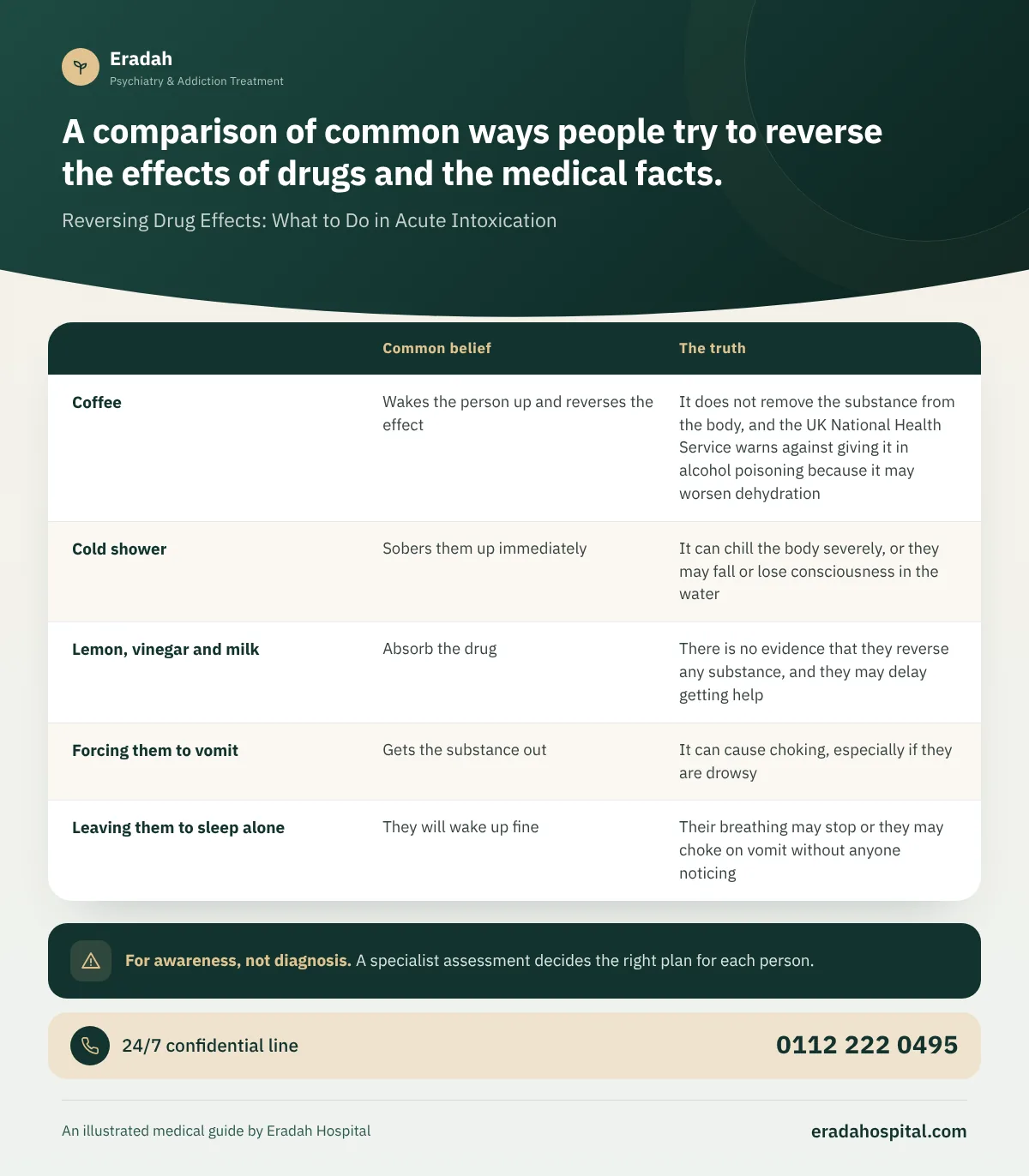
Myths about reversing drug effects
| Common belief | The truth | |
|---|---|---|
| Coffee | Wakes the person up and reverses the effect | It does not remove the substance from the body, and the UK National Health Service warns against giving it in alcohol poisoning because it may worsen dehydration |
| Cold shower | Sobers them up immediately | It can chill the body severely, or they may fall or lose consciousness in the water |
| Lemon, vinegar and milk | Absorb the drug | There is no evidence that they reverse any substance, and they may delay getting help |
| Forcing them to vomit | Gets the substance out | It can cause choking, especially if they are drowsy |
| Leaving them to sleep alone | They will wake up fine | Their breathing may stop or they may choke on vomit without anyone noticing |
After the episode: what now?
An acute episode is a warning sign. If hallucinations or suspicion continue after the effect wears off, it may be drug-induced psychosis, which needs a psychiatric assessment. If episodes recur or use is regular, this is a chance for a calm conversation about treatment, not punishment. The path begins with a medical assessment, then supervised detox when needed, then a treatment program suited to the person. At Eradah, the first consultation is free and confidential.