What are hallucinations?
A person who hears a voice calling them in an empty room, or sees people standing at the door, is not "imagining" in the sense we usually mean. Their brain is producing a perception that seems completely real to them. That is why it does not help to tell them "there's nothing there." What helps is looking with them for the cause.
The UK's National Health Service (NHS) defines hallucinations as hearing, seeing, smelling, tasting or feeling things that seem real but exist only in the person's mind. They also include the sensation that the body is moving when it is still, such as flying or floating. A hallucination in this sense is a perception without an external stimulus: the brain creates the sound or image with no source in reality.
Because hallucinations have so many possible causes, from lack of sleep to schizophrenia and from fever to alcohol withdrawal, a hallucination alone is not enough to conclude anything. It is like a headache: a symptom that calls for asking about its cause before treating it.
Are hallucinations common?
More than many people think, and this alone eases the stigma around them:
Sources: McGrath et al. (JAMA Psychiatry, 2015); Ohayon (Psychiatry Research, 2000) in the United Kingdom, Germany and Italy; Waters et al. (Schizophrenia Bulletin, 2014). Figures vary with how the question is asked, and no documented Egyptian figures are available.
The important point is that most of these experiences are brief and not linked to illness. Hallucinations that recur in broad daylight, or that the person believes and acts on, are the ones that deserve attention.
What types of hallucinations are there?
Hearing voices that talk, comment or command, or hearing murmuring and knocking. They are especially associated with schizophrenia but are not exclusive to it.
Seeing people, shapes, lights or animals. They are most common with drugs, delirium, dementia and vision loss.
A sensation of insects crawling on or under the skin, or of being touched. They are strongly linked to drug use and alcohol withdrawal.
Smelling odors that are not there. They may be linked to neurological causes such as epileptic seizures.
A strange taste in the mouth for no reason, which the person may interpret as someone poisoning them.
Images or sounds as you fall asleep or wake up. They are very common and usually normal.
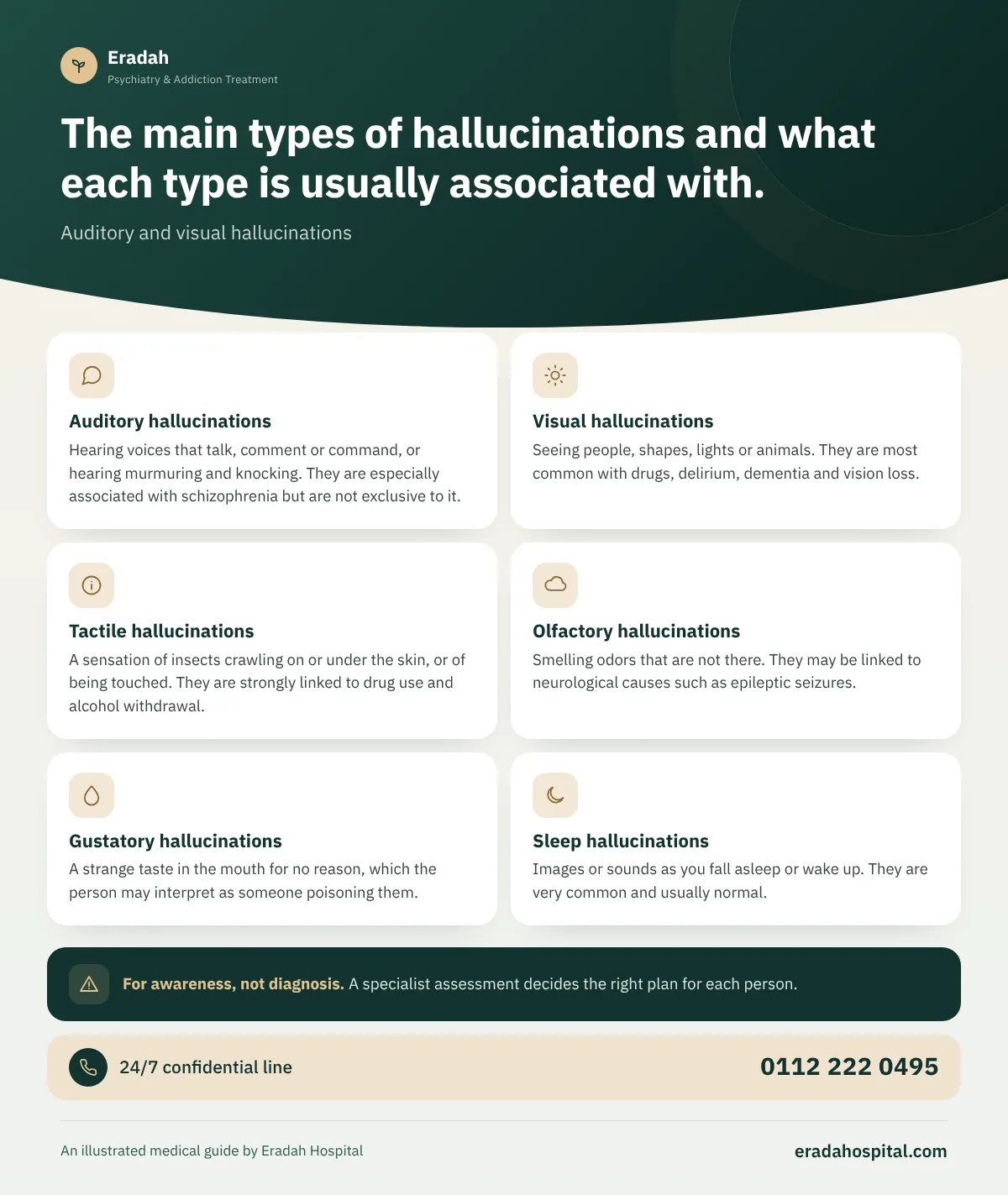
The types often occur together. The review by Waters and colleagues found that visual hallucinations in psychosis usually come with auditory ones. The doctor pays attention to the details of the experience: What do the voices say? Does the person know they are not real? When do they appear?
What is the difference in meaning between auditory and visual hallucinations?
A StatPearls review says that hearing voices is especially associated with schizophrenia, but it also appears in mood disorders, trauma, substance use and neurological illness. The person's distress grows when the voices are threatening, insulting or commanding.
Visual hallucinations are traditionally linked to organic causes, drugs and eye disease, but research shows they are not as rare in psychosis as was once believed. In the large European survey, daytime visual and auditory hallucinations were strongly linked to psychotic disorders and to anxiety, while other types of daytime hallucinations were linked more to organic or toxic causes. This is why the type of hallucination alone is not enough for a diagnosis.
What is the difference between hallucinations, delusions and illusions?
| Hallucinations | Illusion | Delusions | |
|---|---|---|---|
| Definition | A sensory perception with no external source | A real thing that is misinterpreted | A fixed false belief |
| Example | Hearing a voice in an empty room | Seeing a coat hanging up and thinking it is a person | Being certain that the neighbors are plotting against them |
| On closer inspection | The voice or image remains | The mistake disappears with a closer look or better lighting | Does not change with evidence or discussion |
| What it means | A symptom whose cause needs to be found | Often normal with tiredness or darkness | A symptom of psychosis or delusional disorder |
Hallucinations and delusions often occur together in psychosis: the person hears a voice and then builds a belief on it that they are being watched or persecuted, as in paranoia.
When are hallucinations not a sign of illness?
The NHS notes that hallucinations can be temporary and brief in ordinary situations, including: waking up or falling asleep, migraine, high fever, extreme hunger and sleep deprivation. These experiences usually share three features: they are short, the person often realizes they are not real, and they do not disrupt their life.
What causes hallucinations?
The NHS lists many causes, chiefly: mental health conditions such as schizophrenia, bipolar disorder, severe depression and post-traumatic stress disorder; drugs and alcohol; dementia and Parkinson's disease; vision loss; medication side effects; delirium, especially in older adults; and infections and brain tumors. We explain each group, what distinguishes it, and how the doctor tells them apart on the causes of hallucinations page. When a substance is the cause, the details are in the guide to drug-induced psychosis.
When are hallucinations dangerous?
The NHS recommends seeking urgent medical advice for any hallucinations, and calling an ambulance immediately in the following cases:
- A wish to harm oneself or others, or voices commanding it.
- Agitation or severe aggression.
- Hallucinations that are getting worse quickly.
- Sudden confusion or unintelligible speech.
- Hallucinations after stopping alcohol or sedatives, especially with tremors and sweating.
- Appearing for the first time in an older person, or with severe headache or seizures.
In these cases call the ambulance (123) or the mental health support line 16328 (24 hours), and do not let the person drive themselves to the emergency room.
Can hallucinations be treated?
Yes, and treating hallucinations mainly means treating their cause: antipsychotics and cognitive behavioral therapy for psychosis, detox and addiction treatment if a substance is the cause, and treating the infection or adjusting medications for organic causes. StatPearls says that auditory hallucinations respond well to appropriate psychiatric medication. We go into the options, ways of living with voices, and how the family can support the person on the hallucination treatment page.
Hallucinations guide: everything you need to know
We have gathered everything about hallucinations into 2 pages, each answering one question in detail. Choose what you are looking for:
Causes of hallucinations
What causes hallucinations? Schizophrenia, severe depression and trauma, drugs and alcohol withdrawal, dementia and Parkinson's disease, vision loss, fever and lack of sleep, and how the doctor determines the cause of a hallucination.
Hallucination treatment
How are hallucinations treated? Treating the cause first, the role of antipsychotics, cognitive behavioral therapy and "avatar" therapy for voices, treating drug-related hallucinations and those from poor vision, and how to support the person.
Hallucinations with danger or confusion? Get help now
- Voices that command the person to harm themselves or others, or a stated wish to do so
- Hallucinations getting worse quickly, or severe agitation and aggression
- Sudden confusion, unintelligible speech or a high fever
- Hallucinations with tremors and sweating days after stopping alcohol
- Severe headache, weakness on one side of the body or seizures along with the hallucinations
Stay with the person and talk to them calmly. Do not mock what they see or hear, and do not confirm it either. Keep dangerous objects out of their reach without confrontation, and do not let them drive. Call the ambulance on 123 or take them to the nearest emergency room, bring their medications, and tell the medical team about any alcohol or substance they used. You can call the mental health support line 16328 (24 hours) for advice.
Ambulance 123 Mental health support line 16328