What is an overdose?
An overdose is acute poisoning that happens when the body takes in more of one or more substances than it can handle, disrupting vital functions such as breathing, consciousness, heartbeat and body temperature. It can end in full recovery if help arrives in time, in permanent brain and organ damage, or in death.
An overdose does not always mean a “large amount.” It can happen with an amount the person has used before if their tolerance has dropped after a break, if they mixed the substance with alcohol or sedatives, or if the substance was adulterated or stronger than they thought. That is why there is no such thing as a “safe amount” of drugs.
An overdose may be accidental, or it may be intentional in a moment of despair. Either way, it is a medical emergency that deserves immediate help, without blame or delay.
Possible overdose? Call ambulance 123 immediately
- Does not respond when you call out loudly or shake their shoulder
- Very slow, irregular or stopped breathing, or snoring and gurgling sounds
- Blue or gray lips or fingernails, and cold, clammy skin
- Pupils as small as pinpoints (with opioids)
- Seizures, severe chest pain, or a very high temperature with agitation
- Vomiting while barely conscious
Call ambulance 123 immediately and tell them what you know about what the person took. If they are breathing, place them on their side in the recovery position; if they stop breathing, follow the ambulance dispatcher's resuscitation instructions. Do not leave them alone until the paramedics arrive, and if the overdose was intentional, also call the mental health support line 16328.
Ambulance 123 Mental health support line 16328What are the signs of an overdose?
The signs vary by substance, and you often do not know exactly what the person took, or they may have mixed several substances. So do not wait until you are sure; any one of these signs is enough to call the ambulance:
| Type of substance | Examples | Main signs |
|---|---|---|
| Opioids | Heroin, tramadol, morphine, codeine, fentanyl, methadone | Loss of consciousness, slow or stopped breathing, very small pupils, blue lips, snoring or gurgling sounds |
| Sedatives and alcohol | Xanax, Rivotril, Valium, pregabalin, alcohol | Severe confusion, difficulty waking the person, vomiting, slow or irregular breathing, cold clammy skin, low body temperature, and sometimes seizures |
| Stimulants | Crystal meth (shabu), cocaine, amphetamine, Captagon | Chest pain, severe palpitations, very high temperature, agitation or intense suspicion, seizures, and stroke signs such as weakness on one side of the body or difficulty speaking |
| Synthetic cannabinoids | Strox, Voodoo | Severe agitation or psychosis, seizures, rapid heartbeat, vomiting, loss of consciousness |
| Mixing substances | Opioids or sedatives with alcohol, or stimulants mixed with sedatives | The most dangerous situation: respiratory depression is multiplied, and the signs of one substance can hide behind another |
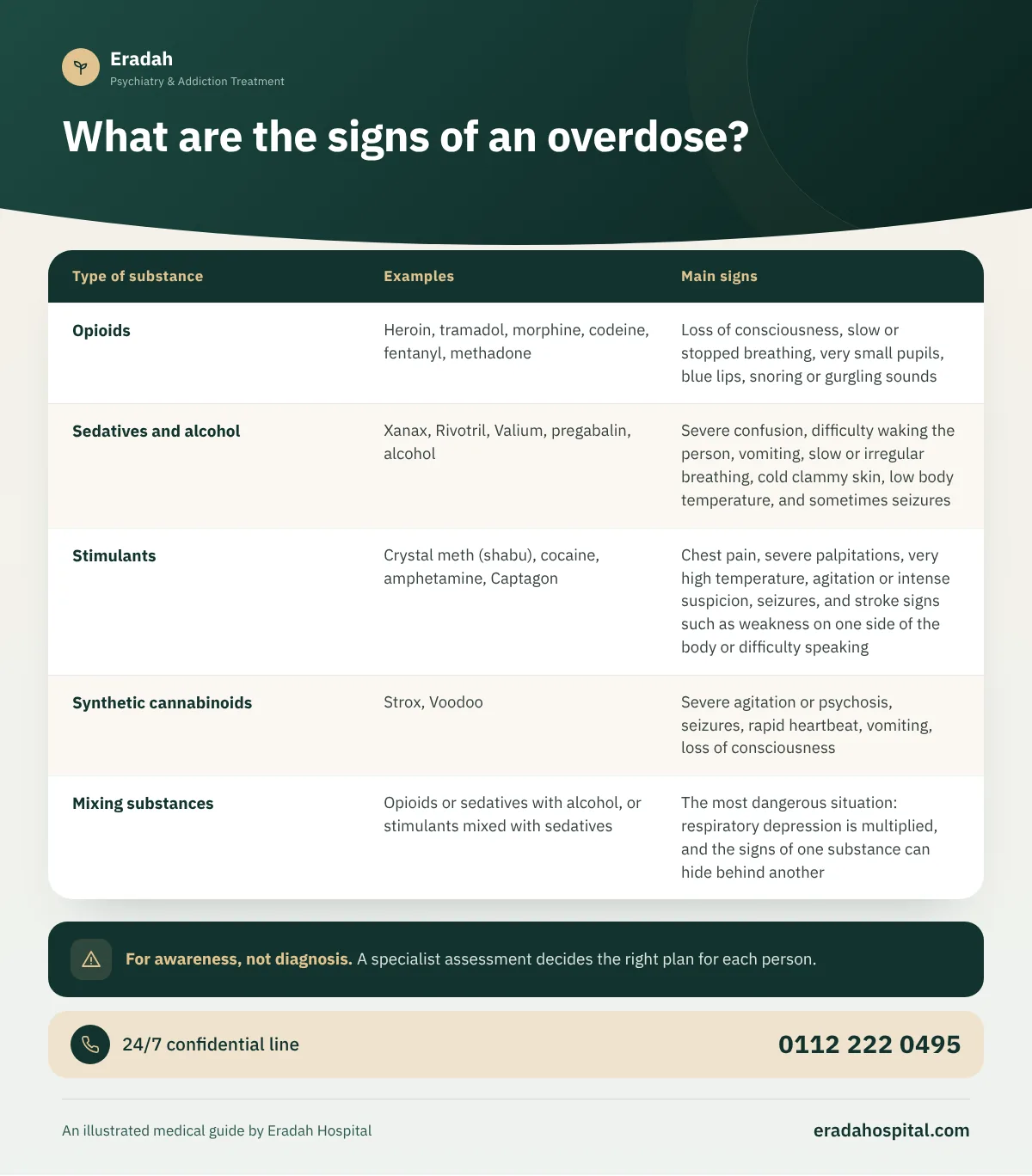
The World Health Organization notes that the three characteristic signs of an opioid overdose are pinpoint pupils, loss of consciousness, and weak breathing. The US National Institute on Alcohol Abuse and Alcoholism (NIAAA) explains that very slow or irregular breathing, difficulty waking the person, and cold, bluish skin are signs of dangerous alcohol poisoning.
What to do right away if you suspect an overdose
- Make sure you are safe first, then call out loudly and gently shake their shoulder to see if they respond.
- Call ambulance 123 immediately, or ask someone else to call while you stay with the person. Say clearly: “An unconscious person, suspected overdose.”
- Check their breathing: look at their chest and listen to their breath for a few seconds.
- If they are breathing: place them on their side in the recovery position so they do not choke on vomit.
- If they are not breathing, or breathing in gasps: start resuscitation following the instructions of the ambulance dispatcher on the phone, and do not stop until help arrives.
- If you suspect opioids and naloxone is available by prescription or medical instruction, use it as you were trained, while continuing to call the ambulance.
- Stay with them and keep watching their breathing, and do not give them food or drink.
- Gather information: what they took and when, and keep any medicine boxes or packaging to give to the paramedics.
World Health Organization guidance stresses that the priority for anyone helping a person with an opioid overdose is to open the airway, support breathing and give naloxone if available, then monitor consciousness and breathing closely until full recovery.
How do you put someone in the recovery position?
The recovery position (the safe side position) is used for a person who is unconscious but breathing, because it keeps the airway open and lets vomit drain out instead of being inhaled. In brief, the steps are:
- Step 1Straighten their legs
With the person lying on their back, straighten their legs and remove glasses and any bulky objects from their pockets.
- Step 2Arm at a right angle
Place the arm nearest you at a right angle to their body, palm facing up.
- Step 3Other hand to the cheek
Bring the back of their far hand against their cheek on your side and hold it there.
- Step 4Bend the far knee and roll them
Lift their far knee until it bends, then pull it toward you so they roll onto their side.
- Step 5Tilt the head back
Tilt their head slightly back and lift the chin to keep the airway open, and keep watching their breathing until the ambulance arrives.
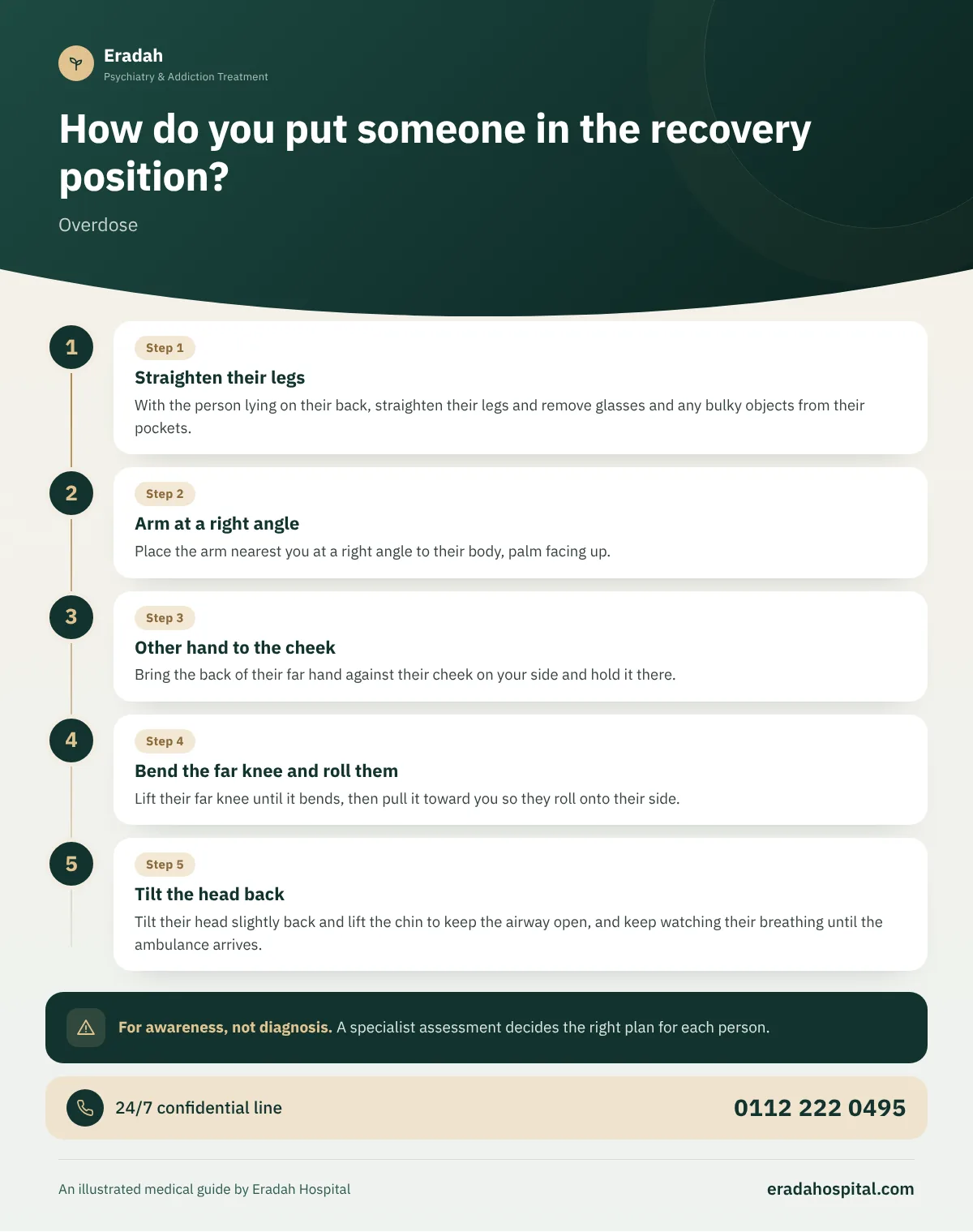
If their breathing stops at any point, return them onto their back and begin CPR following the ambulance instructions. This guide is not a substitute for an accredited first aid course, and we recommend that every family attend one.
What should you never do?
In moments of panic, popular “remedies” spread that can kill. These are the most common, and why they are dangerous:
| The mistake | Why is it dangerous? |
|---|---|
| A cold shower or ice water | It does not reverse the effect of the substance, and it can cause cold shock, a fall or drowning, and it wastes precious time. |
| Trying to make them vomit | They may inhale the vomit into their lungs and choke, especially when barely conscious. |
| Leaving them to “sleep it off” | Breathing can slow and stop during “sleep,” and many deaths happen this way. |
| Giving them another substance to wake them | A stimulant, salt or any other substance does not treat the overdose, and it may add to the strain on the heart or cause new poisoning. |
| Coffee, food or drink | They do not reverse the poisoning, and they can cause choking in someone who cannot swallow well. |
| Hitting or slapping them hard | It can cause injury and does not wake someone who is truly in an overdose. |
| Delaying the call out of fear of scandal | Minutes matter, and brain damage begins when oxygen runs low. The person's life comes first. |
NIAAA also stresses that cold showers, coffee and “letting them sleep it off” do not reverse alcohol poisoning and may make things worse.
What is naloxone? Is it available in Egypt?
Naloxone is an emergency medicine that temporarily reverses the effects of opioids, restoring breathing in someone who has stopped breathing because of heroin, tramadol, morphine and similar drugs. It is used in emergency departments and ambulances, and the World Health Organization recommends making it available to people who may witness an opioid overdose, such as patients' families, along with training in how to use it.
- It works on opioids only. It does not reverse the effects of alcohol, sedatives or stimulants, but it is usually not harmful if given to someone who has not taken opioids.
- Its effect is shorter than that of some opioids, so symptoms can return after the person wakes up. That is why they must be taken to the hospital and monitored even if they improve.
- It can cause sudden withdrawal symptoms in someone who is used to opioids, such as agitation and vomiting. This is expected and is managed medically.
- Its availability outside hospitals in Egypt should be confirmed with a doctor or pharmacist, and it should only be used according to medical instructions.
Tramadol overdose: signs that differ from other opioids
A tramadol overdose needs special attention, because tramadol is not a “pure” opioid. It activates opioid receptors to a degree, and at the same time raises serotonin and norepinephrine in the brain. So its overdose combines two dangers: depressed consciousness and breathing like any opioid, plus seizures and serotonin syndrome, which are unlike what happens with heroin.
| The sign | Why does it happen? |
|---|---|
| Deep drowsiness or loss of consciousness | The opioid effect on the brain |
| Slow or irregular breathing, or odd snoring | Depression of the breathing center, made worse by alcohol, sedatives and pregabalin |
| Seizures, even in people without epilepsy | Tramadol's effect on neurotransmitters in the brain |
| Fast heartbeat, and the pupils may be wide rather than narrow | The norepinephrine and serotonin effect |
| Agitation, tremor, heavy sweating, high temperature and muscle rigidity | Serotonin syndrome, especially with some antidepressants |
| Nausea and repeated vomiting | Risk of choking on vomit if consciousness drops |
In a review of 114 cases of intentional tramadol poisoning at a poison center in Tehran, the most common signs were nausea and vomiting, central nervous system depression, rapid heartbeat and seizures. In another case series of 158 patients, 15% had seizures, and they were more common in those who arrived with dilated pupils. So do not wait for the “pinpoint pupil” sign known from opioids; its absence does not rule out a tramadol overdose.
Even if the patient wakes up after naloxone or seems to have improved, they need to be assessed in the emergency department, because naloxone reverses only the opioid part of the effect and does not treat seizures or serotonin syndrome. Someone who survives an overdose then needs a real plan, usually starting with medically supervised detox and then a tramadol addiction treatment program. You will find details on seizures and the risk of mixing on the harms of tramadol page.
Crystal meth and cocaine overdose: how it differs and what to do
An overdose of crystal meth (shabu) or cocaine looks different from an opioid overdose: instead of breathing slowing and consciousness fading, the whole body becomes dangerously overstimulated. The StatPearls reference explains that the most serious effects of cocaine toxicity fall on the heart and blood vessels, from a racing pulse, abnormal heart rhythm and high blood pressure to heart attacks and stroke, and it is similar with crystal meth.
Chest pain or pressure, severe or irregular palpitations, fainting.
A very hot body, heavy sweating or sudden dryness, flushing with confusion.
Seizures, a sudden severe headache, weakness on one side of the body or difficulty speaking.
Severe agitation, suspicion and hallucinations, or unusual aggression.
- Call ambulance 123 immediately, and tell them what you know about the substance and the time.
- Move people and dangerous objects away, reduce noise and lighting, and speak calmly.
- Do not restrain them by force; strong resistance combined with a high temperature can increase the danger to them and to you.
- If they are hot, move them somewhere cooler and remove extra clothing, without an ice-cold shower.
- If they lose consciousness but are breathing, place them in the recovery position; if they stop breathing, follow the ambulance instructions.
After surviving, the person needs a heart check and a psychological assessment, then a real treatment plan, as described in crystal meth addiction treatment and cocaine addiction treatment.
Who is most at risk of overdose?
After detox, or leaving a rehab facility, hospital or prison, the body's tolerance drops sharply, so the amount used before becomes dangerous.
Opioids or sedatives combined with alcohol or pregabalin multiply respiratory depression, and this is among the most common causes of death.
No one sees the signs or calls the ambulance in time.
Illicit substances may contain stronger drugs such as fentanyl without the user's knowledge.
Heart, lung, liver and kidney disease raise the risk of complications.
Depression and hopelessness raise the risk of intentional overdose and need urgent attention.
The World Health Organization notes that people who return to use after a period of abstinence, and those who mix opioids with alcohol or sedatives, are among the groups most at risk of overdose. That is why we always stress that detox must be followed by rehabilitation and follow-up, not an immediate return home.
How big is the overdose problem worldwide?
Source: World Health Organization fact sheet on opioid overdose. There are no unified published Egyptian figures, so we rely on international figures.
What if the overdose was intentional?
Sometimes an overdose comes in a moment of despair. Treat it like any overdose: call ambulance 123 immediately, do not leave the person alone, and keep medicines and substances out of their reach. Once they are physically stable, they need an urgent psychological assessment before leaving the hospital.
Do not blame or confront them at this moment; the crisis is temporary and help is available. You or they can call the mental health support line 16328 around the clock. You can read about the link between suicidal thoughts and substance use in the dual diagnosis guide.
What comes after surviving an overdose?
Surviving an overdose is a clear warning that the danger is real and may happen again, and it is not the end of the story. Someone who survived once is at risk of it happening again if they return to using in the same way. But it is also a moment when many people are more ready to ask for treatment.
- Staying in the hospital for observation until the doctor decides they are safe, even if they seem fine.
- Having a medical and psychological assessment to understand what caused the overdose and the degree of dependence.
- Starting a real treatment plan that includes detox and rehabilitation, rather than simply going back home.
- Treating any accompanying depression, anxiety or suicidal thoughts.
- Making an emergency plan with the family, and talking to the doctor about naloxone if the substance was an opioid.
On the addiction treatment page you will find the full stages, and in the detox program how stopping is done safely under medical supervision. For the harms of each substance in detail, see pages such as harms of heroin, harms of tramadol and harms of alcohol.