What is Captagon?
On the Arab street, the name Captagon is given to small stimulant pills that circulate among young people, but the name itself goes back to an old German medication that no longer has legal existence anywhere in the world.
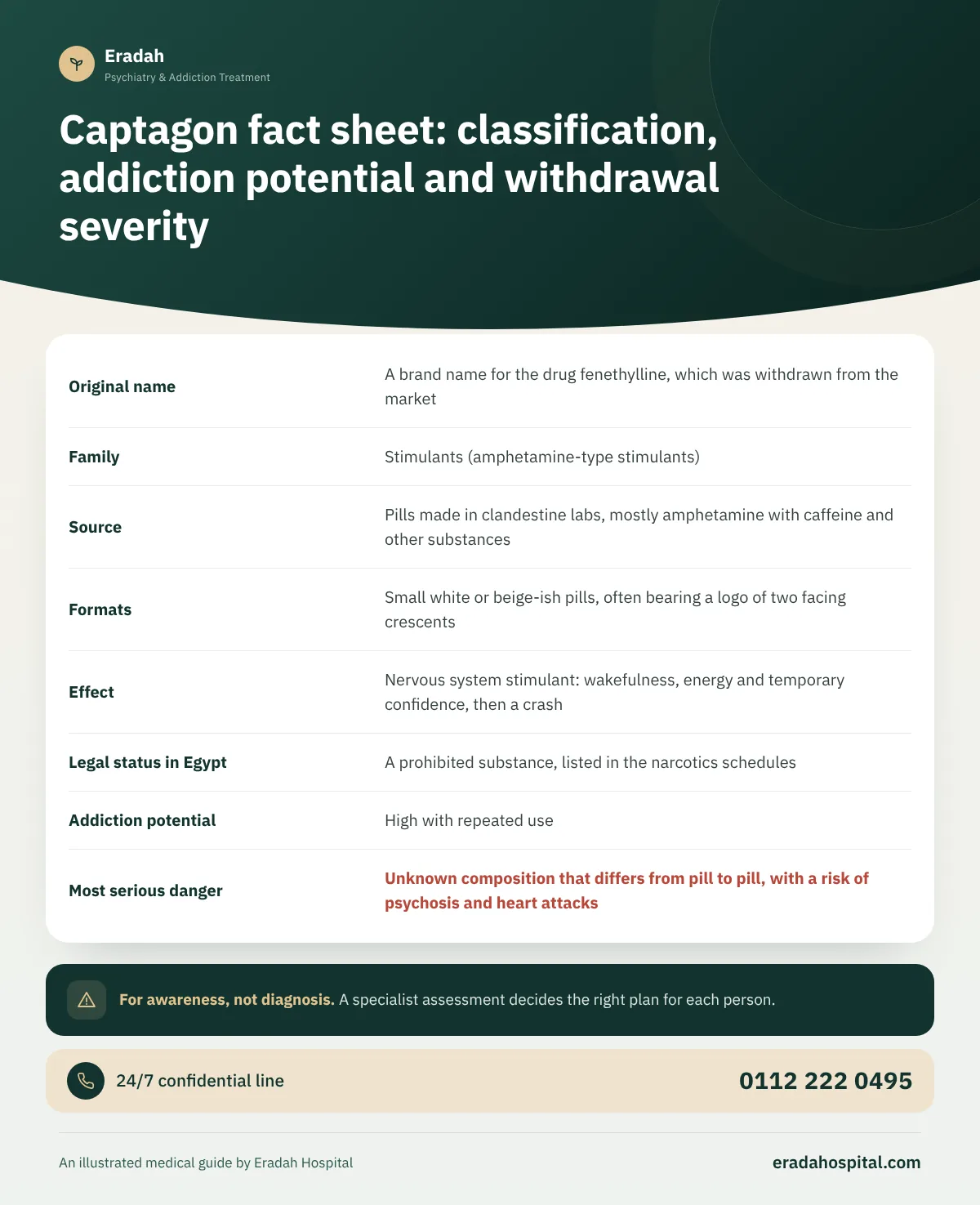
What matters is for families to know that what is sold today as Captagon is a clandestine product under no oversight, not a medication “stolen from pharmacies” as is rumored, and no one, not even the person selling it, knows exactly what each pill contains. That is what makes Captagon different in danger from any stimulant medication with a known composition.
From a German medication to illicit pills: the story of Captagon
- 1961Fenethylline is made
A German company made fenethylline, a molecule that combines amphetamine and theophylline, and launched it under the brand name “Captagon.”
- The 1960s and 1970sMedical use
The drug was prescribed to treat attention deficit disorder and narcolepsy, and as a nervous system stimulant.
- 1986International ban
Fenethylline was placed in Schedule II of the United Nations Convention on Psychotropic Substances after its potential for abuse became clear.
- The 1990s onwardClandestine labs
Counterfeit pills bearing the Captagon logo began to be manufactured in southeastern Europe, and production then moved to the Middle East.
- Since roughly 2009The original drug disappears
Production of legitimate fenethylline stopped worldwide, and the name remained attached only to illicit pills.
What do the Captagon pills in circulation today contain?
Analysis of pills seized in recent years has shown that fenethylline is rare in them and that they are mostly mixtures made in secret. Among the most notable things found in them:
The main active ingredient in most pills, responsible for the stimulant effect and for addiction.
Added in large amounts, it amplifies amphetamine’s effect on the heart, nerves and sleep.
Such as theophylline, paracetamol or quinine, and sometimes substances of unknown origin.
Some seized pills contained no amphetamine at all, only other substances, which confirms how random the composition is.
How does Captagon affect the brain and body?
Because most of the pills rely on amphetamine, their effect follows the same pathway: the release of large amounts of dopamine and norepinephrine in the brain. Shortly after taking the pill, the user feels alert, energetic and confident, with less sense of hunger and tiredness, and this lasts for many hours.
- On the brain: euphoria and a desire to talk and move, followed, as the effect wears off, by exhaustion, distress and irritability.
- On the heart and circulation: a faster pulse and higher blood pressure, and the added caffeine increases this strain.
- On sleep and appetite: staying awake for many hours and losing the desire to eat.
- With repeated use: tolerance that pushes the person to take more pills, then dependence and difficulty functioning without them.
The original drug, fenethylline, was a single molecule that breaks down in the liver into two parts: amphetamine, responsible for the stimulant effect, and theophylline, a substance related to caffeine that widens the airways and stimulates the heart. This may explain why clandestine manufacturers tried to imitate its effect by mixing amphetamine with caffeine or theophylline.
To learn more about the active substance itself, its medical uses and its scientific status, read the amphetamine guide.
Captagon, shabu and tramadol: a quick comparison
Captagon and crystal meth (shabu) are stimulants from the same family but of different strength, while tramadol is an opioid painkiller from an entirely different family. Even so, the street lumps them together, because all three are often used for the same reason: “energy” for long work, staying up late or studying. The table shows why the danger of each differs, and for a detailed comparison of the two stimulants alone, see the page Captagon or shabu: which is more dangerous?.
| Captagon | Crystal meth (shabu) | Tramadol | |
|---|---|---|---|
| Family | Stimulant; most pills are amphetamine and caffeine | Powerful stimulant (methamphetamine) | An opioid that also raises serotonin |
| Format | Pills that often bear two crescents | Crystals or powder, usually smoked | Pharmaceutical tablets or capsules |
| Effect on sleep and appetite | Insomnia and loss of appetite | Severe insomnia that can last days, with loss of appetite | Often drowsiness, and insomnia during withdrawal |
| Most dangerous acute complication | Heart rhythm disturbance, high body temperature and psychosis | Psychosis, violence, stroke and heart rhythm disturbance | Seizures and respiratory arrest |
| Withdrawal | Exhaustion, depression, long sleep and cravings | Similar but more intense, and the depression can reach suicidal thoughts | Aches, sweating, diarrhea, anxiety and insomnia |
| Emergency medication that reverses the effect | None | None | Naloxone, for the opioid component only |
The most dangerous part is that many people do not stop at one substance: someone takes Captagon or shabu to stay up, then tramadol or a sedative to “come down” and be able to sleep. This switching strains the heart and brain from both directions, hides the signs of overdose, and makes withdrawal more complicated because it combines the symptoms of depressants and stimulants.
Treatment differs depending on the predominant substance: stimulant addiction is treated mainly with behavioral therapy and monitoring of mood and sleep, as in amphetamine addiction treatment and shabu addiction treatment, while tramadol often needs a gradual taper under medical supervision as part of tramadol addiction treatment. When several substances are involved, detox in a properly equipped facility is the safest option.
Why is Captagon widespread in the Arab region?
Captagon is tied to the Arab region more than to anywhere else in the world. Over the past two decades its production shifted to labs in Syria and Lebanon, and the Gulf states, led by Saudi Arabia, became its biggest markets. Reports from the European Monitoring Centre point to the seizure of hundreds of millions of pills on the Arabian Peninsula within a few years.
After the political change in Syria in late 2024, the United Nations announced in December 2025 the dismantling of large production labs and a decline in large-scale production there, with at least 177 million pills seized in the Arab region within a year. But it warned that existing stockpiles may supply the market for a while, that production may move elsewhere, and that smugglers may turn to more dangerous stimulants such as methamphetamine.
Sources: the European Monitoring Centre for Drugs paper on the Captagon market, and United Nations News on the UNODC report of December 2025.
Who is most likely to use Captagon?
Captagon differs from many drugs in that many of those who use it start for a “practical” purpose rather than to seek a high, and regional studies point to particular groups:
| Category | Common motive |
|---|---|
| Students | Staying up to study before exams and believing it strengthens concentration |
| Drivers | Fighting sleep on long trips and night shifts |
| People working long hours | Fighting fatigue and increasing output |
| Young people at gatherings and parties | Energy, daring and peer pressure |
| People who want to lose weight | Loss of appetite |
Myths and facts about Captagon
| The myth | The truth |
|---|---|
| “Captagon is an ordinary stimulant medication” | The original drug disappeared years ago, and what is sold today is clandestine pills of unknown composition. |
| “One pill during exams won’t do anything” | Even a single pill can cause severe palpitations or a panic attack, and no one knows what is inside it. |
| “Captagon makes a person feel no fear or pain” | This is an exaggerated picture; the European Monitoring Centre points to the difficulty of proving what the media has promoted about a direct link to major violence, but it can cause impulsivity, aggression and suspiciousness. |
| “Captagon doesn’t cause addiction like heroin” | It causes real addiction of a different kind, based on intense cravings, depression and a crash after stopping. |
The legal status of Captagon in Egypt
Captagon in all its forms is a prohibited substance in Egypt. Its active ingredient amphetamine, as well as fenethylline, is listed in the narcotics schedules attached to Law No. 182 of 1960 and its amendments, and the law criminalizes possessing, trading and dealing in it. The Fund for Drug Control and Treatment of Addiction offers free, confidential treatment through the hotline 16023.
This is general educational information and not legal advice.
Captagon guide: everything you need to know
We have gathered everything about Captagon into 7 pages, each answering one question in detail. Choose what you are looking for:
Captagon harms
The danger of pills of unknown composition to the heart and brain, psychosis and aggression, road accidents, and the effect on students and pregnancy.
Captagon addiction symptoms
How the family can detect use: staying up at night, loss of appetite and behavior change, the appearance of the pills, and diagnostic criteria.
Amphetamine and Captagon withdrawal symptoms
The crash, exhaustion and depression after stopping, how long each stage lasts, and when withdrawal becomes dangerous. A page shared with amphetamine.
Amphetamine and Captagon addiction treatment
Assessment, stabilization, cognitive behavioral and motivational therapy, treatment of psychosis and depression, and relapse prevention. A page shared with amphetamine.
How long Captagon stays in the body
What testing actually detects in Captagon pills, and how long it shows in urine, blood and hair.
Captagon and sex: what really happens behind the “energy pill”?
Captagon and sex: why some people think it is a sexual stimulant, what research says about amphetamine and erectile dysfunction, the danger of combining it with erectile dysfunction medications, and what happens after stopping.
Dealing with a person addicted to Captagon: a family guide from staying up to treatment
Dealing with a person addicted to Captagon step by step: how to read the stages of staying up and crashing, what to say to them, how to handle irritability and suspicion, limits around money and driving, and when to call the ambulance.
Found Captagon pills on your son? What should you do?
- Don’t act in the heat of anger; take time to calm down and think.
- Ask about the reason before anything else: exams, work, friends or emotional distress.
- Explain to him that no one knows what is inside the pill, and that this is a risk on top of the danger of the substance itself.
- Don’t keep the pills at home, and don’t try them or “test” them yourself.
- Seek a specialist assessment even if he says it was “just once”; early intervention is far easier.
- Memorize the ambulance number, 123, and learn the signs of poisoning shown at the bottom of this page.
Signs of poisoning from Captagon pills: call the ambulance (123) immediately
- Very high body temperature, or sweating that stops, with flushing and confusion
- Chest pain spreading to the arm or jaw, or severe irregular palpitations
- A seizure or loss of consciousness, even briefly
- Sudden agitation and violence, or hallucinations and intense fear of things that are not there
- A sudden severe headache, or numbness and weakness on one side of the body, or slurred speech
Call the ambulance (123) immediately and say that the person took stimulant pills, if you know. Move them away from heat and crowds and speak to them in a calm voice. If they lose consciousness, place them on their side and stay beside them until help arrives. Don’t give them coffee, energy drinks or any other pills.
Call the ambulance 123