What is drug-induced psychosis?
Drug-induced psychosis, which doctors call substance- or medication-induced psychotic disorder, is the appearance of hallucinations or delusions as a direct result of using a substance, either while it is acting or during withdrawal from it, provided there is no better explanation such as an independent psychotic illness.
The essential difference between it and primary psychotic illnesses is that the symptoms have a clear external cause and usually recede as the substance leaves the body and withdrawal ends. But “usually” does not mean “always”: some cases persist or recur, which is why follow-up after the episode is necessary.
Psychosis can happen the first time a person uses a strong substance, can appear after years of regular use, or can follow abrupt stopping of a substance the body has grown used to, such as alcohol. The UK’s National Health Service confirms that both using drugs and suddenly stopping them after long use can trigger a psychotic episode.
How do drugs cause psychosis?
Different substances take different routes to the same result:
Stimulants such as shabu and cocaine sharply raise dopamine in pathways linked to suspicion and over-attributing meaning to things, which produces persecutory thoughts and hallucinations.
High-potency hashish and synthetic cannabinoids such as Strox disturb perception and thinking, and synthetic compounds are far stronger than natural ones.
Hallucinogens such as LSD and magic mushrooms directly alter how the senses are processed, and the experience can turn into terror and delusions.
When alcohol or sedatives are stopped suddenly after long use, the brain stays in a state of overexcitation, and hallucinations, delirium and seizures can appear.
Staying awake for days on end with stimulants can by itself produce psychotic symptoms and multiplies the effect of the substance itself.
Which drugs cause psychosis?
Almost any substance that affects the brain can cause psychosis under certain conditions, but some are far better known than others. Medical references also list legitimate medications that can rarely cause it, such as cortisone and some Parkinson’s medications, which is why no prescribed medication should be stopped without the doctor:
| Substance | When psychosis usually appears | What distinguishes it |
|---|---|---|
| Shabu, amphetamine and Captagon | During use, especially after long stretches without sleep | Intense suspicion and persecution, a feeling of insects under the skin, and it can last for weeks |
| Strox and Voodoo | Within minutes to hours of use | Severe agitation and unpredictable behavior, and the composition of the substance is unknown |
| Hashish and bango | With heavy use or high-potency types | Paranoia and ideas of reference, and a strong link to the later development of schizophrenia |
| Cocaine | During repeated use in a single session | Acute, relatively short suspicion that can recur quickly with each use |
| LSD and magic mushrooms | While under the effect | Sensory distortions and terror, and sometimes perceptual disturbances persist afterward |
| Ketamine | While under the effect | Detachment from the body and reality, and confusion |
| Alcohol | Usually during withdrawal, and rarely with heavy drinking | Withdrawal hallucinations can develop into life-threatening delirium tremens |
How long does drug-induced psychosis last?
There is no single duration, as it depends on the substance, the amount used, how long it was used and the person’s condition. Medical references indicate that symptoms are usually short and recede after the substance leaves the body, while stimulant psychosis can last for weeks:
- HoursHallucinogens, cannabis and cocaine, usually
Symptoms usually settle as the effect of the substance ends, in a safe place under observation.
- DaysShabu, Strox and alcohol withdrawal
Suspicion and hallucinations can last several days, and this often requires hospital care.
- WeeksSome stimulant cases
Residual symptoms may remain for weeks with gradual improvement, especially after long use.
- More than a month after stoppingA sign that calls for reassessment
Symptoms that continue for a long time after intoxication and withdrawal have ended lead the doctor to look for an independent psychotic disorder.
Durations are approximate and vary from person to person, and only the treating doctor can judge them.
What is the difference between drug psychosis, schizophrenia and delirium?
| Point of comparison | Drug psychosis | Schizophrenia | Delirium |
|---|---|---|---|
| Cause | A substance or withdrawal from it | A predisposition in the brain with multiple factors | An acute organic cause such as poisoning, severe withdrawal or infection |
| The start | Linked in time to use or stopping | Usually gradual, with early signs | Rapid, over hours or days |
| Consciousness and orientation | Usually knows the place and time | Usually knows the place and time | Confused, does not know where they are or what time it is |
| Visual and tactile hallucinations | Relatively common | Less common than auditory ones | Common |
| Course | Usually improves with stopping | Chronic, needs long-term treatment | A medical emergency that resolves when the cause is treated |
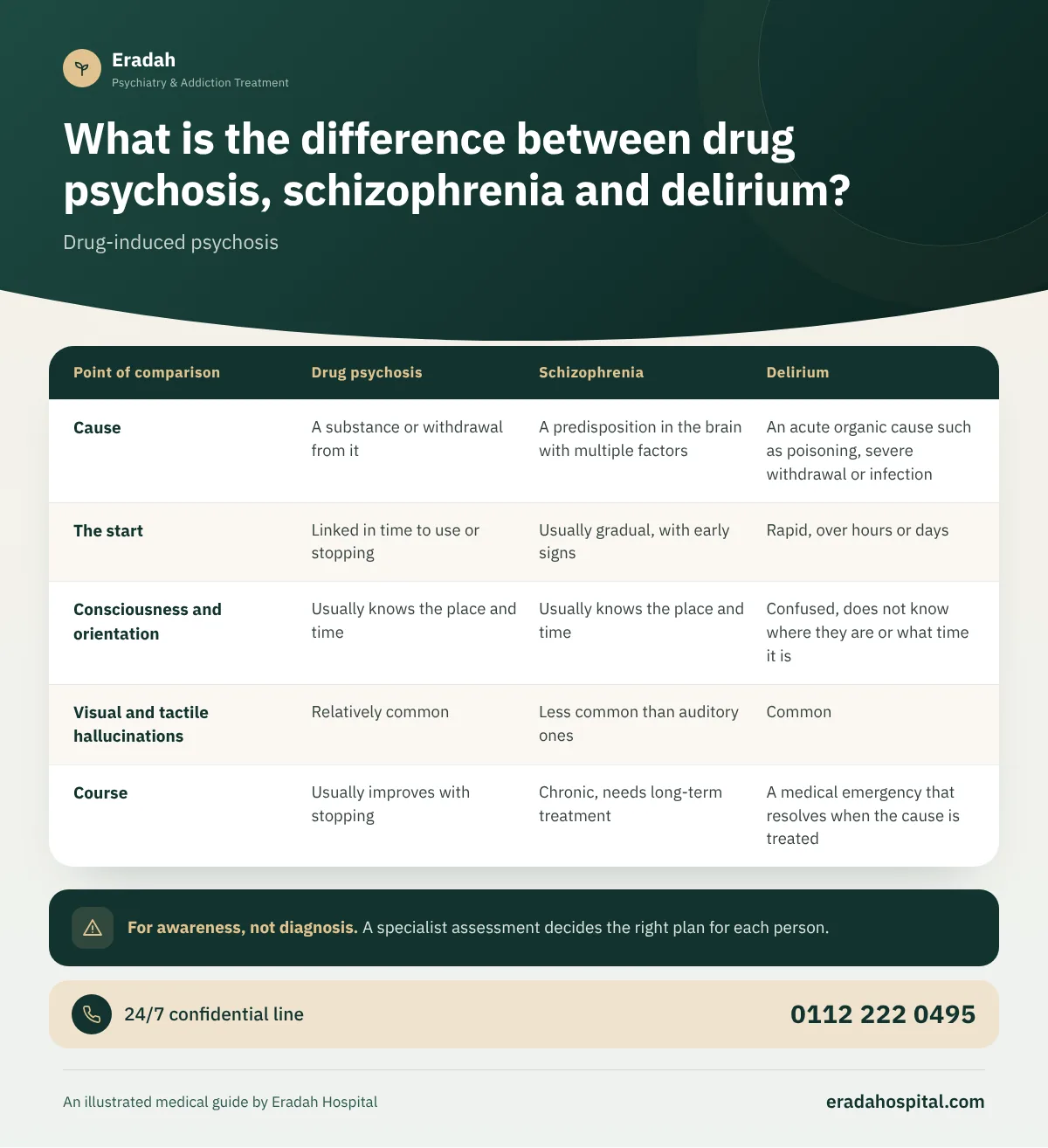
Delirium, on the other hand, is a medical emergency that differs from ordinary psychosis, and its best-known example is delirium tremens in alcohol withdrawal. You will find the detailed difference between schizophrenia and other conditions in the schizophrenia guide.
When does drug psychosis point to a deeper mental illness?
Doctors look for several signs that make them suspect the substance was not the only cause and may have uncovered an underlying disorder such as schizophrenia or bipolar disorder:
- Symptoms lasting a long time, about a month or more, after complete stopping and the end of withdrawal.
- Psychotic symptoms or a decline in functioning before substance use even began.
- Symptoms far more severe than would be expected from the type and amount of the substance.
- Episodes recurring even with little or no substance use.
- A strong family history of schizophrenia or bipolar disorder.
A large Danish study indicates that about a third of people who went through drug psychosis were later diagnosed with schizophrenia or bipolar disorder, with the highest proportion seen with hashish. The details are on the page Harms of drug-induced psychosis.
Who is most at risk of drug-induced psychosis?
- Teenagers and young adults: because the brain has not finished developing, and early use is linked to higher risk.
- People with a family history of schizophrenia or bipolar disorder.
- People who use strong or unknown-composition substances such as synthetic cannabinoids and shabu, or who mix more than one substance.
- People who use heavily and for long periods, with sleeplessness and poor eating.
- People who have had a previous psychotic episode, since episodes tend to return faster with each new use.
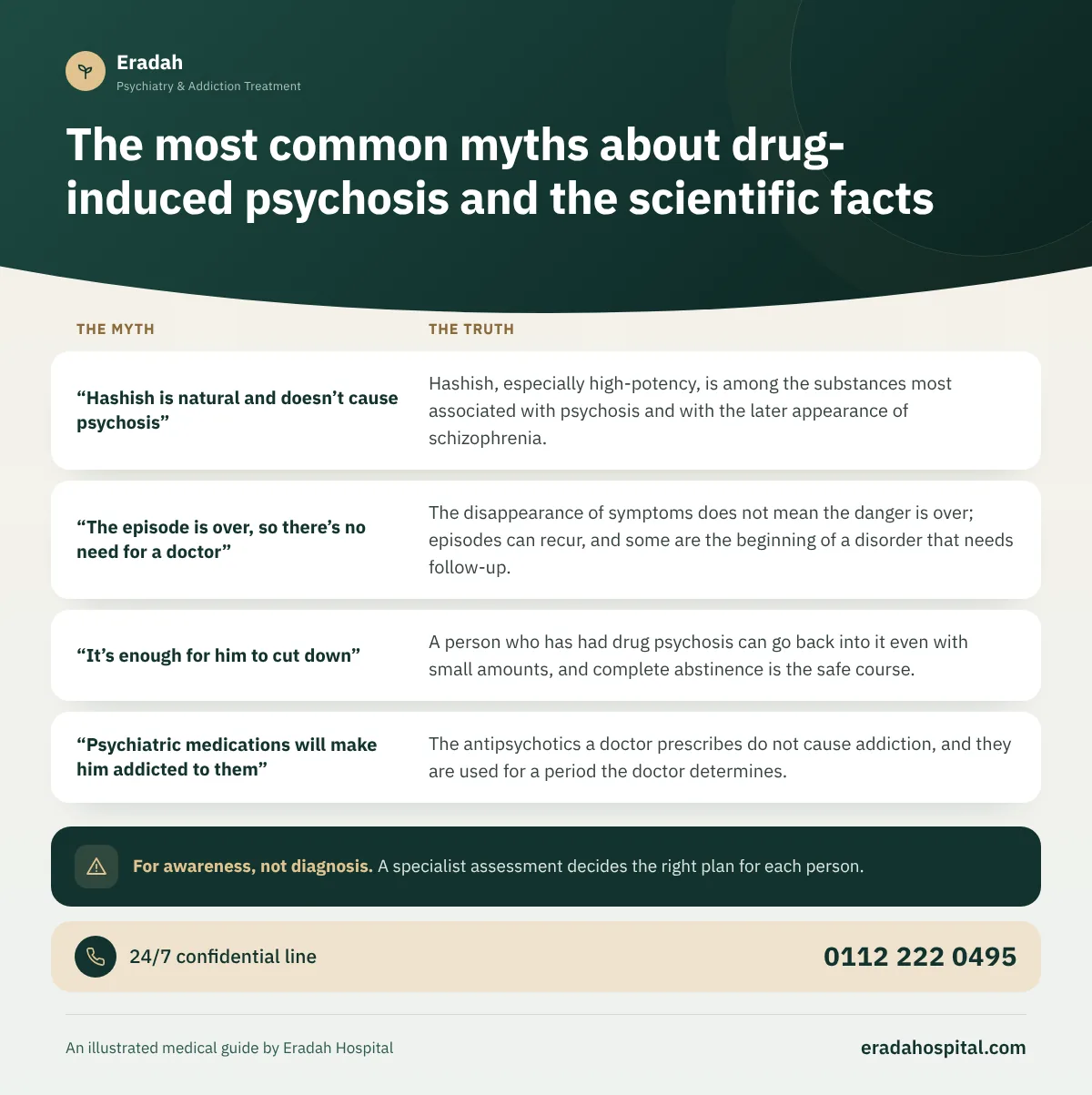
Common myths about drug psychosis
| The myth | The truth |
|---|---|
| “Hashish is natural and doesn’t cause psychosis” | Hashish, especially high-potency, is among the substances most associated with psychosis and with the later appearance of schizophrenia. |
| “The episode is over, so there’s no need for a doctor” | The disappearance of symptoms does not mean the danger is over; episodes can recur, and some are the beginning of a disorder that needs follow-up. |
| “It’s enough for him to cut down” | A person who has had drug psychosis can go back into it even with small amounts, and complete abstinence is the safe course. |
| “Psychiatric medications will make him addicted to them” | The antipsychotics a doctor prescribes do not cause addiction, and they are used for a period the doctor determines. |
What should the family do after a first drug-induced psychotic episode?
The first episode is a shock for the family, but it is also an opportunity: many young people are not convinced of the danger of substance use until they see what the substance did to their minds. The most important things the family can do once the episode has calmed:
- Do not consider it over once he leaves the emergency room; arrange a follow-up appointment with a psychiatrist who specializes in addiction.
- Talk with him calmly about what happened, without shaming or threatening, and focus on your fear for him.
- Keep substances and the people linked to use away as far as possible, without locking him up or using violence.
- Watch for a return of suspicion or sleep disturbance in the following weeks and tell the doctor.
- Take care of yourselves; what you saw is painful, and psychological support for the family is part of treatment.
Drug-induced psychosis guide: everything you need to know
We have gathered everything about drug-induced psychosis into 3 pages, each answering one question in detail. Choose what you are looking for:
Symptoms of drug-induced psychosis
Hallucinations, suspicion and agitation as they appear with each substance, how the family can tell an acute episode from the mere effect of the substance, and when it is an emergency.
Harms of drug-induced psychosis
Accidents, violence and self-harm during an episode, recurrence of episodes, and the possibility of progression to schizophrenia or bipolar disorder.
Treating drug-induced psychosis
Handling the episode in the emergency room, the role of antipsychotics and sedatives, then addiction treatment, abstinence and long-term follow-up.
An acute psychotic episode after substance use, or suicidal thoughts? Get help now
- Severe agitation or suspicion that leads the person to attack others or run into the street unaware of the danger
- Voices commanding them to harm themselves or others, or talk about death or ending their life
- Confusion and not knowing the place or time, together with a high temperature, heavy sweating or severe shaking
- Seizures, chest pain or loss of consciousness
- Not eating, drinking or sleeping for days in a row
Call the ambulance on 123 or go to the nearest emergency room, and tell the medical team honestly what the person took, if you know. Stay with them in a quiet place with low light and little noise, speak calmly, and do not argue with them or restrain them by force, and move dangerous objects out of their reach without confronting them. You can call the mental health support line 16328 around the clock.
Ambulance 123 Mental health support line 16328