“I thought I was in control, until I found I had lost my job, my health and my home in two years.” This sentence sums up how the harms of drugs work: they creep in slowly, the person using thinks they are far from them, then they appear together in the body, the mind and the family all at once.
What are the harms of drugs, and why do they differ from person to person?
The harms of drugs are everything a substance leaves behind in damage to the health and life of the person using it and those around them. Their size depends on several factors: the type of substance, since stimulants strain the heart while opioids and sedatives suppress breathing; the amount and duration of use; the method of use, since smoking and injecting get the substance to the brain faster and increase its addictiveness; mixing more than one substance; and then age and physical and mental health. That is why one person may look “fine” after years while another collapses quickly, but the harm builds up in everyone.
According to the 2026 World Drug Report from the United Nations Office on Drugs and Crime, about 331 million people used at least one drug in 2024, roughly 6.2% of those aged 15 to 64, and cannabis (hashish and marijuana) remained the most widely used.
Harms of drugs on the brain and mental health
Almost every addictive substance acts on the brain’s reward circuit, releasing large amounts of dopamine. With repetition the brain adapts: its response to natural pleasures weakens, and the areas of judgment, decision-making and impulse control weaken, so use becomes a compulsive behavior rather than a choice. The US National Institute on Drug Abuse describes these changes as explaining the compulsive nature of addiction.
- Mood and anxiety disorders: depression, panic attacks and sharp mood swings, especially during withdrawal.
- Psychosis: suspicion and hallucinations that can appear with stimulants such as shabu and with high-potency hashish, with details in drug-induced psychosis.
- Memory and concentration: slowed thinking and weaker learning and attention.
- Nerve damage: some substances, such as volatile solvents, can destroy nerve cells.
Harms of drugs on the body: organ by organ
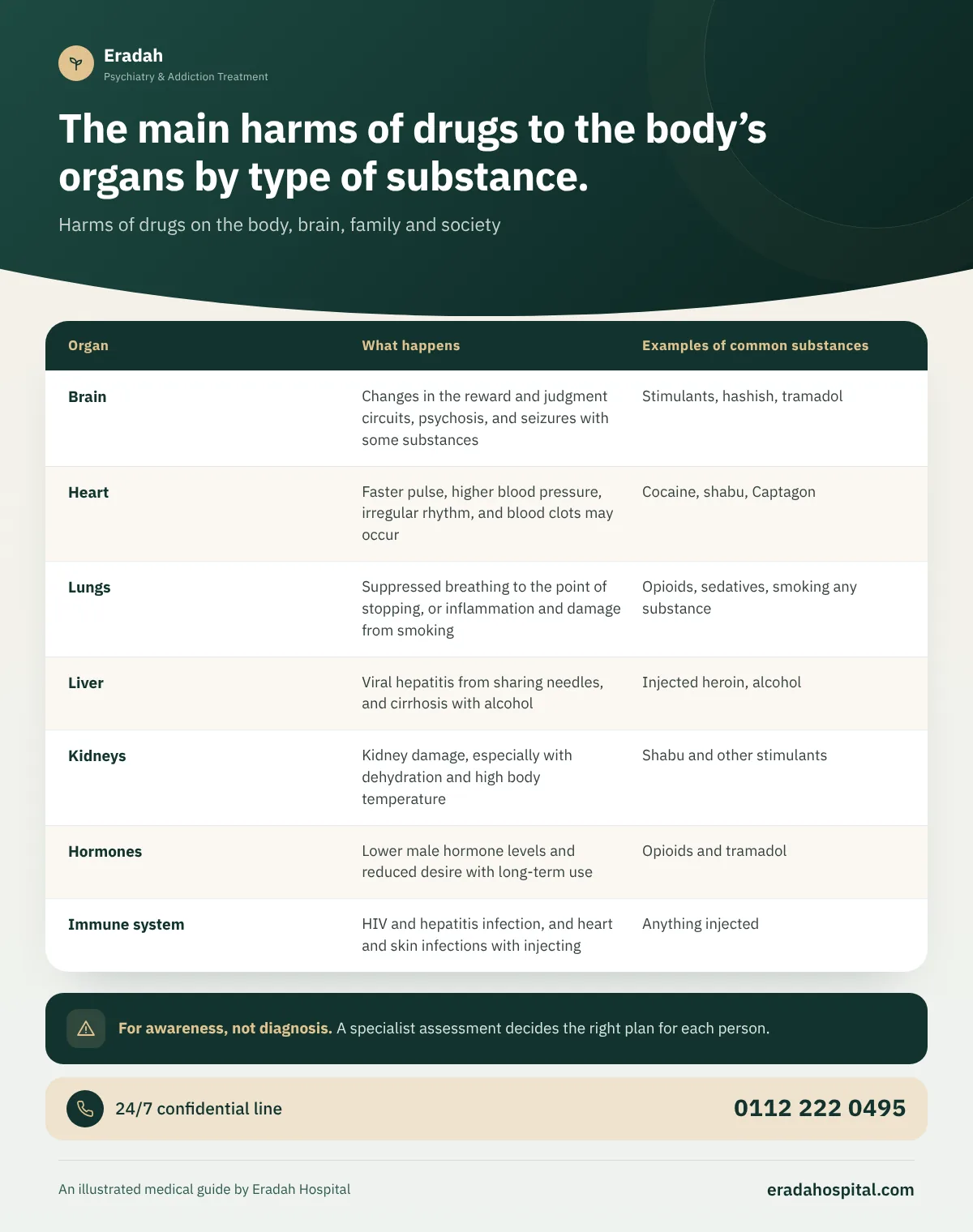
| Organ | What happens | Examples of common substances |
|---|---|---|
| Brain | Changes in the reward and judgment circuits, psychosis, and seizures with some substances | Stimulants, hashish, tramadol |
| Heart | Faster pulse, higher blood pressure, irregular rhythm, and blood clots may occur | Cocaine, shabu, Captagon |
| Lungs | Suppressed breathing to the point of stopping, or inflammation and damage from smoking | Opioids, sedatives, smoking any substance |
| Liver | Viral hepatitis from sharing needles, and cirrhosis with alcohol | Injected heroin, alcohol |
| Kidneys | Kidney damage, especially with dehydration and high body temperature | Shabu and other stimulants |
| Hormones | Lower male hormone levels and reduced desire with long-term use | Opioids and tramadol |
| Immune system | HIV and hepatitis infection, and heart and skin infections with injecting | Anything injected |
The US National Institute on Drug Abuse stresses that people with addiction often also suffer from lung disease, heart disease, stroke, cancer or mental disorders, and that sharing injection equipment is one of the main ways HIV and hepatitis C are transmitted. You will find details for each substance on pages such as harms of hashish and harms of tramadol.
The most dangerous drugs
There is no single answer, because “danger” has many faces: risk of death, speed of addiction, and harm to others. In a well-known study published in The Lancet in 2010, British experts rated 20 substances on 16 criteria of harm, and heroin, crack and methamphetamine (shabu) came first among the substances most harmful to the user, while alcohol came first in overall harm (72 out of 100) because it does the most harm to others, followed by heroin (55) and then crack (54).
- Potent opioids such as heroin and fentanyl: the greatest danger is stopped breathing. The World Health Organization estimates that about 80% of the roughly 600,000 drug-related deaths in 2019 were linked to opioids.
- Synthetic stimulants such as shabu: rapid addiction, psychosis and harm to the heart.
- Synthetic substances of unknown composition such as Strox: the person using it does not know what they are taking or at what concentration.
Harms of drugs on the family
The person using is rarely the only one hurt. The family lives with worry, lies and vanishing money, and daily life can become the management of one crisis after another. Children are affected in particular: instability, fear and sometimes neglect or violence, experiences that raise the chance they will struggle later. A spouse often falls into the role of the “rescuer” who covers up the use, wearing themselves out without the illness stopping. The Family Guide offers practical ways to cope without the family losing itself.
Harms of drugs on work and society
- Lower productivity, absence and job loss.
- Road and workplace accidents under the influence of a substance.
- Debts and legal problems that weigh on the family for years.
- A burden on hospitals, emergency rooms and mental health services.
- The spread of blood-borne infections among people who inject.
Does the harm of drugs go away after stopping?
Many harms improve clearly with abstinence and treatment: sleep and appetite return gradually, mood and concentration improve, and many relationships regain their balance. But some harms can last, such as liver cirrhosis, some mental disorders or nerve damage, which is why every month gained early matters. The urge to use may stay strong for a while after stopping because the brain’s changes take time to settle, and this is why a relapse prevention plan is important.
How do you start treatment before the harms pile up?
The first step is a medical and psychological assessment that determines the extent of the harm, the substance used and whether there are accompanying mental illnesses. After that the patient may need medically supervised detox, then a residential treatment program or outpatient treatment depending on the case, with treatment of dual diagnosis if present. At Eradah the journey begins with a free, confidential first consultation.