What are the immediate harms of hashish?
During the hours of its effect, the brain is not in its normal state, and that alone is enough to cause harm, even for someone using for the first time.
Distorted sense of time and distance, and impaired attention and short-term memory.
Especially with strong varieties or in first-time users, and it can reach temporary suspicion and paranoia.
Increases the workload on the heart and may cause dizziness or a drop in blood pressure on standing.
Poor motor coordination and a higher risk of accidents and injuries.
Does hashish affect memory, concentration and intelligence?
Yes. The hippocampus, the brain's center for forming memories, is rich in cannabinoid receptors, so THC weakens the ability to learn and retain new information. In people who use regularly, this effect continues for days after use, so the person is as if living in a constant fog.
Long-term studies suggest that regular use that starts in adolescence may be linked to a decline in some mental abilities, and that part of this decline may not fully return even after stopping. People who start later usually see their mental performance improve after a period of abstinence.
Does hashish kill ambition?
Many families notice that their son has lost interest in study and work and become "indifferent to everything." Regular use is linked to lower motivation, poorer academic performance and a higher chance of leaving education, partly because of THC's effect on the reward system and partly because time and attention revolve around use.
Does hashish cause psychosis and schizophrenia?
This is one of the most serious harms of hashish and one of the best established scientifically. THC can cause an acute psychotic episode: hallucinations, unrealistic beliefs that someone is watching or plotting against the person, and incoherent speech. The episode usually ends when the substance wears off, but in some people it can be the start of a chronic psychotic illness.
In a large European study published in The Lancet Psychiatry, daily use of high-potency cannabis was linked to roughly five times the likelihood of a psychotic disorder compared with people who never used it. The risk rises with a family history of schizophrenia or bipolar disorder, and with starting in adolescence.
Does hashish cause suspicion and paranoia?
Yes, suspicion is among the best-documented psychological effects of hashish. In an experiment published in Schizophrenia Bulletin with 121 people prone to paranoid thoughts, THC provoked suspicion by increasing anxiety and strange perceptual experiences, and the risk is greater with high-potency varieties. The suspicion usually ends when the effect ends, but if it lasts for days or becomes a firm conviction that leads to accusing family members or carrying something for self-defense, it may be the start of drug-induced psychosis and needs an assessment.
We explain the difference between passing suspicion and paranoia that needs intervention, and how a family can handle it step by step, on the page Hashish and Paranoia: Understanding Suspicion and How to Respond.
Hashish, anxiety and depression
Many people use hashish to calm anxiety or escape sadness, but regular use is linked to higher rates of anxiety, depression and sleep disturbance, and may increase negative thoughts in teenagers. The relationship runs in both directions; a mental health disorder pushes people to use, and use makes the disorder worse, which is why many patients need dual diagnosis treatment.
What is cannabinoid hyperemesis syndrome?
Cannabinoid hyperemesis syndrome is a condition affecting some people who use cannabis regularly over long periods, marked by repeated episodes of severe nausea, persistent vomiting and abdominal pain. One characteristic feature is that the person feels temporary relief from a hot shower, and repeats it compulsively.
The danger of this syndrome is that continuous vomiting can cause severe dehydration, disturbed body salts and kidney injury, and the patient may go to the emergency room many times without a correct diagnosis because they do not connect the vomiting to hashish. The only definitive treatment is stopping cannabis completely.
- Prodromal phaseMorning nausea and fear of vomiting
It may last months, with mild abdominal pain, and some people think hashish treats the nausea and so use more.
- Vomiting phaseSevere, repeated vomiting episodes
Vomiting for hours or days with abdominal pain, frequent hot showers, and a risk of dehydration.
- Recovery phaseAfter stopping cannabis
Symptoms gradually disappear, and may return if the person goes back to use.
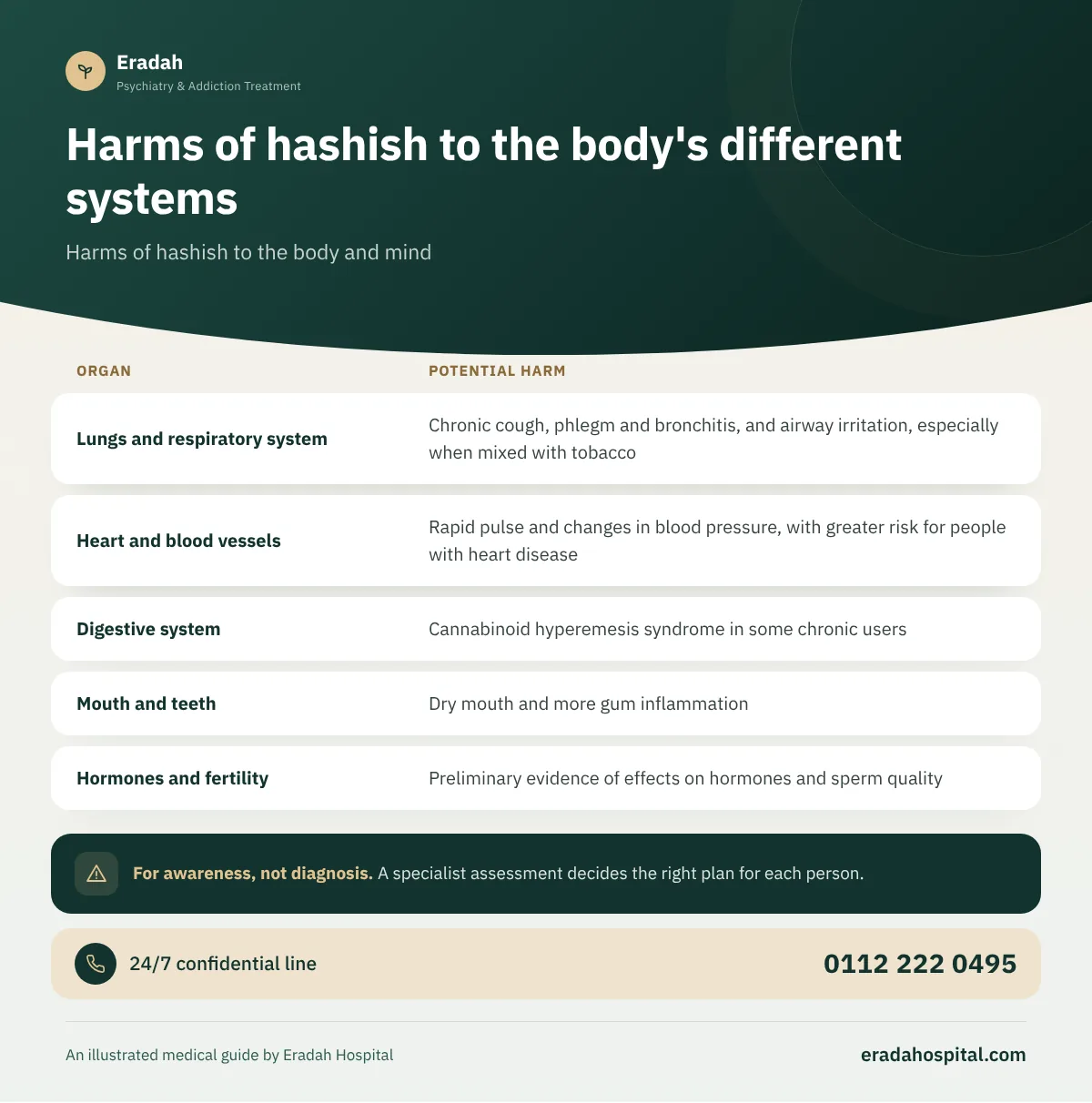
Harms of hashish to the heart, lungs and the rest of the body
| Organ | Potential harm |
|---|---|
| Lungs and respiratory system | Chronic cough, phlegm and bronchitis, and airway irritation, especially when mixed with tobacco |
| Heart and blood vessels | Rapid pulse and changes in blood pressure, with greater risk for people with heart disease |
| Digestive system | Cannabinoid hyperemesis syndrome in some chronic users |
| Mouth and teeth | Dry mouth and more gum inflammation |
| Hormones and fertility | Preliminary evidence of effects on hormones and sperm quality |
The effect of hashish on sexual health in brief
Some young men think hashish "makes it last longer" or increases enjoyment, but the temporary feeling of relaxation is one thing and the effect of regular use is another. A systematic review linked cannabis smoking to a higher rate of erectile dysfunction, and a Danish study linked smoking more than once a week to lower sperm concentration. Added to this are anxiety and suspicion with strong varieties, and closeness with a partner becoming tied to the substance.
We set out what the conflicting research says in detail, and what improves after stopping, on the page Hashish and Sex: The Feeling in the Moment and What Research Says.
Does hashish improve sleep or ruin it?
Many people use hashish to get drowsy quickly, and at first it may work. But THC changes the structure of sleep itself, reducing the dreaming stage the brain needs to consolidate memory and regulate emotions, and over time tolerance builds, so the person needs more to fall asleep.
The result is that the person becomes unable to sleep without hashish, wakes exhausted despite enough hours of sleep, and has severe insomnia when trying to stop. In other words, hashish does not treat insomnia; it postpones and deepens it.
Is driving under the influence of hashish dangerous?
Yes. THC slows reaction time and impairs judgment of distance and attention to the road, and British health sources estimate that driving under the influence of cannabis can double the chance of a serious or fatal crash. The risk multiplies further when hashish is combined with alcohol. Impairment can also continue after the high has passed, so a person feeling that they have "sobered up" does not mean they can drive safely.
Harms of hashish in pregnancy and breastfeeding
THC crosses the placenta to the baby, and use during pregnancy is linked to lower birth weight, and research suggests the child's brain development and attention may be affected later. THC also passes into breast milk. For this reason health authorities advise stopping cannabis completely during pregnancy and breastfeeding, and asking for medical help if stopping is hard.
Why is hashish more dangerous for teenagers?
The teenage brain is still developing until about the mid-twenties, and the endocannabinoid system takes part in this development. So teenagers are affected more by THC: a higher risk of addiction, a higher risk of psychosis, and a bigger effect on memory and school achievement. According to NIDA, people who start using cannabis before age 18 are four to seven times more likely to develop cannabis use disorder than those who start as adults.
What happens when hashish is mixed with other substances?
- With alcohol: Worsens poor coordination, dizziness and vomiting, and sharply raises the risk of accidents.
- With sedatives and pills: Such as pregabalin and benzodiazepines, it may increase sedation, drowsiness and confusion.
- With stimulants: More strain on the heart, plus anxiety and insomnia.
- With synthetic cannabinoids: A product may be sold as hashish while mixed with a synthetic substance, causing seizures, loss of consciousness or sudden violence.
When does a person who uses hashish need emergency care? Call ambulance (123) immediately
- A severe panic attack that does not settle, or psychosis: hallucinations, intense suspicion, incoherent speech or aggression
- Chest pain, severe palpitations or fainting
- Repeated vomiting that does not stop, with signs of dehydration: intense thirst, passing little urine and dizziness on standing
- Seizures, loss of consciousness or sudden agitation, especially if the substance is suspected of being mixed with a synthetic drug such as Strox
- A child swallowing any product containing cannabis: extreme drowsiness, unsteadiness or difficulty breathing
Call ambulance (123) and do not leave the person alone. If they are vomiting or have lost consciousness, place them on their side (recovery position) so they do not choke, and tell the paramedics honestly what was taken so they can choose the right treatment. Do not use any home remedies.
Call the ambulance 123
30Social and professional harms
The harms of hashish are not limited to the body; regular use is linked to declining academic and job performance, family and marital problems, growing financial burdens, and legal trouble because it is a banned substance in Egypt. These harms often appear slowly, so the person does not notice them until years later.
To learn the signs that use has turned into addiction, see the symptoms of hashish addiction.