Short-term harms of tramadol
These harms can appear within hours of taking tramadol, and they increase with large amounts or pills of unknown strength:
- Nausea, vomiting, and dizziness, which are among the most common side effects.
- Drowsiness, slowed thinking, and poor concentration, which raise the risk of road and workplace accidents.
- Constipation, dry mouth, and sweating.
- Headache and sleep disturbance in some people.
- Respiratory depression, with the greatest risk in the first days and when the amount is raised or it is mixed with other depressants.
Does tramadol cause seizures?
Yes, and this is one of its most important harms, setting it apart from other opioids. The official drug leaflet states that seizures have been reported even within the therapeutic dose range, and that the risk rises when it is exceeded. The risk rises further in the following situations:
- Taking large amounts or smuggled pills of unknown strength.
- Having epilepsy, a previous head injury, or a brain disorder.
- Combining it with certain antidepressants or antipsychotics.
- Withdrawing from alcohol or sedatives at the same time.
- Slow processing of the drug by the liver because of other medicines or genetic factors.
Serotonin syndrome: the danger of mixing with medicines
Because tramadol raises serotonin, combining it with other medicines that raise serotonin can cause a dangerous condition called serotonin syndrome. These medicines include some antidepressants, some migraine medicines, and St. John's wort. Its signs include:
Agitation and severe tension, confusion, or hallucinations.
High temperature, rapid pulse, heavy sweating, and unstable blood pressure.
Tremor, muscle stiffness, involuntary jerking, and loss of balance.
This is an emergency that needs a hospital right away, which is why the doctor must know every medicine the patient takes before prescribing tramadol.
Long-term harms of tramadol on the body
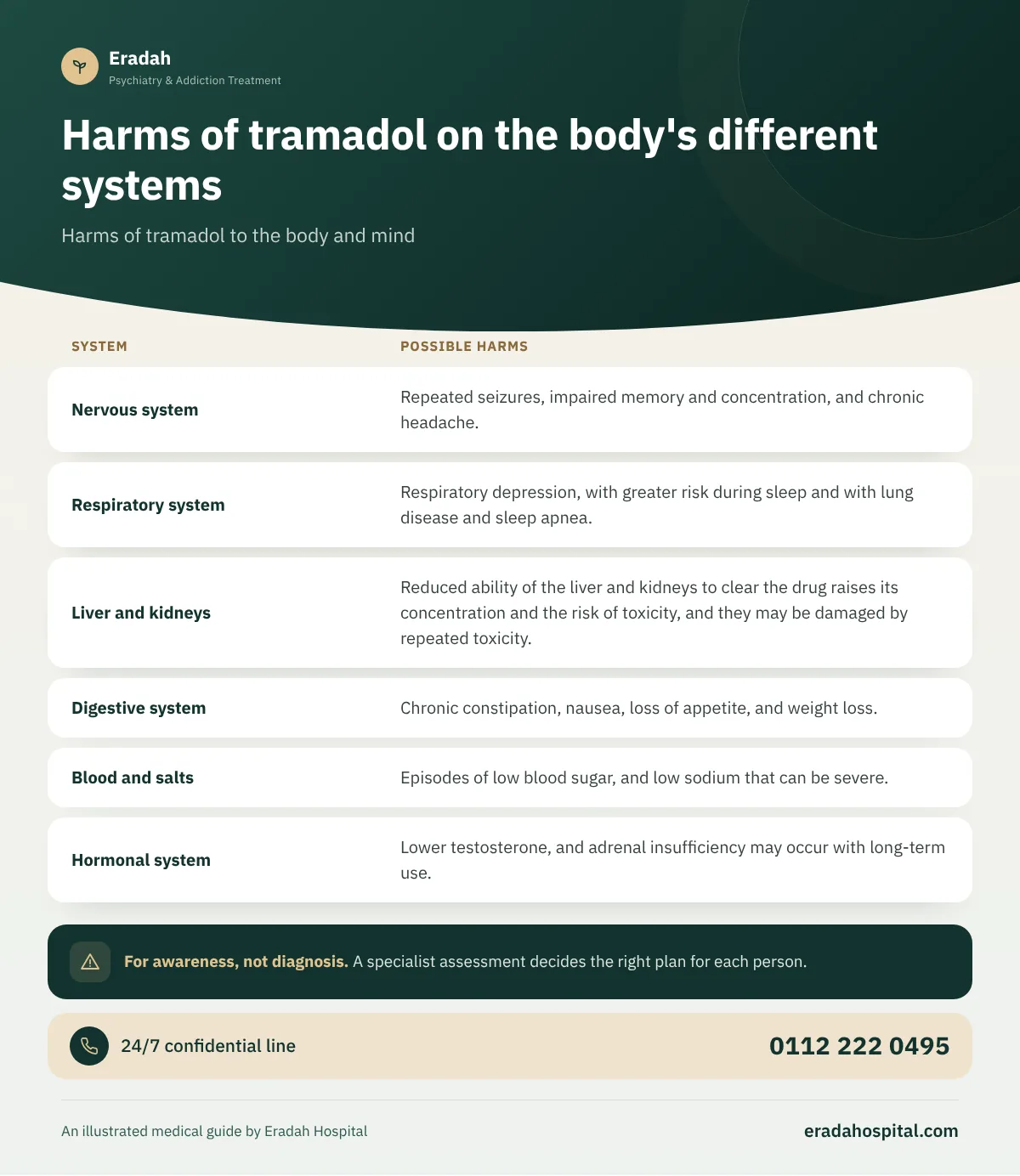
With repeated use over weeks and months, especially outside medical supervision, harms accumulate across the body's systems:
| System | Possible harms |
|---|---|
| Nervous system | Repeated seizures, impaired memory and concentration, and chronic headache. |
| Respiratory system | Respiratory depression, with greater risk during sleep and with lung disease and sleep apnea. |
| Liver and kidneys | Reduced ability of the liver and kidneys to clear the drug raises its concentration and the risk of toxicity, and they may be damaged by repeated toxicity. |
| Digestive system | Chronic constipation, nausea, loss of appetite, and weight loss. |
| Blood and salts | Episodes of low blood sugar, and low sodium that can be severe. |
| Hormonal system | Lower testosterone, and adrenal insufficiency may occur with long-term use. |
Does tramadol harm sexual ability?
A belief is widespread in Egypt that tramadol improves sexual performance, and it is one of the main things that has driven young men to use it. The truth is that any temporary delay of ejaculation is followed, with continued use, by greater harm: chronic opioid use lowers testosterone, as the official drug leaflet states, which weakens desire, erections, and fertility, and may disrupt the menstrual cycle in women. A study at Ain Shams University showed that erection was the most affected aspect among users, and the reassuring news is that these disturbances often improve after stopping and treatment.
We go into detail on what trials say about the “pill that makes it last longer,” the danger of combining it with premature ejaculation medicines, and what improves after stopping, on the page Tramadol and Sex: The Truth Behind the “Pill That Makes It Last Longer”.
Harms of tramadol on mental health
Tramadol may begin with a temporary feeling of better mood, but continued use leaves the opposite effect on mental state:
- Depression, anxiety, and sharp mood swings, especially between doses.
- Irritability and quick temper, which can reach outbursts of rage.
- Sleep disturbance and loss of enjoyment in ordinary things.
- A higher risk of suicidal thoughts in people with depression, a situation that calls for immediate intervention.
If the person has an earlier psychiatric disorder, care is needed that deals with both conditions together, known as dual diagnosis.
Harms of mixing tramadol with other substances
| The mix | The main risk |
|---|---|
| Tramadol + pregabalin | Doubled suppression of breathing and consciousness, a mixture that is common and dangerous in Egypt. |
| Tramadol + sedatives | Severe respiratory depression that can reach coma and death. |
| Tramadol + alcohol | Doubled respiratory depression, with a risk of choking on vomit. |
| Tramadol + antidepressants | Serotonin syndrome and a higher risk of seizures. |
| Tramadol + hashish or stimulants | Impaired consciousness and judgment, and strain on the heart with stimulants. |
Harms of tramadol on pregnancy and children
Regular use of tramadol during pregnancy can result in a baby born with neonatal withdrawal syndrome, a condition that can be life-threatening if it is not detected and treated. A pregnant woman must not stop the medicine suddenly on her own, but should see her doctor right away so a safe plan can be made for her and the fetus.
Tramadol is prohibited for children under 12, because some of them convert it very quickly into its active compound and are exposed to dangerous respiratory depression. That is why the medicine must be kept locked away, out of children's reach.
Harms of tramadol in older adults
Older adults are more sensitive to the harms of tramadol, because the liver and kidneys clear it more slowly, and because they often take other medicines that may interact with it. Among the main risks in them: dizziness, falls and fractures, confusion, low blood sodium and sugar, and severe constipation. That is why prescribing it for them needs careful assessment and close follow-up.
Do the harms of tramadol go away after stopping?
Most harms improve gradually after stopping and treatment: sleep, appetite, hormonal balance, and sexual performance return, and mood and concentration improve over weeks to months. Someone who has had repeated seizures needs a neurological assessment and follow-up. What matters is that stopping happens under medical supervision, not suddenly at home.
Signs of tramadol overdose: call an ambulance (123) immediately
- Convulsions or a sudden epileptic seizure, even in someone who does not have epilepsy
- Very slow, irregular or stopped breathing
- Pupils that are extremely small, like pinpoints
- Blue lips and fingernails and cold skin
- Loss of consciousness, with no response to calling or touch
Call an ambulance on 123 immediately. If the person is convulsing, place them on their side away from hard objects, do not put anything in their mouth, and stay with them until help arrives. Emergency doctors use naloxone to reverse respiratory depression, while being ready to manage seizures.
Call the ambulance 123
21Social and professional harms
Many people start tamol to cope with work pressure, then work itself becomes impossible without it, and income gradually turns into spending on pills. Common harms include: