“We were an ordinary household, and suddenly we were living on fights, debts and lies.” Addiction does not affect just one person in the home; it slowly reshapes the whole married life until both partners get used to situations they would never have accepted before. Understanding this effect is the first step toward stopping it.
Trust: The First Thing Addiction Destroys in a Marriage
The US medical encyclopedia MedlinePlus notes that secretive behavior to hide drug use and making excuses are common signs of a substance use disorder. In a marriage this turns into a chain of broken promises: “the last time,” “I was at my friend’s,” “the money was stolen.” With every lie the partner loses a sense of safety and starts monitoring and searching, so the person using feels besieged and lies more.
How Does the Cycle of Addiction Work Inside the Home?
- 1Use and hiding
Use begins or increases, and the husband or wife hides it with lies and excuses.
- 2Discovery and clash
The partner discovers missing money or the signs, and a fight and accusations follow.
- 3Promises and cover-ups
He promises to stop, and the partner covers for him in front of relatives and pays the debts.
- 4Tension and isolation
Anger and fear build up, and both withdraw from family and friends.
- 5Return to use
He escapes the tension into the same substance, and the cycle begins again.
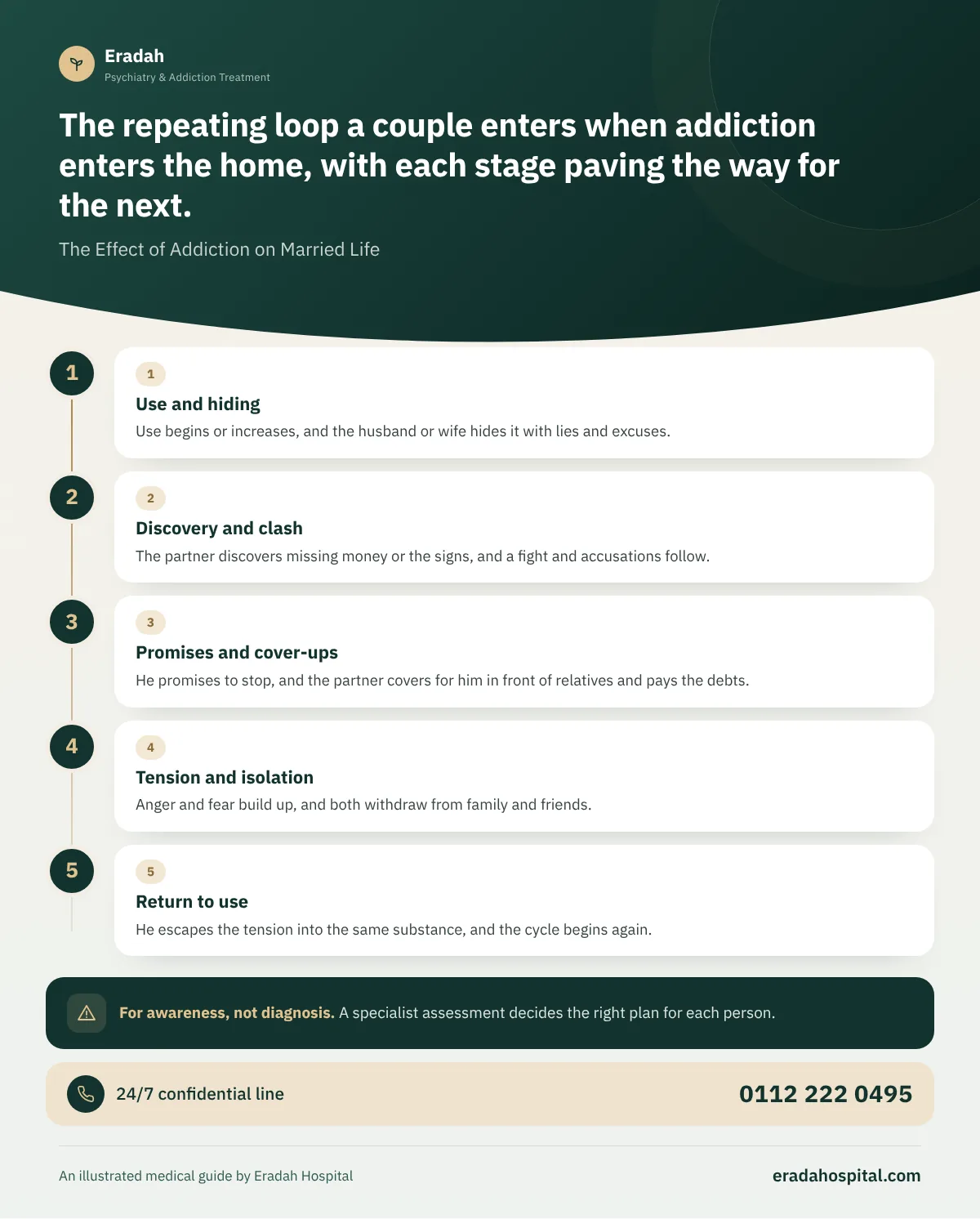
Breaking the cycle does not wait for the person who uses drugs to admit it. The partner can stop covering up, set boundaries and seek support for themselves, which is what the guide How to Convince a Person with Addiction to Get Treatment explains.
The Financial Effect of Drugs on Married Life
Money is one of the clearest losses: a salary drained, secret loans, selling the wife’s gold or the household furniture, and sometimes losing the job altogether. The other partner is forced to bear the household expenses alone, piling on exhaustion and a sense of injustice. The practical solution is to protect what remains: separate accounts, keep documents and savings in a safe place, and don’t pay drug-related debts in secret.
Intimacy and Having Children
Many substances affect desire, sexual performance and fertility, some at first and most with continued use, in addition to the fact that conflict and lack of trust extinguish closeness between spouses. We detail each substance’s medical effect on the page Drugs and Sex. Drug use also increases risky behaviors that can pass an infection to the partner.
Addiction and Domestic Violence: What Does the Research Say?
A study published in the Journal of Consulting and Clinical Psychology in 2003 followed men receiving treatment for domestic violence or alcohol use disorder, day by day for five months, and found that the likelihood of physical aggression toward the wife was more than 8 times higher on drinking days than on non-drinking days in the first group, and about 11 times higher in the second group. Addiction does not justify violence, but it clearly raises its risk.
The Effect of Addiction in a Marriage on the Children
According to a report from the US Substance Abuse and Mental Health Services Administration (SAMHSA), about 12.3% of children in the United States live with at least one parent with a substance use disorder, and these children are more likely to have psychological and behavioral problems and to develop substance use later. Children pick up on tension even when they do not understand its cause. In the family guide to addiction you will find how to explain to children what is happening without loading them with more than they can bear.
Does Addiction Lead to Divorce?
Addiction is often a cause of separation when losses pile up without treatment, but divorce is not the inevitable end. The decision is personal and depends first on safety, then on the partner’s willingness to get treatment. In cases of violence or putting the children in danger, moving away becomes protection, not failure. We discuss this decision from the wife’s perspective in the guide Dealing with an Addicted Husband.
How Can a Couple Treat the Effects of Addiction Together?
An analysis published in Clinical Psychology Review in 2008 pooled the results of 12 randomized trials involving 754 participants and found that behavioral couples therapy was better than individual therapy at reducing substance use and its problems and improving relationship satisfaction, and its advantage held on all of these measures at follow-up. The idea is for the couple to learn to communicate without accusation, agree on a daily plan that supports abstinence, and rebuild trust in small steps.
At Eradah, treatment begins with a free, confidential first consultation, and the wife can start it alone. We offer residential treatment for men and a family program that brings the couple together in structured sessions, followed by follow-up to protect recovery after returning home.