Is there one sign that confirms drug use?
Many parents look for one decisive sign: the look of the eyes, a smell, or a piece of paper in a pocket. The truth is that most signs of substance use, taken one at a time, have other innocent explanations. What really stands out is the pattern: a group of changes that appear together, differ from the person’s usual self, and last for weeks.
In its guidance for parents, the US National Institute on Drug Abuse (NIDA) warns that adolescence itself is full of mood swings and a desire for privacy, and that telling normal adolescence from the start of a problem depends on how severe and how fast the change is, and whether it comes with other signs. So compare your son with himself a few months ago, not with other people’s children.
Signs also differ by substance and by stage of use: someone who tries a drug once or twice may show no signs at all, while advanced addiction shows in every part of life. This guide covers the general signs they share, and each substance has its own page with its specific signs, linked at the bottom of the page.
What are the behavioral signs of drug use?
Behavioral changes are usually the first thing a family notices, and they are clearer than physical signs because they touch daily life at home:
- Sudden secrecy: always keeping the room closed, hiding the phone, and being very upset by any ordinary question about where they have been.
- A change of friends: dropping childhood friends and attaching to new people the family does not know and that they do not want to introduce.
- Sharp mood swings: unusual irritability and angry outbursts, or listlessness and indifference, or excessive cheerfulness that does not fit the situation.
- Disturbed sleep: staying up late and sleeping for long stretches in the daytime, or going days with almost no sleep and then sleeping deeply for many hours.
- Loss of interest: giving up sports, hobbies, and family occasions they used to enjoy.
- Lying and justifying: conflicting stories about where they were, when, and what happened to the money, and repeated excuses for absences.
- Sudden, frequent outings: short phone calls followed by leaving quickly, or nights away without a convincing explanation.
These signs alone are not enough to judge, but if three or four of them come together and persist, that is reason enough to open a calm conversation and ask for a specialist’s opinion.
What physical signs might appear in a person who uses drugs?
Physical signs vary a lot with the type of substance, because each group affects the body differently. The table below summarizes the general picture for each group, with a reminder that the absence of these signs does not rule out use:
| Substance group | Signs you may notice | Detailed guide |
|---|---|---|
| Opioids and strong painkillers | Drowsiness and a “nodding off” state, very small pupils, itching, constipation, slow speech | Heroin · Tramadol |
| Stimulants | Energy and fast talking, wide pupils, little sleep and eating, weight loss, tension or suspiciousness | Crystal meth (shabu) · Captagon |
| Hashish and bango | Red eyes, laughing or spacing out, a big appetite, slowed reactions, a distinctive smell | Hashish · Bango |
| Synthetic cannabinoids | Sudden strange behavior, seizures or fainting, severe agitation or panic | Strox · Voodoo |
| Sedatives | Unsteady walking, heavy speech, drowsiness, poor memory, as if “drunk” but without the smell | Pregabalin · Rivotril |
| Alcohol | A smell, unsteadiness, a flushed face, mood swings, and morning tremor with dependence | Alcohol |
Other general physical signs include neglect of personal hygiene and appearance, unexplained weight loss or gain, a runny nose or persistent cough, wounds or bruises they cannot explain, and wearing long sleeves in hot weather. Also notice smells on clothes or in the room, and excessive attempts to cover them with perfumes and incense.
How does substance use show up at school and work?
School, university, and work are among the clearest mirrors of substance use, because drugs weaken concentration, memory, motivation, and discipline. NIDA guidance advises parents to contact the school when they notice a sudden change in performance:
- A sudden drop in grades after a steady level.
- Frequent absences, or skipping classes and lectures without the family knowing.
- Complaints from teachers about sleeping in class, inattention, or behavior problems.
- Leaving a job, frequent lateness, or conflicts with colleagues and managers.
- Loss of enthusiasm for the future and the goals they used to talk about.
A decline in school performance can also be a sign of depression, anxiety, learning difficulties, or bullying, so do not make it evidence for a verdict. Make it a reason to ask and understand.
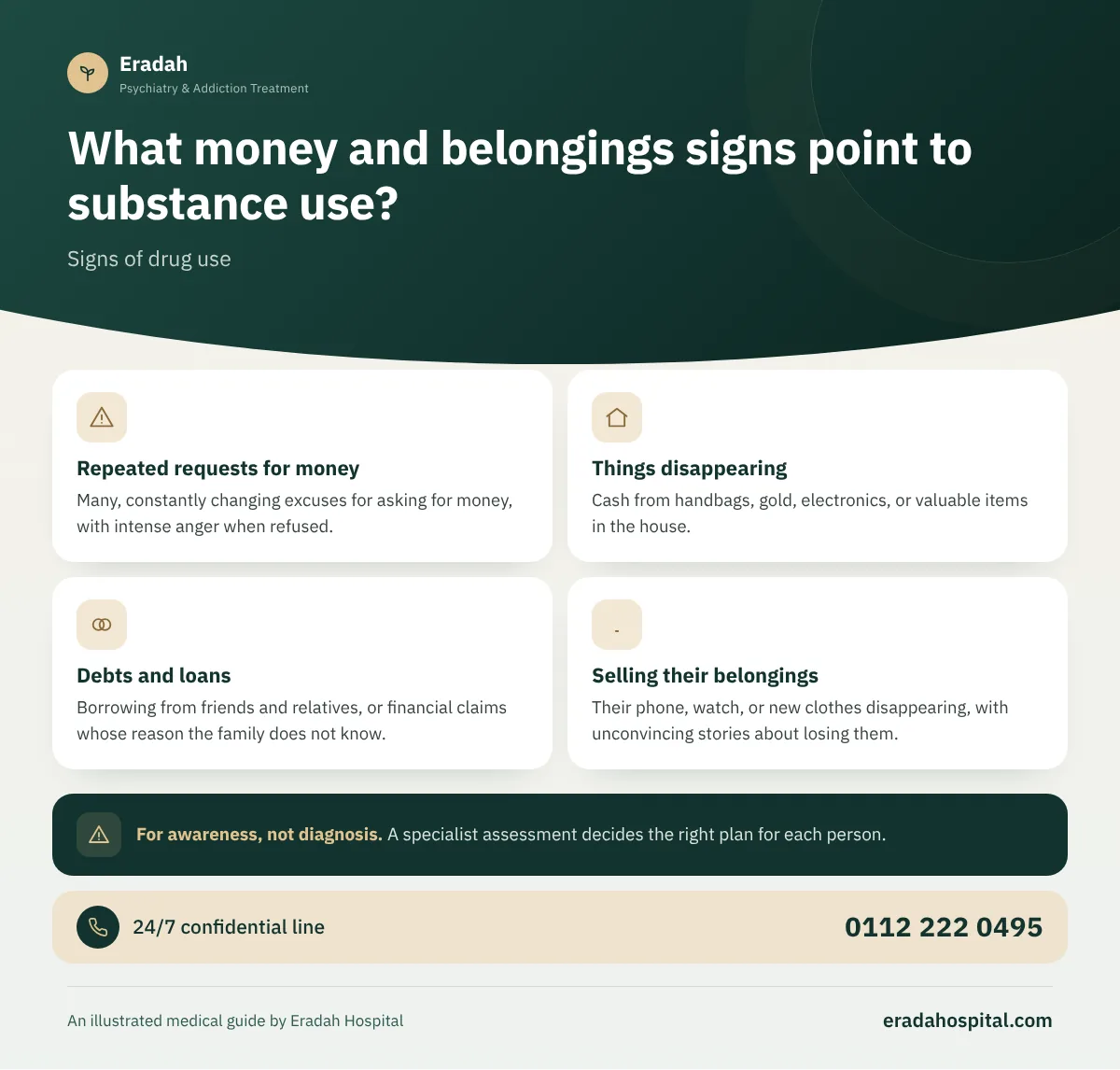
What money and belongings signs point to substance use?
As use continues, the need for money grows, so financial signs appear that parents and spouses notice, and they are often stronger than the physical signs:
Many, constantly changing excuses for asking for money, with intense anger when refused.
Cash from handbags, gold, electronics, or valuable items in the house.
Borrowing from friends and relatives, or financial claims whose reason the family does not know.
Their phone, watch, or new clothes disappearing, with unconvincing stories about losing them.
For spouses, the signs may show in household spending: sums that vanish from the account, belongings sold, or a sudden inability to meet obligations even though income is unchanged.
What things might you find at home?
A family may sometimes find worrying items in a room, in clothing, or in a car. We will not describe the paraphernalia in detail here, because it does not help families and could be misused, but it is useful to watch in general for:
- Pills or blister packs of medication not prescribed to them, or a family member’s medication running out at an unexplained speed.
- Items you do not understand the reason for or use of, especially if they are burned at the edges or carefully hidden.
- Small bags or tightly sealed containers in unusual places.
- Many empty cough medicine bottles, or containers of adhesives and solvents with no reason to be there.
What is not a sign of substance use?
It is important not to turn every behavior into an accusation, because a wrong accusation damages trust and can push a son into isolation. Many of the signs above have other causes that deserve attention in their own right:
| What you notice | Other possible explanations |
|---|---|
| Sadness, withdrawal, and little sleep | Depression or anxiety, or a relationship or school problem |
| Mood swings and wanting privacy | Normal adolescent changes, especially if no other signs come with them |
| Distraction and declining school performance | ADHD (attention-deficit/hyperactivity disorder), learning difficulties, or bullying |
| Weight loss and tiredness | Health problems such as thyroid disease, diabetes, or anemia |
| Red eyes | Allergy, lack of sleep, or late nights in front of screens |
| Long nights on the phone | Gaming addiction or screen addiction, which is a different problem with its own treatment |
If your son takes a medication prescribed by a doctor, some medications can cause drowsiness or changes in appetite. Rather than guessing, this calls for an assessment in which the doctor gathers the whole picture and tells use apart from mental illness and physical problems, or finds that they occur together.
Does a home test detect drug use accurately?
The home test strips sold in pharmacies give only a preliminary result. The US Food and Drug Administration (FDA) explains that any preliminary positive result must be confirmed by a second test in a laboratory, that some foods, supplements, and medicines can affect the result, and that no test of this kind is one hundred percent accurate.
- False positive: some cold and allergy medicines and others can give a result that looks like stimulants.
- False negative: if the test is done after the substance has cleared from the body, or if the strip does not detect the substance at all, as with many types of synthetic cannabinoids.
- Prescription medications: the strip cannot tell therapeutic use from misuse.
- Effect on the relationship: testing by force or by deception can destroy the trust you will need later to persuade them to get treatment.
So we prefer that testing be part of a complete medical assessment, where the reason is explained to the person and a doctor interprets the result. You will find how long each substance stays in the body on the substance pages, such as how long hashish stays in the body.
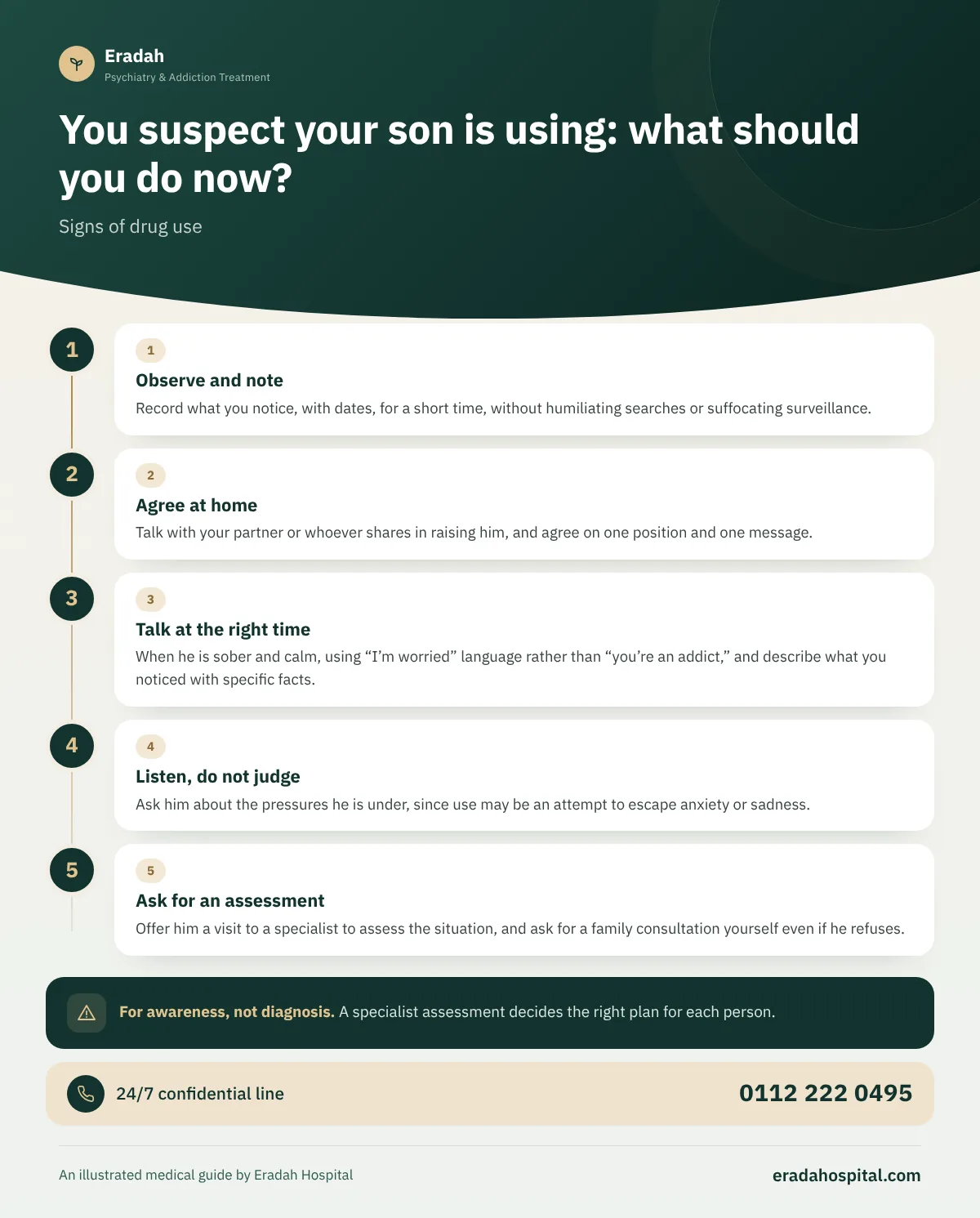
You suspect your son is using: what should you do now?
Suspicion alone is an exhausting stage, but it is also a chance for early intervention before the problem deepens. Here are ordered steps to help you act calmly:
- 1Observe and note
Record what you notice, with dates, for a short time, without humiliating searches or suffocating surveillance.
- 2Agree at home
Talk with your partner or whoever shares in raising him, and agree on one position and one message.
- 3Talk at the right time
When he is sober and calm, using “I’m worried” language rather than “you’re an addict,” and describe what you noticed with specific facts.
- 4Listen, do not judge
Ask him about the pressures he is under, since use may be an attempt to escape anxiety or sadness.
- 5Ask for an assessment
Offer him a visit to a specialist to assess the situation, and ask for a family consultation yourself even if he refuses.
If he denies it or refuses, do not give up after the first attempt. Learn the evidence-based approach to conversation and encouragement in our guide on how to persuade a person with addiction to get treatment, and go back to the guide for families of a person with addiction to learn what to avoid and how to protect yourself and the rest of the family.
Signs of use for each substance
If you suspect a particular substance, these detailed guides cover its specific signs and how to tell it apart from others:
Hashish addiction symptoms and signs of use
The most widespread among young people: the eyes, mood, appetite, and smell.
Details OpioidsTramadol addiction symptoms and signs of use
A common painkiller that is often misused, with signs in energy, mood, and sleep.
Details StimulantsCrystal meth (shabu) addiction symptoms and signs of use
Staying up for days, weight loss, irritability, and suspiciousness that can reach psychosis.
Details Synthetic cannabinoidsStrox addiction symptoms and signs of use
Strange behavior and sudden seizures, and ordinary testing may not detect it.
Details SedativesPregabalin addiction symptoms and signs of use
A medication that is misused: unsteady walking, heavy speech, and drowsiness.
Details OpioidsHeroin addiction symptoms and signs of use
Pinpoint pupils, drowsiness, and itching, with a high risk of overdose.
DetailsWhen do the signs become an emergency?
Some of what you see is a sign of poisoning that needs an ambulance immediately, and it cannot wait for a conversation like other signs of use. These signs call for phoning the ambulance without hesitation, and the details are on the overdose page:
Signs of poisoning or overdose? Call the ambulance on 123 immediately
- Unresponsive or hard to wake
- Very slow or irregular breathing, or bluish lips and fingernails
- Very small pupils with heavy drowsiness
- Seizures, chest pain, or a very fast heartbeat
- High fever, heavy sweating, and agitation or severe confusion
- Hallucinations or frightening suspiciousness with aggression or talk of self-harm
Call the ambulance on 123 immediately and do not wait. If they are unconscious but breathing, place them on their side, stay with them, do not give them food, drink, or any medication, and do not try to wake them with cold water. Keep any packet or blister strip you found with them to give to the doctor. If there is a risk of self-harm, you can call the mental health support line on 16328.
Ambulance 123 Mental health support line 16328