What does a nervous breakdown mean?
“I worked for months without stopping, and suddenly on an ordinary day I sat down on the bed and couldn't get up or answer anyone.” This is how many people describe the moment that others call a nervous breakdown. The phrase sounds frightening, but it is really a signal from mind and body that the load has grown heavier than you can carry, and that it is time to ask for help rather than endure more.
Australia's healthdirect health service describes a nervous breakdown as a period when stress or mental health problems become physically and emotionally overwhelming, and notes that it is also called a mental health crisis. Cleveland Clinic adds that it is a feeling that life's pressures have overwhelmed a person physically, mentally and emotionally, so that they can no longer cope or function effectively.
Is a nervous breakdown an illness or a medical diagnosis?
No. Cleveland Clinic states plainly that “nervous breakdown” is not a medical diagnosis or a specific mental health condition. It is a vague term used by the public and the media, and its use has declined because it is not a medical term and has gradually taken on a negative meaning. A doctor will not write “nervous breakdown” in a report; instead, the doctor will look for the medical condition that explains what is happening.
But this does not mean the suffering is imaginary. The same source stresses that the feelings and symptoms are real, and that severe stress that stops a person from working and enjoying life is a health condition that deserves treatment, not a sign of weakness or personal failure.
Is nervous breakdown common?
More than people think. In American surveys spanning forty years, published by Swindle and colleagues in American Psychologist, 19% of participants in 1957 said they had felt an impending nervous breakdown, and the figure rose to 26% in the 1996 survey. The researchers also noted that over time people relied more on informal support from family and friends, and on mental health professionals who are not physicians.
These are relatively old American figures. No Egyptian or Arab figures are available for this concept, because it is not a diagnosis recorded in medical statistics.
What does a nervous breakdown feel like from the inside?
People who have been through it describe a sense of losing control. Cleveland Clinic notes that a person in crisis may feel “stuck,” overwhelmed or helpless, unable to cope or carry on with life. The simplest tasks become a mountain: showering, answering the phone, choosing what to eat.
“Nothing big happened that day... just an extra request from my manager. But I sat in the car and couldn't move, and I cried for a whole hour.” This is a common description in accounts of people who have had a mental health crisis, not a quotation from any particular patient.
This is why a breakdown seems sudden to those around the person, when it is usually the end of a long build-up: months of stress, too little sleep and postponed rest, until one small incident becomes “the last straw.”
How is a nervous breakdown different from a panic attack and psychosis?
People often confuse these conditions, and telling them apart matters because the treatment and the urgency differ:
| Nervous Breakdown | Panic attack | Psychotic breakdown | |
|---|---|---|---|
| Duration | Days to weeks of being unable to cope | Minutes; peaks quickly, then subsides | May last days or weeks |
| Contact with reality | Mostly intact | Intact, with intense fear of dying or losing control | Loss of contact with reality: delusions, hallucinations and intense suspicion |
| Main feeling | Exhaustion, hopelessness and helplessness | Sudden terror with palpitations and shortness of breath | Confusion and strange thoughts that others cannot see |
| Urgency | Assessment soon; emergency care if there is a risk to life | Medical assessment; emergency care if it is the first time with chest pain | A psychiatric emergency needing urgent assessment |
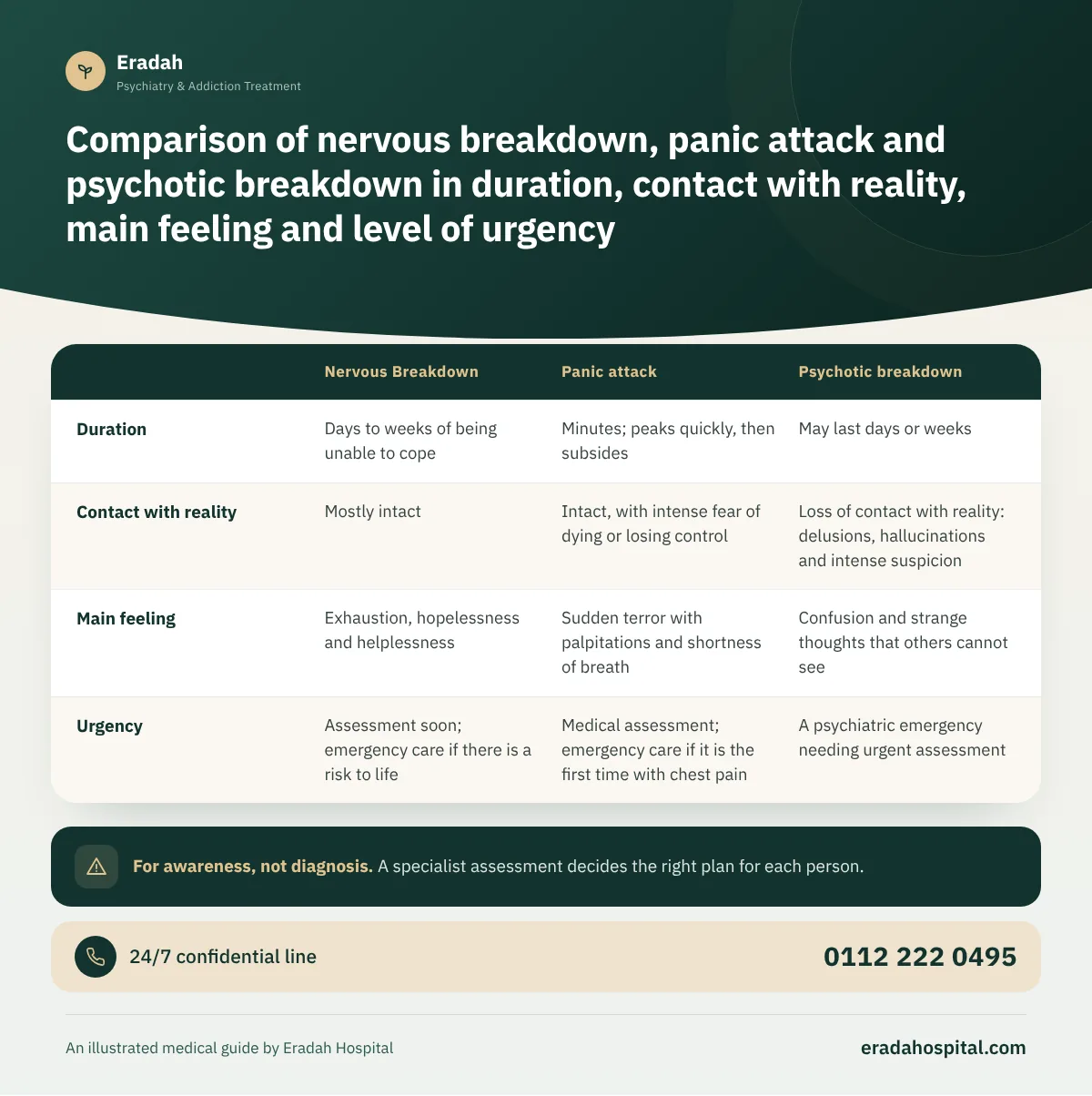
Cleveland Clinic stresses that a person going through what people call a nervous breakdown has usually not lost contact with reality; they have lost the ability to cope with stress. If hallucinations or strange thoughts appear, read about psychosis, and if the episodes are brief and sudden, they may be panic attacks.
Nervous breakdown symptoms in brief
Symptoms vary with the cause, but they usually combine uncontrollable anxiety or sadness, withdrawal from activities and people, missed work, irritability and feelings of shame or hopelessness, along with insomnia, palpitations, sweating and changes in appetite. For a detailed list of psychological, behavioral and physical signs and warning signs, see nervous breakdown symptoms and signs.
Causes of nervous breakdown in brief
A breakdown may follow a single severe event such as divorce, job loss or a serious illness in the family, or a long build-up of stress, or an untreated mental illness such as depression or anxiety. The risk rises with a lack of support, financial pressure and family history. The details are in causes of nervous breakdown.
Nervous breakdown treatment in brief
Treatment starts with safety and rest, then an assessment to identify the underlying condition, then psychotherapy, chiefly cognitive behavioral therapy, medication when needed at the doctor's decision, and a gradual return to life. The stages of recovery, how long it takes and when hospital admission is needed are covered in nervous breakdown treatment.
What should you do if you feel you are on the edge of a breakdown?
- Step away from the source of stress for a while if you can, with a short break or time off; Cleveland Clinic calls this a “time out” in which you calm your mind and body.
- Breathe slowly: take a deep breath in through the nose that fills the belly, hold it for three seconds, then let it out slowly through pursed lips, and repeat several times.
- Don't stay alone: tell someone you trust what you are going through.
- Stay away from alcohol and non-prescribed sedatives; they make the crisis worse and do not solve it.
- Call your doctor or book an appointment with a psychiatrist, especially if you cannot carry out your daily tasks.
How do you help someone going through a nervous breakdown?
Instead of listing everything they have to do, ask them plainly: how can I help you right now?
Say you are worried about them, and ask what they think about seeing a doctor, without arguing or forcing.
Temporarily take over some responsibilities, such as the children, errands or meals.
Any talk of self-harm calls for immediate contact with a doctor or emergency services.
This advice matches what Cleveland Clinic recommends: ask what you can do to help, express your concern and ask what they think about talking to a doctor without arguing or forcing, and seek specialist help right away if they talk about harming themselves.
Nervous Breakdown Guide: Everything You Need to Know
We have gathered everything about nervous breakdown into 3 pages, each answering one question in detail. Choose what you are looking for:
Nervous breakdown symptoms and signs
What are the symptoms of a nervous breakdown? Psychological signs such as hopelessness, crying and irritability, behavioral signs such as withdrawal and missing work, physical signs such as insomnia and palpitations, and the warning signs that call for emergency care.
Causes of a nervous breakdown
What causes a nervous breakdown? Traumatic events such as divorce and job loss, accumulated pressure from work, money and caregiving, untreated mental illness, substance use and withdrawal, and risk factors.
Nervous breakdown treatment and steps to recovery
How is a nervous breakdown treated? The stages of recovery from safety to returning to work, the role of cognitive behavioral therapy and medication, the expected time to improvement, and when psychiatric hospital admission is needed.
Acute mental health crisis? These signs call for emergency care now
- Talking about death, suicide or self-harm, or suddenly saying goodbye to family
- Hallucinations (seeing or hearing things that are not there) or intense suspicion of others
- Stopping eating and drinking, or being completely unable to care for oneself
- Severe confusion or strange behavior that is out of character for the person
- Heavy use of alcohol, sedatives or drugs, or severe withdrawal symptoms
Do not leave the person alone. Ask them calmly and directly how they feel and what they are thinking, and listen without blame or lectures; asking directly does not plant the idea, it opens the door to help. Call an ambulance on 123 or take them to the nearest emergency room, or call the mental health support line 16328 (24 hours), and keep medications and anything they could use to harm themselves out of reach.
Ambulance 123 Mental health support line 16328