What is adjustment disorder?
“Ever since I traveled I haven't been myself. I cry for no reason and can't concentrate at work.” A single big change can turn life upside down. Sadness and anxiety afterward are normal, but when the reaction is stronger than expected and disrupts work or home, it may be adjustment disorder.
The Cleveland Clinic describes adjustment disorder as a strong emotional or behavioral reaction to stress or trauma, causing short-term symptoms that make you react more than you normally would, and doctors may call it situational depression. The MedlinePlus encyclopedia explains that symptoms appear because the person has trouble coping, and that their reaction is stronger than would be expected for that kind of event. The American diagnostic manual (DSM-5) classifies it among the trauma- and stressor-related disorders, and the eleventh revision of the International Classification of Diseases (ICD-11) also covers it, with clearer criteria.
Causes of adjustment disorder
Any stress can be a cause, and more than one event may build up until a breaking point. Examples cited by references include:
The death of a loved one, the end of a relationship, or divorce.
Traveling for work or study, or changing homes and cities.
A diagnosis of a chronic illness in you or someone you love.
Losing a job, financial difficulties or problems at school.
Marriage, having a child or retirement can be stressful too.
Accidents or natural disasters that turn life upside down.
It cannot be predicted who will develop it among people exposed to the same stress, but the Cleveland Clinic lists among risk factors: personality, past experiences, family history, and having other mental disorders.
Symptoms of adjustment disorder
- Sadness, a feeling of hopelessness and crying easily.
- Anxiety, tension and sometimes trembling.
- Difficulty concentrating.
- Irritability and quickly getting worked up.
- Sleeplessness despite exhaustion.
- Reckless, impulsive or aggressive behavior.
- Physical symptoms: headache, aches and palpitations.
- Withdrawal from people and a decline at work or school.
Types of adjustment disorder
According to the Cleveland Clinic, the American diagnostic manual specifies several types according to the main symptom: with depressed mood, with anxiety, with mixed anxiety and depressed mood, or with disturbance of conduct such as rebelliousness and recklessness, or with a mix of emotions and conduct, plus an unspecified type. It is called acute if symptoms last less than six months, and chronic if they last six months or more.
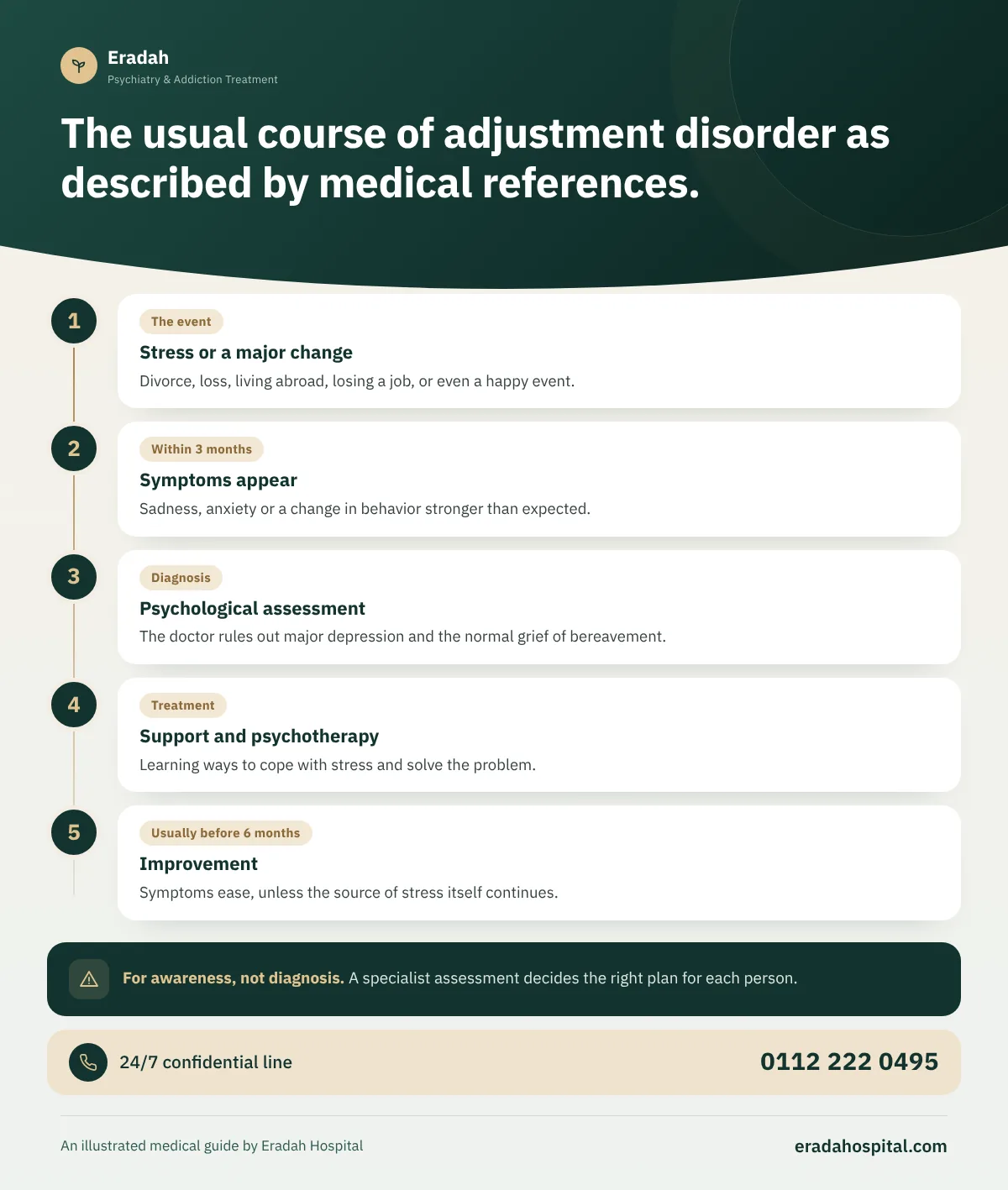
Duration and course of adjustment disorder
- The eventStress or a major change
Divorce, loss, living abroad, losing a job, or even a happy event.
- Within 3 monthsSymptoms appear
Sadness, anxiety or a change in behavior stronger than expected.
- DiagnosisPsychological assessment
The doctor rules out major depression and the normal grief of bereavement.
- TreatmentSupport and psychotherapy
Learning ways to cope with stress and solve the problem.
- Usually before 6 monthsImprovement
Symptoms ease, unless the source of stress itself continues.
The difference between adjustment disorder, depression and ordinary stress
Ordinary psychological stress bothers you but does not clearly disrupt your life. Adjustment disorder is diagnosed when the reaction is greater than expected or causes clear problems at work or home, provided the criteria for another disorder are not met and the symptoms are not part of the normal grief over the death of a loved one. If the full symptoms of major depression are present, it is diagnosed as depression, not adjustment disorder. And if the event was traumatic and life-threatening and intrusive memories and nightmares appear, it may be post-traumatic stress disorder.
The Cleveland Clinic notes that one global study estimated its prevalence at about 2% of people, and that a US study estimated it as the reason for between 5% and 20% of outpatient mental health visits, with figures varying with the criteria and samples.
Treatment of adjustment disorder
According to MedlinePlus, the goal is to relieve symptoms and return you to your level of functioning before the event. The foundation of treatment is talk therapy, especially cognitive behavioral therapy, which helps you recognize negative thoughts and turn them into more helpful thoughts and actions, and family therapy or support groups may be added. The doctor may prescribe a medication for anxiety, sleeplessness or severe sadness, but alongside psychotherapy, not instead of it, and the doctor decides the type and dose. Do not start or stop any medication without a doctor. You can request an assessment in Eradah's outpatient clinics.
What can help you now?
- Acknowledge that what you are going through is hard, and that struggling to adjust is not failure.
- Break the problem into small steps that can be solved.
- Keep a routine for sleep, eating and movement as far as you can.
- Talk to someone you trust and do not isolate yourself.
- Stay away from alcohol and sedatives without a prescription.
- Ask for help if symptoms continue or affect your work and home.
Suicidal thoughts or danger to self? Get help now
- Talk of wanting to die or of there being no way out of the crisis
- Severe hopelessness after a loss, divorce or job loss
- Self-harm or talk of it
- A sudden increase in alcohol, drug or sedative use without a prescription
- Reckless behavior that puts their own life or others' lives at risk
Do not leave the person alone. Ask them calmly and frankly what they are thinking, and listen without blame or mockery; asking does not plant the idea, it opens the door to help. Call an ambulance (123) or take them to the nearest emergency room, or call the mental health support line 16328 (24 hours), and keep medications and other things they could harm themselves with out of their reach.
Ambulance 123 Mental health support line 16328