What is post-traumatic stress disorder?
Post-traumatic stress disorder (PTSD) is a psychological condition that arises after exposure to an event that is life-threatening or extremely terrifying, or after witnessing such an event happen to someone else. The mind remains “stuck” at the moment of danger, recalling it against the person's will, and the body treats the safe present as if it were still in the middle of the event.
It is entirely normal to feel fear, sadness, tension and trouble sleeping in the days and weeks after a traumatic event. This is an expected human response, and in most people it gradually settles. But when the response lasts more than a month, grows stronger instead of fading, and begins to disrupt work, relationships and sleep, doctors speak of post-traumatic stress disorder.
In the International Classification of Diseases (ICD-11) the disorder has the code 6B40 and falls within the group of “disorders specifically associated with stress,” alongside another condition, “complex post-traumatic stress disorder” (6B41). The American DSM-5 places it among “trauma- and stressor-related disorders.” In both, the diagnosis requires a traumatic event that came before the symptoms.
What counts as a traumatic event?
Not every painful situation is “trauma” in the medical sense. What is meant here is an event involving a real threat to life or safety or a risk of serious injury, whether it happened to the person themselves, they witnessed it, or they learned that it violently or suddenly happened to someone close to them. Examples include:
Serious road accidents, fires, workplace accidents, falls and severe injuries.
Physical or sexual assault, armed robbery, domestic violence and severe, repeated bullying.
Living in conflict zones, displacement and seeking refuge, detention, and military service.
The sudden or violent death of a loved one, or witnessing a death or serious injury.
Earthquakes, floods, building collapses and severe epidemics.
A stay in intensive care, a difficult childbirth, and a diagnosis of a life-threatening illness.
Emergency doctors, paramedics, firefighters and journalists in conflict zones are also exposed to this kind of event through their work, because they repeatedly face difficult scenes. The details of why some people are affected and others are not are on the causes page.
How common is post-traumatic stress disorder?
These figures come from the World Health Organization and carry two important messages: first, trauma is a very common human experience, and second, most people who go through it do not develop the disorder. The organization also notes that about 40% of people with the disorder recover within a year without intervention, while in others it continues for years if untreated.
Women are affected more than men; in the United States, for example, statistics estimate lifetime prevalence at about 8% of women versus 4% of men, partly related to the different kinds of trauma each is exposed to. We have no reliable published Egyptian figures to rely on here.
What does it feel like from the inside?
Many people with the disorder describe their life after the trauma as having “split into a before and an after.” They may smell a scent or hear an ordinary sound and find their heart pounding and their body stiffening as if the danger were returning. They may stay away from certain roads, places or conversations without explaining why, and feel distant from loved ones, as if there were glass between them.
“I knew I was safe, but my body didn't believe it.” (A phrase repeated by many people who have been through the experience, not a quotation from a specific patient.)
This contradiction between what the mind knows and what the body feels is the core of the disorder. That is why phrases like “forget it” or “be strong” do not help; what is happening is tied to how memory is stored and how the brain's alarm system responds, not to willpower.
What happens in the brain after trauma?
During danger the amygdala (the alarm center) activates and releases stress hormones that prepare the body to flee or fight. After the danger has passed, this response should settle, and the event should be stored in memory as “the past, which is over.”
In post-traumatic stress disorder the alarm system stays highly sensitive, the regulating regions at the front of the brain become less able to calm it, and the memory is not filed in a clear time order. So it returns as vivid sensory fragments: images, sounds and bodily sensations, rather than as a story from the past. The reassuring news is that the brain is flexible, and trauma-focused psychological therapy helps reprocess the memory until it loses its charge.
Acute reaction, post-traumatic stress disorder or complex trauma?
There is no separate page for the types, so here we summarize the main differences doctors use:
| The situation | Timing | What sets it apart |
|---|---|---|
| Acute stress reaction | Hours to days after the event | An expected, normal response; ICD-11 considers it a passing state rather than a mental disorder, and it usually settles quickly |
| Acute stress disorder (DSM-5) | 3 days to one month after the event | Severe symptoms resembling those of post-traumatic stress but within the first month |
| Post-traumatic stress disorder (PTSD) | Lasts at least several weeks (more than one month according to DSM-5) | Reliving the event, avoidance, and a constant sense of threat with clear disruption of life |
| Complex post-traumatic stress disorder | Usually after prolonged or repeated trauma that is hard to escape | Post-traumatic symptoms plus difficulty regulating emotions, a negative self-image, and ongoing problems in relationships |
| Adjustment disorder | Within weeks of a life stressor | A reaction to non-life-threatening stress such as divorce or job loss, without intrusive memories |
Psychiatry also recognizes that symptoms can be delayed, appearing months or even years after the event, sometimes when facing new stress or an occasion that recalls the trauma.
How does it differ from anxiety, depression and normal grief?
- Generalized anxiety: anxiety that moves between different subjects in life, whereas post-traumatic fear is tied to a specific event and its reminders. See generalized anxiety disorder.
- Panic attacks: they come suddenly and may have no clear trigger, whereas here they are often set off by a reminder of the event. See panic attacks.
- Depression: it shares loss of pleasure and withdrawal with the disorder, and the two often occur together, but depression does not necessarily include intrusive memories or heightened alertness. See depression.
- Grief for a loved one: normal grief centers on longing for the person, but when the death is violent or sudden, images of the moment of death itself may take hold, and this needs assessment.
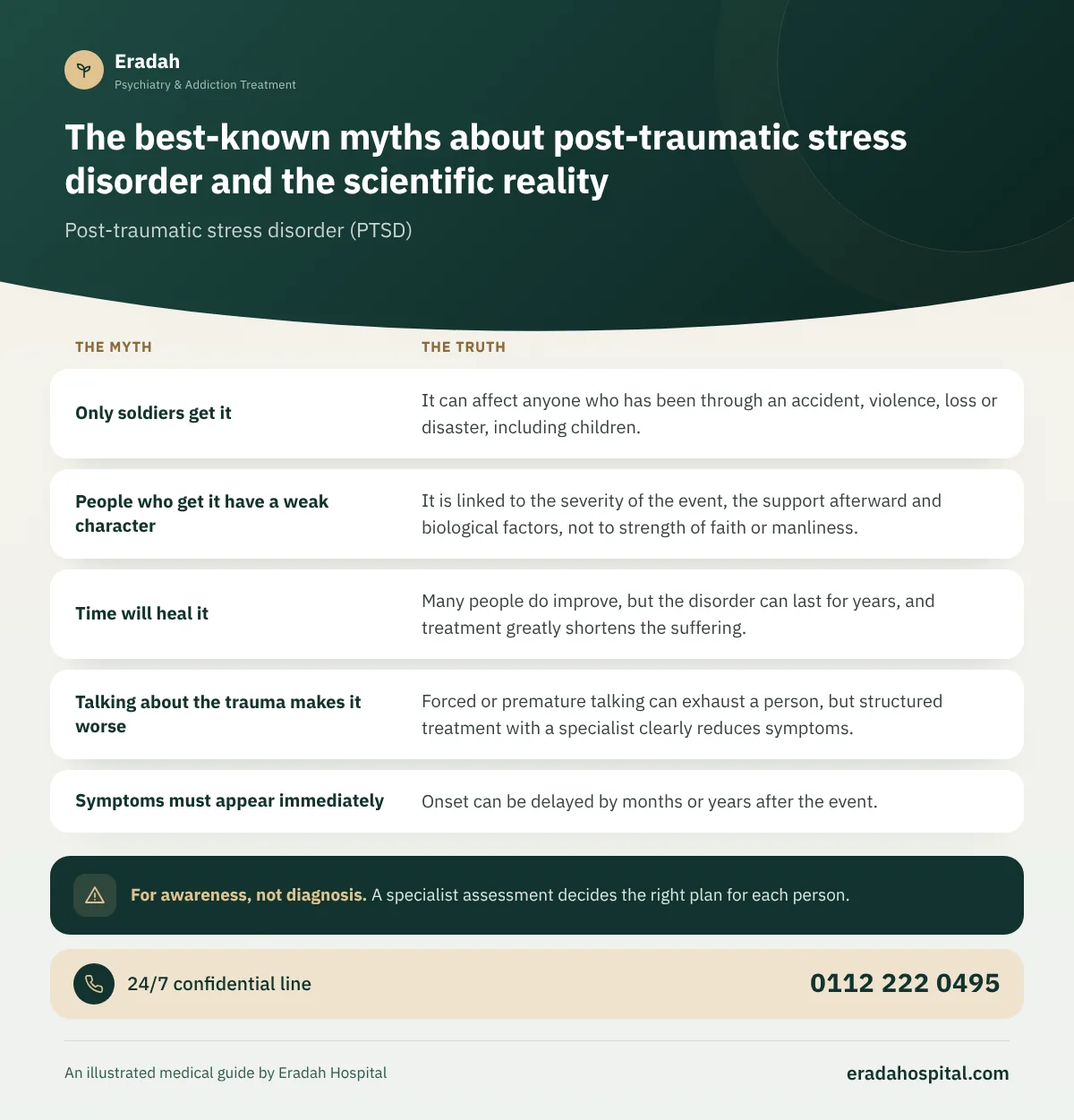
Common myths and the facts
| The myth | The truth |
|---|---|
| Only soldiers get it | It can affect anyone who has been through an accident, violence, loss or disaster, including children. |
| People who get it have a weak character | It is linked to the severity of the event, the support afterward and biological factors, not to strength of faith or manliness. |
| Time will heal it | Many people do improve, but the disorder can last for years, and treatment greatly shortens the suffering. |
| Talking about the trauma makes it worse | Forced or premature talking can exhaust a person, but structured treatment with a specialist clearly reduces symptoms. |
| Symptoms must appear immediately | Onset can be delayed by months or years after the event. |
When should you see a psychiatrist?
- More than a month has passed since the event and the symptoms have not eased or have grown.
- Sleep is disturbed most nights by nightmares or heightened alertness.
- You have started to avoid work, study, going out, or important people in your life.
- You turn to alcohol, sedatives or any substance to forget or to sleep.
- You feel anger or emotional numbness that harms your relationships.
- Thoughts of death or self-harm have appeared, and here help is urgent.
A psychiatrist or a therapist trained in trauma assesses the condition and distinguishes between a normal reaction, the disorder, and any accompanying depression or addiction. You are not asked to tell all the details of the event in the first session; you set the pace.
Can you recover from post-traumatic stress disorder?
Yes, and recovery is the rule, not the exception. The World Health Organization states that trauma-focused psychological therapies, such as trauma-focused cognitive behavioral therapy and eye movement desensitization and reprocessing (EMDR), are the proven first choice. Many people improve even many years after the event; it is never too late to ask for help.
How can the family support a person who has been through trauma?
- Provide safety and calm first, and keep a simple daily routine that restores a sense of control.
- Listen if they want to talk, do not pressure them to tell details, and do not question them about what happened.
- Avoid blame such as “why did you go there?” and minimizing such as “be thankful it wasn't worse.”
- Notice changes in sleep, mood and substance use without suffocating monitoring.
- Gently encourage them to seek specialist help, and offer to go with them to the first appointment.
- Look after yourself too; supporting a traumatized person is exhausting, and the family has every right to ask for support.
Post-traumatic stress disorder guide: everything you need to know
We have gathered everything about post-traumatic stress disorder into 5 pages, each answering one question in detail. Choose what you are looking for:
Post-traumatic stress disorder symptoms and signs
Intrusive memories, nightmares, avoidance, heightened alertness and mood changes, how they look in children and teenagers, and the signs of complex trauma.
Causes of post-traumatic stress disorder
Why do some people develop it and others do not after the same event? The role of the type and repetition of trauma, stress hormones, genetics, and social support after the event.
Harms and complications of post-traumatic stress disorder
What the disorder does without treatment to sleep, the heart and the body, to work, relationships and family, and the risk of depression, addiction and suicidal thoughts.
Treatment of post-traumatic stress disorder
Trauma-focused cognitive behavioral therapy, EMDR and suitable medication, the particulars of treating children and complex trauma, and the role of the family.
PTSD and addiction
Why do people with the disorder turn to alcohol, sedatives and drugs to numb memories, and how are both treated together in an integrated program.
Suicidal thoughts or danger to self? Get help now
- Talking about wanting to die, or that life is no longer worth living, or that others would be better off without them
- Severe despair and a feeling that the pain will never end, or overwhelming guilt and shame tied to the event
- Saying goodbye to family and friends, or suddenly giving away treasured belongings
- Severe detachment from reality, or reliving the memory as if it is happening now, with agitation that does not settle
- A sudden increase in drinking alcohol or using sedatives or drugs, or dangerous impulsiveness and recklessness
Stay with the person and do not leave them alone, listen calmly without judgment or argument, and ask them directly about their thoughts; asking does not plant the idea. Call ambulance (123) or go to the nearest emergency department, or call the mental health support line 16328, and keep medication and objects that could harm them out of reach until help arrives.
Ambulance 123 Mental health support line 16328