What are anxiety, obsessive-compulsive and trauma-related disorders?
Anxiety in itself is not an illness; it is an alarm system that protects us from danger and pushes us to prepare. But it becomes a disorder when the alarm rings with no real danger, with far greater intensity than the situation calls for, or for long periods that disrupt life.
This family brings together three closely related groups. Anxiety disorders, such as generalized anxiety, panic attacks and social phobia, in which fear or worry is the central feature. Obsessive-compulsive disorder (OCD), in which disturbing thoughts intrude into a person’s mind and they perform repetitive actions to ease their anxiety. And post-traumatic stress disorder (PTSD), which appears after exposure to a terrifying or threatening event.
OCD and PTSD were once classed among the anxiety disorders, then the American diagnostic manual DSM-5 and the international classification ICD-11 separated them into independent groups, because each has its own nature. We have still grouped them here as one family because they share fear and avoidance, are treated in similar ways, and often occur together in the same person.
What happens in the brain with anxiety?
Deep in the brain is a small area called the amygdala, which works as a fast alarm system, and an area at the front of the brain, the prefrontal cortex, which acts as a calm reviewer that judges the real danger. In the disorders of this family, the alarm becomes more sensitive and the reviewer’s role in calming it weakens.
Pounding heart, rapid breathing, tense muscles and sweating are real physical changes, not “acting.”
Serotonin, norepinephrine and GABA take part in regulating anxiety, which is why some medications help.
Escaping the situation brings temporary relief, but it teaches the brain that the situation really is dangerous, so the fear grows.
After trauma, the memory is stored differently, so it returns vividly, as if it were happening now.
This explains why treatments that gradually retrain the brain to face what it fears safely work, rather than simply avoiding it.
Types of anxiety, OCD and trauma disorders
Each disorder in this family has a full guide and its own pages. Here is a brief card for each:
Also known as: chronic anxiety
Excessive worry about everyday matters that is hard to control and lasts for months, with tension, sleeplessness and fatigue.
- Category
- Anxiety disorders
- How common
- One of the most common anxiety disorders
- Typical onset
- At any age, usually beginning gradually
- Link to addiction
Strong
When to seek help: if worry has become daily for months, is hard to control, and affects your sleep and work.
Panic attacks
Panic disorderAlso known as: panic disorder
Sudden episodes of intense fear with a pounding heart and shortness of breath, which the person often believes is a heart attack.
- Category
- Anxiety disorders
- How common
- Common, and more so in women
- Typical onset
- Usually late adolescence or early adulthood
- Link to addiction
Strong
When to seek help: once a heart cause has been ruled out by an examination, if attacks keep recurring and you have come to fear them.
Social phobia
Social anxietyAlso known as: pathological shyness
Intense fear of social situations and of being judged by others, which leads some people to turn to drugs or alcohol to get through them.
- Category
- Anxiety disorders
- How common
- One of the most common anxiety disorders
- Typical onset
- Usually childhood or adolescence
- Link to addiction
Strong
When to seek help: if you avoid school, work or social occasions out of fear of embarrassment, or need a substance in order to face people.
Repetitive, distressing thoughts and compulsive acts meant to ease the anxiety they cause, taking up hours of the person's day.
- Category
- Obsessive-compulsive and related disorders
- How common
- Less common than anxiety, but not rare
- Typical onset
- Usually between late childhood and early adulthood
- Link to addiction
Moderate
When to seek help: if the thoughts or rituals take up a large part of each day or disrupt your life and relationships.
Also known as: post-traumatic stress
Intrusive memories, nightmares, avoidance and heightened alertness after exposure to a traumatic event.
- Category
- Trauma-related disorders
- How common
- About 3.9% of people over a lifetime
- Typical onset
- Usually within a month of the traumatic event
- Link to addiction
Very strong
When to seek help: if nightmares, intrusive memories and avoidance last more than a month after the trauma.
Phobias
Phobias (Specific Phobia)Also known as: specific phobia
Intense, persistent fear of a specific object or situation that is out of proportion to its real danger and leads to avoidance. It responds well to exposure therapy.
- Category
- Anxiety disorders
- How common
- About 7.4% of people over a lifetime
- Typical onset
- Usually childhood (around age 8)
- Link to addiction
Moderate
When to seek help: if fear makes you turn down a job, travel or important treatment, or you need a sedative to face it.
Illness anxiety
Health AnxietyAlso known as: health anxiety, hypochondria
Persistent fear of having a serious illness despite normal test results, with repeated searching, checking and reassurance-seeking.
- Category
- Anxiety and physical symptoms
- How common
- About 5.7% over a lifetime
- Typical onset
- Usually early adulthood
- Link to addiction
Weak
When to seek help: if the fear persists for six months or more despite normal test results and affects your work and life.
Body dysmorphic disorder
Body Dysmorphic DisorderAlso known as: body dysmorphia
A painful preoccupation, lasting hours, with a flaw in appearance that others cannot see or that looks very minor. It is not vanity.
- Category
- Obsessive-compulsive and related disorders
- How common
- Between 2% and 3% of people
- Typical onset
- Usually adolescence
- Link to addiction
Moderate
When to seek help: if thinking about your appearance takes hours each day or keeps you from going out, and immediately if you feel any hopelessness.
Hoarding disorder
Hoarding DisorderAlso known as: compulsive hoarding
Severe difficulty getting rid of belongings, until they pile up and make rooms of the home unusable, with distress when sorting is attempted.
- Category
- Obsessive-compulsive and related disorders
- How common
- About 2.5% of adults
- Typical onset
- Adolescence, worsening with age
- Link to addiction
Weak
When to seek help: if clutter stops you from using your home, threatens safety, or causes ongoing conflict with family.
Adjustment disorder
Adjustment DisorderAlso known as: situational depression
A stronger-than-expected emotional reaction to a stressful event or major change, beginning within 3 months of the event.
- Category
- Trauma and stress
- How common
- About 2% of people
- Typical onset
- Any age, within 3 months of the event
- Link to addiction
Moderate
When to seek help: if your reaction to the change disrupts your work or home life, and immediately if you have any thoughts of harming yourself.
What is the difference between the disorders in this family?
These disorders share the presence of anxiety, but what triggers it and how it shows up differ from one disorder to another. This table summarizes the main differences:
| Disorder | Focus of the fear | How it appears | Characteristic behavior |
|---|---|---|---|
| Generalized anxiety disorder | All everyday matters | Constant worry on most days for months, with tension and insomnia | Excessive thinking and seeking reassurance |
| Panic attacks | The attack itself and its physical symptoms | Sudden attacks that peak within minutes | Avoiding places where attacks have happened |
| Social phobia | Other people’s gaze and judgment | Intense fear in social situations or when performing in front of others | Avoiding gatherings, speaking and meetings |
| Obsessive-compulsive disorder (OCD) | Intrusive, disturbing thoughts | Repetitive thoughts the person often knows are exaggerated | Compulsive actions such as washing, checking or counting |
| Post-traumatic stress disorder (PTSD) | The memory of a traumatic event | Intrusive memories, nightmares and heightened alertness | Avoiding anything that reminds them of the trauma |
Each disorder has a full page: generalized anxiety disorder, panic attacks, social phobia, OCD, and post-traumatic stress disorder. The guide to types of OCD explains its different forms in detail.
When does normal anxiety become a disorder?
Anxiety before a job interview, an exam or an operation is normal and useful. Pathological anxiety differs in four ways that the doctor looks for:
Far greater than the actual situation deserves.
It lasts weeks or months, not hours or days.
It prevents study, work, sleep or leaving the house.
It is hard to stop or ignore however hard the person tries.
Anxiety, OCD and trauma disorders in numbers
This family is among the most common mental health conditions in the world, and many start in childhood or adolescence and continue into adulthood without treatment:
The World Health Organization notes that women are more affected by anxiety disorders and PTSD than men, and that most people who experience trauma do not develop the disorder; only a minority do. Source: World Health Organization fact sheets on anxiety, PTSD and mental disorders.
Common myths about anxiety and OCD
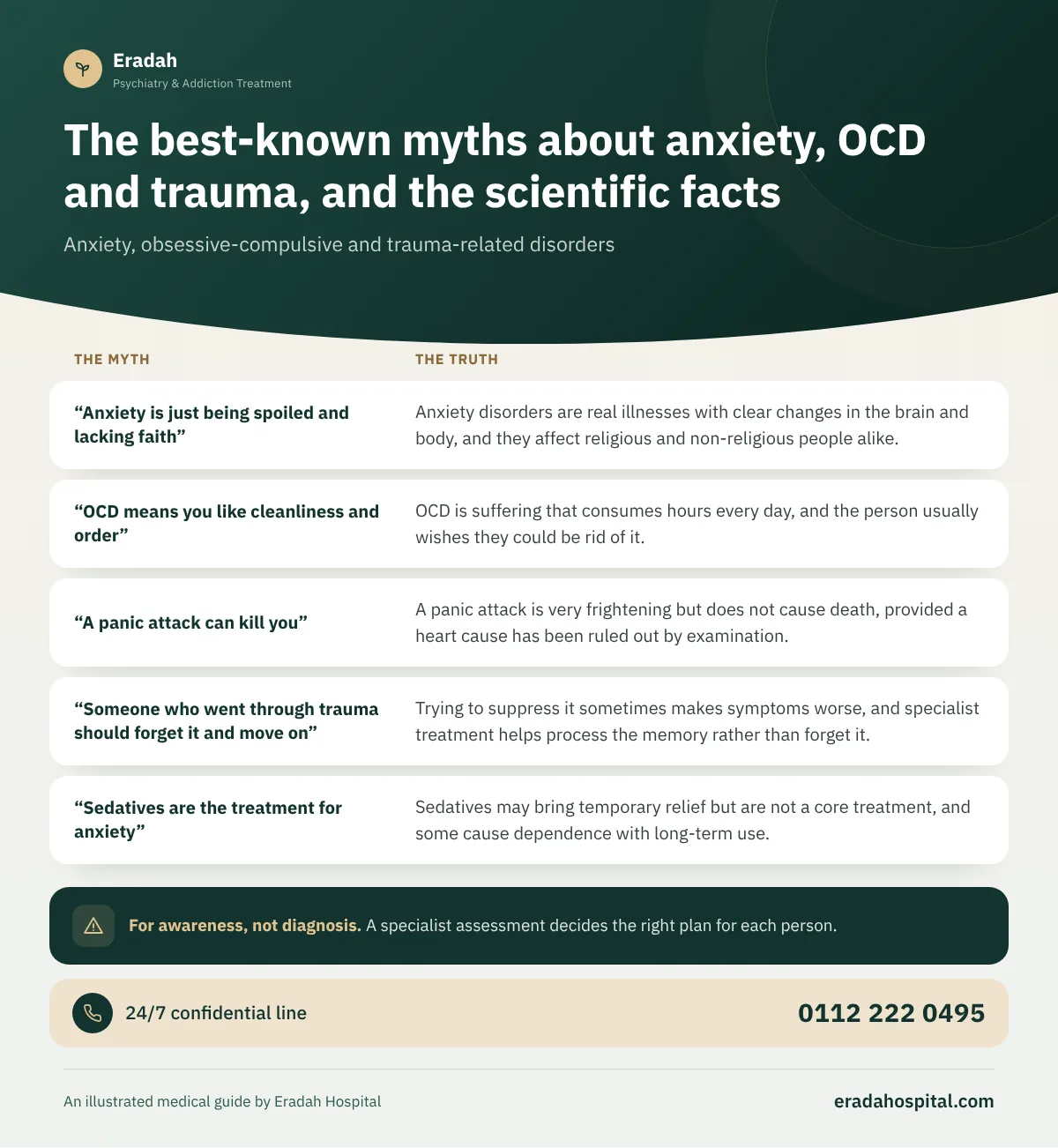
| The myth | The truth |
|---|---|
| “Anxiety is just being spoiled and lacking faith” | Anxiety disorders are real illnesses with clear changes in the brain and body, and they affect religious and non-religious people alike. |
| “OCD means you like cleanliness and order” | OCD is suffering that consumes hours every day, and the person usually wishes they could be rid of it. |
| “A panic attack can kill you” | A panic attack is very frightening but does not cause death, provided a heart cause has been ruled out by examination. |
| “Someone who went through trauma should forget it and move on” | Trying to suppress it sometimes makes symptoms worse, and specialist treatment helps process the memory rather than forget it. |
| “Sedatives are the treatment for anxiety” | Sedatives may bring temporary relief but are not a core treatment, and some cause dependence with long-term use. |
What are the shared risks of these disorders without treatment?
- Avoidance that gradually widens until it narrows the person’s life and isolates them.
- Decline in study, work and career opportunities.
- Later depression, as the two often occur together.
- Chronic insomnia, exhaustion, physical pain and repeated doctor visits with no physical cause.
- Turning to alcohol, sedatives or hashish to calm anxiety.
- A higher risk of thoughts of self-harm, especially with trauma and accompanying depression.
When do you need a psychiatrist?
Seek a specialist assessment if you notice any of these signs. This is an awareness list, not a diagnosis.
- Daily anxiety that is hard to control for several months.
- Repeated sudden attacks of fear after the doctor has ruled out a physical cause.
- Avoiding school, work, gatherings or going out for fear of embarrassment or of an attack.
- Repetitive thoughts or rituals that take up a long time every day.
- Nightmares, intrusive memories and constant tension for more than a month after a traumatic event.
- Needing a sedative or a substance in order to sleep or face people.
How are anxiety, OCD and trauma disorders treated?
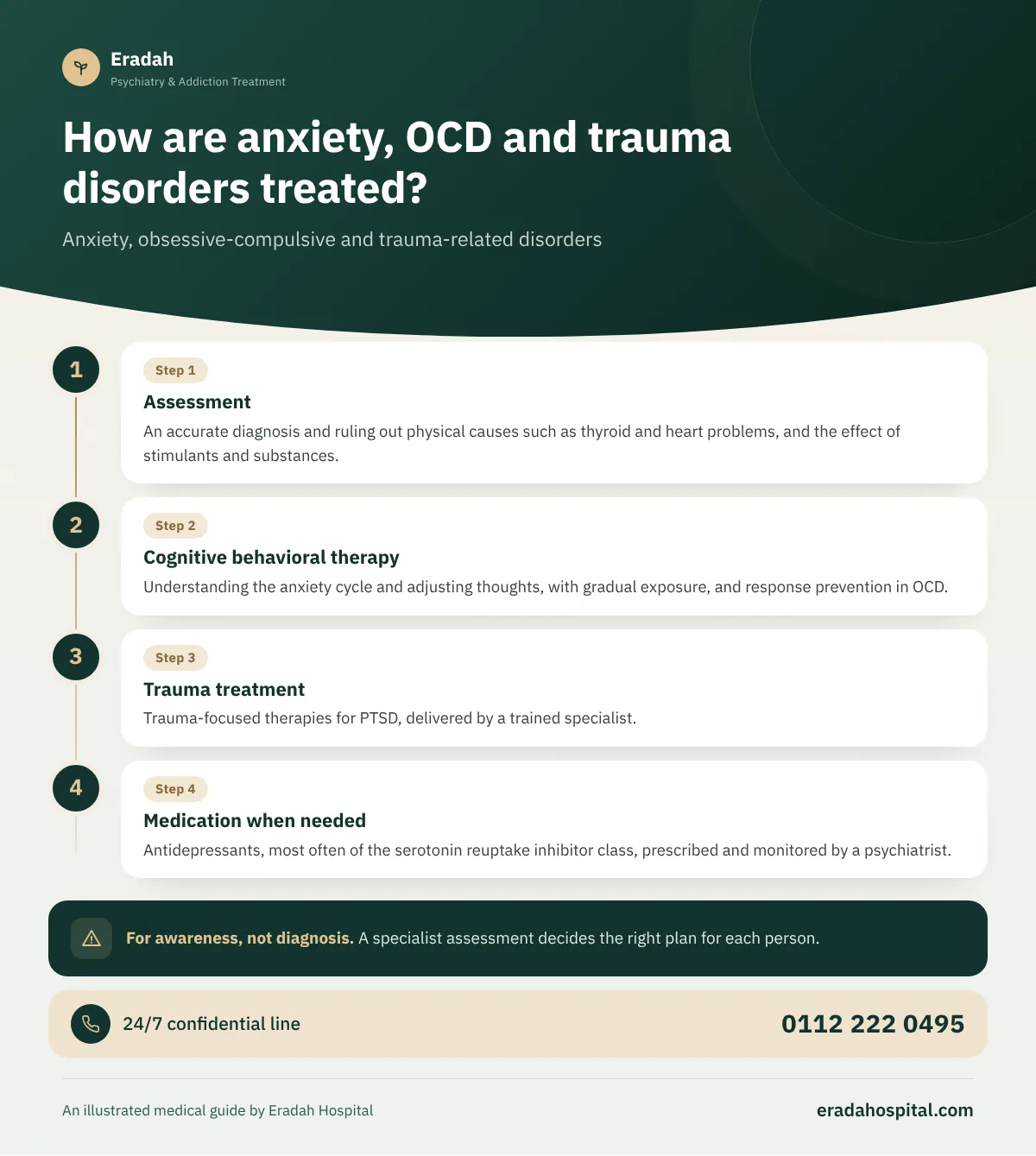
This family is among the most treatment-responsive mental health conditions. The broad outlines of treatment are similar across its members, with specific details for each disorder:
- Step 1Assessment
An accurate diagnosis and ruling out physical causes such as thyroid and heart problems, and the effect of stimulants and substances.
- Step 2Cognitive behavioral therapy
Understanding the anxiety cycle and adjusting thoughts, with gradual exposure, and response prevention in OCD.
- Step 3Trauma treatment
Trauma-focused therapies for PTSD, delivered by a trained specialist.
- Step 4Medication when needed
Antidepressants, most often of the serotonin reuptake inhibitor class, prescribed and monitored by a psychiatrist.
Treatment details for each disorder are on its pages: generalized anxiety treatment, OCD treatment, and PTSD treatment.
Anxiety, trauma and addiction
Anxiety and trauma are among the strongest routes into addiction. Someone with social phobia may drink or use drugs to be able to face people, someone with generalized anxiety or panic attacks may come to depend on sedatives, and someone living with the effects of trauma may look to a substance for sleep without nightmares or for temporary forgetting.
But the relief does not last. Over time, tolerance and dependence develop, and withdrawal brings anxiety worse than before, so the loop closes. Some substances, such as stimulants and hashish, can also trigger panic attacks in themselves. Successful treatment treats anxiety and addiction together. Read about social phobia and addiction and PTSD and addiction, or the dual diagnosis page.
How can the family help someone with anxiety or OCD?
- Validate their suffering. Saying “there’s nothing to be afraid of” does not reassure them; it makes them feel misunderstood.
- Do not take part in OCD rituals or give endless reassurance; this feeds the problem, so ask the therapist for guidance on it.
- Encourage gradual facing of fears without pressure or ridicule.
- During a panic attack, stay calm, help them breathe slowly, and remind them the attack will pass.
- With trauma survivors, leave them free to talk when they want, and do not force them to recount details.
- Watch for any growing reliance on sedatives, alcohol or drugs, and raise it early.
Panic attack or heart attack? Suicidal thoughts? When to get help immediately
- Chest pain for the first time, or pain spreading to the arm or jaw with sweating, especially with heart disease, diabetes or high blood pressure
- Severe shortness of breath that does not improve, or fainting
- Symptoms unlike previous attacks that a doctor has diagnosed
- Talk of wanting to die or of life no longer being bearable
- Severe hopelessness after a trauma, or complete withdrawal
- Trauma memories leave the person detached from reality or at risk
If there is chest pain and you are not sure it is panic, treat it as an emergency and call an ambulance (123) immediately; examination is what will reassure you. With any thoughts of death, stay with the person and listen without judgment, remove dangerous objects, and call 123 or the mental health support line 16328, available around the clock.
Ambulance 123 Mental health support line 16328