What is psychological stress?
Stress is what happens inside you when you feel that what is being asked of you is more than the time, energy or capacity you have. The World Health Organization defines it as a state of worry or mental tension caused by a difficult situation, and regards it as a natural human response that pushes us to face the challenges and threats in our lives.
“I’m under pressure” is a sentence we hear every day at work, at home and on the street, and it actually describes two different things: the source of the stress, such as an exam, a debt or a child’s illness, and your response to it, such as insomnia, irritability, a tense neck and smoking more. The source is not always in your hands, but the response can be trained and eased, and that is the core of every stress-management plan.
Stress does not come only from bad events. According to Cleveland Clinic, its sources can be positive too, such as a new job, a new baby or moving to a new home, because any major change demands effort from the body and mind to adapt.
Is stress a mental illness?
No. Stress is not a medical diagnosis, and you will not find it under that name in lists of mental disorders. It is a state everyone goes through. The US National Institute of Mental Health says that everyone feels stress from time to time, and the World Health Organization confirms that most of us handle it well and keep going with our lives and work.
But “not an illness” does not mean “doesn’t matter.” When stress becomes prolonged and intense, it can pave the way to real medical conditions, most commonly anxiety and depression, as the World Health Organization notes. It can also end in work exhaustion, which the organization calls burnout, or in an adjustment disorder when it follows a major life change and the reaction goes beyond what would be expected. Telling these conditions apart is the doctor’s job, not that of online tests.
What happens in your body under stress?
When the brain senses a threat, such as a speeding car or an angry message from your boss, the body sets off an alarm chain known as the “fight or flight” response. Adrenaline is released, so the pulse quickens, breathing speeds up and muscles tense. Then cortisol rises to supply the body with energy and keep it alert. The UK’s National Health Service describes adrenaline as the hormone that usually gives us a boost to move quickly.
The problem is that the body does not distinguish much between a life-threatening danger and a prolonged social or financial pressure, so it responds to both in a similar way. With short-term stress, everything returns to normal once the situation ends. But when the alarm goes off every day for weeks, systems designed to run for minutes keep running nonstop, which Cleveland Clinic describes as a gradual “wear and tear” on the body, with symptoms and damage appearing along the way.
Types of stress: acute, episodic acute and chronic
Cleveland Clinic divides stress into three main types according to its duration and frequency:
| Type | What it looks like | Example |
|---|---|---|
| Acute stress | Short; comes and goes quickly, and can be motivating or unpleasant | Studying for a big exam, a presentation at work, or a passing argument |
| Episodic acute stress | Repeated bouts of stress that leave no time to return to calm | Common in some professions, such as healthcare workers |
| Chronic stress | Lasts weeks or months without a clear break | Marital problems, work pressure, or a financial crisis |
The last type is usually what doctors mean when they talk about the harms of stress, because the body gets no chance to recover between one wave and the next.
What is the difference between stress, anxiety and burnout?
These words overlap in everyday speech, but the difference matters because what suits one may not be enough for another. The US National Institute of Mental Health sums up the basic difference: stress is a response to an external cause and usually fades when the situation ends, while a pathological anxiety is a persistent feeling of apprehension that can remain even when there is no current threat.
| Psychological stress | Anxiety disorder | Burnout | |
|---|---|---|---|
| Source | Usually a clear external situation or demand | Inner apprehension that may not be tied to a current cause | Chronic work pressure that has not been well managed |
| Duration | Usually eases when the cause goes away | Lasts for months and jumps from one topic to another | Builds up slowly over months |
| Main feeling | Tension, preoccupation and urgency | Fear and constant expectation of the worst | Exhaustion, flatness and detachment from work |
| Is it a diagnosis? | No, a natural response | Yes, a treatable mental disorder | An occupational phenomenon according to the WHO, not a medical condition |
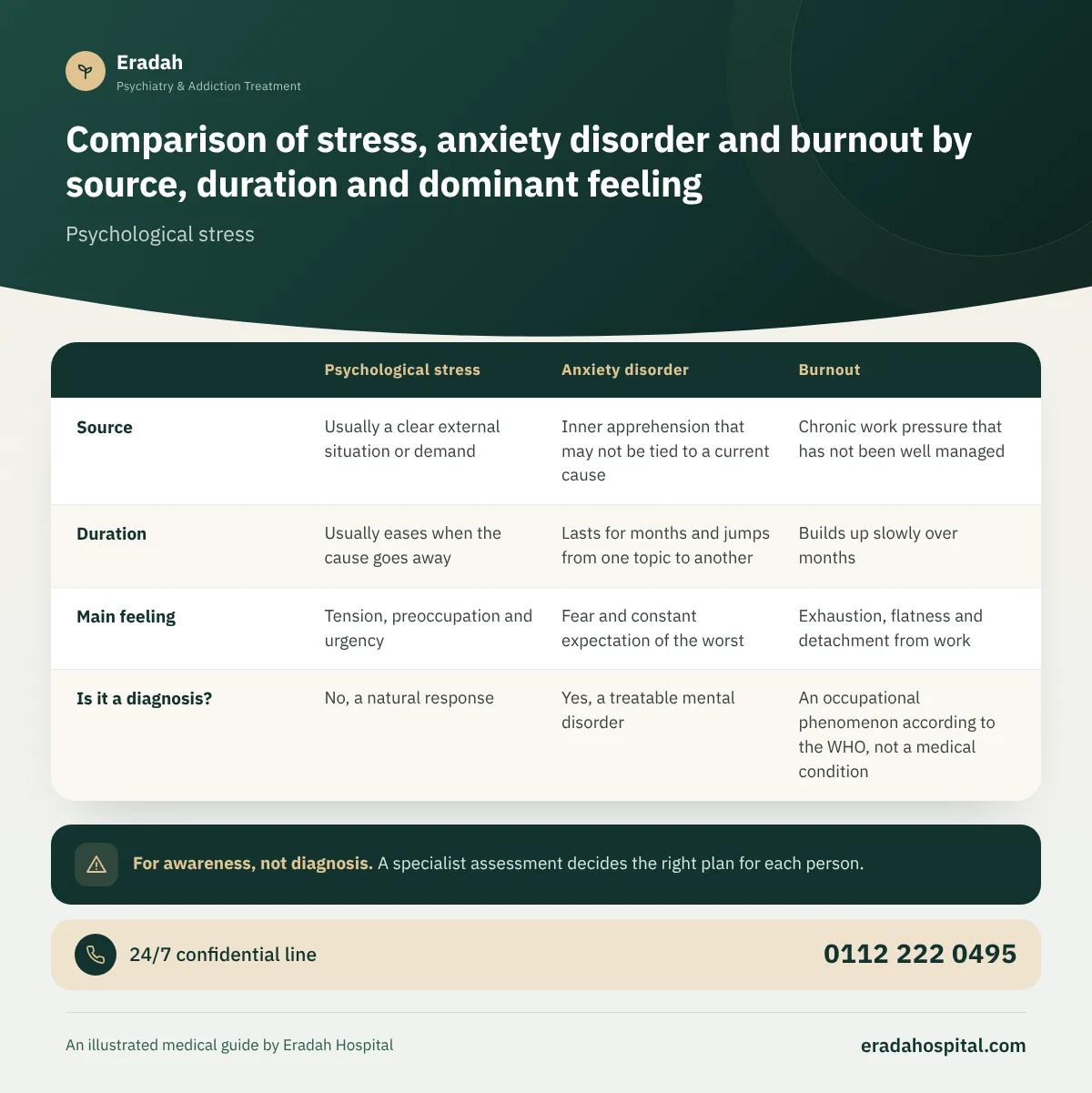
If anxiety is excessive, persistent and hard to stop even on calm days, it is more likely to be generalized anxiety disorder, which has its own diagnosis and treatment. If the exhaustion is tied specifically to work, read our guide to burnout.
Symptoms of stress in brief
Stress shows up in feelings, body and behavior together: nervousness and quick irritability, difficulty concentrating and racing thoughts, headaches, muscle tension and stomach upset, changes in sleep and appetite, and more smoking, coffee or withdrawal from others. Many people notice the physical symptoms before they realize they are under stress. The full details, including dizziness, skin rashes and when a symptom is a warning sign, are on the page Symptoms and Signs of Stress.
Causes of stress in brief
There is no single cause of stress. It is a meeting of external circumstances and a person’s capacity to cope. According to the World Health Organization, common sources include unrealistic workloads, an unstable job, exams, and conflicts with family or colleagues, along with public crises such as pandemics, wars and economic crises. People’s tolerance of the same situation differs depending on genes, upbringing, past experiences and the support available, as we explain in Causes of Stress.
Harms of stress in brief
Short-term stress is mostly harmless, but chronic stress leaves its mark on sleep, immunity, the digestive system, the heart and blood vessels, and hormones, and is linked to anxiety and depression. A review published in Nature Reviews Cardiology states that epidemiological data show chronic stress predicts the occurrence of coronary heart disease. What the studies say in detail is covered in Harms of Stress on the Body and Mind.
Treatment of stress in brief
Dealing with stress begins with two questions: what can be changed at its source, and what can I train in my response? Proven tools include organizing your day and sleep, physical activity, slow breathing and talking with people you trust, followed by mindfulness programs and cognitive behavioral therapy when self-help is not enough. The practical steps, and when you need a specialist, are in Treating Stress and Ways to Cope.
Stress and addiction: why do they so often go together?
Researcher Rajita Sinha of Yale University says in a scientific review that stress is a well-known risk factor for developing addiction and for relapse after recovery, and that early childhood stress and accumulated adversity alter the brain’s stress and reward systems. The World Health Organization notes that chronic stress may increase the use of alcohol, tobacco and other substances.
In reality, the story often starts with an innocent sentence: a pill that “calms the nerves” after work, or a hashish cigarette that “relaxes the mind.” It brings quick calm, so the brain learns that this is the shortest path to relief and asks for it with every new stress. That is why relapse prevention programs treat learning alternative skills for coping with stress as a core part of treatment, not a luxury.
Common myths about stress
| The myth | The truth |
|---|---|
| All stress is harmful | The World Health Organization says a little stress is beneficial and helps us carry out our activities; the problem is excessive or prolonged stress. |
| People who feel stressed have weak personalities | Stress is a universal human response, and people differ in its sources and in how they cope with it. |
| As long as I’m working and getting things done, I’m fine | Many people keep working while their sleep, stomach and relationships pay the price. |
| A vacation alone solves the problem | It may bring temporary relief, but if the source or the way of responding does not change, the tension quickly returns. |
| Stress can be measured with a blood test | Cleveland Clinic says stress is a subjective experience that tests cannot measure, and a doctor may use questionnaires to understand its impact. |
When do you need a psychiatrist because of stress?
You don’t have to fall apart to ask for help. See a specialist if you notice:
- Tension, insomnia or irritability lasting more than two weeks despite your attempts to calm down.
- A clear decline in work, studies, relationships or self-care.
- Sudden attacks of fear with a racing heart and shortness of breath, or anxiety that stays after the cause is gone.
- Persistent sadness and loss of pleasure in things you used to love.
- Relying on sedatives, sleeping pills, alcohol or any substance to get through your day.
You can start with a confidential consultation in our outpatient clinics with no obligation. If thoughts of death or self-harm appear, help is urgent: ambulance (123) or the mental health support line 16328.
Stress Guide: Everything You Need to Know
We have gathered everything about stress into 4 pages, each answering one question in detail. Choose what you are looking for:
Psychological stress symptoms and signs
What are the symptoms of stress? Its emotional signs such as irritability and racing thoughts, physical signs such as headaches, dizziness, stomach upset and rashes, behavioral signs, and when a symptom is a warning that needs a doctor.
Causes of psychological stress
What causes stress? Pressures from work, money and relationships, and life changes even happy ones, and why one person is affected more than another: genes, upbringing, thinking style and support.
Harms of psychological stress on the body and mind
What are the harms of chronic stress? Its effect on the heart, blood pressure, immunity, stomach, sleep, hormones and skin, its link to anxiety, depression and addiction, and what the studies say.
Treating psychological stress and ways to cope with it
How do you get rid of stress? Proven steps for organizing your day and sleep, slow breathing and movement, mindfulness programs and cognitive behavioral therapy, the role of medication, and when you need a doctor.
Has stress turned into danger? Ask for help now
- Talking about death, wanting to disappear, or being a “burden” on others
- Severe or crushing chest pain, sudden shortness of breath, or fainting (treat as a heart problem until proven otherwise)
- Complete inability to sleep, eat or do any task for several days
- Excessive use of sedatives, or mixing them with alcohol or drugs “to calm the nerves”
- Fits of anger that reach threats or violence toward oneself or others
Do not leave the person alone. Calmly and frankly ask how they feel and what they are thinking, and listen without blame; asking directly does not plant the idea, it opens the door to help. For chest pain, fainting or any threat to life, call an ambulance (123) immediately. For suicidal thoughts, call an ambulance or take them to the nearest emergency room, or call the mental health support line 16328 (24 hours), and keep medications and anything they could use to hurt themselves away from them.
Ambulance 123 Mental health support line 16328